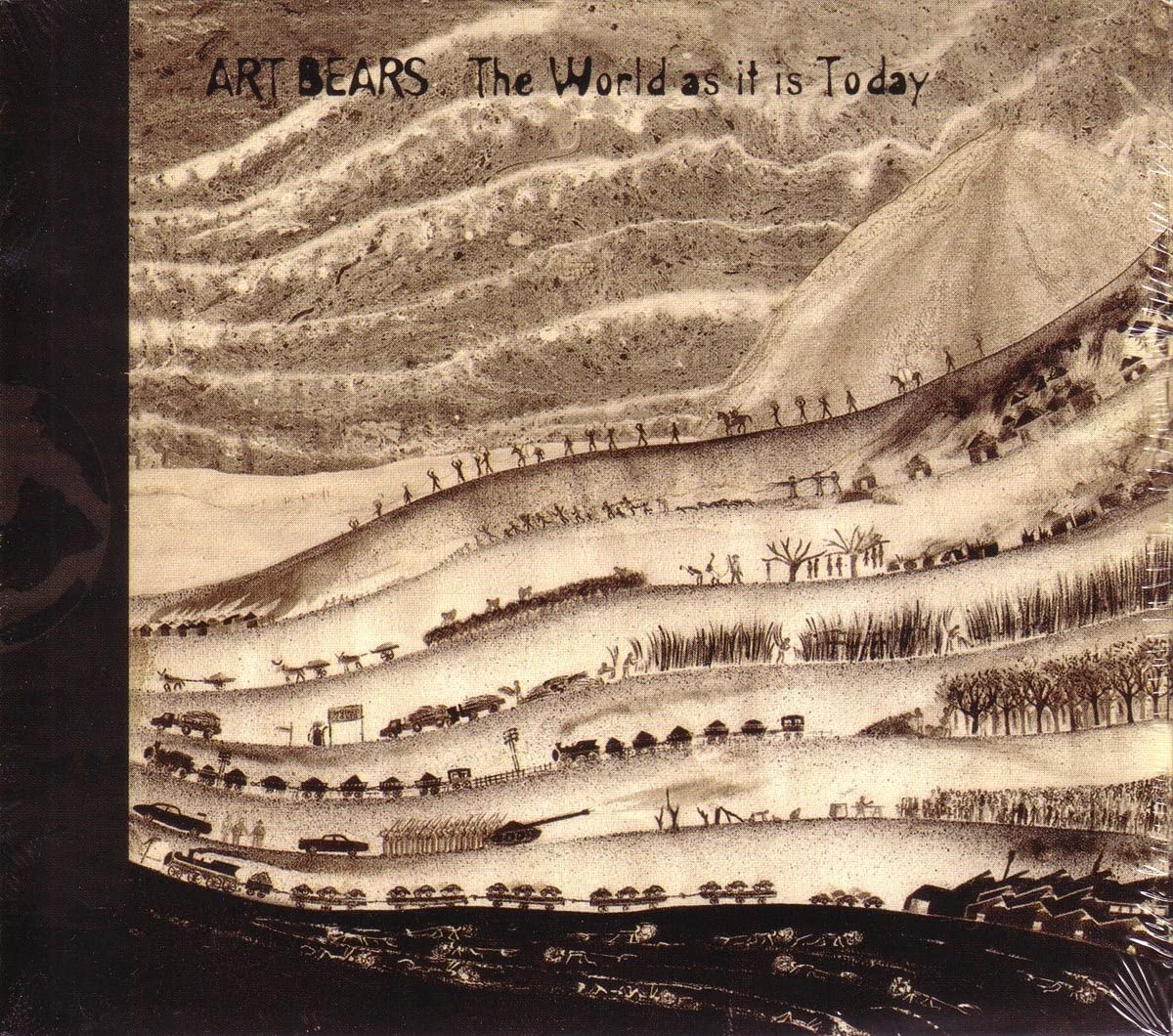
The World As It Is Today is Art Bears’ third studio album.
Art Bears was formed in 1978 after Henry Cow fell into crisis following a dispute over the band’s future artistic direction. Drummer Chris Cutler and guitarist/violinist Fred Frith wanted to write songs with vocals, while another member of the band, Tim Hodginson, wanted to focus purely on ultra-complex instrumental compositions. The problem was resolved by making the already started Hopes And Fears album the debut of Art Bears, while Henry Cow recorded their instrumental swan song, Western Culture, in 1979.
The entire late-’70s Henry Cow lineup appeared on the first Art Bears album, Hopes And Fears, due to the way it came together, but on the band’s second album, Winter Songs, Art Bears was heard for the first time in its true trio format, with vocalist Dagmar Krause performing alongside Cutler and Frith. After Winter Songs, Art Bears embarked on its only tour, joined by Peter Blegvad (Slapp Happy) and Marc Hollander (Aksak Maboul). After a tour of about ten shows, Art Bears returned to the studio to work on their third album, which was titled The World As It Is Today.
The World As It Is Today continues the trio format of Winter Songs, and the division of labor is the same as always: Cutler wrote all the lyrics, to which Frith composed the music in a remarkably short two days.
The recordings themselves were once again made in Switzerland at producer Etienne Conodini’s Sunrise Studio over a two-week period in early fall 1980. Cutler and Frith played all the instruments on the album themselves, while Krause handled the vocals in his own distinctive style. In fact, Krause delivers perhaps the most breathtaking vocal performances of her career on this album. In particular, her spine-chilling, drawn-out scream in the song “Freedom” possesses such primal power and intensity that one rarely encounters anything like it. For me, Krause’s extreme vocalization on “Freedom,” combined with Frith’s off-kilter guitar strumming, is one of the finest moments in music history.
The World As It Is Today is primarily built around electric guitars, violins, keyboards, and both acoustic and electronic drums. Cutler apparently used some kind of homemade electronic drum kit that allowed him to trigger effects and manipulate the drum sound in real time. Don’t expect the traditional 80s electric drum sound on this album. And that’s a good thing!
Cutler and Frith have woven numerous tape loops into their more conventional instrumentation, with the music of the tapes flowing both forward and backward as needed. The folk music influences heard on their two previous albums have largely been pared down. The music is dense, complex, and at times sounds almost industrial. Cutler’s drums clatter wildly and erratically amidst tape loops, atonal pianos, and buzzing, wailing electric guitars. Rather than individual instruments, what often matters most is the chaotic yet organic soundscape they create. In terms of studio technique and soundscape, Art Bears takes a significant leap forward on The World As It Is Today compared to their previous albums. Which doesn’t mean the album sounds overly polished or like a typical early ’80s high-tech album. On the contrary, despite its creativity, the album’s overall sound remains charmingly homemade.
Read also: Review: Univers Zero – Ceux Du Dehors (1981)
Stylistically, many of the compositions on The World As It Is Today are reminiscent of “War,” the opening track from Henry Cow’s In Praise Of Learning. Similarly, the album’s tracks are compact 1- to 4-minute miniatures where avant-garde meets pop. At times, they seem to follow structures familiar from pop music until the whole thing is interestingly disrupted by some experimental section, after which the music perhaps returns to more familiar territory. Or maybe not. But what’s brilliant is that these departures don’t feel like forced gimmicks; instead, convention and avant-garde usually come together in a very natural way. Assuming, of course, that the listener is equipped with an open mind. I can imagine that for a listener accustomed solely to pop music, The World As It Is Today might be quite confusing to listen to. A good example of the album’s duality is the opening track, “The Song of Investment Capital Overseas” (what a name!), in which Krause first sings quite melodically, like a peddler traveling around the world. The capitalism spreading alongside the merchant reaps its harvest until the music shifts into a dominant, clattering cacophony of percussion, effectively illustrating the song’s satirical message.
Out of town, my work takes me
“The Song Of The Martyrs”
Out of town
I empty villages
I burn their houses down
I set up factories
Lay out plantations
And bring prosperity to
The poorer nations
The roads and rails
Run like cracks and
Carry me
Upon their backs
The World As It Is Today is stylistically more cohesive than its predecessors, which jumped—in a fascinating way—from one style to another. The World As It Is Today is, in fact, a loose concept album whose theme is, broadly speaking, the destruction of the Western world under the yoke of capitalism. When the album was made in 1980, Margaret Thatcher’s right-wing government was firmly in power, and it was clear that the socialist revolution—which had, in principle, had a chance of happening in England in the 1970s—had been permanently derailed. Based on the lyrics of The World As It Is Today, Cutler was angrier than ever.
Cutler’s lyrics tackle the subject in his typical style, at times using quite lofty and complex language. This time, however, the lyrics aren’t teeming with cryptic allegories; instead, they’re clearly more straightforward than before. This directness is taken to the extreme in the song titles—what do you make of these three, for example: “The Song of Investment Capital Overseas,” “The Song of the Monopolists,” and “The Song of the Dignity of Labor Under Capital”? The revolutionary nature of Cutler’s lyrics is also more aggressive than before, to the extent that Krause refused to sing the lyrics he found too violent in the song “Albion, Awake!”. The song was ultimately recorded as an instrumental, but Cutler’s lyrics were still printed on the album cover. On the other hand, amidst all the defiance and revolutionary fervor, there is also a new kind of hopelessness that perhaps best surfaces in the line “things seem worse than ever” from “The Song Of The Martyrs,” which Krause repeats in a heart-wrenching, haunting voice accompanied by a relentlessly pounding drum loop.
All our lives, all of us
Whose bones you have
Climbed on
– were all our lives wasted?
– were we martyred to
Finish with all forms
Of slavery forever – only
To witness our offspring
Complacent and bought off
With scraps – to see
Workmen and women
Divided?O as we look about us
“The Song Of The Martyrs”
Things seem worse than ever
The World As It Is Today has been accused of being elitist, nihilistic, Marxist, and unnecessarily gloomy, and all of that is true to some extent, but on the other hand, it is precisely those elements that make the album so exceptional and intriguing. The World As It Is Today is Art Bears’ strongest album, and its only real weakness is its 32-minute runtime. I could have listened to this for much longer.
Lue myös:
- Review: Rush – Roll The Bones (1991)
- Review: David Sylvian – Gone To Earth (1986)
- Review: David Bowie – Low (1977)
- Levyarvio: A.W. Yrjänä – Eidolon (2026)
- Review: Khatsaturjan – Monologue Of Chronos (2026)
- Review: Yes – Going For The One (1977)
- Levyarvio: Echolyn – Mei (2002)
- Review: Island – Pictures (1977)
- Levyarvio: Khatsaturjan – Monologue Of Chronos (2026)
Unfortunately, The World As It Is Today was Art Bears’ last album, unless you count the 2003 album Revisited, on which other artists reinterpret and remix the band’s repertoire.
The Art Bears trio has since collaborated on numerous occasions. Chris Cutler and Dagmar Krause played together on the debut album Sirens And Silences / Work Resumed On The Tower by News From Babel, a group formed in 1983, which is a clear continuation of the Art Bears’ style. Frith was replaced as composer by another former Henry Cow musician, Lindsay Cooper. Cutler and Frith, on the other hand, have played together on numerous duo albums as well as in The Science Group.
Art Bears’ career was regrettably short-lived, but the band left behind three fascinating albums—all of which shattered genre boundaries—whose impact has been far greater than their modest sales figures would suggest.
Best tracks: “The Song of Investment Capital Overseas”, “Truth”, “Freedom “Civilization”, “The Song Of The Martyrs”
Author: JANNE YLIRUUSI
Tracks
- ”The Song of Investment Capital Overseas” 2:38
- ”Truth” 2:56
- ”Freedom” 3:25
- ”(Armed) Peace” 2:30
- ”Civilisation” 4:52
- ”Democracy” 2:22
- ”The Song of the Martyrs” 4:09
- ”Law” 0:51
- ”The Song of the Monopolists” 1:48
- ”The Song of the Dignity of Labour Under Capital” 2:27
- ”Albion, Awake!” 4:08
Art Bears
Fred Frith: guitars, keyboards, viola, violin, xylophone Chris Cutler: drums, electronic drums, sounds Dagmar Krause: vocals
 Pienemmät Purot
Jätä kommentti