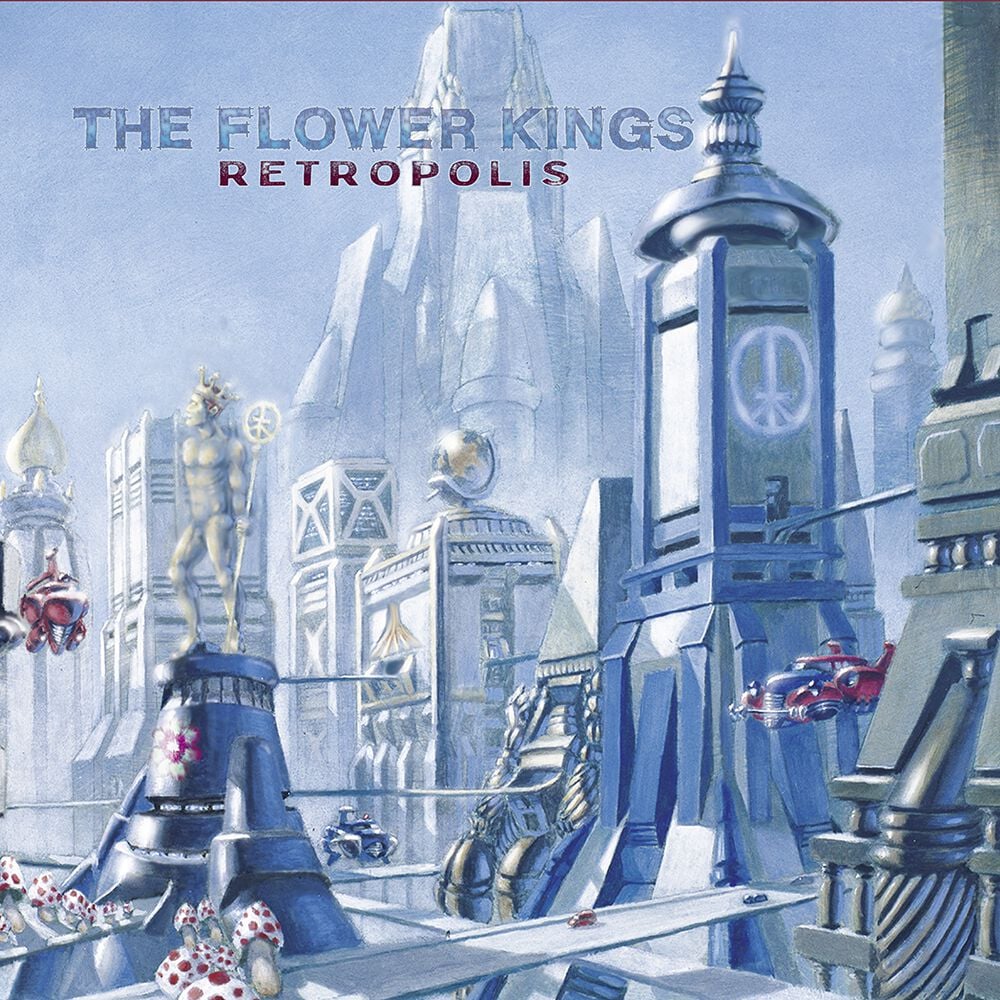
Retropolis is The Flower Kings’ second studio album.
Born in Uppsala, Sweden, in 1956, Roine Stolt joined the progressive rock band Kaipa at the age of just 17. Stolt recorded three albums with Kaipa and played over 100 concerts before leaving the band in 1979 to form his own new band, Fantasia. Fantasia released a couple of albums and broke up in 1983. In the 1980s, it was no longer possible to make a living playing prog, so Stolt focused mainly on session guitar work and also released a few pop-oriented solo albums, which, however, did not achieve much success.
In the early ’90s, Stolt realized that it might be the right time to return to prog. Progressive rock was making a small comeback at the grassroots level, and this resurgence had been helped along by, among others, bands made up of Stolt’s compatriots, such as Änglagård and Anekdoten. Stolt wanted to be part of the new wave of progressive rock.
Stolt’s return to prog came with his 1994 solo album The Flower King. The album was old-school symphonic prog made with a cheerful, lighthearted hippie attitude, with clear influences from Yes and Genesis, among others, without the compositions themselves ever sounding like too direct imitations. The Flower King may not have elicited the same cheers as Änglagård’s debut Hybris a couple of years earlier, but it received a positive enough reception that Stolt founded a new band based on the concept.
The name of the new band was, of course, The Flower Kings, and over the years it became one of the most significant and popular so-called third-wave prog bands. And probably also the longest-running and most prolific. By 2025, The Flower Kings will have released nearly 20 studio albums, many of which are double albums.
The Flower Kings’ debut album Back In The World of Adventures was released in 1995 and was recorded largely with the same musicians who had already worked with Stolt on The Flower King. Back In The World of Adventures also continued largely in the same musical vein as The Flower King, and Retropolis doesn’t bring much new to the table. Retropolis, however, does everything a little better than its predecessor.
Read also: Review: Spock’s Beard – The Light (1995)
Retropolis’s music draws heavily on the traditions of 1970s symphonic prog, but its sound isn’t as purely retro as that of, say, the aforementioned Änglagård and Anekdoten. The Flower Kings’ music is easy to listen to. Beautiful melodies and clear themes play a central role, but the music is still quite complex at times, and more avant-garde sections are scattered throughout. Stolt deserves credit for how he manages to make complex music so accessible. This accessibility is further supported by the music’s optimistic and bright hippie vibe. In terms of ethos, The Flower Kings are significantly closer to Yes than, say, King Crimson or Van der Graaf Generator.
Retropolis features the same quintet as the previous album: Stolt’s guitar and vocals are backed by his brother Michael Stolt on bass guitar, Tomas Bodin on keyboards, Jaime Salazar on drums, and Hasse Bruniusson on percussion. All are accomplished musicians. Percussionist Bruniusson, who played on Samla Mammas Manna, is a particularly interesting addition to the band. In principle, Salazar’s drums would have sufficed quite well, but Bruniusson’s wild percussion adds a spicy extra flavor to many tracks, bringing not only polyrhythmics but also a touch of avant-garde unpredictability. Bruniusson’s role is thus, in a way, similar to that of Jamie Muir in King Crimson back in the day.
It is clear, however, that Roine Stolt is the true monarch of The Flower Kings. Three of the album’s tracks are credited to Tomas Bodin, but in practice these three short instrumentals account for just over four minutes of the album’s nearly 70-minute total running time, and all other material was composed by Stolt. Stolt also produced the album, even though for some reason it was credited to the pseudonym Don Azzaro. “Don Azzaro” produced all of The Flower Kings’ albums up until 2003, when Stolt finally took on the role under his own name. And of course, we mustn’t forget that Stolt sings nearly all of the album’s English-language vocals and does an excellent job as an electric guitarist. Stolt is no technical monster playing a million notes a minute, but he is a highly skilled and stylistically astute guitarist. He knows how to construct solos that develop logically and contain a natural dramatic arc, and he supports his playing by tastefully utilizing various effects. I would guess that the key guitarists who have had a particularly strong influence on Stolt’s style are Steve Howe, Frank Zappa, Steve Hackett, and David Gilmour.
Read also
- Review: David Bowie – Low (1977)
- Levyarvio: A.W. Yrjänä – Eidolon (2026)
- Review: Khatsaturjan – Monologue Of Chronos (2026)
- Review: Yes – Going For The One (1977)
- Levyarvio: Echolyn – Mei (2002)
- Review: Island – Pictures (1977)
- Levyarvio: Khatsaturjan – Monologue Of Chronos (2026)
- Levyarvio: Porcupine Tree – In Absentia (2002)
- Review: Univers Zero – s/t (1977)
The album opens with a brief sound collage titled “Rhythm of Life,” featuring the movement of a ping-pong ball, which transitions into the title track. The over 11-minute instrumental “Retropolis” begins with majestic Mellotron sounds, somewhat reminiscent of “Watcher Of The Skies.” From there, the track quickly shifts into a rhythmically complex and intense section, richly adorned with Bruniusson’s percussion, where Stolt’s electric guitar and Bodin’s Hammond organ take turns in a tasteful interplay. “Retropolis” contains numerous distinct sections, including an avant-garde interlude with percussive clinks and door-opening sounds, as well as a light section played on acoustic guitar heard right at the very end. The transitions from one section to the next are generally smooth, and the song remains consistently engaging despite its long duration. Sonically, “Retropolis” is a fitting blend of new and old. Amidst the vintage keyboards, one can even hear subtle sequenced passages. “Retropolis” is a truly magnificent track and may well be the highlight of The Flower Kings’ entire discography.
The third track, ”Rhythm of the Sea,” begins with an abstract, quiet intro lasting over a minute, after which strummed chords on an acoustic guitar really get the song going; finally, nearly 14 minutes into the album, we hear the first vocals. Stolt’s singing sounds like a combination of John Wetton and Peter Gabriel. Of course, Stolt’s voice lacks that same charisma or power, but he handles the vocals quite competently, especially when you consider that he isn’t singing in his native language.
Some of the songs have a bit too much of that “world-embracing” vibe, with big choruses that sound a bit cheesy. A prime example of this is the 10-minute “There Is More to This World,” which otherwise sounds a lot like Yes, but whose choruses would fit better on an AOR album or in the Eurovision Song Contest. At times, The Flower Kings’ way of combining cheesy choruses with full-on prog rock in the background feels really odd. The impression isn’t entirely off-putting, but it is quite contradictory. This is also where a major difference with Yes emerges; whereas Jon Anderson’s lyrics, at their best, possess a strange cosmic poeticism, Stolt mostly takes the path of least resistance, settling for platitudes like: “There is more to this world than we see with our eyes & (Feels like Heaven, feels like flying).” As a side note, while writing this, I listened to Retropolis four times, and the song that gave me the most persistent earworm was “There Is More to This World.”
Fortunately, after ”There Is More to This World,” we return to a selection of instrumental music. First, we hear Bodin’s beautiful piano interlude ”Romancing the City,” which lasts less than a minute, before moving on to the album’s second highlight.
The charming instrumental ”The Melting Pot” brings Scandinavian folk music influences (though there was already one ethnic section among the many parts of ”Retropolis”) as well as a jazzy feel to the mix. The composition’s central melody is delightfully reminiscent of Pekka Pohjola’s early recordings. Guest Ulf Wallander’s soprano saxophone, on the other hand, takes one’s thoughts in the direction of Piirpauke, led by Sakari Kukko. On the other hand, the wordless vocalization reminiscent of North American indigenous peoples, Stolt’s rapid guitar strumming, and Bodin’s Keith Emerson-inspired synthetic organ sounds pull the music in entirely different directions. All in all, as the song’s title suggests, it’s a rather successful melting pot of different genres. And for once, Stolt manages to keep the song’s length in check. “The Melting Pot” lasts just under six minutes.
The sixth track, “Silent Sorrow,” offers a slightly more playful vibe, with an upbeat and catchy chorus, bluesy solos from both Stolt and Bodin, and some tasty interplay from the rhythm section during the instrumental section in 7/8 time. On vocals, Stolt is supported by Hasse Fröberg, who sings with a brighter voice (he also duets with Stolt on “There Is More to This World”). Fröberg became an official member of the band on the next album.
Next up is “The Judas Kiss,” one of the album’s highlights. Softly ringing bells set the song in motion, and after a brief organ interlude, the track shifts to a tense electric guitar riff before launching into the main vocal section. “The Judas Kiss” is a slightly darker and heavier-sounding track than the rest of the material, and its atmosphere brings to mind Emerson, Lake & Palmer’s “The Knife Edge.” The song is punctuated here and there by wolf howls and dog barks embedded in the music (the dog bark sounds as if it were sampled directly from Pink Floyd’s “Dogs”…). The jazzy, lighter interlude heard toward the end provides a pleasant contrast, and the transition from Stolt’s raw-sounding electric guitar to a rapid organ section reminiscent of Emerson is effective.
I have to admit that, as far as I’m concerned, the album could have ended with “The Judas Kiss.” That would have given us about 40 minutes of excellent prog, and the album as a whole would have been really strong. It’s not that the remaining 19 minutes or so of the album are bad music (though “The Road Back Home,” the closing track, occasionally strays too obviously into Genesis territory), but they also don’t really bring any particularly interesting new angles or anything that hasn’t already been executed more compellingly in earlier tracks. Less would sometimes be more. Roine Stolt never learned this lesson. Later in their career, The Flower Kings would have truly benefited from a strong producer who would have set limits on Stolt’s lack of self-criticism regarding his prolific output, but unfortunately, the Flower Kings seem to be in an eternal union with Don Azzaro.
Despite the fatigue caused by the band’s later work, Retropolis still sounds, decades later, like a fresh tribute to the symphonic progressive rock of yesteryear, successfully updated for the 1990s.
Best tracks: ”Retropolis”, ”Melting Pot”, ”Silent Sorrow”, ”The Judas Kiss”
Author: JANNE YLIRUUSI
Read also: Review: Steven Wilson – The Overview (2025)
Tracks
- ”Rhythm of Life” 0:32
- ”Retropolis” 11:07
- ”Rhythm of the Sea” 6:12
- ”There Is More to This World” 10:15
- ”Romancing the City” 0:57
- ”The Melting Pot” 5:45
- ”Silent Sorrow” 7:42
- ”The Judas Kiss” 7:43
- ”Retropolis by Night” 3:18
- ”Flora Majora” 6:50
- ”The Road Back Home” 8:55
The Flower Kings
Roine Stolt: vocals, guitars, additional keyboards Tomas Bodin: Hammond C3 organ, piano, Mellotron, synthesizers, effects Hasse Bruniusson: percussion, drums (10) Jaime Salazar: drums, percussion Michael Stolt: bass guitar
Guests
Hasse Fröberg: vocals (4, 7) Ulf Wallander: soprano saxophone (6, 11)
 Pienemmät Purot
Jätä kommentti