Classically trained wind instrument player Lindsay Cooper is best known for her work with the avant-prog band Henry Cow, but she also played a significant role in the all-female Feminist Improvising Group and in News From Babel, which released two albums.
Cooper was also a highly significant figure in that his virtuoso bassoon playing inspired so many musicians that this instrument—so rare in rock music—became almost a trademark of the chamber-music-inspired avant-prog scene.
Cooper began his solo career in 1981 by composing the music for the film The Song Of The Shirt, which was released on the album Rags. Cooper’s solo career focused largely on music she composed for films, theater, or modern dance. However, Cooper’s music—which avant-gardistically blended art music, rock, and cabaret—was always artistically ambitious, and she always strove to ensure that his compositions would also function as pure music, detached from their original intended purpose. Of course, Cooper also composed a great deal of “true” art music, but unfortunately, by no means all of it was ever recorded (some of these works can be heard on the compilation A View From The Bridge).
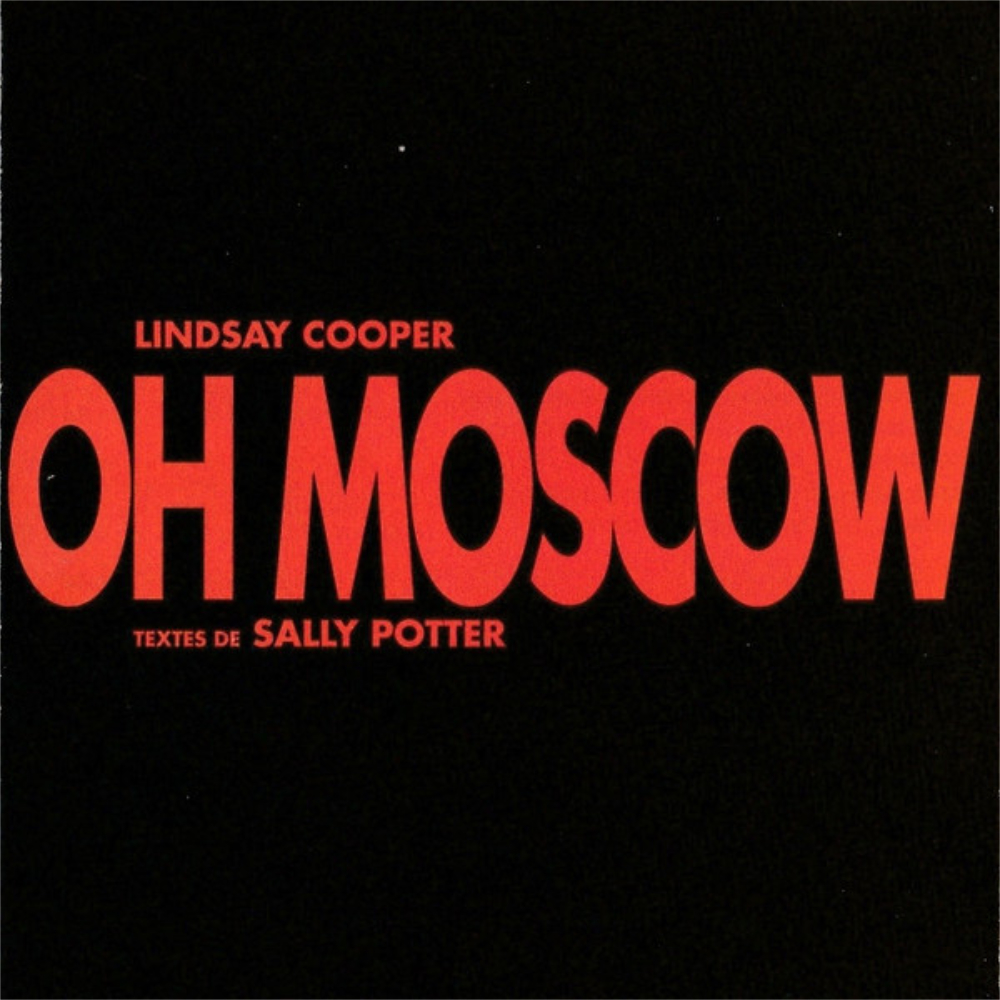
Oh Moscow is one of the few Cooper albums that wasn’t composed to accompany another work of art. Oh Moscow is a series of songs that explores the effects of the Cold War on Europe. In rock terms, it is a concept album.
Oh Moscow was created in collaboration with singer/songwriter/filmmaker Sally Potter. Cooper had composed the music for Potter’s film The Gold Diggers in the early 1980s, and Potter had sung on a few tracks on other albums as well. In addition to feminism, Cooper and Potter were united by shared political convictions. Both Cooper and Potter were ardent leftists—or, to put it bluntly, communists.
Potter had visited the Soviet Union several times, and during her travels she had conceived the idea for a song cycle dealing with the Cold War. Cooper, for his part, had long been planning to work on a large-scale composition and had already developed some rough drafts for it. Potter’s theme and lyrics seemed to complement Cooper’s compositions perfectly. Work progressed slowly amid other projects, but when the Zurich Jazz Festival contacted Cooper in 1987 and asked if she had any new music to offer for the festival, Cooper really got down to work and finished the piece. Oh Moscow was premiered at the Zurich Jazz Festival that same October.
Ironically, the Berlin Wall fell just over a month after the first performance of Oh Moscow. Strictly speaking, this rendered the work obsolete more quickly than any of its creators could ever have predicted. The fall of the Berlin Wall and the end of the Soviet Union ushered in a new era, and people soon began to believe that war-like barbarism would no longer touch Europe. Since then, we have unfortunately learned that this was excessive optimism.
Lue myös: Reviews: News From Babel – Sirens And Silences / Work Resumed On The Tower (1984)
Cooper and Potter assembled Oh Moscow to be performed by a talented multinational ensemble. From England, they brought in trumpeter/vocalist Phil Minton and bassist Hugh Hopper, known from Soft Machine. The tenor saxophone and clarinet were played by Alfred Harth, a wild German avant-garde wind player who had made a name for himself in Cassiber. On drums was Marilyn Mazur, a jazz musician born in the U.S. but raised in Denmark, who has played with Miles Davis and Jan Garbarek, among others. Rounding out the lineup was the classically trained Croatian keyboardist Elvira Plenar.
Oh Moscow was performed in its original form 25 times between 1987 and 1993. The lineup otherwise remained the same for the live shows, but instead of Mazur, the drums were occasionally played by Charles Hayward, Peter Fairclough, or Chris Cutler. The piece was recorded for the album in October 1989 in Quebec, Canada. At that time, Mazur was behind the drum kit. The relatively large number of performances at notable venues (primarily theaters and festivals) suggests that something in Cooper and Potter’s work struck a particularly deep chord, especially considering that the music is quite avant-garde. Perhaps it was the Cold War theme that resonated. The tour also included two performances in the Soviet Union, and the work was presented in my home country, Finland, at the Tampere Jazz Happening in 1990. Oh Moscow is likely the best-known and most widely performed of Cooper’s compositions.
Oh Moscow’s music mostly sounds tightly composed, but there are clearly moments of improvisation mixed in as well; for example, “Oh the Passing of Time, Europe”—which features atonal, surging piano passages—is likely more or less entirely free improvisation. The hour-long song cycle is performed without breaks between its ten parts.
As is almost always the case with Cooper’s compositions, the music on Oh Moscow is quite complex. There’s no shortage of irregular time signatures, intricate harmonic structures, and dissonance, but on the other hand, Oh Moscow may still be the most accessible album of Cooper’s solo career.
The album kicks off in grand style with “England Descending,” a track that explores the new state of decline of England, the former empire. The song showcases many of the album’s hallmarks: complex rhythms, captivating melodies, and a harmonic landscape that alternates between dissonance and harmony, Potter’s clear, melancholic yet resolute vocals, and Harth’s rough, screeching, and rattling tenor saxophone.
We bought your movies-cars-music, and we lost ours
“England Descending,” however, does not yet introduce the album’s second vocalist. The next track—the playful yet bitingly sarcastic “Allies”—does so effectively. Vocal duties on the album are effectively shared by Potter and Phil Minton, a specialist in strange sounds, and it is precisely in “Allies”—where the lyrics criticize American cultural imperialism—that he gets to showcase his skills most strikingly. Midway through the song, he launches into a truly thunderous and blood-curdling Donald Duck-style squawk, which briefly transitions into a Marilyn Monroe impersonation.
Read also:
- Review: John Greaves & Peter Blegvad: Kew. Rhone. (1977)
- Review: Flea – Honora (2026)
- Review: Pink Floyd – Animals (1977)
- Levyarvio: Flea – Honora (2026)
- Review: Yes – Magnification (2001)
- Review: Jethro Tull – Songs From The Wood (1977)
- Review: A.W. Yrjänä – Eidolon (2026)
- Review: Rush – Roll The Bones (1991)
- Review: David Sylvian – Gone To Earth (1986)
I wrote earlier that Oh Moscow seemed to have become outdated almost as soon as it was published. Unfortunately, however, history repeats itself, and with dictator Vladimir Putin waging his barbaric and illegal war of invasion in Ukraine, the West and Russia are once again in the midst of a new war of aggression. That is why the lyrics of Oh Moscow’s magnificent title track resonate once more. The lyrics explore the relationship between Russia and Europe as if from the perspective of two lovers: the lovers have been separated under dramatic circumstances, and the lyrics longingly ask whether a reunion might still be possible. Right now, the idea seems difficult, but perhaps one day.
Oh Moscow / I forgot / You were there / I was not
I turned away / My face to another / Continent – / Flashy lover
Can I return to your arms? / Is it too late? / Can we know each other /Without hate?
Come back, come back / Across the border /Exiled lover / To a new order
Is it possible?
Oh Moscow.
Oh Moscow consists mostly of fairly intense music, but it also includes some more serene moments, the best example of which is the piano-driven “Lovers,” where Potter’s magnificent vocals really shine.
One minor drawback of the album is that its live-recorded soundscape is a touch bleak. It would have been extremely interesting to hear a carefully crafted studio version of Oh Moscow as well. In 1999, an orchestral version of the work was performed at the Bologna Opera House, but unfortunately, no official recording of this is available. The same fate befell the A Celebration of Lindsay Cooper concerts, which were organized after Cooper’s death and featured half of Oh Moscow.
Lindsay Cooper had been diagnosed with MS back in the 1970s. She didn’t reveal this to anyone but her closest friends and family until the late 1990s, when her illness prevented her from performing live anymore. Lindsay Cooper ultimately passed away in 2013 at the age of 63, having been, by that point, almost completely incapacitated for years—a heartbreaking situation.
Lindsay Cooper is one of the most significant figures in avant-prog, and 1991 was one of the most important years of her career, thanks to three outstanding releases.
Best tracks: ”England Descending”, ”Lovers”, ”On German Soil”, ”Oh Moscow”
Author: JANNE YLIRUUSI
Lue myös: Review: Sunday All Over the World – Kneeling At The Shrine (1991)
Tracks
- ””England Descending” 7:46
- ”The Allies” 5:30
- ”Lovers” 4:10
- ”Oh the Passing of Time, Europe” 4:12
- ”Liberty Bonds” 6:38
- ”On German Soil” 7:20
- ”Curtain Descending” 3:10
- ”Prayer” 9:57
- ”Forgotten Fruit” 4:23
- ”Oh Moscow” 6:21
Lindsay Cooper: bassoon, alto saxophone Sally Potter: vocals Elvira Plenar: piano, synthesizer Alfred Harth: tenor saxophone, clarinet Phil Minton: trumpet, vocals Hugh Hopper: bass guitar Marilyn Mazur: drums
 Pienemmät Purot
Jätä kommentti