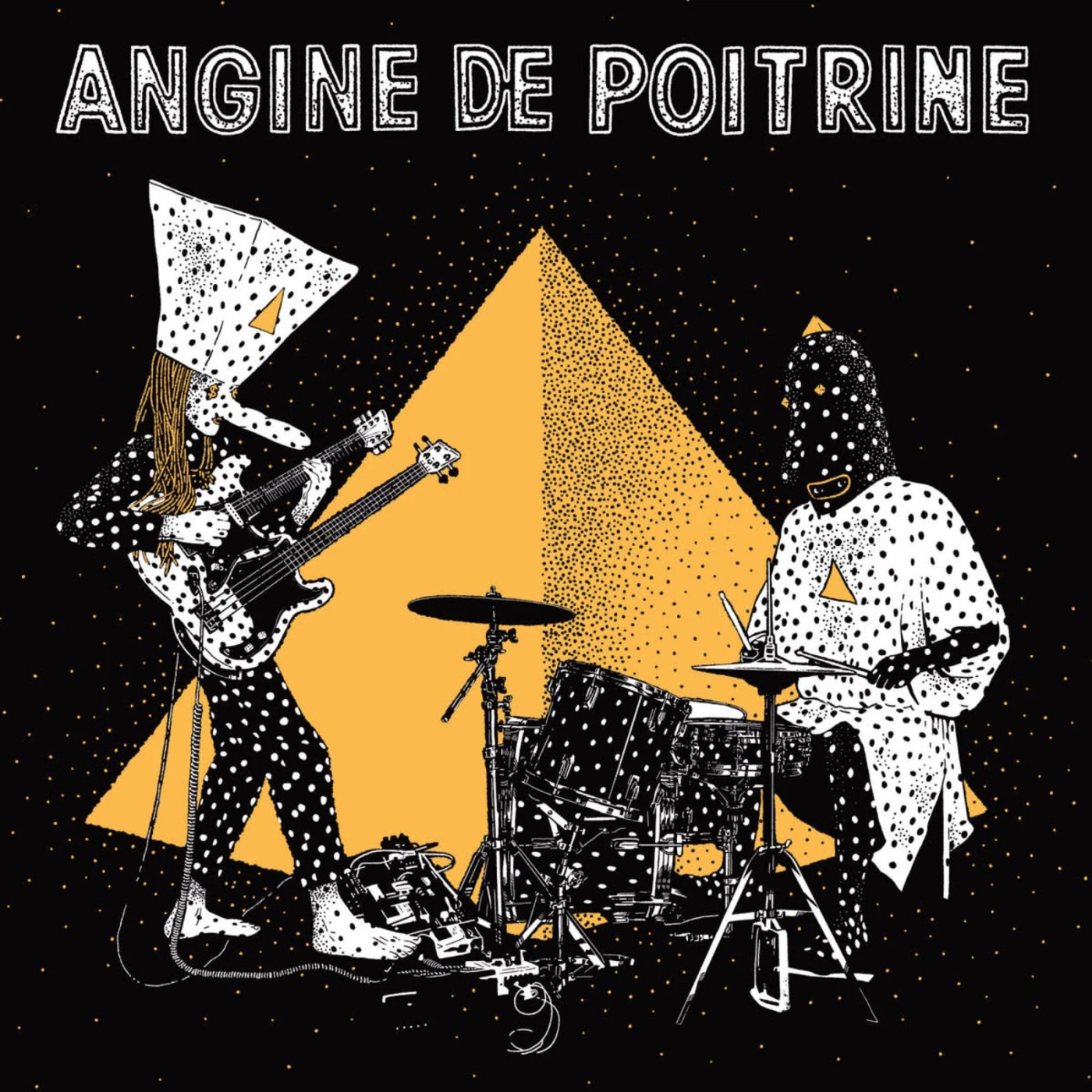
Vol. II is Angine de Poitrine’s second studio album.
Math rock—with its technical nature and appeal to die-hard music nerds—doesn’t usually spark viral phenomena. However, the Canadian band Angine de Poitrine managed to do just that.
The band’s KEXP* live video, released in February 2026, racked up over 15 million views on YouTube in just a few months and millions more on Instagram. Until just a short while ago, the duo—known mainly within Quebec’s local scene and among experimental music enthusiasts—rose to international prominence overnight. Streaming numbers skyrocketed, festival and tour invitations began pouring in, and the band soon performed at a free concert at the Montreal International Jazz Festival in front of over 70,000 people.
*KEXP is a radio station based in Seattle whose high-quality live performances have become an important springboard for new and alternative artists.
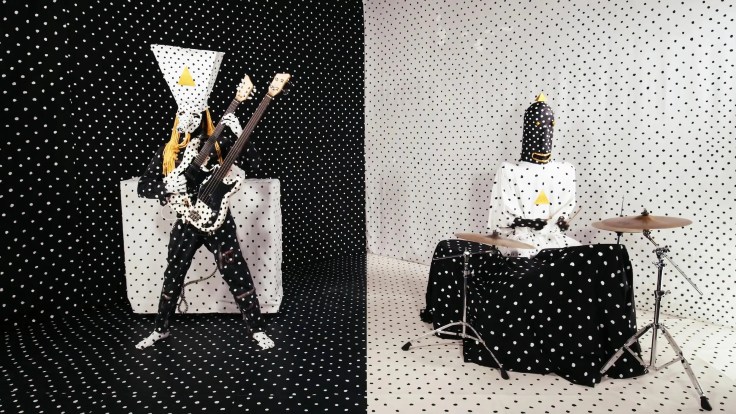
So what exactly is Angine de Poitrine? Formed in Québec in 2019, the duo consists of guitarist and bassist Khn de Poitrine and drummer Klek de Poitrine, who hide behind stage names and masks made of papier-mâché. The band originally started as a joke when the pair performed at the same club twice in the same week and decided to play the second show under the name of a new band, while remaining unrecognizable. Both the masks and the name stuck. The French term for angina pectoris also aptly describes the duo’s music: a rhythmically breathless, dissonant style that creates a constant sense of urgency.
Perhaps the timing was perfect, too. Just as many people had begun to worry that algorithms and artificial intelligence were turning popular music into a predictable, mediocre mass, a band emerged whose very essence exudes originality, personality, and human ingenuity. Angine de Poitrine’s music doesn’t feel like a product but rather like a wild, crazy idea that neither artificial intelligence nor record label executives could ever come up with.
The band aptly describes its style with the cumbersome phrase “mantra-rock Dada Pythago-Cubist orchestra.” “Mantra-rock,” in particular, captures the essence of their music well, as the songs are built around repetitive riffs. To some, they create a hypnotic flow; to others, they may sound like endless droning. In practice, however, Angine de Poitrine belongs primarily in the realm of math rock, where rhythm—rather than melody—is the most important building block of the music.
The band’s unique sound is largely built around a combination of a double-neck guitar and a bass guitar, both custom-built for Khn de Poitrine. Both necks feature a microtonal fretboard, which allows for notes outside the standard semitone scale. Thanks to this, Khn is able to build songs on his own by alternately layering guitar and bass riffs using a live looper.

For Angine de Poitrine, looping isn’t just a technical trick or an extra flourish—it’s an essential part of their compositional style. The songs build layer by layer: first, a simple riff emerges, and new rhythmic and melodic lines are added on top of it. Each new layer simultaneously alters the meaning of what has been heard before, making the music feel alive and constantly moving forward, even though its basic material remains the same for a long time. It is precisely this that makes the duo’s music, at its best, both mechanically precise and yet hypnotically organic.
One of the band’s most distinctive features is microtonality. It’s rarely heard in Western popular music, although artists such as King Gizzard & the Lizard Wizard, Horse Lords, and The Mercury Tree have made use of it. Microtonal music involves pitches that fall between standard semitones, giving the music a subtly off-kilter tone. Just as irregular time signatures throw the listener’s sense of rhythm off balance, microtonality does the same to harmony.
Microtonalism is a central element of Angine de Poitrine’s music, but at the same time, Khn uses it rather sparingly. The leaps within the scale remain small, which is enough to create a slightly off-kilter atmosphere without breaking up the tonal picture into something too fragmented and strange.
The band’s debut album, Vol. I, didn’t quite win me over yet. It already had an interesting and fully formed concept, but the execution still felt a bit rough around the edges. Vol. II doesn’t fundamentally change the band’s sound, but it does everything just a tad better. If Vol. I was a promising prototype, Vol. II is the finished product.
The building blocks remain the same: microtonal guitar, layered looping, complex rhythms, and the almost telepathic interplay between the two musicians. Now the compositions feel a bit more free-flowing and the groove is stronger. Compositions built layer by layer, the sustained development of themes, and an ambitious compositional approach also bring the music closer than ever to progressive rock. That said, the line between math rock and prog has, of course, always been blurred—and somewhat artificial.
Production also has taken a clear leap forward. Whereas the debut album at times sounded a bit thin and one-dimensional, Vol. II sounds considerably fuller. In particular, the bass’s rich, round tone brings much-needed weight to the music, and the drum hits snap along with truly satisfying precision.
Read also: Review: Mike Johnson – The Gardens Of Loss (2026)
Of the album’s six tracks, the first three—“Fabienk,” “Mata Zyklenk,” and “Sarniezz”—were already performed during the live show on KEXP. The first two, in particular, are among the album’s highlights.
“Fabienk” begins with a strangely gurgling microtonal guitar pattern that gradually builds into a hypnotic groove in 7/8 time. The loops build up layer by layer, strange vocal sounds break up the structure just enough, and the song breathes steadily forward without a traditional verse-chorus structure. If anyone asks what Angine de Poitrine is all about, “Fabienk” is the best possible answer.
“Mata Zyklenk,” which also begins with a staccato rhythm, is built around a strong riff, but its mood is more restless. Melodic ideas that hint at the sounds of the Middle East, a rhythm that constantly pushes forward, and Klek de Poitrine’s precise yet lively drumming make it one of the album’s most energetic moments. “Mata Zyklenk” proves that Khn and Klek can also make music with unusual time signatures groove deliciously. At this point, it’s worth mentioning that Klek is an absolutely phenomenal drummer. His playing is tight, yet lively and fluid.
One of the strengths of Vol. II is also its moderate length. Just over 38 minutes feels just right for this kind of music. The ideas have time to develop, but the repetition doesn’t become tedious. After listening to Angine de Poitrine’s meticulous work, you’ll be happy to hear something completely different.
Read also:
- Review: Flea – Honora (2026)
- Review: Pink Floyd – Animals (1977)
- Levyarvio: Flea – Honora (2026)
- Review: Yes – Magnification (2001)
- Review: Jethro Tull – Songs From The Wood (1977)
- Review: A.W. Yrjänä – Eidolon (2026)
- Review: Rush – Roll The Bones (1991)
- Review: David Sylvian – Gone To Earth (1986)
- Review: David Bowie – Low (1977)
It would be easy to argue that Angine de Poitrine’s success is based mainly on their bizarre masks and spiky outfits, and it hasn’t been hard to find such views online. That interpretation, however, overlooks the essential point. If the visual concept alone were enough, any math rock band could have done the same thing. I don’t believe that. In reality, it is precisely the originality of the music, the rhythmic ingenuity, the exceptionally tight ensemble playing, and the duo’s ability to make even complex rhythms groove that make Angine de Poitrine genuinely interesting.
It may also be a matter of a certain kind of gatekeeping. The idea that success should be based solely on musical merit is a beautiful one, but history tells a different story. Ever since the days of Niccolò Paganini, artists’ success has also been supported by factors outside of music. Many of the biggest names in progressive rock also built a strong visual identity: Genesis had Peter Gabriel’s bewildering costumes and masks, Pink Floyd had massive light shows, and Emerson, Lake & Palmer had a grand piano spinning from the ceiling. Angine de Poitrine’s masks are part of the same continuum—and hardly a stranger phenomenon.
On the other hand, I also fully understand those who wonder why Angine de Poitrine, in particular, became a global phenomenon, while countless other experimental musicians—just as interesting and at least as talented—perform year after year to small audiences. In practice, however, Angine de Poitrine’s success takes nothing away from anyone. On the contrary, at its best, it can attract entirely new listeners to math rock, progressive rock, and more experimental music.
Although Vol. II improves upon its predecessor in nearly every respect, it also raises questions about the band’s future. Angine de Poitrine’s style currently feels exceptionally fresh, but at the same time rather limited. A third album in the same vein might still work, but after that, it would probably be wise to broaden their musical expression. Personally, I’d love to hear longer compositions that allow more room for thematic development, airier textures, and the genuinely hypnotic power of mantra-like repetition. Expanding the instrumentation could also open up new possibilities. For example, a microtonal trumpet might fit surprisingly naturally into the ensemble’s distinctive sound.
Best tracks ”Fabienk”, ”Mata Zyklenk”, ”Utzp”
Author: JANNE YLIRUUSI
Read also: Review: Yes – Aurora (2026)
Tracks
- ”Fabienk” 6:31
- ”Mata Zyklek” 6:09
- ”Sarniezz” 4:35
- ”Utzp” 6:50
- ”Yor Zarad” 6:29
- ”Angor” 6:16
Khn de Poitrine: microtonal guitars, microtonal bass guitar, looper, vocals, Klek de Poitrine: drums, vocals
 Pienemmät Purot