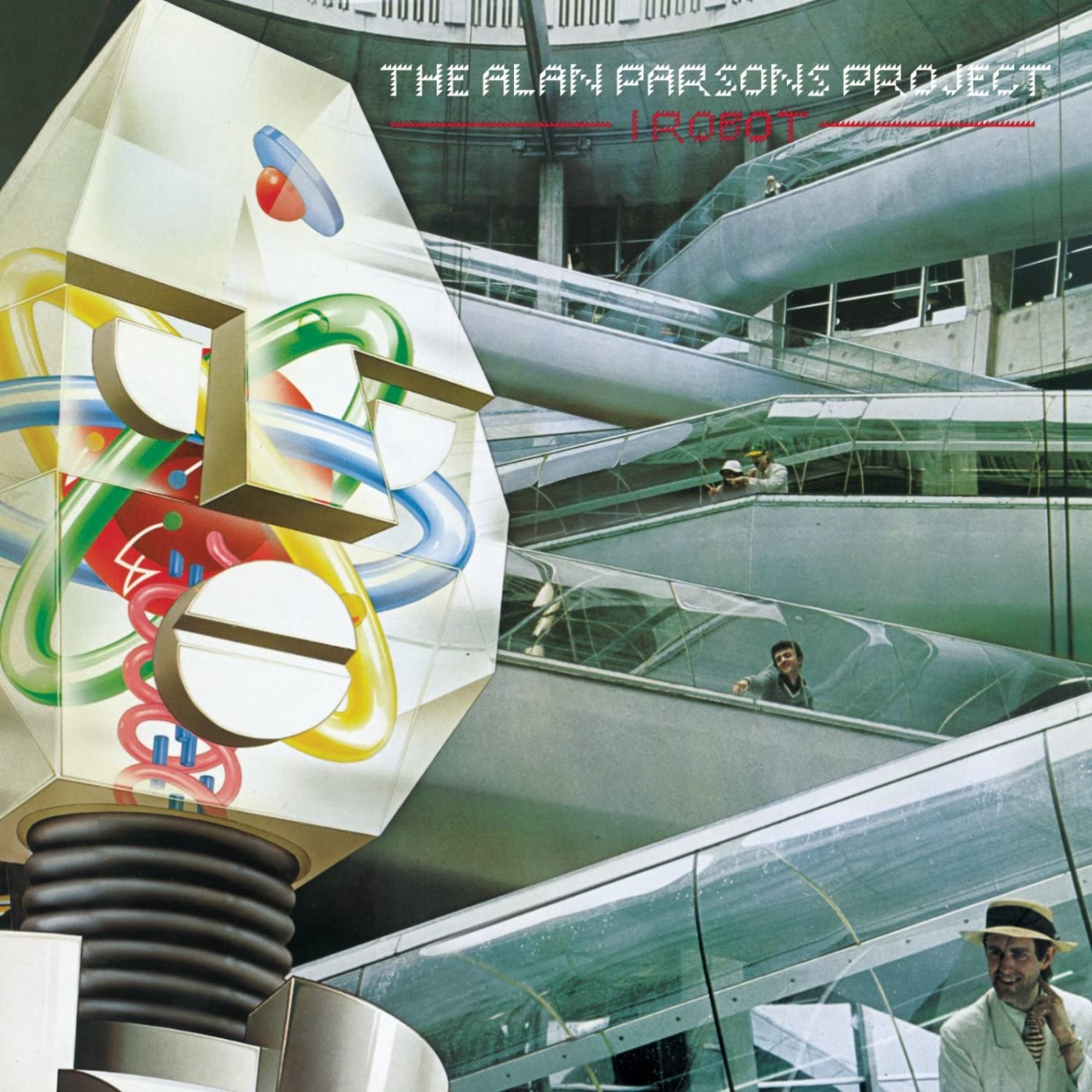
I Robot is The Alan Parsons Project’s second studio album.
Originally conceived as a one-off project, the album Tales Of Mystery And Imagination — which drew inspiration from the stories of Edgar Allan Poe — was successful enough that producer Alan Parsons and songwriter Eric Woolfson decided to continue their collaboration.
Like its predecessor, I Robot is also a concept album, but whereas the concept behind Tales Of Mystery And Imagination was very literal, the theme in I Robot is only suggestive. The album was originally supposed to be based on sci-fi author Isaac Asimov’s Robot series, and specifically the book I, Robot (1950), but the rights could not be secured, so Parsons and Woolfson, being clever guys, dropped the comma from the album’s title. The theme of philosophical reflection on robotics and artificial intelligence is reportedly still present on the album, but only very subtly.
”I Robot… The story of the rise of the machine and the decline of man, which paradoxically coincided with his discovery of the wheel… and a warning that his brief dominance of this planet will probably end, because man tried to create robot in his own image.”
That’s the grandiose claim made on the inner sleeve of the album’s original release, but I certainly find it hard to connect most of the lyrics to that statement. Of course, with a little goodwill, the lyrics to “I Wouldn’t Want To Be Like You,” for example, could be interpreted as a self-aware machine expressing its disappointment in humanity, its creator.
In terms of its theme, I Robot isn’t particularly interesting, but musically speaking, how does the album differ from its excellent predecessor?
The Alan Parsons Project’s debut, Tales Of Mystery And Imagination, successfully blended prog and more straightforward rock with influences from art music, and I Robot largely continues in the same vein. The music, however, is clearly softer and more pop-oriented than before. There are also new elements of funk and even soul.
The overall sound is more electronic than before. Tales featured very few synthesizers, but on I Robot their role is significantly greater. To play these instruments, the band enlisted Duncan Mackay, a keyboardist known for his Rick Wakeman-esque solo albums, to support Parsons and Woolfson. Although synthesizers take center stage on the album, the arrangements are fortunately still diverse and meticulously crafted.
And just like on their debut, this album also features a not-so-secret weapon, Andrew Powell, a classically trained composer whose dynamic orchestrations bring a pleasant sense of grandeur and drama to the music.
Read also: Review: Pink Floyd – The Division Bell (1994)
The album gets off to a spectacular start with the instrumental title track “I Robot,” driven by a relentlessly pulsing sequenced rhythm. The potentially monotonous rhythm track is elegantly embellished not only with tinkling keyboards but also with a cimbalom, a kantele, and an eerie choir. It’s a great start to the album, even if the song doesn’t quite manage to find a proper ending.
As “I Robot” fades out, one of the album’s highlights begins: the funky “I Wouldn’t Want To Be Like You.” Featuring even some disco elements and sung with soulful power by Lenny Zakatek, the song is a simple yet truly effective pop track. Zakatek went on to become one of TAPP’s regular vocalists on subsequent albums. I wouldn’t be surprised if “I Wouldn’t Want To Be Like You” and many other tracks served as inspiration for Daft Punk’s excellent retro album Random Access Memories (2013).
I Robot continues its winning streak with the song “Some Other Time,” sung by Peter Straker, which at first seems like a wistful ballad but soon transforms—thanks to the band’s robust playing and Andrew Powell’s powerful orchestrations—into a highly dynamic and grandiose track. The short but snappy guitar solo by Ian Bairnson—a guitarist already familiar from TAPP’s previous album—is also a highlight.
“Some Other Time” is followed by “Breakdown,” which is a decent song in its own right, but doesn’t really become truly inspiring until the swelling sections toward the end. The choir chants grandly, and the orchestral arrangement—with its blaring trombones—seems to imitate Ron Geesin’s arrangement of “Atom Heart Mother” by Parsons’ former employer, Pink Floyd. The influences are a little too obvious, but the end result is still effective. This is certainly not the last time we’ll hear Pink Floyd influences on this album…
“Don’t Let It Show,” sung by Dave Townsend and closing out Side A, is ultimately the wistful ballad the album had previously hinted at with “Some Other Time.” “Don’t Let It Show,” too, builds into quite a prog-rock romp toward the end, powered by the orchestra and the band. “Don’t Let It Show” essentially sets the template for an Alan Parsons Project ballad: a melancholic, almost tearful, understated opening section, followed by a full-blown orchestral crescendo at the end. The same formula was followed in many of TAPP’s later songs. Perhaps most successfully in the stunning mini-epic “Silence And I” from Eye In The Sky (1981).
The B-side of I Robot is considerably more uneven than the first half, which is a shame because if the album had maintained the quality of the first half all the way through, we would have had an album nearly on par with the project’s debut.
Following “The Voice”—which opens the B-side with a funky, detective-movie-style orchestration (reminiscent of Shaft and similar films) and is carried by a plodding bass ostinato—comes the album’s most insignificant track. The instrumental “Nucleus” is built around a dull drum machine beat, over which ethereal and slightly avant-garde synthesizer sounds are layered. The song vaguely brings to mind Pink Floyd’s “On The Run,” but is by far a much less interesting piece of work.
The next track, “Day After Day (The Show Must Go On),” also brings to mind Pink Floyd—and this time, because of its lyrics as well. The lyrical concept behind “Day After Day” seems to have been directly lifted from Pink Floyd’s classic “Time.” The song laments the relentless passage of time and lost opportunities in almost the exact same words. Musically, the track—which makes use of a lap steel guitar in a Pink Floyd-esque way (again!)—is certainly pretty, but also a bit unremarkable and repetitive.
Read also:
- Review: Porcupine Tree – Signify (1996)
- Review: The Walker Brothers – Nite Flights (1978)
- Year by Year : Best albums of 1977 – 1-10
- Levyarvio: Absoluuttinen Nollapiste – Nimi muutettu (2002)
- Review: Philip Glass – Songs From Liquid Days (1986)
- Levyarvostelu: Peter Gabriel – Up (2002)
- Review: John Greaves & Peter Blegvad: Kew. Rhone. (1977)
- Review: Flea – Honora (2026)
- Review: Pink Floyd – Animals (1977)
As a composer, Andrew Powell was given a platform in Tales’s long suite “The Fall of the House of Usher,” and he was once again given a chance to shine. Specifically, Powell was able to compose a single three-minute instrumental piece for the album on his own. Powell’s composition “Total Eclipse” is performed entirely by the orchestra and choir. In this ominous and dramatic piece, the influence of Powell’s mentor, György Ligeti (Powell studied under Ligeti in the 1960s), is evident. “Total Eclipse” is an intriguing piece in all its ominous, chilling dissonance, which borders on avant-garde art music. Partly simply because it feels stranger than it actually is—simply because it’s placed within a saccharine prog-pop album like I Robot. I enjoy listening to “Total Eclipse,” but the track doesn’t contribute to the album’s cohesion. It doesn’t seem to fit in with the rest. I would have loved to hear Powell release an entire album of this kind of material under his own name. On the other hand… I can also listen to Ligeti.
“Total Eclipse” flows directly into the album’s closing track, the instrumental “Genesis Ch. 1 V. 32,” which is somewhat reminiscent of Vangelis. The title track begins promisingly with a menacing swell (Powell’s arranged choir sighs along magnificently once again), but ultimately doesn’t really go anywhere. It’s a great appetizer without a proper main course.
I Robot doesn’t quite measure up to its edgy predecessor, Tales Of Mystery And Imagination. The song material is mostly high-quality and the execution is top-notch, but the music still often comes across as a bit bland and doesn’t quite reach that diamond-level brilliance often enough. Thanks to its many Pink Floyd-esque moments, the album also doesn’t feel like the same kind of unique work as Tales. Despite its flaws, however, I Robot is still a pleasure to listen to and, in every respect, high-quality, carefully crafted music.
I Robot was a huge success, selling over a million copies in the U.S. alone. This success cemented the direction for Alan Parsons and Eric Woolfson. The project’s music continued its journey toward the mainstream, and what followed was a steady stream of carefully produced—though often slightly repetitive and risk-averse—prog-pop albums. Tales Of Mystery And Imagination and I Robot remain The Alan Parsons Project’s best albums, though there are a few highlights to be found in their later work as well.
Best tracks: ”I Wouldn’t Want To Be Like You”, ”Some Other Time”, ”I Robot”, ”Total Eclipse”
Author: JANNE YLIRUUSI
Tracks
- ”I Robot” 6:02
- ”I Wouldn’t Want to Be Like You” 3:22
- ”Some Other Time” 4:06
- ”Breakdown” 3:50
- ”Don’t Let It Show” 4:24
- ”The Voice” 5:24
- ”Nucleus” 3:31
- ”Day After Day (The Show Must Go On)” 3:49
- ”Total Eclipse” 3:09
- ”Genesis Ch. 1 V. 32”
Musicians
David Paton: bass guitar, acoustic guitar, backing vocals Stuart Tosh: drums, percussion, backing vocals Ian Bairnson: electric guitar, acoustic guitar, backing vocals Eric Woolfson: keyboards, vocoder, backing vocals Alan Parsons: keyboards, vocoder, backing vocals, acoustic guitar Duncan Mackay: keyboards B.J. Cole: steel guitar John Leach: cimbalom, kantele Lenny Zakatek: vocals Allan Clarke: vocals Steve Harley: vocals Jack Harris: vocals Peter Straker: vocals Jaki Whitren: vocals Dave Townsend: vocals The English Chorale: vocals The New Philharmonia Chorus: vocals Hilary Western: backing vocals Smokey Parsons: backing vocals Tony Rivers: backing vocals John Perry: backing vocals Stu Calver: backing vocals Andrew Powell: orchestral and choral arrangements and conducting, keyboards
Producer: Alan Parsons
Label Arista



Jätä kommentti