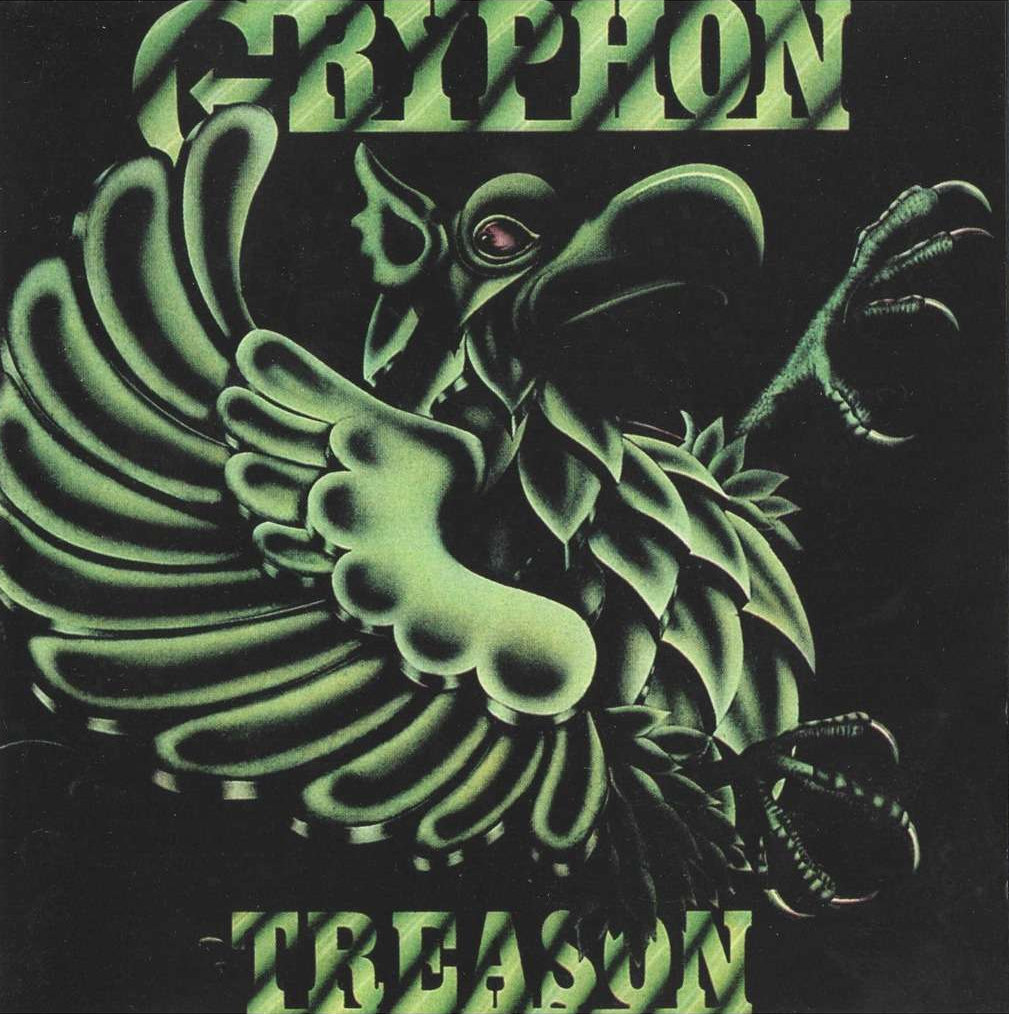
Treason is the fifth studio album by Gryphon, which was founded in 1973.
Gryphon began its career as a completely acoustic band that played medieval-style music. Gradually, the band—which had received a classical education at the Royal Academy of Music—added electric instruments to its acoustic arsenal (including the crumhorn and bassoon) and moved closer and closer to progressive rock. The band’s fourth album, Rain Dance, was already relatively “standard” symphonic progressive rock, and much of the band’s uniqueness had faded, even though the music itself was of high quality.
In 1974 and 1975, Gryphon played as the opening act for Yes on a couple of different tours, and Brian Lane, who managed Yes, had also become Gryphon’s manager. Yes’s music, as well as the success the band enjoyed, made an impression on Gryphon, and Lane—known as a shrewd manipulator—certainly pushed Gryphon, for his part, further and further toward the mainstream. Treason continues Gryphon’s journey toward the mainstream of electronic progressive rock.
In particular, the album’s opening track, the ten-minute “Spring Song”—which plays with dynamics in a powerful way—is a potent blend of Gryphon’s medieval quirkiness and Yes’s intricate rock power. In fact, the end result is also reminiscent of Gentle Giant, who, of course, also dabbled a bit in medieval music.
The song “Flash In The Pantry” also sounds strongly like Gentle Giant, spiced up with Steve Howe-esque guitar work. Although “Flash in the Pantry” can’t exactly be called a completely original song, it’s a really fun track, and the percussion-driven instrumental section heard midway through is absolutely magnificent (and very nicely recorded!). Treason actually sounds, as a whole, more like a skillful blend of Yes and Gentle Giant than like old Gryphon.
Read also:
- Review: Flea – Honora (2026)
- Review: Pink Floyd – Animals (1977)
- Levyarvio: Flea – Honora (2026)
- Review: Yes – Magnification (2001)
- Review: Jethro Tull – Songs From The Wood (1977)
- Review: A.W. Yrjänä – Eidolon (2026)
- Review: Rush – Roll The Bones (1991)
- Review: David Sylvian – Gone To Earth (1986)
- Review: David Bowie – Low (1977)
“Spring Song” is a powerful mini-epic, but the remaining six tracks on the album are a somewhat more mixed bag. These 4- to 5-minute songs are, for the most part, thoroughly enjoyable music, but at times they also feel a bit impersonal. On the one hand, nearly every track has some interesting moments—such as a resonant bassoon or a medieval-sounding organ—that clearly set them apart from run-of-the-mill prog. On the other hand, at times those same moments also feel a bit disjointed.
Another clear sign of Gryphon’s push toward the mainstream is the significantly greater amount of vocals compared to their earlier work. Only one track is instrumental (the excellent, slightly jazzy “Snakes And Ladders”). Vocals are handled by the band’s drummer, David Oberlé. He handles the job quite admirably, and when he isn’t deliberately trying to sound like an Irish leprechaun, his voice is actually quite beautiful. Horn player Brian Gulland and guitarist Bob Foster provide effective backing vocals.
Although some of Gryphon’s early eccentricity has been lost on Treason, the album has at times been judged too harshly. The music on Treason may not be as strange or complex as the band’s widely acclaimed classics Midnight Mushrumps and Red Queen To Gryphon Tree (both from 1974), but the album’s compositions (mostly penned by multi-instrumentalist Richard Harvey) are still quite sophisticated, interestingly arranged, and continue to feature plenty of virtuosic performances. The music on the album also has a cheerful sound and, above all, is fun to listen to. And at the very least, Treason easily outshines its counterpart, Gentle Giant’s Missing Piece—an artistic and commercial flop released that same year. Gryphon streamlined and simplified its musical expression far more successfully than its slightly more famous counterpart.
To be honest, I think I like this Gryphon Yes/Gentle Giant hybrid more than the band’s more original and generally more highly regarded albums. Treason may not be the most original music in the world, but it’s enjoyable to listen to. Besides, music that sounds like a mix of Yes and Gentle Giant is, after all, still quite a long way from the true mainstream of rock!
Read also: Review: Gentle Giant – Octopus (1972)
One area where Treason undoubtedly excels compared to its predecessors is its sound. Treason was produced by Mick Glossop and John Leckie, two of the UK’s elite recording engineers, and the album’s sound is truly magnificent—undoubtedly the best ever heard on a Gryphon release.
Treason failed to elevate the band’s popularity beyond its cult status, and the band disbanded shortly after the album’s release. The band didn’t make a comeback until 2015, playing a few shows, and finally released a surprisingly successful studio album, ReInvention, in 2018.
Best tracks: ”Spring Song”, ”Flash in the Pantry”, ”Snakes And Ladders”
Author: JANNE YLIRUUSI
Tracks
- ”Spring Song” (Harvey, Sebastion) – 10:00
- ”Round & Round” (Harvey, Sebastion) – 4:30
- ”Flash in the Pantry” (Gulland, Sebastion) – 4:57
- ”Falero Lady” (Harvey, Sebastion) – 4:08
- ”Snakes and Ladders” (Harvey) – 5:15
- ”The Fall of the Leaf” (Harvey, Sebastion) – 4:22
- ”Major Disaster” (Foster, Sebastion) – 4:04
Gryphon
David Oberlé: vocals, percussion Brian Gulland: bassoon, French horn, recorders, backing vocals Bob Foster: guitars, backing vocals Richard Harvey: keyboards, piano, saxophone, recorders Jonathan Davie: bass guitar Alex Baird: drums
 Pienemmät Purot
Jätä kommentti