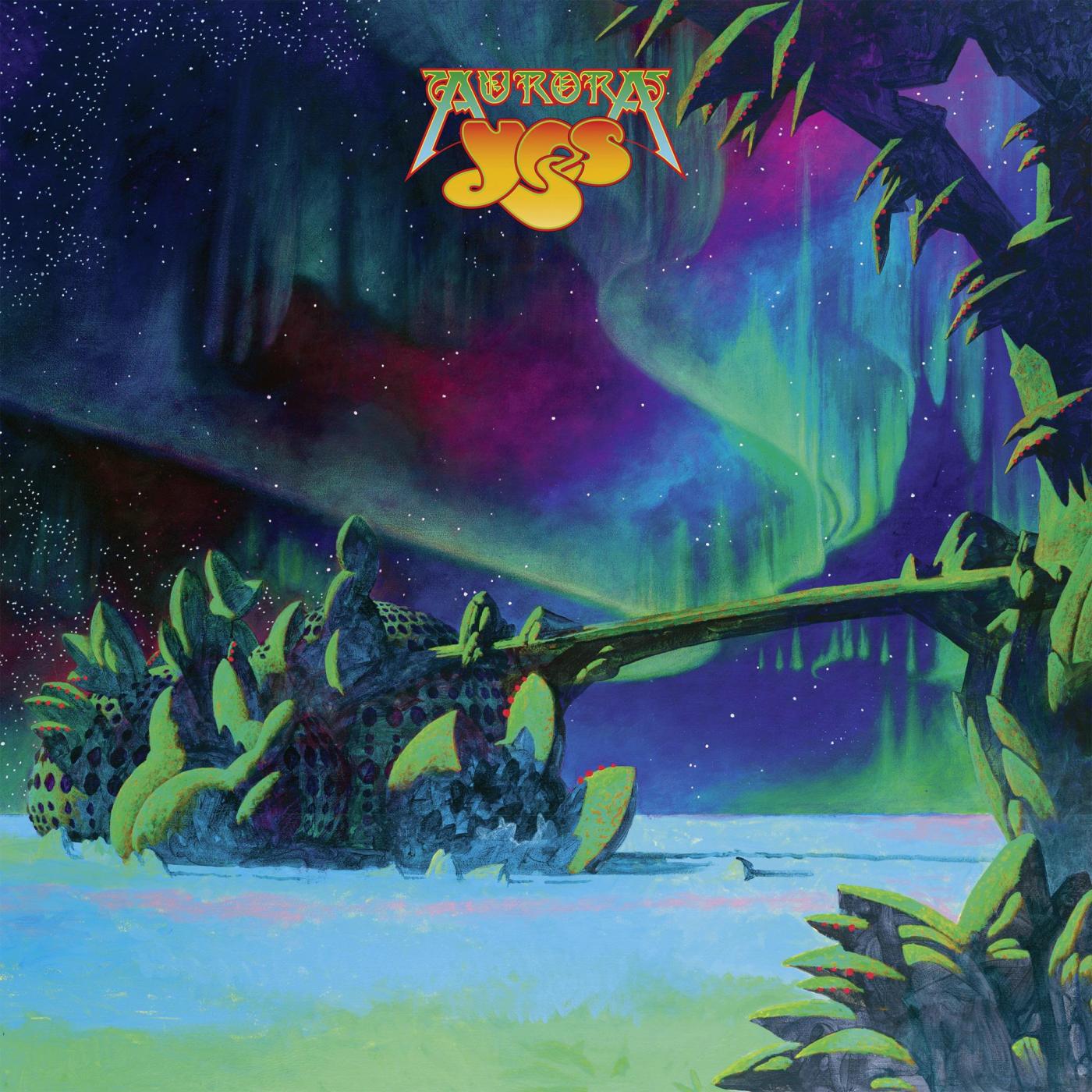
Aurora is Yes’s 24th studio album.
Founded in 1968, Yes has had a turbulent career, to say the least. The lineup has changed frequently, the band has experimented with various styles with mixed success, and its popularity has fluctuated from large arenas to stadiums and back to small theaters.
The 2020s have been perhaps the most consistent period in Yes’s long career—for better or for worse. Over the years, the band has featured a huge number of strong personalities, but when looking at the band’s entire history, three clear leading figures stand out above the rest: the band’s founders, bassist Chris Squire and vocalist Jon Anderson, as well as guitarist Steve Howe, who first joined the band in 1971. Anderson was sidelined in 2008 after falling seriously ill. He has since recovered and continues to perform energetically with his own band. Squire, on the other hand, passed away in 2015, after which the band was effectively left under Howe’s leadership.
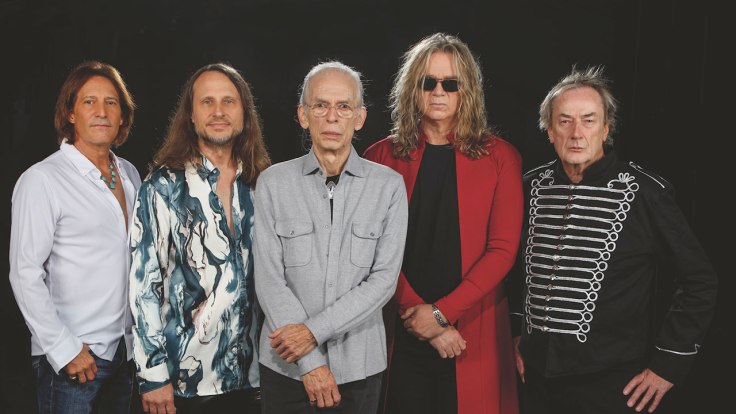
Howe has managed to keep the lineup exceptionally stable since the early 2020s. The only significant exception was the death of drummer Alan White in 2022. However, even that did not radically change the band’s operations, as another drummer, Jay Schellen, had already been brought in to support White—who had long been in fragile health—and naturally took over the drumming duties at this point. The bass is played by Billy Sherwood, who has been associated with Yes since the late 1980s; the keyboards are handled by Geoff Downes, who first joined the band during the Drama era; and the vocals are provided by Jon Davison, the former lead singer of Glass Hammer and various Yes cover bands.
After two Yes albums led by Steve Howe, Aurora offers few surprises. The Quest and Mirror To The Sky defined the band’s new direction, and Aurora does not significantly alter that course. The current Yes no longer seeks to compete with its own classic era in terms of speed, virtuosity, or unpredictability. The lineup led by Howe builds its music instead on strong melodies, meticulous arrangements, and calmly unfolding atmospheres. The band’s recognizable hallmarks are still present: Howe’s distinctive guitar work, lush keyboard arrangements, vocal harmonies, and occasional progressive structures. The use of a symphony orchestra has also become an established part of Yes’s current sound. Orchestral arrangements are no longer isolated highlights but one of the band’s central tonal elements, used to bring a sense of space, grandeur, and epic scale to the music. On Aurora, however, the role of the symphony orchestra (with Paul Joyce once again handling the orchestrations) has been slightly reduced, and it is heard on only two tracks.
Review: Jon Anderson & The Band Geeks – True (2024)
The over seven-minute-long “Aurora” is credited to Howe and Davison. I assume that Howe is primarily responsible for the composition and Davison for the lyrics. The structure of “Aurora” reveals, even on the first listen, that Yes has not abandoned progressive rock. Individual instrumental performances or sections may not be as virtuosic as they once were in the band’s history, but compositionally, this is a relatively complex structure. The song progresses through several consecutive sections, including an intro, three verses, two different interludes, long instrumental passages, and an orchestral-sounding climax. The structure is based on a recognizable song form, but it is expanded with instrumental passages characteristic of progressive rock.
”Aurora” begins dramatically, yet understatedly, with a piano whose fateful tones are briefly interrupted by a colorful and somewhat corny surge from the symphony orchestra. The orchestra recedes, and the piano plays alone for a moment, until the orchestra returns with a more romantic sound. At the one-minute mark, the mood shifts completely: the orchestra and piano disappear from the stage, and the band takes their place. It’s a relief, in a way, when the uneven orchestral intro ends, but at the same time, one might question the entire purpose of the intro, as it feels so disconnected from the actual body of the song.
The band plays for about half a minute on its own before Jon Davison begins singing. Davison sings once again like Mickey Mouse. On a superficial level, his high, clear voice brings Jon Anderson to mind. The performance is technically strong, but the tone of his voice can be considered narrow compared to Anderson’s more multi-layered and rough-edged delivery. Still, Davison’s interpretation has its own appeal, and his way of constructing melodic lines is exceptional; nor do the vocal lines on “Aurora” seem to follow the most predictable paths.
One thing that makes ”Aurora” a pleasant surprise is Jay Schellen’s drumming. Schellen, who definitively replaced Alan White on Mirror In The Sky, hadn’t entirely convinced me before, but on ”Aurora,” his lively playing works quite well. He plays a lot, but not too much, and naturally finds his place among the rest of the music. At this point, it’s also easy to notice one problem that plagues the entire Aurora album: Schellen never really drives the music forward at any point, but rather plays as if he’s just going along with it. This is probably because the drum tracks were recorded separately from the rest of the music and were among the final stages of the recording process. Personally, I find myself longing for the “good old days” when Yes, like most other rock bands, first recorded the backing tracks live—drums, bass, and rhythm guitar—which allowed for a greater sense of live groove. In today’s model, where musicians record their parts in bits and pieces from different corners of the globe, the groove of rock ’n’ roll and genuine ensemble playing is easily lost. Fortunately, however, “Aurora” aims for an orchestral sound (and I’m not just referring to the symphony orchestra making cameo appearances here and there), so Schellen’s playing can also be viewed in a positive light as fulfilling the role of the orchestra’s percussionist. I have to give a slight minus, however, for Schellen’s drum sound, which still comes across as somewhat lifeless. Despite all the grumbling, though, I have to admit that Schellen’s drumming seems to fit the music better now than ever before. He’s finally starting to earn his place in Yes.
What about the band’s more senior members? Steve Howe, of course, takes his place in the ensemble with consummate ease, just as one would expect from the song’s composer and the band’s leader. Howe’s first solo, around the three-and-a-half-minute mark, is played with a bright, jazzy sound and remains restrained, yet still demonstrates that the maestro’s fingers are still nimble even at the age of 79. However, this solo—and, unfortunately, the entire album—lacks the biting aggression that was once one of the cornerstones of Howe’s multifaceted guitar playing and made listening to it so thrilling.
Howen’s second solo, which comes in at the six-minute mark, sounds more varied, exploring several different sounds and blending naturally with Downes’s synthesizers and the strings providing the backing. Downes would have had an opportunity here to shine as a soloist, but he doesn’t really take it. Downes is known more as a texturalist and rhythm player than as a nimble soloist, and in “Aurora” he does indeed weave in some really tasty organ-like parts and synthesizer pads, though these are mixed a bit too far into the background. Looking at the album as a whole, Downes takes on a slightly more active role than on Mirror To The Sky, where he seemed to be completely overshadowed by Howe and the orchestra. Now, at least, he plays short synthesizer solos on several tracks.
While Downes raises his profile on Aurora, bassist Billy Sherwood, on the other hand, seems to take more of a back seat than before. Sherwood is a skilled bassist, and his playing is agile and precise on both the title track and the other songs, but the overall presence of the bass guitar comes across as too muffled. Sherwood’s overall sound is a bit too clean, and the bass is generally mixed too low. Overall, the production on Aurora leaves something to be desired. It certainly sounds clear and well-defined (you can hear the bass guitar, but you don’t really FEEL it), but actually a bit too much so. The end result sounds somewhat thin, sterile, and lifeless. The instruments float apart from one another, and you constantly find yourself thinking that something is missing: that certain “glue” that would bind everything together into a coherent whole. That said, it must be noted right away that at least this album doesn’t cause ear fatigue the way many modern, turbocharged recordings do. The sound hasn’t been compressed to the point of distortion, and in many places, the airiness of the sound appropriately supports the positive nature of the music and lyrics.
”Aurora” is brought to a close in a relatively elegant manner, transitioning from the solo section to a partial chorus—accompanied by the orchestra—and then proceeding through a brief coda to the song’s conclusion.
What about the other tracks on Aurora? The album is consistent, for better or worse. There aren’t any real low points (though Davison’s somewhat twee “Emotional Intelligence” does come across as a bit dull), but on the other hand, there are few true highlights as well. It’s actually difficult to single out any particular favorites above the rest. If I had to choose, I’d name the third track, “Love Lies Dreaming”—dominated by Davison’s angular melodies—as the best track. The composition flows organically and smoothly, and it features excellent guitar runs as well as a nice little acoustic solo from Howe. The beautiful “Ariadne,” which explores an ancient myth (“Ariadne’s thread”), also works well: it integrates the orchestra into the band more effectively than the title track and skillfully varies its instrumentation.
There’s also one “long song” on the album. Yes is known for its long, epic tracks, and when it comes to compositions over 20 minutes long, few prog bands have as many successes in that category as Yes. Aurora doesn’t quite aim for that scale, but it does include one track that’s nearly 14 minutes long.
“Countermovement,” however, isn’t the kind of symphonic masterpiece from the old days that Yes managed to create, especially in the ’70s; rather, it’s a rhapsody composed of four separate songs. The four parts don’t have much to do with one another, but they’ve still been woven together so that the whole is greater than the sum of its parts. The track begins and ends with the short instrumentals “Tara” and “Freedom’s Edge,” both composed by Howe. The central part of the piece is “Anytime Soon,” initially sung by Howe alone, in which the guitar wizard—whose vocals are, to put it mildly, a bit dry—reflects on what it’s like to be a musician. Fortunately, Howe’s vocals are backed by Davison, but at least he isn’t singing out of tune this time! In fact, this might be the best vocal performance of Howe’s career. The bar just isn’t set very high! There was a good reason he wasn’t allowed to sing lead vocals back when Anderson or Squire were still at the helm of the Yes ship. “Blink Of An Eye,” sung solely by Davison, expresses concern about the loss of identity in the AI-driven digital revolution. Davison’s lyrics are well-written, but I have to point out that the criticism of AI feels a bit ironic, considering that the music videos for both of the album’s singles (“Aurora” and “Turnaround Situation”) seem heavily AI-assisted productions.
One more note on ”Countermovement”: a variation of “Your Move” (The Yes Album, 1971) from the acoustic section—complete with Portuguese guitars—has been slipped in, which is a poor choice, because it only serves as a reminder of how seemingly effortlessly Yes managed to create memorable and enduring music in the 1970s. Nothing on “Countermovement” is quite as interesting as the “Your Move” reference.
Yes also continues the somewhat odd practice, started on the two previous albums, of sneaking in a couple of bonus tracks. On previous albums, the bonus tracks were hidden on separate CDs, but now the record label seems to have remembered that a CD can hold 80 minutes of music, and this time the two bonus tracks follow immediately after the “main program.” However, there’s probably little need for this distinction, as these extra songs don’t differ all that radically from the rest of the material in terms of quality or style. Presumably, if the band were asked, their answer would be diplomatic and clichéd: “They’re good songs, but they didn’t fit into the overall concept of the album.”
Be that as it may, the first of the bonus tracks, “Jambustin’,” caused quite a stir with its title even before the album’s release. Even after the release, many people still seem to find it just as embarrassing as one might expect from the title (a reference to Barbados’s roundabouts), but I actually think it’s a pretty fun and upbeat track. The chorus, which repeats the song’s ridiculous title, is certainly silly, but otherwise the song—which blends two different themes together quite naturally—flows nicely and is the track that sticks in your head the most throughout the entire album.
“Watching The River Roll,” composed by Billy Sherwood, is also reasonably enjoyable. Sherwood clearly strives, especially in his vocal melody, to channel his former bandmate Chris Squire. The song nicely brings Downes’s synthesizers to the forefront, but also makes room for Howe’s 12-string Portuguese guitar and mandolin.
Read also
- Levyarvio: Absoluuttinen Nollapiste – Nimi muutettu (2002)
- Review: Philip Glass – Songs From Liquid Days (1986)
- Levyarvostelu: Peter Gabriel – Up (2002)
- Review: John Greaves & Peter Blegvad: Kew. Rhone. (1977)
- Review: Flea – Honora (2026)
- Review: Pink Floyd – Animals (1977)
- Levyarvio: Flea – Honora (2026)
- Review: Yes – Magnification (2001)
- Review: Jethro Tull – Songs From The Wood (1977)
Including the bonus tracks, the 59-minute album is, for the most part, an enjoyable experience. Staying true to Yes’s traditions, it exudes a positive attitude and a certain vague striving toward spiritual enlightenment. It offers strong melodies, some successful individual performances in the realm of solos, and polished arrangements. At the same time, the music has lost a significant portion of that sense of danger, energy, and rhythmic power that made the 1970s Yes such an exceptional band. The end result is a dignified, professionally executed, and often beautiful piece of progressive rock that undeniably sounds like Yes—at least Steve Howe’s Yes—but no longer truly strives to reinvent itself.
Back in the day, Yes’s music often changed quite radically from one album to the next. Sometimes these changes were the result of the core members’ constant desire to explore new, uncharted musical directions; at other times, they were the result of changes in the band’s lineup, with new musicians steering the music in a direction that came naturally to them. At times, the changes were jarring and poorly justified, but on the other hand, this constant evolution inevitably kept Yes fresh and full of surprises throughout their career.
If you liked The Quest and Mirror to the Sky, you’ll most likely like Aurora as well. The same goes the other way around: if the current Yes sound hasn’t won you over, Aurora won’t change your mind. On their last three albums, Steve Howe and company have created their own way of making Yes music. This iteration of the Yes style may not be among my all-time favorites, but I have to respect the fact that Yes is still making music on its own terms without imitating anyone—not even its own distant past.
Aurora sounds good, but it still leaves me feeling a little empty and frustrated. At the same time, I’m glad that my old favorite band is still forging ahead, making new music without embarrassing themselves, but on the other hand, a thought keeps nagging at the back of my mind: they should be able to do better under the name Yes.
Best tracks: “Aurora”, “Love Lies Dreaming”, “Ariadne”
Kirjoittaja: JANNE YLIRUUSI
More to read about Yes:
Tracks
- ”Aurora” Davison, Howe 7:25
- ”Turnaround Situation” Davison 5:48
- ”Love Lies Dreaming” Davison, Howe 6:24
- ”Countermovement” 13:44
- i. ”Taro” Howe
- ii. ”Anytime Soon” Downes/Howe
- iii. ”Blink of an Eye” Davison/Sherwood/Schellen
- iv. ”Freedom’s Edge” Davison, Howe, Downes, Sherwood, Schellen
- ”Ariadne” Davison, Downes, Sherwood 6:14
- ”All Hands on Deck” Howe 3:03
- ”Outside the Box” 4:18
- i. ”Light” Howe
- ii. ”Outbox” Howe, Sherwood
- ”Emotional Intelligence” Davison 3:30
Bonus tracks:
- ”Jambustin'” Davison, Howe 4:22
- ”Watching the River Roll” Sherwood 4:40
Yes:
Jon Davison: lead vocals (1–3, 5, 8, 9), vocals (7i, 7ii), duo vocals (4ii, 4iii, 6, 10), electric rhythm guitar (1), organ (1, 2, 8), piano (2, 3, 8), acoustic rhythm guitar (2), synth (3), acoustic guitar (8) Steve Howe: guitars [Steinberger electric 12-string guitar (1, 4iii), Fender Telecaster (1, 4iii, 6), Gibson ES-175D (1, 2, 4iii, 6), Variax sitar guitar (1, 4iii, 6), Gibson Les Paul Junior (1, 2, 7ii), Williams pedal steel (2), Gibson Chet Atkins nylon-string guitar (2, 3), Steinberger GM4T electric guitar (3, 8), steel guitar (4i, 4iv), acoustic and electric guitars (4ii, 4iv), Fender steel guitar (4iii, 6, 8, 9), Martin MC38 SH acoustic guitar (4iii, 5, 9), Martin 0018SH acoustic guitar (4iii), Gibson Tennessean (4iii), Portuguese 12-string guitar (4iii, 10), electric Leslie guitar (5), acoustic Gibson ES-175D double-wah guitar (5), Martin J12-65M 12-string acoustic guitar (6), 6- and 12-string acoustic guitar (7i), Martin MC28 and 000-C acoustic guitars (7ii), Fender Stratocaster (9), Gibson ES-175D Leslie guitar (10)], mandolin (4ii, 10), Gibson F4 mandolin (4iii)], autoharp (1), harmonica (4iii), duo vocals (4ii, 6), harmony vocal (2), vocal (7i), additional keyboards (1), additional synth (9), washboard (9) Geoff Downes: synth (1, 2, 4ii, 9, 10), chorus organ (1), verse piano (3), organ (4i, 6, 8), piano (4ii, 4iii, 5, 9), Mellotron (4iii), string synths (4iv), lead synth (7ii) Billy Sherwood: bass guitar (1–6, 7ii, 8–10), vocals (1, 2, 5, 7i, 7ii), duo vocals (4iii, 10), additional electric guitar (4ii, 5) Jay Schellen: drums (1–6, 7ii, 8–10)
Other musicians:
Czech National Symphony Orchestra: Orchestra (1,5) Paul K. Joyce: Orchestral arrangements Vladimir Martinka: Conductor

