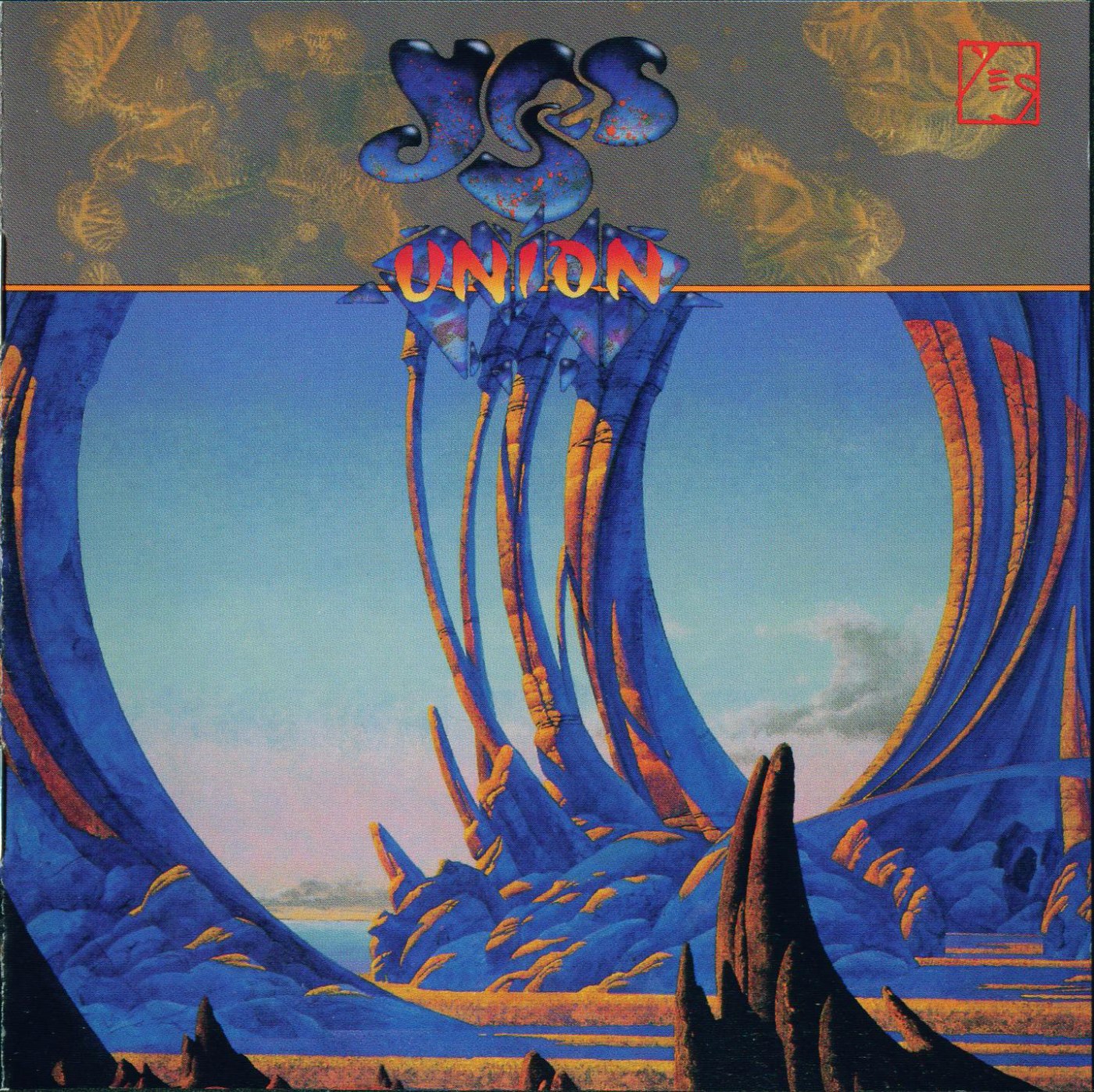
Union is Yes’s 13th studio album.
The making of Yes’s previous album, Big Generator, had been a painful process. This was particularly frustrating because none of the band members were particularly satisfied with the hard-won result, and the album also failed to meet the commercial expectations set by 90125. Nevertheless, the band valiantly promoted the album in the United States and Japan from November 1987 through April 1988.
Changes were still on the horizon, however, as following the concert held in May 1988 to celebrate the 40th anniversary of the Atlantic record label, vocalist Jon Anderson left Yes for the second time.
In public, Anderson has cited disagreements over the band’s musical direction—and in particular, an excessive focus on pop—as the reason for his departure. This may well be true, but what likely weighed just as heavily in the balance was the fact that As the original driving force behind Yes, Anderson could not settle for the role of a bystander, a position he had inevitably drifted into after bassist Chris Squire and, especially, new guitarist/composer Trevor Rabin had gained the upper hand following the massive success of 90125.
Rabin released a decent AOR album, Can’t Look Away, in the summer of 1989, but otherwise the remaining members of Yes seemed to focus mainly on enjoying life. Squire, in particular, threw himself wholeheartedly into this lifestyle, and his life in Los Angeles was apparently one long party for years on end.
Anderson’s camp was more active. Anderson had built his own version of Yes around drummer Bill Bruford, keyboardist Rick Wakeman, and guitarist Steve Howe. Of course, they couldn’t use the name Yes, so the band ended up with a less concise but, on the other hand, effectively self-explanatory name: Anderson Bruford Wakeman Howe. The quartet released their excellent debut album in June 1989.
After the album’s release, ABWH had toured successfully and returned to the studio shortly after the tour with the intention of recording their next album. At this point, however, the quartet quickly hit a roadblock. Whereas the first ABWH album had been carefully demoed and prepared by Anderson prior to the actual recordings, this time the quartet had hardly any finished material ready. This wouldn’t necessarily have been a problem, however, if the band had been given the space to develop their music, as Bruford has stated that he, Howe, and Wakeman had some quite interesting material in the works. That didn’t happen, however, because the record label intervened and announced that this time around, the album needed to include hits, and the A&R staff wasn’t convinced that the rough drafts ABWH had cobbled together so far would produce such material.
The record label’s demands set in motion a series of events that ultimately led to the infamous Union album. It’s a bit comical, but perhaps more sad, how quickly Anderson changed his tune. Just a few years earlier, he had vowed to go his own way, putting his own musical vision first. Be gone, you ever-piercing Power Play machine! Now, however, Anderson caved in and went begging for hits… from none other than Trevor Rabin!
Trevor Rabin has said that Anderson asked him to join the band and even play on the upcoming ABWH album. I wonder what Howe would have thought of that? However, the hits were the top priority, and Rabin offered Anderson three demos. Anderson was to choose one of these, and Rabin would keep the rest. Anderson, however, wanted all three songs, and eventually the management teams from both camps got involved and began plotting a reunion that would unite “East Coast Yes” (ABWH) and “West Coast Yes.”
It’s a bit of a mystery why Rabin and Squire, in particular, agreed to the reunion, but it was likely influenced by the fact that they simply hadn’t been able to get their own Yes project off the ground. The candidates for the new vocalist included both Supertramp’s former singer Roger Hodgson and the younger Billy Sherwood, who was part of the band World Trade, which blended AOR and prog. Hodgson apparently didn’t want to take the job in the end, and Sherwood, though flattered, felt that Anderson’s shoes were too big for him to fill. Sherwood did, however, become part of the Union project and later played a role in Yes as well, eventually even taking over Chris Squire’s spot after his death. Rabin and Squire’s desire to reunite was also fueled by the fact that both were eager to get back on the road, and the half-finished ABWH album offered a quick route to do so. And let’s not forget that Squire probably needed the money to keep the party in Los Angeles going as usual.
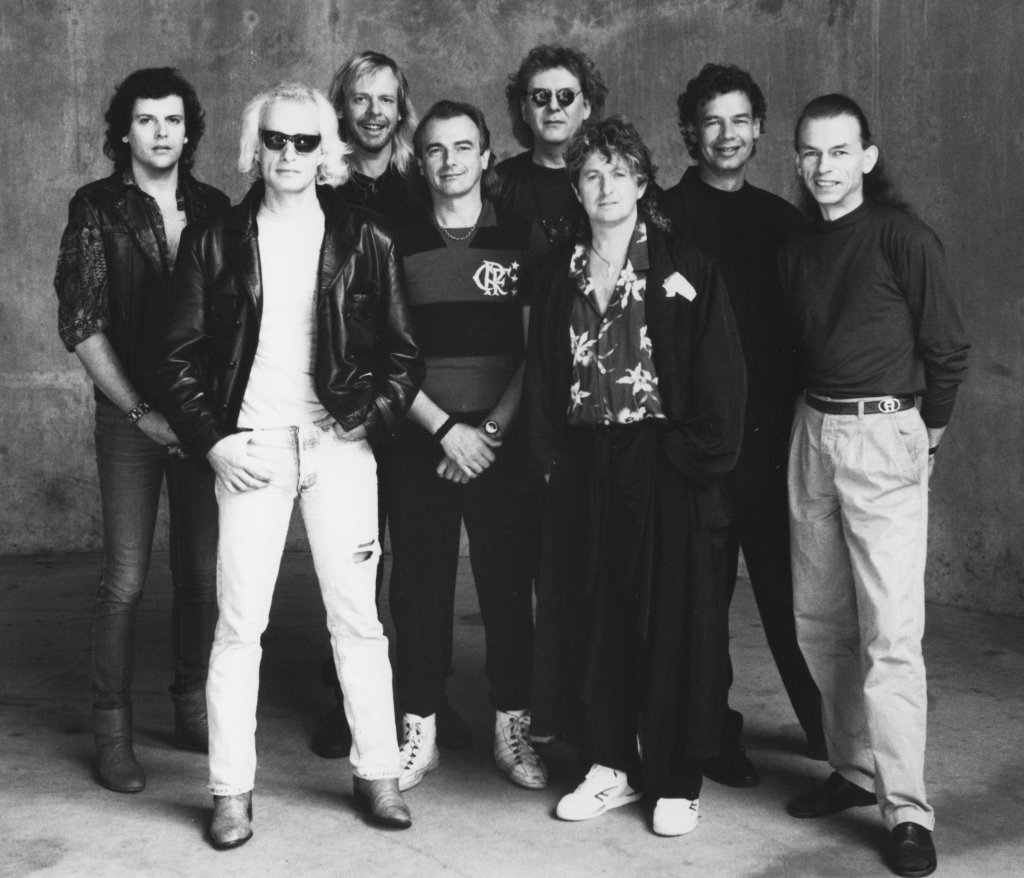
Even if the motives behind the merger weren’t necessarily particularly noble, is the idea really that crazy? Of course not. For example, Ornette Coleman often played with ensembles that doubled up on the same instruments, and Yes’s contemporary King Crimson put together the acclaimed “double trio” (two guitarists, two bassists, two drummers) just a few years later.
The unfortunate truth, however, is that there was no real fusion within Union. There is very little cross-pollination between the East and West Coast Yes bands on the album. Anderson does sing a bit on all the Rabin-Yes songs, and Squire handles some of the backing vocals on the ABWH tracks, but that’s about it.
The situation takes a tragicomic turn when you look at the album booklet to see who’s actually playing on the record. There are no fewer than 14 studio musicians (not counting the backing vocalists). Why is such a large ensemble needed when you have an eight-piece mega-Yes lineup consisting mostly of musicians hailed as virtuosos? We’ll come back to this a bit later and dive into the music itself.
Review: Jon Anderson – Change We Must (1994)
Stylistically, Union’s music is, to generalize a bit, a fairly clear continuation of the prog-influenced pop/rock found on 90125 and Big Generator. On average, however, Union’s songs have a slightly rockier—and even heavier—feel. At times, they veer straight into hard rock territory. It’s actually a bit strange that an album dominated by Jon Anderson is this rock-oriented.
Union can be broken down in many ways based on the artists. The most obvious division is, of course, between ABWH and West Coast-Yes, which form the two main camps. A couple of individual tracks stand out somewhat apart from these two camps.
The first of these standalone tracks is Steve Howe’s acoustic solo piece “Masquerade.” It’s a two-minute miniature featuring the supple, melodic guitar playing typical of Howe. Howe’s solo guitar tracks have a long tradition, as the first ones were already heard on The Yes Album and Fragile. Decades later, I don’t think songs like this are particularly justified on band albums anymore, since all the members have their own solo careers, but it is a pleasant track in its own right. And from Yes’s perspective, the track was undoubtedly worth including, as it earned a Grammy nomination for Best Instrumental Song of the Year. Great publicity for the album!
Another of the standalone tracks is also an instrumental. “Evensong,” which clocks in at under a minute, is a gentle, atmospheric drum/Stick duet between Bruford and Tony Levin (Levin continues as ABWH’s bassist on Union as well) that sounds like the intro to one of King Crimson’s energetic ’80s tracks. Or why not, say, a new Yes epic? As it stands, however, it remains a completely disconnected miniature, and I’d wager that even Bruford has wondered why it ended up on the album.
The West Coast Yes, also known as Rabin’s posse, contributes four tracks to the album: ”Lift Me Up,” ”Saving My Heart,” ”Miracle of Life,” and ”The More We Live – Let Go.”
”Lift Me Up” is a song credited to Rabin and Squire and one of the demos Rabin originally offered to ABWH (what happened to the other two demos is unclear to me). In the end, however, the song was performed specifically by West Coast Yes, featuring Anderson on vocals. It’s a pretty effective rock song that would have fit perfectly on 90125, but wouldn’t have stood out from the crowd in any positive way. A somewhat unremarkable track. “Lift Me Up” was the album’s first single and even became a minor hit.
“Saving My Heart” is a Rabin composition. This slightly saccharine song is light reggae-pop featuring a massive chorus typical of Rabin. Even Rabin thought the song didn’t suit Yes at all, but Anderson insisted on including it. A mistake. Union is a vague collection of tracks, but “Saving My Heart” stands out particularly clearly from the rest. It’s a perfectly fine pop song, but it doesn’t sound like Yes at all.
“Miracle Of Life,” composed by Rabin in collaboration with film composer Mark Mancina (who would go on to collaborate with another prog giant, Emerson, Lake & Palmer, a few years later), begins with a fine, complex intro featuring drummer Alan White’s most intense playing on the album. The transition from the intro to the actual song around the two-minute mark is somewhat of an anticlimax. The effect is thus somewhat similar to “Changes” on 90125. Great intro, mediocre song.
”The More We Live – Let Go” is the best track by West Coast Yes on Union. The song, which swirls with Squire and Billy Sherwood’s fatefully grandiose sound, has a subtle, cosmic atmosphere. And even though Anderson handles the lead vocals, it’s nice to hear Squire’s voice in a more prominent role than usual. The song is vaguely reminiscent of the material from Squire’s excellent solo album Fish Out Of Water (1975). What’s a bit odd about the song is that Squire doesn’t play bass on it at all—Sherwood handles that instead. Sherwood played the bass track on the demo, and that was enough for Squire. Respectable solidarity or just plain laziness? This decision does have a precedent, as on Drama (1980), Trevor Horn played bass on the track “Run Through The Light.” At this point, I should note that I’m not sure if Tony Kaye plays at all on Union. He is credited with the Hammond organ and piano, but I’m not sure… those instruments don’t really stand out much in the West Coast Yes songs.
As far as I know, the four songs by West Coast-Yes mentioned above were played more or less without outside help, but when it comes to ABWH’s tracks, the situation is radically different.
Jonathan Elias, who produced ABWH’s material together with Anderson (Elias had previously produced, among others, Duran Duran and Grace Jones), has said that Anderson and Howe didn’t get along at all during the sessions and competed to badmouth each other. Apparently, the same thing happened between Howe and Wakeman. Wakeman was apparently rarely seen in the studio either, so when keyboards were needed, it was easier to call in a session musician.
However, Elias has been most critical of Howe, whom he has called “a clueless pothead who can’t play.” Perhaps Howe had a bad season precisely during the Union sessions, but Elias’s claim seems a bit odd, since as recently as 1989 Howe played excellently on the ABWH tour, and there didn’t seem to be anything particularly wrong with his playing on the Union tour either.
However, the chemistry within the band was clearly in shambles in the ABWH camp—whatever the reason—and in the end, most of the guitar parts on that camp’s songs were played by session musician Jimmy Haun. Haun was told to play “like Howe, but with a more modern touch.” Apparently, very little of Wakeman’s playing ended up on the album in the end. At least the drums and bass guitars seem to be mostly played by Bruford and Levin.
By the way, it’s interesting that Elias has complained about hearing a lot of grumbling from the BWH side, but Anderson was left alone because, apparently, everyone was afraid of him! In the ’70s, Anderson was called “Little Napoleon” and “the iron-fisted hippie.” Apparently, these nicknames still held true even in the early ’90s!
At this point, I’d like to add a personal touch. I was introduced to Yes in the early ’90s after buying The Yes Album and Union (which I mistakenly thought was a compilation!) on a whim. This was also my first exposure to Steve Howe’s guitar playing. So I got to know Howe’s playing style through two albums, one of which I learned years later that most of the guitar tracks weren’t actually played by Howe. You can probably imagine my confusion.
No matter who plays ABWH’s songs, I still think Union’s best moments come from that sector. In my opinion, “I Would Have Waited Forever,” “Shock To The System,” “Without Hope You Cannot Start the Day,” and “Silent Talking” are particularly successful. It’s worth noting here, though, that when I talk about ABWH, I mean the band songs where Anderson was in charge. In practice, however, some of these songs were composed by Anderson and Elias together, and as we noted above, the musicians might have been Bruford, Wakeman, and Howe, but it’s very possible that their spots were filled by session musicians.
The album’s best track, “I Would Have Waited Forever,” kicks off with Anderson’s forceful vocals and then shifts into a section driven by a powerful, off-beat electric guitar riff (apparently played by Haun). In the background, Levin’s bass pumps heavily and Bruford pounds his electronic drums like there’s no tomorrow. Over its six-minute runtime, the song goes through numerous different sections and is so packed with all kinds of electronic noise that, depending on your mood, it either causes nausea or delight. Most days, I really enjoy this energetic song, even though it is quite overproduced.
“Shock To The System” is a mid-tempo yet still fairly energetic song driven by a heavy guitar riff, punctuated by fantastic electric guitar breaks. Anderson sings with intensity once again. Almost screaming. The song’s brief, more melodic middle section is truly excellent, and Anderson’s vocals possess that good old Yes magic.
“Without Hope You Cannot Start the Day,” composed by Anderson and Elias, is another successful track. The song begins with an atmospheric and emotional intro, rich with piano and synthesizer swells, over which Anderson sings with sensitivity.
Originally, Wakeman played a complicated piano intro for the song, which Elias has described as if it were ripped straight from a Rachmaninoff piano concerto. Elias and Anderson didn’t feel that Wakeman’s elaborate take on the intro was appropriate, so Elias played a simpler piano track himself instead. I understand Elias and Anderson’s perspective well, as Wakeman’s flourishes can sometimes be in poor taste, but perhaps the intro could have used a bit more flair to make it sound more like Yes.
The remaining intro, however, works beautifully in its understated simplicity, especially since Anderson’s vocal performance is moving and the melody is strong. After the ballad-like opening, the song shifts into an energetic section in 9/8 time, where Levin and Bruford do a great job. The thin-sounding electric guitar successfully adds a bit of edge here and there. The song’s complex chorus is also catchy in all its quirkiness. According to Haun, Howe doesn’t play on the song at all—all the guitars are played by him.
“Without Hope You Cannot Start the Day” is a bit rough around the edges as a song, since its different parts don’t flow together particularly smoothly, but that’s never really bothered me much.
“Silent Talking” is a song credited to the entire ABWH (plus Elias) that rolls along powerfully, slipping and sliding on its irregular rhythm like ice, and features a tasty guitar riff from Howe. Most of the guitars are, however, once again played by Haun. The main riff is, however, Howe’s creation, and it—like a few other riffs from the album—was heard in new versions on Howe’s solo album Turbulence, released shortly after Union (Turbulence had actually been recorded before Union).
I mentioned earlier that “Saving My Heart” stands out on the album because it doesn’t sound like Yes, but the same can be said of “Angkor Wat.” Credited to Anderson, Elias, and Wakeman, “Angkor Wat” is essentially a New Age-inspired piece built solely on synthesizers and Anderson’s vocals. It’s not bad at all, but perhaps it would have been better suited for one of Anderson’s solo albums. “Angkor Wat” is, however, one of the few tracks on the album where Wakeman is clearly playing. Not his typical fast-paced solos filled with arpeggios, though, but rather numerous overlapping atmospheric layers.
The rest of ABWH’s tracks are perfectly decent, but a bit forgettable or stylistically too similar to some other better song on the album.
”Dangerous (Look in the Light of What You’re Searching For)” is worth mentioning because it sounds amusingly like a cross between Michael Jackson and ”Owner Of A Lonely Heart.” (Side note: Rabin later ended up playing guitar on Jackson’s song “D.S.,” which features a sample from “OFALH.”)
“Take The Water To The Mountain,” composed solely by Anderson and accompanied mainly by synthesizers and electronic percussion, sounds like a B-side by Peter Gabriel. It’s not actually a bad song, but it would have been better suited to Anderson’s solo album. Gabriel himself would hardly have been satisfied with it.
“Holding On” and “Give And Take” are rock songs that don’t really leave much of an impression. Except for the endless chorus refrain in the latter. It’s actually a bit baffling that the entire Union project started because ABWH didn’t have enough material, and in the end, there were way too many songs! Personally, I would have left “Holding On,” “Saving My Heart,” “Dangerous,” and “Give And Take” off the album (which, incidentally, is only included on the European and Japanese editions).
The production of ABWH’s tracks has been heavily criticized. If we set aside the way the songs make vague use of studio musicians, I don’t think the end result sounds particularly bad. The biggest problem is a certain kind of overproduction that plagues most of the songs produced by Elias. The music isn’t allowed to breathe at almost any point; instead, every gap is crammed full of overlapping tracks competing with one another. An endless array of synthesizers, guitars, and various percussion instruments fills nearly every second. Perhaps this was Elias’s vision of progressive rock: there has to be a LOT of everything, ALL THE TIME. On the other hand, this does bring a certain intensity and richness to the music. Every song has plenty to listen to and endless details. Unfortunately, the quality of those details isn’t always something to cheer about. The songs on West Coast Yes, on the other hand, suffer in part from a certain demo-like quality and a sense of incompleteness. Still, Union doesn’t sound bad in terms of its sound; I’d argue that the problems have been somewhat exaggerated over the years. Partly by the Yes members themselves, who were, understandably, disappointed with their own role in the final result.
Read also:
- Review: Philip Glass – Songs From Liquid Days (1986)
- Levyarvostelu: Peter Gabriel – Up (2002)
- Review: John Greaves & Peter Blegvad: Kew. Rhone. (1977)
- Review: Flea – Honora (2026)
- Review: Pink Floyd – Animals (1977)
- Levyarvio: Flea – Honora (2026)
- Review: Yes – Magnification (2001)
- Review: Jethro Tull – Songs From The Wood (1977)
- Review: A.W. Yrjänä – Eidolon (2026)
Union received poor reviews upon its release, but still sold reasonably well. In the U.S. alone, the album sold half a million copies. Everything is relative, however. Union’s sales figures fell far short of Big Generator, let alone 90125. And most worryingly, Union sold roughly the same number of copies as ABWH’s debut album from a couple of years earlier. Bruford, in particular, has recalled with amusement—shaking his head—that the record label didn’t believe ABWH could survive without the Yes brand, and now that the label had been stamped on the album cover, the results didn’t improve at all. On the contrary; considering that the album was recorded in nine different studios around the world with over 30 musicians and technicians, and the legal fees alone for the ABWH/Yes merger were likely astronomical (the contract reportedly ran to 90 pages…), it is highly likely that the record label took a massive loss on the entire project.
With a few exceptions, Yes fans don’t really appreciate the album, and the same goes for the musicians who played on it. This is especially true for those who thought they were playing on the album, but found out otherwise when they finally got to hear it.
Wakeman has said that he first heard the album while riding in a limousine in New York and was so disappointed with the result that he threw the cassette out the car window. In fact, Wakeman has referred to Union as Onion for decades because the album makes him cry.
Bruford, for his part, has described the album as the worst he has ever played on (in fact, Bruford is wrong, as the weakest is Symphonic Music Of Yes, released a few years later) and said it is a prime example of what is most wrong with Yes. In Bruford’s view, Yes is always chasing the maximum amount of money in the short term because its members are constantly short on cash due to their overly extravagant lifestyles.
Steve Howe, for his part, has bitterly remarked that he was deeply disappointed that the Union venture ultimately led to him losing not only ABWH but also Yes. I would also guess that Howe has never forgiven Anderson for his betrayal regarding Union. The fallout from this may still be felt today; for if it’s up to Howe, Anderson won’t be welcomed back into Yes.
Anderson himself has kept a very low profile regarding Union. I don’t recall him ever commenting on it since its release. Could it be that he’s even ashamed of his own role in the whole fiasco?
Squire and Rabin have taken a somewhat more neutral stance on the album. It’s as if they’re shrugging their shoulders: “It was a crappy gig, but at least we got it done.” Rabin has, however, claimed that he has never even listened to Union in its entirety.
The Yesshows ‘91: Around the World in 80 Dates tour, which kicked off after the album’s release and spanned 80 shows, at least offered the members of Yes some consolation. The tour was a commercial success (at its peak, the band played to audiences of 18,000) and for some of the shows, the band returned to a circular, rotating stage built in the middle of the audience. In the same style as the Tormato tour. The eight-piece band played competently, but no one had bothered to write particularly interesting arrangements for such a large band. Bruford, in particular, found the experience frustrating. The other members have taken a more positive view of the experience, and Rabin and Wakeman in particular got along exceptionally well and even became friends during the tour.
The Union tour can be considered Yes’s first nostalgia tour. Only a few tracks from Union were played; otherwise, the setlist focused on both 1970s classics and 1980s hits. You can get a taste of the Around the World in 80 Dates tour at least in the form of Union Live, released in 2011. Warning: the sound quality is mostly at a decent bootleg level.
After the Union tour, it was unclear which of the eight musicians were still members of Yes.
Howe has said that he suggested the eight-member Yes continue and record a new studio album. In Howe’s vision, the compositions would be structured according to the strengths of the different members, and not everyone would need to be heard at the same time all the time. A lovely idea, but if we are to believe reports that Howe didn’t really get along with anyone, it’s also quite unrealistic.
It soon became clear that Howe would be out of the band, and Bruford probably didn’t even want to join. For a while, it looked as though Yes’s new lineup would be built around Anderson, Squire, Rabin, Kay, White, and Wakeman, but in the end, Wakeman was dropped from the equation. What remained, then, was the quartet that had made 90125, which was apparently largely dictated by the record label. Evidently, the dream of repeating the success of 90125 was still alive. On the other hand, if you think about it realistically, perhaps that quartet was the only one possible at that moment—one that got along well enough with each other while still being worthy of the Yes brand.
We had to wait until 1994 for Yes’s next album; Talk, released that year, was the first on which Anderson and Rabin truly collaborated.
It has become clear from the above that the band members don’t really care much about Union, and not many Yes fans are particularly enthusiastic about the album either. To speak of enthusiasm would be an exaggeration even in my own case, but even though I realize that the way Union was put together was completely perverse and that, as a whole, the album is a shapeless lump lacking a coherent vision, I must nevertheless admit that I enjoy a large part of its music. Union is certainly not a prime example of an excellent Yes album, but in my opinion, it’s still an entertaining and energetic rock record. Yes has made worse ones. Unfortunately.
Author: JANNE YLIRUUSI
Tracks:
- ”I Would Have Waited Forever” Anderson, Steve Howe, Elias 6:32
- ”Shock to the System” Anderson, Howe, Elias 5:08
- ”Masquerade” Howe 2:16
- ”Lift Me Up” Rabin, Squire 6:29
- ”Without Hope You Cannot Start the Day” Anderson, Elias 5:16
- ”Saving My Heart” Rabin 4:38
- ”Miracle of Life” Rabin, Mark Mancina 7:30
- ”Silent Talking” Anderson, Howe, Wakeman, Bruford, Elias 3:57
- ”The More We Live – Let Go” Squire, Billy Sherwood 4:53
- ”Angkor Wat” Anderson, Wakeman, Elias 5:23
- ”Dangerous (Look in the Light of What You’re Searching For)” Anderson, Elias 3:37
- ”Holding On” Anderson, Elias, Howe 5:23
- ”Evensong” Levin, Bruford 0:50
- ”Take the Water to the Mountain” Anderson 3:11
- “Give And Take” Anderson, Howe, Elias 4:29
Yes:
Jon Anderson: lead and backing vocals (all tracks except 3 and 13), acoustic guitar, percussion Steve Howe: acoustic and electric guitars (1, 3, 8, 12, and 15) Trevor Rabin: electric guitars, lead and backing vocals (4, 6, 7, and 9) Chris Squire: harmony and backing vocals (1, 2, 4–7, 9, and 11), bass (tracks 4, 6, 7). Tony Kaye: Hammond B-3 organ, piano (4, 6, 7, and 9) Rick Wakeman: keyboards (tracks 1, 2, 5, 8, 10–12, 14, and 15) Bill Bruford: acoustic and electric drums, percussion (tracks 1, 2, 5, 8, and 11–15) Alan White: acoustic drums and percussion (tracks 4, 6, 7, and 9)
Other musicians:
Jonathan Elias: piano (5), synthesizers/programming, backing vocals Tony Levin: bass guitar (tracks 1, 2, 5, 8, 11, 12, 14, and 15), Chapman Stick (13) Jimmy Haun: electric and acoustic guitars (tracks 1, 2, 5, 8, 11, 12, 14, 15)[23] Billy Sherwood: bass guitar, keyboards, guitars, programming, backing vocals (track 9) Allan Schwartzberg: acoustic percussion Gary Barlough: synthesizer Jerry Bennett: synthesizer, synthesized percussion Jim Crichton: synthesizer (11) Pauline Cheng: speech (10) Gary Falcone: backing vocals Deborah Anderson: backing vocals Ian Lloyd: backing vocals Tommy Funderburk: backing vocals Sherman Foote: synthesizer Brian Foraker: synthesizer programming Chris Fosdick: synthesizer Rory Kaplan: synthesizer programming Alex Lasarenko: synthesizer Steve Porcaro: keyboards, synthesizer programming Michael Sherwood: backing vocals Danny Vaughn: backing vocals
 Pienemmät Purot
Jätä kommentti