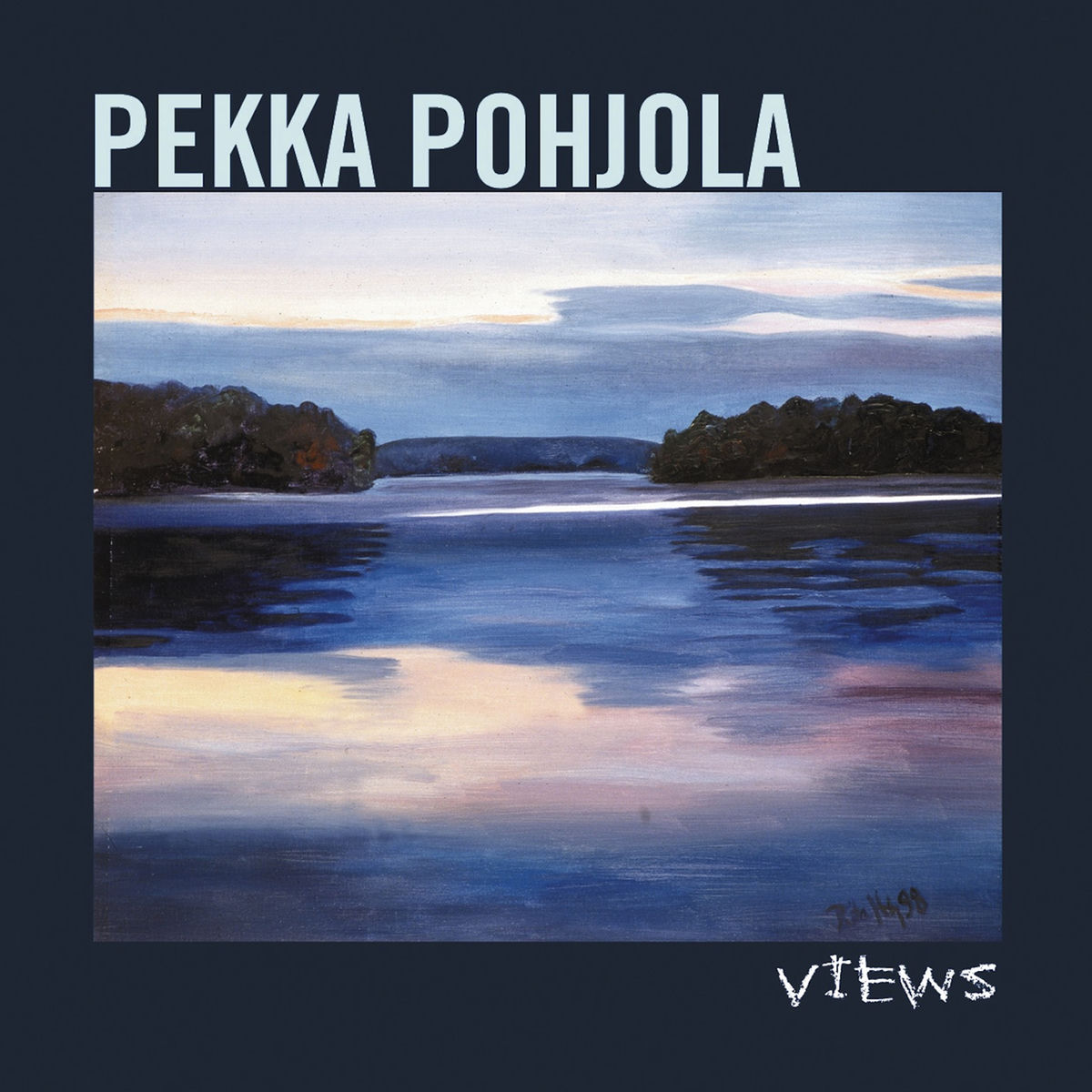
Views is Pekka Pohjola’s 14th studio album.
It seems that after the excellent Pewit album (1997), the atmosphere in Pohjola’s “electric band” began to wane. Based on interviews, the quartet—Pohjola, Seppo Kantonen (keyboards), Markku Kanerva (guitars), and Anssi Nykänen (drums)—who had been playing together for a long time, had begun to grow tired of one another. Kantonen has even stated that he had grown tired of Pohjola’s music, which, according to him, no longer offered any surprises. The maestro himself probably felt more or less the same way, as Views, the follow-up to Pewit, introduces a wealth of new ideas.
Four years passed between Views and its predecessor, Pewit. Pohjola had trouble getting into the swing of composing, but the spark for creating new music finally came from a commission by the Finnish jazz institution UMO Helsinki Jazz Orchestra—or UMO for short. UMO commissioned a piece from Pohjola for double bass and big band. The result was the three-part “Us” (or “Me”), a nearly 30-minute composition that premiered in Helsinki in April 2000. Pohjola was pleased with the piece and decided to build his next studio album around this material.
(The three parts of the original ”Us” can be heard on the 2010 album Beauty And The Beast – UMO Plays The Music Of Pekka Pohjola.)
”Us” offered Pohjola a new angle on composition, but Views is also, in terms of its execution, a very different album from its predecessor. Pewit, like most of Pohjola’s previous albums, was built around a core band, but this time the lineup includes nearly 30 musicians: wind players, string players, a harpist, singers, and as many as four different drummers and percussionists. Kantonen, Kanerva, and Nykänen from the “electric band” are still on the album, but they’re only used here and there as needed. The same applies to many of the other musicians on the album. For example, Nykänen actually plays on only one track and also provides overdubs for a few songs, while jazz drummer Mika Kallio takes on a much more prominent role. On the other hand, not all songs feature a drum set at all, and the sound is often downright orchestral.
On this album, Pohjola seems to be clearly distancing himself from rock music, which he had apparently grown tired of. A significant portion of the music on Views is a charming blend of symphonic and jazz-inspired elements, with only the occasional nod toward rock here and there. The album is also largely acoustic. Pohjola’s electric bass guitar is, of course, almost constantly present, but the electric guitar is heard on only one track, and keyboards are used mostly subtly to support the horns and strings. Incidentally, both of Pekka’s sons can be heard on the wind instruments: Ilmari Pohjola’s trombone and the trumpet of rising jazz star Verneri Pohjola feature on four tracks.
Read also: Review: Pekka Pohjola – Harakka Bialoipokku (1974)
Right from the first track, “Waves,” it’s clear that this is no longer rock music. Instead of electric guitars or synthesizers, the seven-minute composition opens with a beautiful melody played on the harp by Laura Hynninen, accompanied by subtly resonating strings. The atmosphere is chamber-music-like, but the wind instruments gradually build the music toward a more grandiose sound. With the exception of Pohjola’s bass guitar, the sound remains acoustic, and instead of rock drums, the track features orchestral percussion played by Tapio “Mongo” Aaltonen. At the climactic moments, the timpani strike with impressive force, like waves crashing against the bow of a boat in a storm.
In terms of orchestration, “Waves” is thus something quite different from what we’ve come to expect from Pohjola, but the composition itself is unmistakably Pohjola. It offers the familiar, distinctly Pohjola-esque, straightforwardly powerful romantic and downright heroic melodies, as well as clear tonal harmony. This time, delightfully, without a steadily pounding drum beat.
If the first song leads the listener to believe that an album of acoustic chamber music is in store, the next track, “The Red Porsche,” pulls the rug out from under them. In fact, in more ways than one. Anssi Nykänen’s rock beat makes a comeback just when you thought you’d gotten rid of it. But what’s even more surprising is that the song is built around the vocals.
On his albums, Pohjola focused almost entirely on instrumental music, and prior to “The Red Porsche,” the only notable exceptions were found on the Urban Tango album (1982). The trio of vocalists—Sami Saari, Kim Lönnholm, and Pemo Ojala—delivers a powerful interpretation of Charles Bukowski’s lyrics. Their three-part harmony is undoubtedly the finest vocal performance ever heard on a Pohjola album. Admittedly, there aren’t many points of comparison.
The rhythm section on ”Nykänen” works well, partly because the song’s versatile arrangement puts it on hold from time to time, allowing the music to flow for long stretches without drums, carried along by the beautifully sounding strings.
What explains the uniqueness of “The Red Porsche” is that the song was originally composed for a play based on Bukowski. It remains unclear to me, however, whether the play was ever staged and, if it was, whether it featured more of Pohjola’s music. In any case, “The Red Porsche” is based on the poem of the same name by the bohemian writer Bukowski. This marks the fulfillment of a long-held dream, as Pohjola had already spoken in the early 1980s about making an entire album based on Bukowski’s texts.
Musically, “The Red Porsche” stands out somewhat from the rest of the album, but it’s interesting that it still fits in thematically. Views is, in fact, an exceptionally urban and American-sounding album for Pohjola. The main exception is the maritime opening track, “Waves.” Now, instead of riding a moped through the shade of a coniferous forest as on Pohjola’s early albums, we’re speeding through an urban metropolis in a sports car.
I know that many Pohjola fans hate the playful “The Red Porsche,” but I think it’s an excellent and fun, carefully arranged song, whose somewhat brash style also references Pohjola’s old idol, Frank Zappa. Personally, I would have loved to hear an entire album of similar material from Pohjola, and it’s interesting that I thought this even before I learned that Pohjola had actually planned something like that. What a shame that the project never came to fruition.
Porsche leads us into the heart of the big city, and “Metropolitan” kicks off the three-song series that concludes the album, based on the previously mentioned “Us” triptych composed for UMO. Structurally, the piece remains largely unchanged—though it has been extended by a few minutes—but there are significant differences in the arrangements. The original versions composed for UMO relied heavily on the winds, but the new version reduces their role, bringing in strings alongside them. The drums are also largely pushed to the sidelines, and Pohjola tones down the composition’s “bass concerto-like” quality, as the bass’s role is diminished when the maestro emphasizes melodies at the expense of rhythm. The new versions indeed sound softer and more subdued. The UMO versions were jazz, whereas now Pohjola leans more toward classical music.
The fourteen-minute “Metropolitan” evokes the pastoral landscapes of the first track through a wistful string theme, but as the orchestration gradually builds, enigmatic and even slightly menacing tones creep into the music. At the two-minute mark, not only the drums but also the brass instruments burst in explosively. This is followed by a rhythmic interlude in which the bass and wind instruments build tension that ultimately erupts into a bold, very Pohjola-sounding trumpet theme.
The countryside is now far behind us, and Porsche is racing us through the concrete canyons of the big city. Over the course of its nearly 15-minute runtime, “Metropolitan” takes us through a variety of moods. At times it meanders in a jazzy manner, at times the synthesizers create a cool, detached atmosphere, and at times the drums strike intensely, jarring the listener awake. The dynamics aren’t as extreme as on Pewit, but they’re still commendable. “Metropolitan,” which flows naturally, is a magnificent composition, though it might have benefited from a bit of tightening, especially toward the end.
“Views,” the second part of the “Us” triptych, is like the slow movement of a symphony. The song’s quiet and slightly mystical opening features subtle ethnic percussion and wind instruments. The beautiful and wistful main theme, created by the interplay of the piano, strings, and flute, gradually takes over. The only rhythmic elements remaining are a tambourine or similar instrument gently jingling in the background, along with the occasional tom-tom beats.
Although I wrote earlier that the “Us” series has been stripped of its original bass concerto-like quality, the bass isn’t completely sidelined. In “Views,” we even hear a long, melodic bass solo by Pohjola. The song is beautiful, but ultimately gets too caught up in repeating its melodic theme and, at times, sounds just a touch too saccharine.
The album culminates with “Us,” which serves as a spectacular finale to the Pohjola’s jazz symphony. The composition, which runs over eleven minutes, begins with a dramatic piano ostinato and a rising trumpet motif, accented by drums that strike lazily here and there. Around the one-minute mark, the music suddenly shifts into a playful piano piece that could almost be an exercise from a music play school. When the same theme shifts to the saxophones, that playful atmosphere—if nothing else—immediately evokes a sense of déjà vu, transporting the listener’s thoughts to Pohjola’s 1970s output.
Soon, however, more dramatic tones emerge as the entire horn section joins in. Like “Metropolitan” before it, this composition also takes the listener through many different moods, but now the musical twists are a notch more surprising, and the solos are given more room to breathe. In addition to a subdued synthesizer solo, there is also another solo by Pohjola. After the solos, however, the music always returns to the playful main theme, which is varied in different ways through the orchestration.
In the very last few minutes, the music also takes on a rock-like drive, as Mika Kallio’s drums and Pohjola’s bass guitar, which drives the rhythm with intensity, propel the song forward.
Read also:
- Review: The Walker Brothers – Nite Flights (1978)
- Year by Year : Best albums of 1977 – 1-10
- Levyarvio: Absoluuttinen Nollapiste – Nimi muutettu (2002)
- Review: Philip Glass – Songs From Liquid Days (1986)
- Levyarvostelu: Peter Gabriel – Up (2002)
- Review: John Greaves & Peter Blegvad: Kew. Rhone. (1977)
- Review: Flea – Honora (2026)
- Review: Pink Floyd – Animals (1977)
- Levyarvio: Flea – Honora (2026)
Pekka Pohjola died in November 2008 at the age of just 56. Seven years passed between the release of Views and his all-too-early death. Since Views was Pohjola’s final studio album, one might mistakenly assume that his creativity had withered prematurely. Pohjola’s ever-increasing self-criticism and alcoholism likely did hinder his artistic work, but he still produced many interesting compositions.
The year 2004, in particular, was a fruitful one for Pohjola. That year saw the premieres of both “Emmi – Symphony No. 2,” composed for a large orchestra and commissioned by the Finnish Radio Symphony Orchestra, and the 28-minute accordion concerto “Bayan,” composed for Veli Kujala and the Avanti! Chamber Orchestra. Both works continue the shift away from rock music that began with Views. Pohjola’s final public performance was a concert with Jukka Perko and a string quintet at the Viapori Jazz Festival in August 2007, during which the program also featured several of the maestro’s new compositions.
Views has received far too little attention, as it didn’t necessarily offer what fans of Pohjola’s progressive rock or jazz-rock were expecting. Views is a restrained, expansive, and compositionally mature work, highlighted by its wind and string arrangements and an almost chamber-music-like atmosphere. In my opinion, this is one of Pohjola’s finest albums, and at the same time, it offers a fascinating glimpse into one possible future direction his music could have taken next. It’s a shame we never got to hear that future.
Best tracks: “Waves”, “Metropolitan”, “Us”
Author: JANNE YLIRUUSI
Read also: Review: Pekka Pohjola – Visitation (1979)
Tracks
- Waves – 6.56
- The Red Porsche – 5.00 (words Charles Bukowski)
- Metropolitan – 14.05
- Views – 7.34
- Us – 11.32
Musicians
Seppo Kantonen: grand piano (solo: 3, 5), keyboards Markku Kanerva: electric guitar (2) Pekka Pohjola: electric bass (solo: 4–5), keyboards Mika Kallio: drums (3–5) Reino “Reiska” Laine: drums (3) Anssi Nykänen: drums (2), drum fills (3, 5) Tapio “Mongo” Aaltonen: percussion Laura Hynninen: harp (1–2) Kim Lönnholm: vocals (2) Pemo Ojala: vocals (2) Sami Saari: vocals (2) Timo Alanen: cello (2–5) Tomas Djupsjöbacka: cello (1) Teemu Kupiainen: viola Jukka Pohjola: second violin Jari Valo: first violin Manuel Dunkel: tenor saxophone (3, 5) Pentti Lahti: alto and baritone saxophones (3, 5) Teemu Matsson: trumpets (2–5) Jukka Perko: alto saxophone (3–5, solo: 3) Ilmari Pohjola: trombones (2–5) Verneri Pohjola: trumpets (2–5) Tapani Rinne: soprano saxophone (1) Teemu Salminen: flute (2), piccolo (4) Markku Veijonsuo: trombones (2–5)


Jätä kommentti