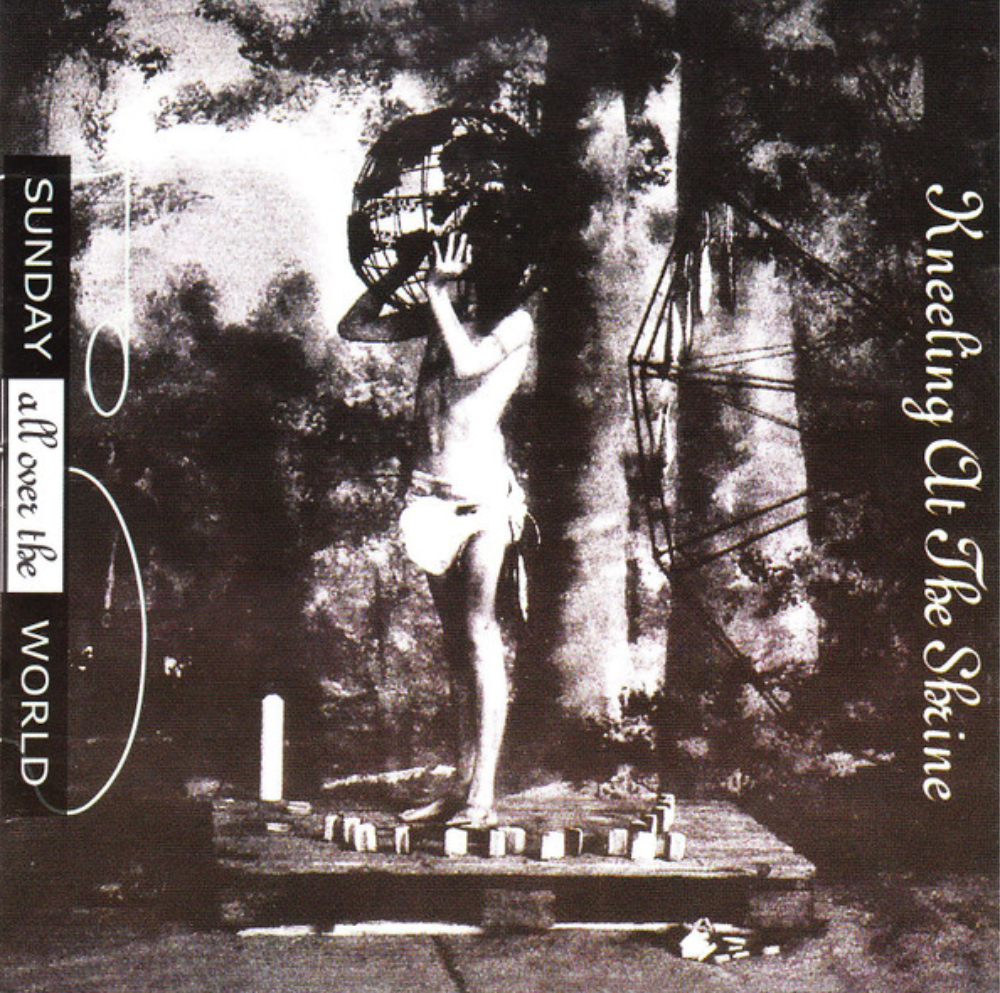
Kneeling At The Shrine is Sunday All Over The World’s debut album.
Those who follow the music scene more casually may recognize Robert Fripp and Toyah Wilcox as the slightly zany senior duo from the YouTube series Sunday Lunch, where they cover rock classics with a laid-back and playful approach.
People who are a little more familiar with his career know, however, that Robert Fripp (b. 1946) is one of the founding members of the legendary King Crimson and a guitar virtuoso who has played alongside such distinctive artists as David Bowie, Peter Gabriel, Brian Eno, and David Sylvian.
Toyah Wilcox (b. 1958), on the other hand, began her musical career in the late 1970s as the frontwoman of the band Toyah, named after herself. Toyah played energetic music that fell somewhere between post-punk and art pop. The band Toyah broke up in 1983, after which Toyah Wilcox launched a solo career. Somewhat confusingly, she uses only her first name, which easily causes confusion with her former band. Since the early 1980s, Toyah Wilcox has also worked extensively as an actress. Mainly on British TV and in theaters.
Fripp and Toyah got married in 1986 on Fripp’s 40th birthday. In 1988, the couple—who had mostly worked separately until then—formed a band called Fripp Fripp and went on a short tour. Shortly thereafter, the name was changed to Sunday All Over The World. The rhythm section of the band consisted of Trey Gunn, who played the Chapman Stick, and drummer Paul Beavis.
Gunn had found his way into Fripp’s circle while studying for a time at the maestro’s unique guitar school, Guitar Craft. For a long time, Gunn became something of Fripp’s right-hand man, and they played together on several different projects and eventually in the reunited King Crimson as well.
Beavis, for his part, had played with Fripp on the album Bewitched (1984), which was recorded with former The Police guitarist Andy Summers. Before the debut of Sunday All Over The World, Gunn and Beavis also appeared on Toyah’s solo album Ophelia’s Shadow, which had been released just two months earlier. Fripp also plays guitar uncredited on a few tracks on that album. Ophelia’s Shadow and Kneeling At The Shrine are, in fact, somewhat stylistically similar. The former leans more toward pop, while the latter sounds more like prog.
Kneeling At The Shrine consists of 11 tracks, mostly in the pop-song format (3–5 min.), credited democratically to the entire quartet. The exception to both of these points is the nearly eight-minute “Freedom,” which closes the album and is credited solely to Fripp and Toyah. This rather minimalist, highly repetitive, and downright hypnotic track represents the album’s most experimental offering. The musical style could be described as art rock with a punk edge, spiced with progressive rock techniques.
Lue myös: Review: Robert Fripp – Exposure (1979)
Kneeling At The Shrine’s opening title track, “Sunday All Over the World,” captures the album’s overall style quite well. The song’s opening, cyclically repeating electric guitar riff immediately brings to mind King Crimson’s 1980s trilogy. Toyah’s theatrically exuberant vocals, however, soon take the mood in a completely different direction. When singing in a lower, more serious tone, Toyah sounds almost like Dagmar Krause, but when expressing herself in a higher, more exuberant voice, the queen of art pop, Kate Bush, comes to mind. This, in fact, raises a question while listening to the album: what would it have sounded like if Bush had sung in 80s King Crimson? Probably something like this.
Beavis is no Bill Bruford, but his boisterously energetic playing—especially on the cymbals of his drum kit—ensures that the title track doesn’t just boil down to maintaining a steady rhythm. Gunn’s vividly pulsating bass patterns, played on the Stick, have a hint of Tony Levin, but his own style is clearly already developing. Gunn is also not as melodic a player as Levin; instead, his style has a Fripp-like edginess. Fripp’s delightful mechanical electric guitar riffing is one of the album’s foundational elements, but every now and then, explosive electric guitar solos also burst forth from Fripp’s hands. This is also the case on the title track. It’s actually quite a treat to hear Fripp in a proper rock mood after so long, without other guitarists, leaving plenty of room for the maestro’s playing.
In addition to the title track, other standout tracks on this consistently strong album include “Kneeling At The Shrine,” “Strange Girls,” “If I Were A Man,” and the previously mentioned “Freedom.”
“Kneeling At The Shrine” is carried by an absolutely fantastic, bouncy bassline, over which Fripp’s electric guitar soars gently and elegantly. Toyah’s vocal performance is versatile, and her voice occasionally soars to downright stratospheric heights in an exhilarating manner.
The bold and aggressive “Strange Girls” opens with an exciting, bouncy tremolo-style electric guitar riff that makes Fripp’s guitar sound like a wild, psychedelic banjo. Later on, we also hear a truly rousing short solo with the same sound. This evokes associations with the album Islands and the song “Sailor’s Tale” from the early ’70s, even though “Strange Girls” is, of course, completely different music otherwise. Gunn’s snappy bass sound on the track brings to mind Mick Karn. Toyah’s lyrics have a sharp feminist edge, and overall, the general theme of the album’s lyrics seems to be the desire to live one’s own life free from authority and norms.
Read also:
- Levyarvostelu: Peter Gabriel – Up (2002)
- Review: John Greaves & Peter Blegvad: Kew. Rhone. (1977)
- Review: Flea – Honora (2026)
- Review: Pink Floyd – Animals (1977)
- Levyarvio: Flea – Honora (2026)
- Review: Yes – Magnification (2001)
- Review: Jethro Tull – Songs From The Wood (1977)
- Review: A.W. Yrjänä – Eidolon (2026)
- Review: Rush – Roll The Bones (1991)
During their live shows, Sunday All Over The World also played plenty of songs that didn’t make it onto Kneeling At The Shrine. Trey Gunn has said that the band had enough material for a second album, and apparently some of the songs were even recorded. However, the success of Kneeling At The Shrine was modest, and the band disbanded shortly after the album’s release.
After Sunday All Over The World, Toyah continued her solo career, while Beavis returned to work as a session drummer. Fripp and Gunn, meanwhile, played together in an experimental guitar quintet, the Robert Fripp String Quintet (which later gave rise to the California Guitar Trio), and toured with David Sylvian, which in turn eventually led to the Sylvian & Fripp project and the excellent studio album The First Day (1993). In 1994, Gunn was part of the lineup when Fripp relaunched King Crimson after a ten-year hiatus. Kneeling At The Shrine can thus be considered, alongside The First Day, an important stylistic bridge from King Crimson’s 1980s trilogy to the band’s renewed form in the 1990s.
Kneeling At The Shrine has unfortunately received very little attention. That’s a shame, because I’m sure most Crimson fans would really enjoy this album. On the other hand, even Kate Bush fans who aren’t averse to rock would probably enjoy it as well.
Best tracks: “Sunday All Over The World”, “Kneeling At The Shrine”, “Strange Girls”, ”If I Were A Man, “Freedom.”
Author: JANNE YLIRUUSI
Read also: Review: King Crimson – Discipline (1981)
Tracks
- ”Sunday All Over the World” 4:06
- ”Blood Bruise Tattoo” 2:54
- ”Kneeling at the Shrine” 5:00
- ”Don’t Take It Away” 2:30
- ”Transient Joy” 4:18
- ”Open Air” 3:36
- ”Strange Girls” 3:12
- ”If I Were a Man” 3:11
- ”Answered with a Smile” 3:08
- ”Storm Angel” 3:29
- ”Freedom” 7:57
Toyah Willcox: vocals Robert Fripp: guitars Trey Gunn: Chapman Stick, backing vocals Paul Beavis: drums, percussion
 Pienemmät Purot
Jätä kommentti