
Olias Of Sunhillow is the first solo album by Yes vocalist Jon Anderson.
Formed in 1968, Yes had achieved a great deal by 1976. Yes had played a significant role in taking progressive rock to a new artistic level and had released seven studio albums, the most recent of which had sold millions despite their strangeness and complexity. By the mid-70s, the band had also become one of the most popular live acts in the rock world. It’s no wonder that after eight years of nearly non-stop recording and touring, the band members were craving a little break from each other. In the end, however, the Yes guys didn’t get to take a vacation, as their record label, Atlantic, offered Yes a unique opportunity: each band member would get to make their own solo album.
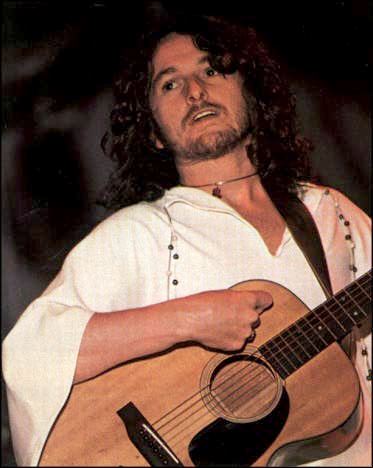
The members of Yes thus set about working on their albums, each in their own way and in their own style. Jon Anderson took the project extremely seriously. For him, this would be an opportunity to prove that he was a true visionary musician, not just a vocalist riding the crest of a wave created by Yes’s virtuoso instrumentalists.
Olias Of Sunhillow was, by any measure, an ambitious project for Anderson’s first solo album. First of all, Anderson developed an entire mythology on which he based his fantastical story, which embraced a vast universe. And more significantly, he wanted to make a true solo album—that is, to play all the instruments on the record by himself without any outside help.
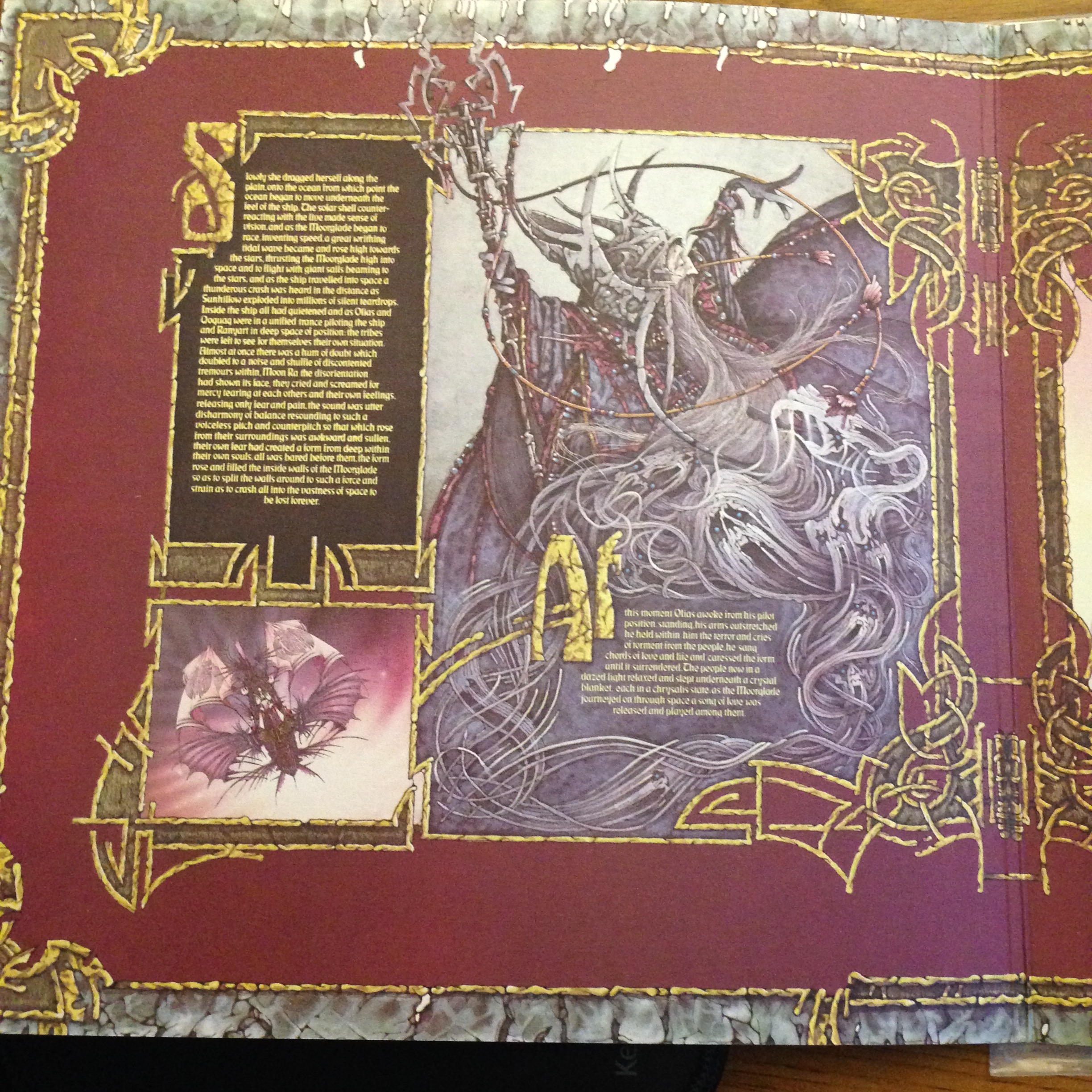
Anderson got the idea for the basic concept of Olias Of Sunhillow from the cover art of Yes’s fourth studio album, Fragile (1971). On the cover, painted by Roger Dean, a ship hovers above a miniature planet, and on the inside cover, that planet has shattered into pieces. Based on this, Anderson developed a hazy story in which a magician named Olias builds a wooden spaceship called the Moorglade Mover. Olias unites four warring tribes through the power of song and ultimately leads them away from the planet, which meets its doom and explodes into “a million teardrops.” The story is magnificently illustrated on the original LP cover with numerous paintings by David Fairbrother-Roe (Roger Dean did not have time for the project). In most CD releases, this side of the album is severely diminished, not only due to the smaller size of the artwork, but also because not all of the paintings are usually included in the booklet.
Jon Anderson shut himself away for eight months in his home studio, built in his garage, and painstakingly pieced the album together, nearly driving himself mad during the protracted process. The album’s release was delayed by half a year from the original schedule as Anderson struggled with it. In Yes, Jon Anderson didn’t have much of a role as an instrumentalist. He might occasionally strum a bit on an acoustic guitar or bang on a tambourine. But even though Anderson isn’t skilled at playing any single instrument, he managed—by using overdubs and, in the peace of the studio, re-recording difficult passages over and over as needed—to create, all on his own, a truly rich and original, ethereal concept album.
However, not everyone believes that Jon Anderson made the album on his own.
The Greek Connection
The Greek synthesizer wizard Vangelis is often mentioned in connection with Olias Of Sunhillow. And he certainly deserves the mention, but some of the conspiracy theorists lurking in the wonderland of the internet still imagine, decades later, that Jon Anderson didn’t actually play the music on the album by himself, but that Vangelis played a significant role in assisting him and that this was deliberately kept secret.
Anderson and Vangelis had actually crossed paths a few years earlier, when Anderson asked Vangelis—whom he admired—to join Yes in 1974. Vangelis did come by to test the waters during the pre-production of the Relayer album, but in the end, no deal was struck. Anderson and Vangelis became friends, however, and Anderson sang on Vangelis’s grandiose 1975 album Heaven And Hell.
Anderson readily admits that Vangelis’s music was a major influence on Olias Of Sunhillow, and some of the album’s music does indeed bear a slight resemblance to the layered orchestral sound of Heaven And Hell; however, Vangelis did not participate in any way in the recording of Olias Of Sunhillow (according to some sources, Vangelis did lend some of his synthesizers for the making of the album). Even Vangelis’s record label, however, imagined that their Greek star had a hand in the matter:
After the album was finished, RCA Records informed Vangelis of their dissatisfaction that he had played on Olias Of Sunhillow without informing them. Vangelis denied any involvement on the album despite RCA having thought the keyboards on the album were performed in his style.
Vangelis was very clear on this point:
”I myself was very surprised it had my name on the thank you-list. Maybe I have influenced Jon, I don’t know. And it’s clear that it’s closer to this than you get with Yes. But maybe it’s a coincidence. In any case, it’s a formidable feat there is such a record when it features like Jon a debutante on keyboards. I believe the record represents more the way he is than what he does with Yes, no offense intended. Anderson is not an instrumentalist in the old sense of the term and yet he has made, with lots of effort, a marvellous record.”
It is very strange that, decades later, some people still imagine that there is some kind of conspiracy or gentlemen’s agreement to hide Vangelis’s involvement in the making of the album, even though Anderson, Vangelis, and recording engineer Mike Dunne (who was the only one present at the sessions besides Anderson) have denied this time and again. Especially since relations between Anderson and Vangelis soured in the late ’90s due to Anderson’s foolishness (he released an alternative version of the Jon & Vangelis album, Page Of Life, without Vangelis’s approval). But in the end, this confusion must surely be counted as a tribute to Anderson’s magnum opus: he managed to create something so magnificent that people don’t even believe he could have done it alone!
Yes’s music is often strange and complex, and their songs are long, pushing the boundaries of popular music. However, Yes’s music can almost without exception be classified as rock music. The same cannot necessarily be said of Olias Of Sunhillow.
Olias Of Sunhillow lacks the bass guitar/drums rhythm section typical of rock music, and its songs don’t really follow standard pop formulas. The instrumentation is largely built around various synthesizers, a harp, percussion, and an acoustic guitar. However, the main focus is on Anderson’s vocals, which are used not only as a solo element but also as a strong part of the instrumentation. Anderson layers her voice in versatile ways throughout the album, creating choir-like effects in places.
”Layering” is, in my opinion, the word that best describes Anderson’s approach to making music on Olias Of Sunhillow. Since Anderson isn’t particularly skilled at playing any instrument, the individual performances on the album are inevitably quite simple (so simple that there’s really no need for a Vangelis!). Anderson, however, turns this to his advantage and patiently builds up these simple modules, layering and interweaving them so that the whole forms a rather complex and fascinating mosaic.
Olias Of Sunhillow sounds a bit like ethnic music, but it doesn’t really lend itself to being associated with any specific geographical region. And since the album’s concept deals with a completely foreign world with its own cultures, this is, of course, more than fitting. When you immerse yourself in the album’s music, it’s easy to imagine you’re listening to music from another world.
Olias Of Sunhillow can also easily be classified as a form of proto-new age music. Its ethereal and, at times, mantra-like music possesses a kind of elusive, soothing “spirituality” that cannot be tied to any specific religion or philosophy. Musically, however, Olias Of Sunhillow is fortunately too radical, too active, and too violent (at times) to be classified as a true New Age album. I wouldn’t recommend meditating with Olias Of Sunhillow playing in the background. Still, Olias Of Sunhillow has likely been a significant source of inspiration for the pioneers of that genre.
The three-minute instrumental track “Ocean Song,” which opens the album with a synthesizer rumble and harp plucking, serves as a splendid intro until the music becomes more rhythmic with “Meeting (Garden of Geda)”/“ Sound Out the Galleon,” with Anderson chanting the word “Meeting” (one example of the album’s mantra-like quality). Around the two-minute mark, Anderson begins to babble vocals in his usual style, and boy, are there plenty of words! Anderson’s idiosyncratic lyrics are perhaps at their strangest on this album, yet they still manage to tell the album’s story in a somewhat coherent way. This time, Anderson also throws in a few words of his own invention to fit the fantasy theme. Perhaps inspired by J.R.R. Tolkien, but he didn’t go so far as to invent an entirely new language for the story, like the French band Magma did.
The album really comes into its own on the somewhat awkwardly titled track ”Qoquaq Ën Transic”/” Naon”/”Transic Tö,” where wildly pounding, almost tribal-sounding percussion and Jon Anderson’s vocals—recorded in multiple overlapping layers—create a massive roar that is truly thrilling to hear.
The most catchy track on the album is “Flight Of The Moorglade,” which features a delightful and upbeat vocal melody; however, the lyrics are so odd that you can’t quite bring yourself to hum along, even if you’d like to. The lively “Flight Of The Moorglade” is the track on Olias Of Sunhillow that comes closest to standard pop music, though its percussively jangling crescendo ultimately makes it something entirely different. ”Flight Of The Moorglade” turned out to be the only single released from the album.
”Solid Space” features the album’s most space-rock-esque (as the title itself suggests!) synthesizer wails, which sound so impressive that even Tim Blake, the space-rock pioneer known from Gong, would probably turn green with envy.
The album is at its most progressive in the 12-minute, three-song suite “Moon Ra”/“Chords”/“Song of Search.” In “Moon Ra,” Anderson’s vocals chant a repetitive mantra over a pulsating percussion backdrop. The music begins to swell gradually, and Anderson layers his vocals magnificently so that the song feels like it’s progressing simultaneously on multiple separate levels, led by competing versions of Anderson. The drum and synthesizer hits hold the whole thing together on their own level. In the end, it all comes together into quite a racket, which is cut off by the majestic and soothing synths of “Chord.” A truly beautiful moment. The song’s final section, “Song Of Search,” begins with a pastoral passage, briefly transforms into a cosmic hymn, and then the mood shifts back to something a bit more down-to-earth as the music shrinks for a moment to a single instrument, with Anderson strumming a nice little interlude on the acoustic guitar. Finally, the synthesizers return, and with them comes the most Vangelis-esque moment on the album. The beautiful dialogue between several synthesizers, sounding understated and chillingly cool, would feel right at home on many of Vangelis’s albums.
The album concludes with “To The Runner,” a powerful cosmic folk anthem, and although it is, along with “Flight Of The Moorgladen,” among the most conventional tracks on the album, it somehow manages to encapsulate the entire album and bring it to a natural close. Not in a grandiose way, but with dignity and grace.
Read also:
- Levyarvio: Absoluuttinen Nollapiste – Nimi muutettu (2002)
- Review: Philip Glass – Songs From Liquid Days (1986)
- Levyarvostelu: Peter Gabriel – Up (2002)
- Review: John Greaves & Peter Blegvad: Kew. Rhone. (1977)
- Review: Flea – Honora (2026)
- Review: Pink Floyd – Animals (1977)
- Levyarvio: Flea – Honora (2026)
- Review: Yes – Magnification (2001)
- Review: Jethro Tull – Songs From The Wood (1977)
Olias Of Sunhillow was a significant psychological milestone for Jon Anderson. He had now created a major album entirely on his own, without the help of the Yes virtuosos. Anderson has said that after Olias Of Sunhillow, he felt confident enough for the first time to proudly list “musician” as his profession on official documents.
Hailing albums as ”unique” is a cliché that nearly every reviewer (myself included, without a doubt) falls back on far too often, but if there’s one album that truly deserves that description, it’s Olias Of Sunhillow. I don’t know of another album like it. With Olias Of Sunhillow, Jon Anderson managed to achieve something remarkable and magical that he himself has never been able to replicate in his subsequent solo career, which has been inconsistent in both quality and style.
Best tracks: ”QoQuaQ Ën Transic / Naon / Transic Tö”, ”Flight of the Moorglade”, ”Moon Ra”/”Chords”/”Song of Search”, ”To The Runner”
Author: JANNE YLIRUUSI
Tracks:
Side A
1. ”Ocean Song” 3:12
2. ”Meeting (Garden of Geda)”/”Sound Out the Galleon” 3:28
3. ”Dance of Ranyart”/”Olias (To Build the Moorglade)” 4:14
4. ”Qoquaq Ën Transic”/”Naon”/”Transic Tö” 7:03
5. ”Flight of the Moorglade”
Side B
1. ”Solid Space” 5:16
2. ”Moon Ra”/”Chords”/”Song of Search” 12:48
3. ”To the Runner” 4:26
Jon Anderson: vocals, guitars, harp, sitar, keyboards, percussion, bass guitar, flute, mandolins, saz
Producer: Jon Anderson
Label: Atlantic
You can find other album reviews here.


Jätä kommentti