
Univers Zero is the debut album by the Belgian band of the same name. The album is also known as 1313.
Drummer/composer Daniel Denis began his career with Soft Machine — and in Arkham, a band that played zeuhl-influenced progressive rock. Denis and Arkham’s keyboardist Jean-Luc Manderlier were invited to join the French band Magma, but Denis’s time with the band lasted only a few shows, as he felt underutilized—his role was largely limited to filling in for drummer Christian Vander whenever Vander, the band’s leader, wanted to sing.
Denis returned to Belgium and joined the jazz-rock band Necronomicon. Little by little band’s musical direction changed as jazz influences were phased out. The band’s name was changed to Univers Zero, and instead of American influences, the revitalized band began drawing on European traditions, particularly the art music of the early 20th century. The band’s most important influences were composers such as Igor Stravinsky, Bela Bartok, and Krzysztof Penderecki, who created innovative and challenging music.
The French band Art Zoyd also became an important source of inspiration for Univers Zero when the groups realized that both bands were making surprisingly similar music. And they were only 30 kilometers apart, even though the French-Belgian border lay between them. The bands went on to collaborate extensively, and Denis, for example, played percussion and drums on several of Art Zoyd’s later albums.
A key factor in the emergence of Univers Zero’s new sound and style was the addition of oboist Michel Berckmans to the band. Upon joining the group, Berckmans adopted the bassoon as his primary instrument, which fit perfectly with the band’s vision of combining chamber music and rock. Alongside Lindsay Cooper of Henry Cow, Berckmans became another major pioneer of avant-prog as a bassoonist and an important inspiration to many other musicians who later incorporated this distinctive-sounding, low-pitched woodwind instrument into rock music. In addition to Univers Zero, Berckmans also played a key role in another Belgian experimental rock band, Aksak Maboul.
Read also:
- Levyarvio: Absoluuttinen Nollapiste – Nimi muutettu (2002)
- Review: Philip Glass – Songs From Liquid Days (1986)
- Levyarvostelu: Peter Gabriel – Up (2002)
- Review: John Greaves & Peter Blegvad: Kew. Rhone. (1977)
- Review: Flea – Honora (2026)
- Review: Pink Floyd – Animals (1977)
- Levyarvio: Flea – Honora (2026)
- Review: Yes – Magnification (2001)
- Review: Jethro Tull – Songs From The Wood (1977)
Univers Zero’s debut album is almost entirely acoustic. Berckmans’s bassoon often takes center stage, but the violin and viola (Patrick Hanappier) and the organ harmonica (Emmanuel Nicaise) also play significant roles. Even some of Christian Genet’s bass parts are played on an acoustic double bass.
However, the chamber music-like quality is also combined with a rock element, and this aspect of the sound is brought in not only by Daniel Denis’s drums, of course, but also by Roger Trigaux’s electric guitar playing. Denis’s drums, admittedly, often sound quite orchestral but can also pound away with satisfying intensity when needed. Trigaux’s role on electric guitar remains quite limited. This likely frustrated Trigaux, as he left the band after the next album and founded his own notable group, Present, in 1979, which offers a heavier and more electric take on Univers Zero’s core concept.
In addition to the “chamber music meets rock” concept, Univers Zero’s style is characterized by two other key elements. Namely, the band’s music is a) very complex and b) extremely dark.
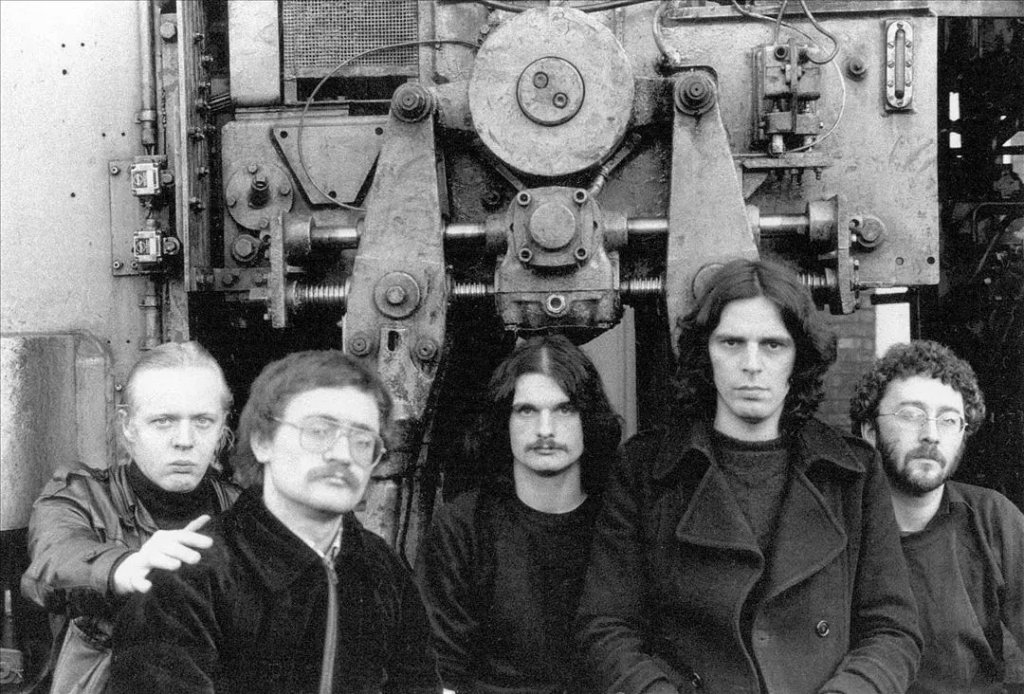
From the very beginning, the band cultivated a dark image not only through their music but also by always dressing in black and favoring dark themes in their song titles. Even Univers Zero’s tour bus was pitch black! When asked in interviews about their sources of inspiration, they would sometimes list the names of serial killers instead of bands. On the surface, everything seemed very dark, but apparently the band was mostly just joking around, even though their music itself is very serious.
The complexity of the music, in turn, is well illustrated by the 15-minute composition “Ronde” by Denis, which opens the album. Beginning with a stubbornly repetitive violin ostinato, the piece initially sounds almost cheerful as the bassoon softly toots along, but the intensity quickly builds and the mood grows increasingly nightmarish. Denis’s march-like drumming propels the piece forward with its angular, irregular time signatures. The song’s rhythmic quality brings to mind Stravinsky, and its dissonant harmonic world evokes Bartók at his most severe. The ever-shifting music of “Ronde” is not only challenging to perform but also very, very far removed from the mainstream of rock—or even progressive rock.
Another highlight of the album is Trigaux’s nearly 8-minute composition “Docteur Petiot” (Marcel Petiot was a French doctor and serial killer who murdered 60 people in the early 20th century). “Docteur Petiot” is the album’s most energetic track. It is also the track on the album that most closely resembles “traditional” progressive rock and brings to mind the music of King Crimson’s Larks’ Tongues In Aspic era. Perhaps somewhat surprisingly, Trigaux does not take a major role as a guitarist on this track either; instead, the lead role is played by a piercingly resonant violin. However, as is the case throughout the album, the real star of “Docteur Petiot” is the band’s tight ensemble playing, which sounds very precisely composed and carefully thought out.
Trigaux’s second composition, “Malaise”—which is a more playful piece than “Doctor Petiot”—also brings King Crimson to mind, but on the other hand, its acoustic sound, and especially the prominent role of the bassoon, clearly distinguishes it sonically from its more famous counterpart. Midway through “Malaise,” there’s a magnificent rhythmic section where Denis plays his drum set like an orchestral percussionist playing his timpani. The entire album is, in fact, full of truly original and innovative drumming that, however, always supports the compositions and is never a self-serving display of virtuosity. Even at this stage of his career, Denis was already one of the genre’s master drummers.
Univers Zero’s debut was originally released as a self-published vinyl limited to just 500 copies, so it was truly the fringes of fringe music. However, the record label Atem soon released a slightly larger pressing of the album, and in 1978, Univers Zero joined the Rock In Opposition movement founded by Henry Cow, which brought the band attention in England and throughout Europe. Little by little, Univers Zero grew to become one of the most significant names in avant-prog, alongside Henry Cow, Magma, and Art Zoyd. Especially in the 1980s, with Henry Cow and Magma out of the picture, it was Univers Zero and Trigaux’s Present that kept the flame of avant-prog—drawn from extremely complex modern art music—alive.
Univers Zero went on to achieve even more spectacular feats on their subsequent albums, but even this debut is an exceptionally strong and distinctive album that has served as an important trailblazer for chamber rock and, in particular, the Belgian avant-prog scene.
(The 2008 reissue of the album, released by Cuneiform, includes Denis’s 28-minute epic composition “La Faulx,” which features bassist Guy Segers’ demonic vocals and a bit more Magma influence than what we’re usually used to hearing from Univers Zero. It’s a truly interesting version of the song, which was eventually recorded for the band’s next studio album, Hérésie.)
Best tracks: ”Ronde”, ”Docteur Petiot”, ”Malaise”
Author: JANNE YLIRUUSI
Tracks
- ”Ronde” (Daniel Denis) 15:13
- ”Carabosse” (Daniel Denis) 3:46
- ”Docteur Petiot” (Roger Trigaux) 7:45
- ”Malaise” (Roger Trigaux) 7:58
- ”Complainte” (Daniel Denis) 3:27
Musicians
Michel Berckmans: bassoon Daniel Denis: drums, percussion Patrick Hanappier: violin, viola, Roger Trigaux: guitar Emmanuel Nicaise: harmonium, spinet Christian Genet: bass guitar, double bass Marcel Dufrane: violin
Producer: Univers Zero
Label: Atem



Jätä kommentti