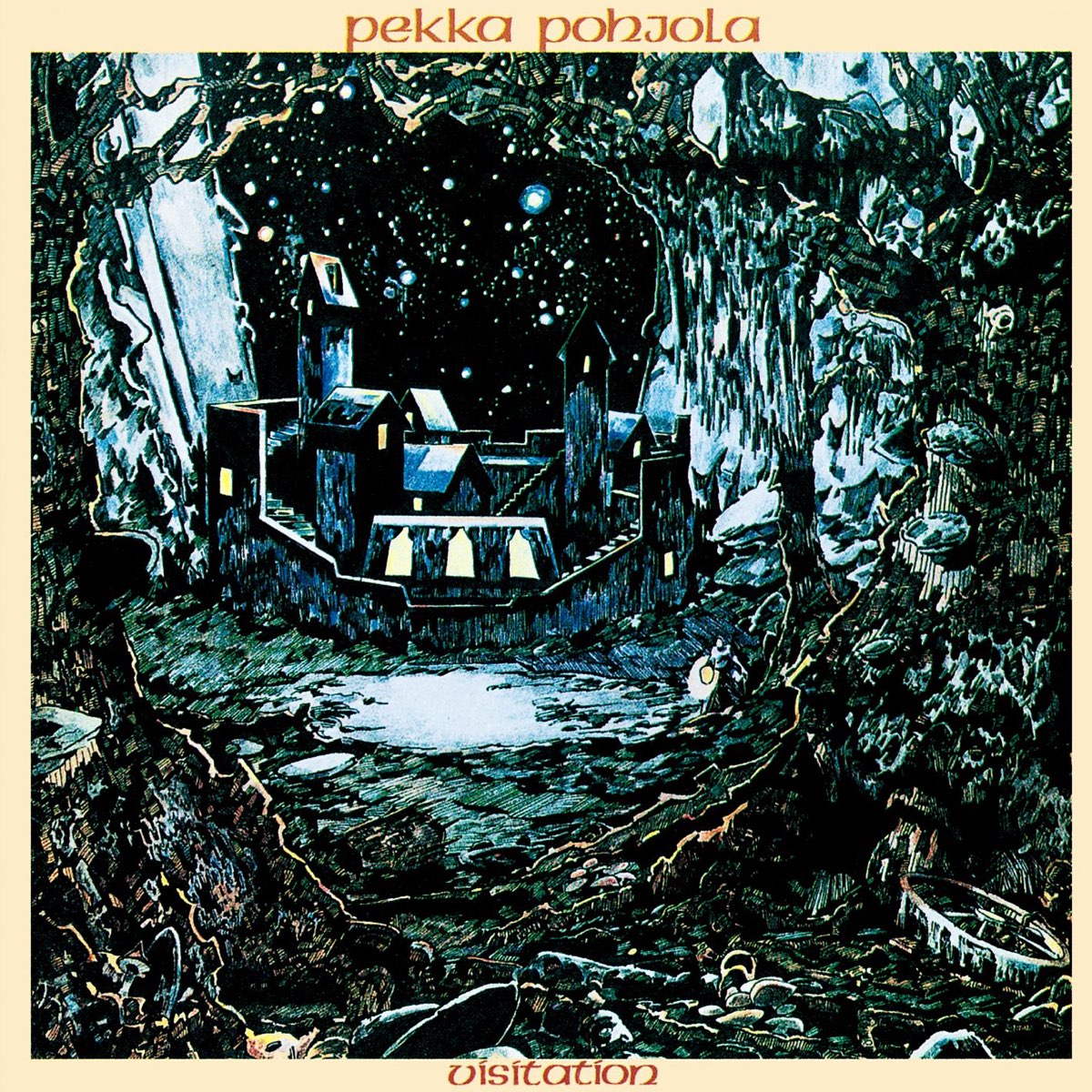
Visitation is Pekka Pohjola’s fourth solo album.
For former Wigwam bassist Pekka Pohjola, the second half of the 70s was a fruitful and busy time.
In 1976 he joined Made In Sweden, a Swedish funky prog band, with drummer Vesa Aaltonen, who he knew from the Tasavallan Presidentti. With Pohjola and Aaltonen, the band made a rather pleasant album Where Do We Begin. Around this time, Made In Sweden was also offered a job as a backing band for the pop band Abba, which was on the rise, but in Pohjola’s words, ”prog pride” prevented them from taking the opportunity. Pohjola left Made In Sweden in the summer of 1977.
However, Pohjola also started working with the musicians of Made In Sweden on his next solo album until Mike Oldfield, who had risen to world fame with Tubular Bells (1973), invited him to England to record in his well-equipped home studio. Produced by Oldfield, Keesojen lehto (1977) presented a more stripped-down arrangement of Pohjola’s music, with electric guitar taking the place of the wind instruments that had played key roles on previous albums. Keesojen lehto is a fine album, although at times it shows a little too much of the hand of guitarist/producer Oldfield.
After the Keesojen lehto, Pohjola joined a ”supergroup” of top Finnish musicians, somewhat flamboyantly named The Group, which included Seppo Tyni (who joined after the original guitarist Nono Söderberg dropped out), drummer Vesa Aaltonen and keyboardist Olli Ahvenlahti, who was voted Finnish Jazz Musician of the Year in 1975.
Unfortunately, the anonymous debut album of this hard-working group remained a rather cautious and at best mediocre jazz-rock album, where long solos took the lead instead of interesting compositions or energetic playing in unison. At best, The Group sounded more like poor man’s Chick Corea or late seenties Weather Report. Pohjola himself has not spoken of the album in a very enthusiastic tone afterwards. A follow-up to The Group was considered, but in the end a second studio album remained a pipe dream, because with the rise of punk rock, the band’s technical music had suddenly become very unpopular.
Eventually, there were no financial means for The Group to continue and the band transformed into the Pekka Pohjola Group after Ahvenlahti and Tyni left the band. Guitarists Juha Björninen and Pekka Tyni (Seppo’s brother) were hired to replace Ahvenlahti and Tyni. Seppo Tyni, however, later returned to the band. The running of the Pekka Pohjola Group was made easier by the fact that Pohjola had received a three-year artist’s grant from the beginning of 1979.
Before the release of his next solo album, Visitation, Pohjola managed to join Oldfield’s Exposed tour in the spring of 1979, where he played as part of a large ”rock orchestra”. Oldfield executed his first tour with great panache, assembling a band of some fifty musicians that was an inspired mix of orchestral musicians, jazz players, folk musicians and rockers. The Exposed tour was an artistic success but a financial disaster and Oldfield scaled down his band to 12 for the next tour. There would have been a place for Pohjola in this ’small’ band, but he was already looking forward to his own music. However, Oldfield’s tour left a lasting impression on Visitation, as tour accountant John Ayton came up with the names of the songs for the album!
Just before Oldfield’s tour in January-February 1979, Visitation, recorded at Finnscandia Studios, also had some drama as the record company Love Records went bankrupt in the middle of the project and the invoices for the album went unpaid. Eventually, the album was released on the more pop-oriented Finnlevy label.
Read also: Review: Wigwam – Being (1974)
Some of the compositions Pohjola originally planned for The Group’s next album ended up on Visitation. The Group’s Tyni and Aaltonen form Visitation’s core band and Ahvenlahti also plays keyboards on a few tracks. However, Visitation’s music is far from the bland jazz-rock of The Group. Pohjola’s arrangements on his own album are considerably more symphonic, and after The Group, which sounded rather American, Visitation sounds distinctly Finnish.
After his first two richly arranged solo albums, Pohjola had worked with Made In Sweden, The Group and also with his own Keesojen lehto album on more limited instrumentation, but Visitation takes a step in a completely different direction. Visitation is the most expansive in terms of instrumentation of Pohjola’s career to date. At times, it is downright orchestral.
On Pohjola’s first albums, his Frank Zappa-like rich songs were at times a bit recklessly bouncing here and there. Keesojen lehto was already a step in a more restrained direction in this respect, and Visitation continues along the same path. Visitation’s compositions feel really well crafted and more cohesive than ever. On the other hand, Visitation benefits from fuller and richer arrangements than Keesojen lehto. It could even be said that Visitation is the first time that the Pohjola style appears in a fully mature version. His stark, Sibelius-like style combined with jazz-rock is something truly original.
Where The Group’s debut was characterised by a laid-back, vacuousness, Visitation is consistently sharp and dynamic. Visitation’s music is not difficult to listen to, but in an exciting way it challenges the listener to really focus on themselves. At no point does Visitation stoop to the level of just an instrumental tapestry of sound. Pohjola does not waste a single moment in his compact compositions (3-7 min.), but each song is full of substance. Every chord has a meaning and every turn of phrase prepares the next one.
”Strange Awakenings” starts the album in style. Pohjola’s elegant piano playing and subdued cymbal rattling build an enigmatic atmosphere until the music really explodes when the horns kick in. Three of Finland’s best saxophonists – Eero Koivistoinen, Pekka Pöyry and Juhani Aaltonen – take turns in a song that balances interestingly somewhere between folk music and jazz. Pohjola solos on his bass guitar at the end of the song, but unlike moments on the man’s first albums, it doesn’t sound at all like a self-indulgent display of brilliance. The solo is cleverly integrated into the composition.
The mood changes in the second track of the album which features Seppo Tyn’s electric guitar. The fast-paced jazz-rock song ”Vapour Trails” seems to anticipate the style of Pohjola’s songs from the 80s and 90s. Fortunately, however, ”Vapour Trails” is much more rhythmically agile than many of Pohjola’s successors in this genre. Tyni plays an excellent electric guitar solo in a slightly Latin-rock style. Pöyry responds to Tyni’s solo with an even more impressive and intense saxophone solo.
The third track, ”Image Of A Passing Smile”, seems to draw equally from the wistfulness of old Finnish schlager music and the grandeur of Sibelian art music. The instrumentation is further expanded by the introduction of the Helsinki Philharmonic Orchestra’s woodwinds and cello. There are also four saxophonists (Teemu Salminen is added to the trio of ”Strange Awakenings”). The first half of the song, with its very beautiful melodies, is mostly acoustic, except for Pohjola’s bass guitar. Pohjola leads the whole orchestra from the back, as it were. Halfway through, we hear Tyni’s brief but poignant electric guitar solo, and the latter half of the song is more energetic, with a stylistic twist that is somewhat a return to the unpredictability of Pohjola’s first albums. Tom Bildo’s buzzing tuba adds a touch of humour.
The smiles don’t fade in the next song either, as ”Dancing in the Dark” is the most playful of the album and the most jazz-rock oriented of all the songs on the album. Tyni’s electric guitar is given plenty of space and Pohjola’s own bouncy bass lines are also delightful to listen to. Pohjola’s bass sound is also deliciously edgy towards the end. Markku Johansson’s trumpet solo adds to the range of soloists on the album.
The three-minute long ”The Sighting” starts off light-hearted and almost childlike, but quickly grows into a more dynamic band piece, again featuring the entire saxophone quartet of the album. There is also another new instrument. This time in the form of Asko Lindgren’s sultry oboe.
The album closes with its longest track, the seven-minute ”Try To Remember”. The composition begins with a psalm-like humility and gradually grows bigger and bigger. The song again features the Helsinki Philharmonic Orchestra. This time the orchestra includes not only the woodwinds but also the entire string section. The woodwinds play beautifully, especially in the first half of the song.
The first version of ”Try To Remember” had already been played under the name of ”Bassokansanlaulu” during The Group days. The simple, devout and often quite simple bass playing of the Pohjola is the backbone on which the other elements are built throughout the song. After a slow and beautiful three-minute section, the drums come in and Pohjola’s bass guitar leads the song to its majestic climax where the Helsinki Philharmonic Orchestra is joined by Johansson’s trumpet and Bilbo’s trombone. Pohjola’s playing is very melodic and towards the end, when he takes on a solo role, the piece could almost be called a small-scale bass guitar concerto.
One would have liked to have heard more orchestral music like ”Try To Remember” from Pohjola in the years to come, but he really only returned to these moods again with the last album of his career, Views (2001). Of course, Pohjola’s ’Symphony No. 1’, composed for symphony orchestra, was also released in 1990, but its forced formality is no match for the effortless fusion of orchestra and ’rock’ band of ’Try To Remember’.
Read also: Harri Kuusijärvi Koutus: Mirage (2020)
Visitation is just 32 minutes long and is a tight package that does not include an empty space. Visitation’s meticulously composed music could be described as symphonic jazz-rock, and its lush and majestic sound is quite distinctive. Pohjola’s compositions are pristine and this time the production values are on the same level. The lush and majestic Visitation is also a fine piece of recording engineering and is, in my opinion, one of the best recorded Finnish albums of the 70s I have heard.
Visitation is the brightest gem of Pekka Pohjola’s impressive solo output.
Best tracks: ”Vapour Trails”, ”Image Of A Passing Smile”, ”The Sighting”, ”Try To Remember”
Author: JANNE YLIRUUSI
Tracks
- Strange Awakening (5:11)
- Vapour Trails (4:44)
- Image of a Passing Smile (5:38)
- Dancing in the Dark (5:39)
- The Sighting (3:32)
- Try to Remember (7:10)
Musicians
Pekka Pohjola: grand piano, bass guitar Seppo Tyni: electric guitar (2-6) Olli Ahvenlahti: electric piano and bass (2), grand piano (6) Pekka Pöyry: saxophone (1-3,5), soprano saxophone (1,4) Juhani Aaltonen: saxophone (1,3,5) Eero Koivistoinen: saxophone (1,3,5) Teemu Salminen: saxophone (1,3,5) Tom Bildo: tuba (3), trombone (6) Markku Johansson: trumpet (4,6) Aale Lindgren: oboe (5) Vesa Aaltonen: drums, percussion (2-4) Esko Rosnell: percussion (2-4) Helsinki Philharmonic Orchestra: woodwinds & strings (3,6)


Jätä kommentti