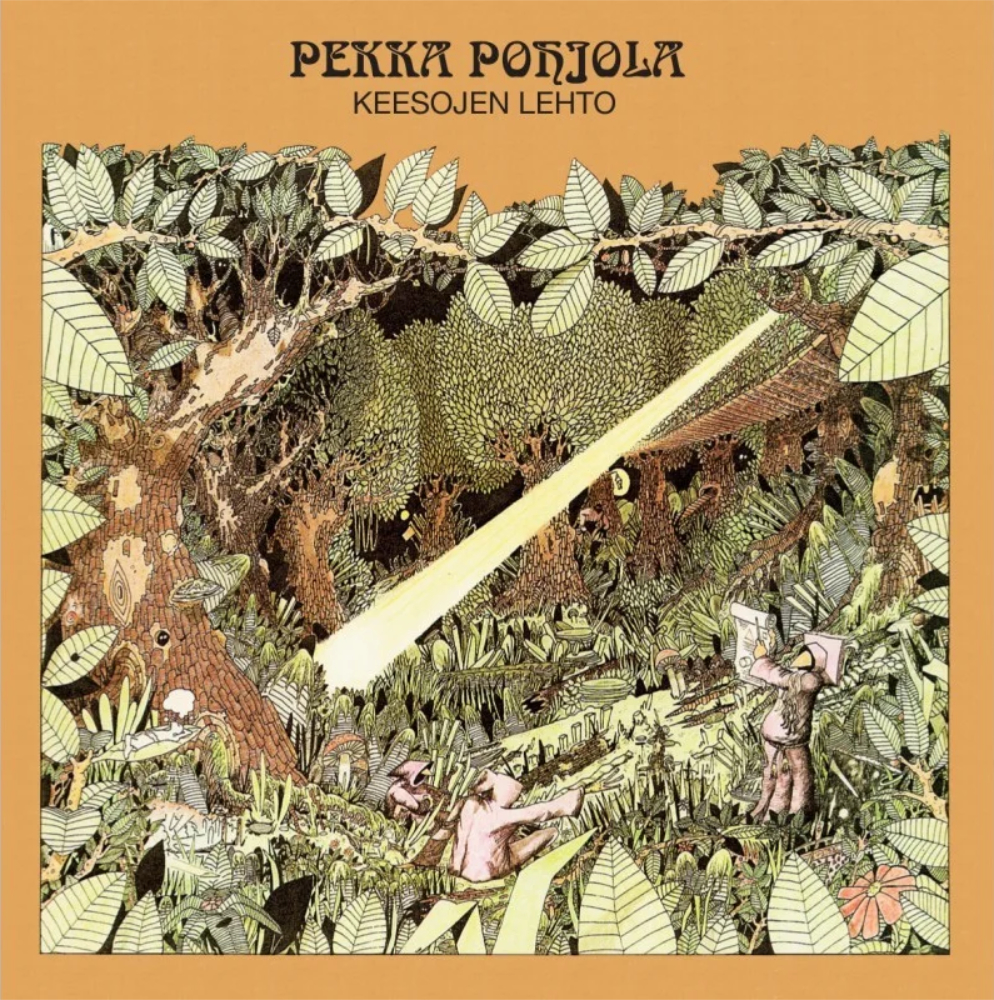
Keesojen lehto is Pekka Pohjola’s third studio album.
By the mid-1970s, it had become quite common for top Finnish rock bands to travel to Stockholm to record, as it was believed at the time that better studios were available there than in Finland. However, Finnish rock musicians had not really engaged in any significant collaboration with their foreign counterparts. Pioneering work in this area was done by Finland’s most respected rock bassist and former Wigwam musician Pekka Pohjola, who—along with drummer Vesa Aaltonen (of Tasavallan Presidentti, among others)—had played with Swedish musicians in the jazz-rock band Made In Sweden.
There were also plans to record Pohjola’s third solo album with the members of Made In Sweden. Recording had already begun in Sweden when it became clear that Tubular Bells star and multi-instrumentalist Mike Oldfield was interested in producing the album. This offer didn’t come out of the blue, as Pohjola had already visited Oldfield’s country estate studio earlier in 1976 to jam and drink whiskey. The two introverted musicians had, surprisingly, hit it off very well, and Oldfield, in particular, had come to regard Pohjola as a musical kindred spirit. Pohjola didn’t necessarily share that view entirely—after all, HE was the scion of Pohjola’s esteemed musical family and a musician trained at the Sibelius Academy, while Oldfield was just some guitarist who’d gotten lucky.
However, the offer to collaborate with the most celebrated and successful musician of recent years was simply too good for Pohjola to pass up. The sessions were put on hold in Sweden, and the few rhythm section recordings that had already been gathered were sent to Oldfield. Work on the album took place at Oldfield’s studio for just under two weeks—a short time compared to the production schedules for Oldfield’s own albums, which often took months upon months.
In terms of its arrangements, Keesojen lehto clearly differs from Pohjola’s first two solo albums. The rich Frank Zappa-esque horn arrangements found on those albums have been replaced with more typical prog instrumentation, and the lead role has shifted to the electric guitar, keyboards, and, of course, at times, Pohjola’s bass. The electric sound is occasionally varied by acoustic guitar, spinet, various percussion instruments, and mandolin.
It would be interesting to know whether this rather radical change in style was specifically due to Oldfield’s decisions as producer, or whether Pohjola had intended to experiment with a new approach to arrangements in any case. If it was Oldfield’s decision, it’s somewhat amusing, since none of his own albums up to that point had used such conventional rock instrumentation. But perhaps both gentlemen wanted to try moving a little closer to the mainstream. After all, Pohjola has often said that he was embarrassed by his first albums because they were so “strange and different” to him.

Whoever was ultimately responsible for the overall direction of Keesojen lehto, Oldfield—in his role as producer—at least brought on board a musician with whom he already had a close relationship: his sister, Sally Oldfield, as well as Gong’s virtuoso drummer, Pierre Moerlen. Oldfield himself also ended up playing most of the guitar parts on the album. Some of the material recorded during the sessions in Sweden was set aside for further work, but members of the Made In Sweden crew—Vesa Aalto, Wlodek Gulgowski, and Georg Wadenius—were not invited to Oldfield’s studio to continue the work.
Keesojen lehto kicks off with the energetic track “Oivallettu matkalyhty” (the album’s quirky song titles were penned by pop star Hector), which was largely put together during the Stockholm sessions. Apparently, not much else was added at Oldfield’s studios besides Moerlen’s percussion and perhaps a few parts played by Pohjola himself. The track is the album’s most boisterous offering and perhaps most reminiscent of the material from the first two albums, even though the arrangement is more stripped-down. There is, however, something a bit stiff and forced about “Oivalletussa matkalyhdyssä” compared to the looser vibe of the previous couple of albums.
Next, the atmosphere calms down as Pohjola plays a heartfelt intro on the spinet for the song “Kädet suoristavat veden.” This is a new version of Pohjola’s composition “Pride of the Biospher,” originally heard on Wigwam’s Being (1974). Whereas the original version was quite somber and even oppressive to listen to, the version on Keesojen lehto is a delicate, semi-acoustic interpretation. The piece features Pohjola’s tinkling spinet alongside Oldfield’s acoustic guitar. Toward the end, Sally Oldfield’s wordless vocals serve as a bridge to the song’s finale, where Oldfield’s piercing electric guitar and string synthesizers bring this beautiful piece to a brief climax.
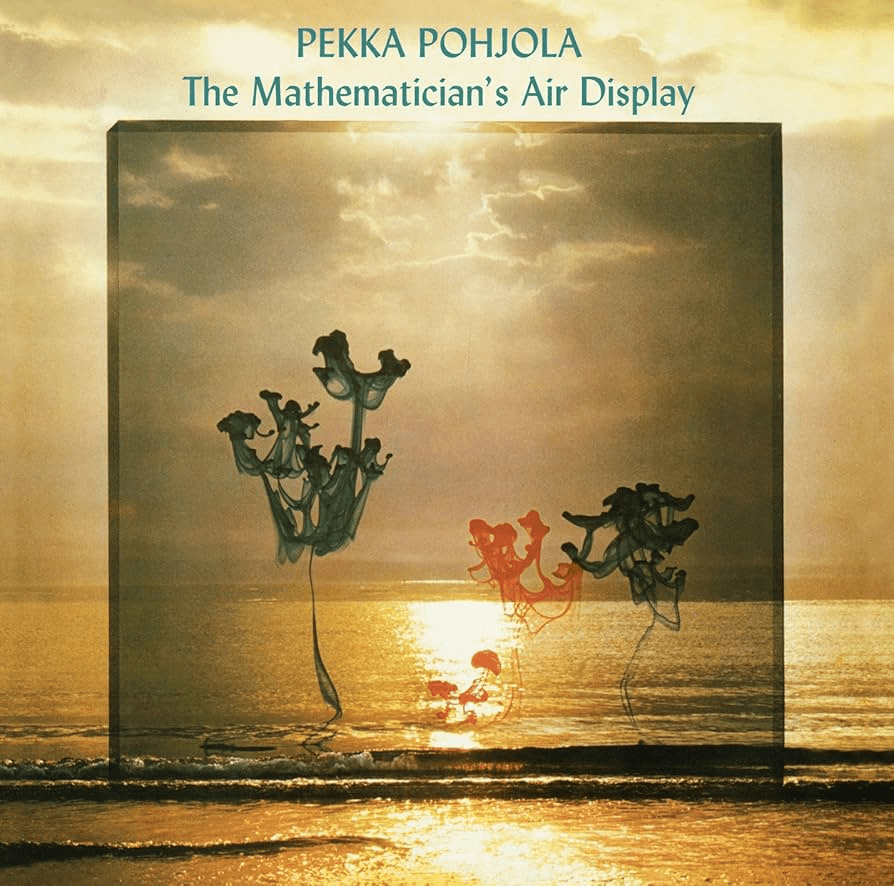
The album’s third track, “Matemaatikon lentonäytös”, is probably one of Pohjola’s most beloved songs and one of the few tracks from Keesojen lehto that could still be heard decades later at Pohjola’s concerts. Given that this is a prog rock song titled “Matematiikon lentonäytös”, (Mathematician’s Air Display) you’d expect some kind of complex, playful interplay of time signatures, but it’s actually a fairly steady-paced track that sounds more dignified than wild. Oldfield’s biting guitar work injects a bit of energy into the mix, but somehow the song never quite takes off at full throttle at any point. Moerlen’s drumming is quite solid, but the drum recording isn’t quite top-notch. Oldfield didn’t have much experience recording drum kits at this stage, so perhaps that’s on him. “Matemaatikon lentonäytös” is pleasant to listen to despite its flaws, but the composition might have had the potential for even more.
So far on this album, Pohjola has kept a relatively low profile as a bassist, and the occasionally disjointed virtuosity heard on the first two albums has been absent. However, the album’s fourth track, the 15-minute “Pääntaivuttelun seuraukset,” is driven specifically by Pohjola’s melodic bass line, which plays for a long time almost entirely on its own, accompanied only lightly by the keyboards. It isn’t until around the three-and-a-half-minute mark that Oldfield’s majestically resonant electric guitar cuts in sharply, bringing the first section of the two-part track—titled “Sulamaan jätetty kipu”—to a close.
The second and longer section, “Nykivä keskustelu tuntemattoman kanssa” (themes from this piece had already been used in Pohjola’s composition “43 Sec. Of Arc Per Century” on the Made In Sweden album), is more varied and includes backing tracks originally recorded at Marcus Music in Stockholm—Vesa Aaltonen is on drums. The section also features Wlodek Gulgowski of Made In Sweden on synthesizer and Georg Wadenius on electric guitar, which alternates with Oldfield’s guitar playing. Wadenius is a perfectly competent guitarist but can’t hold a candle to Oldfield in this fray. Oldfield takes the cake in this “guitar battle” with his majestic solo, in which he succinctly counters Wadenius’s rather lackluster strumming solo with his own classically sharp sound.
Oldfield’s guitar sound is so distinctive and recognizable that it brings a bit too much of that “Oldfield-ness” to the album and, in a way, steals the show from Pohjola’s compositions. I’m a big fan of Oldfield’s guitar playing myself, so personally I don’t see this as a drawback, but I understand that it’s probably partly for these reasons that Pohjola himself has never counted Keesojen lehtoa among his favorites from his own albums. Oldfield was an inexperienced producer, and he probably took on the role of the artist a bit too much on this album.
“Nykivä keskustelu tuntemattoman kanssa” is, in any case, a great song, and toward the end, Pohjola even gets a little carried away with a bass solo, briefly resorting to some light slap bass. There’s something thrillingly life-affirming and noble about the song’s finale. It’s truly majestic in a way, yet somehow “humble” at the same time. The versatile “Pääntaivuttelun seuraukset” is clearly the most successful music on Keesojen lehto.
The album concludes with “Varjojen varaslähtö,” a short, humorous, and upbeat folk tune. The song brings to mind Oldfield’s earlier short pieces (e.g., “Sailor’s Hornpipe,” “Portsmouth,” “In Dulci Jubilo”), which were often arrangements of traditional folk music. In “Varjojen varaslähtö,” Pohjola once again plays the spinet at a brisk pace, Oldfield strums the mandolin, and Sally Oldfield sings with theatrical flair. The track is punctuated—or rather, disrupted—by the occasional whistling of a flute. Midway through, Moerlen’s drums join in the fun until the track returns to the main theme, driven by the spinet and mandolin. A fun track and a nice lighthearted touch to round out the album.
Read also
- Levyarvostelu: Peter Gabriel – Up (2002)
- Review: John Greaves & Peter Blegvad: Kew. Rhone. (1977)
- Review: Flea – Honora (2026)
- Review: Pink Floyd – Animals (1977)
- Levyarvio: Flea – Honora (2026)
- Review: Yes – Magnification (2001)
- Review: Jethro Tull – Songs From The Wood (1977)
- Review: A.W. Yrjänä – Eidolon (2026)
- Review: Rush – Roll The Bones (1991)
Keesojen lehto was released at a rather bad time, with punk already raging full force in Britain and the music press having turned quite sharply against progressive rock. Even Oldfield was of no help here—quite the opposite, in fact, since after a few years of praise, he had become a veritable pariah in the British press. Keesojen lehto received a rather lukewarm reception in Britain, but it fared better in Finland, where, for example, Musa magazine named it Album of the Year. Thanks to the Oldfield connection, however, Keesojen lehto is undoubtedly Pohjola’s best-selling album, as it received relatively wide distribution throughout Europe. The album was marketed in a rather varied manner: in the UK and Japan, it was titled Mathematician’s Air Display; in Sweden, Skuggornas tjuvstart; and in some regions, it was even credited not only to Pekka Pohjola but also featured Mike & Sally Oldfield alongside his name on the cover.
As I mentioned earlier, Pohjola himself hasn’t been particularly pleased with Keesojen lehto, but Oldfield has spoken more positively about the album, and he was at least impressed by Pohjola’s musical skills, as Pohjola was invited to join Oldfield’s first tour as a solo artist. The introverted Oldfield had resisted tour offers for years until, following experimental therapy, his personality changed so radically—almost overnight—that performing live became a possibility. And when the tour finally began, it was done in style: for the 1979 Tour of Europe, Oldfield assembled a band of about 50 musicians, which included two Finnish musicians—Pekka Pohjola on bass guitar and Simo Salminen on trumpet. Pohjola got to experience the big-time rock circus with its limousines and luxury hotels. The tour proved costly for Oldfield, and his next move was to scale back the band to a more manageable lineup of about ten members. Pohjola was also invited to join that group, but he declined, returning to Finland to focus on his own music.
The collaboration between Pohjola and Oldfield can’t really be called a home run, as it isn’t among the brightest gems in either artist’s catalog, but it still offers plenty of enjoyable listening for fans of both maestros’ music.
Best tracks: ”Kädet suoristavat veden”, ”Matemaatikon lentonäytös”, ”Pääntaivuttelun seuraukset”
Author: JANNE YLIRUUSI
Tracks
Side A
1.Oivallettu matkalyhty – 5.05
2. Kädet suoristavat veden – 4.34
3. Matemaatikon lentonäytös – 7.27
Side B
4. Pääntaivuttelun seuraukset
Osa 1: Sulamaan jätetty kipu – 4.30
Osa 2: Nykivä keskustelu tuntemattoman kanssa – 11.21
5. Varjojen varaslähtö – 1.53
Musicians
Pekka Pohjola: bass guitar (1–5), grand piano (1–3, 4/1, 5), spinet (2, 5), synthesizer (3, 4/1), string synthesizer (2–4) Sally Oldfield: vocals (2, 5) Mike Oldfield: guitars (2, 3, 4), percussion (4/2), mandolin and whistle (5) Georg Wadenius: guitar (1, 4/2), percussion (4/2) Wlodek Gulgowski: synthesizer (1, 4/2), grand piano (1, 4/2) Vesa Aaltonen: drums (1, 4/2) Pierre Moerlen: drums (3, 5), percussion (4/1), glockenspiel (4/2)
 Pienemmät Purot
Jätä kommentti