As I write this, the 89-year-old Philip Glass (b. 1937) is today one of the few living classical composers whom the casual listener to pop music is likely to recognise by name. Glass achieved this rare status as early as the 1980s, but his path to success was a long one.
Glass wrote his first compositions as early as the 1960s, but it was not until the latter half of the 1970s that he began to attract serious attention for his minimalist music. His definitive breakthrough in cultural circles was probably the opera Einstein On The Beach, which premiered in 1976.
Glass gained recognition amongst the mainstream public a little later. This was made possible, amongst other things, by the fact that Glass’s music, in its energy, was in a sense kindred to experimental rock. The abundant repetition and the relative simplicity of the harmonies in his compositions also offered a point of engagement quite different from, say, the avant-garde of the Darmstadt school, which was all the rage in classical music circles during the 1960s and 1970s.
Glass’s film music also played a huge part in raising his profile amongst the general public. In particular, the scores for the experimental documentary Koyaanisqatsi (1983) and Paul Schrader’s film Mishima (1985) attracted a great deal of attention.
As early as 1982, Glass also tailored his album Glassworks, as it were, for a pop audience. On that album, he condensed his usually expansive compositions to a scale more in keeping with pop; instead of running to tens of minutes, the track lengths on that album were reduced to 5–7 minutes. Glassworks sold well and successfully introduced the maestro’s music to a wider audience without the bitter aftertaste of compromise.
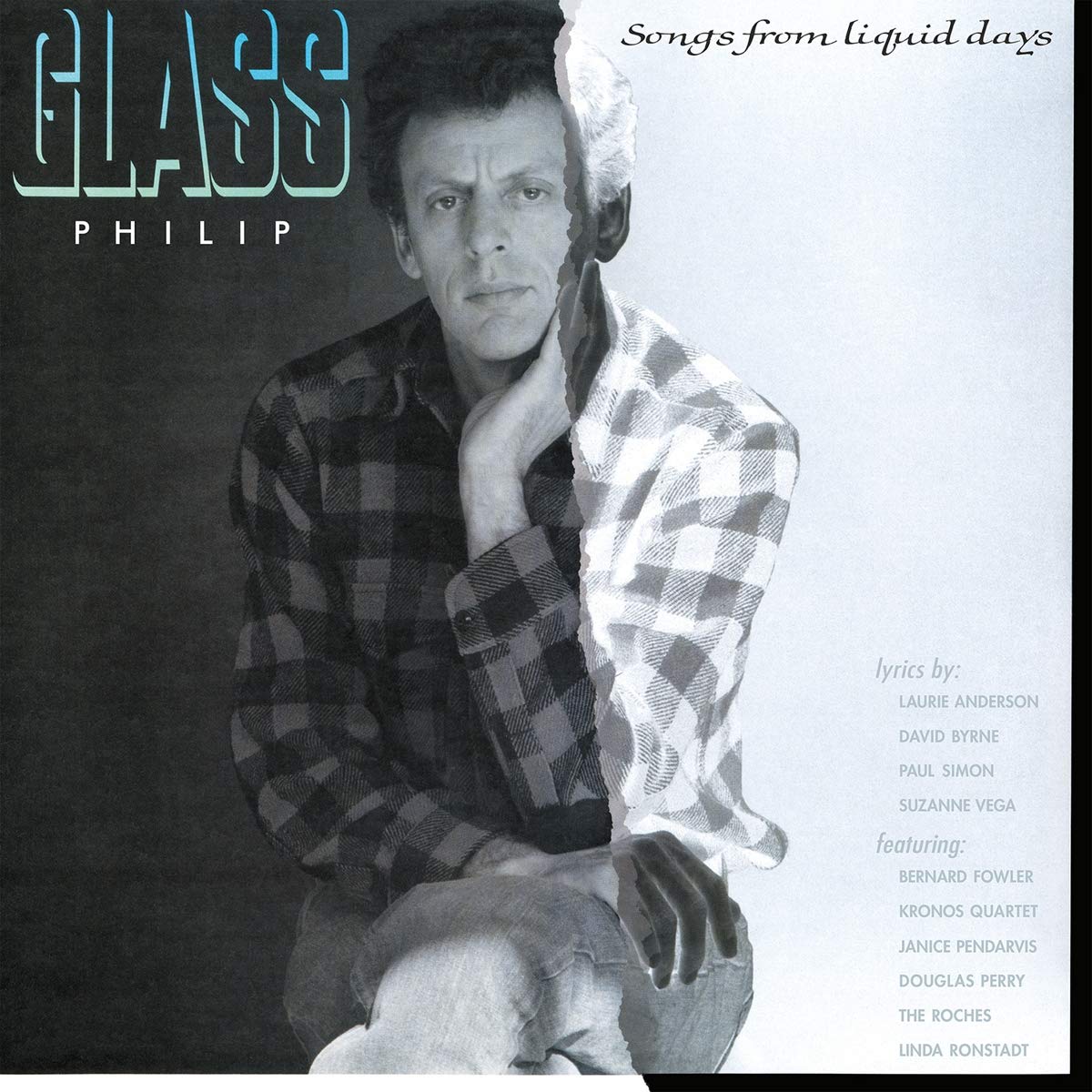
Songs From Liquid Days marked another foray into the mainstream for Glass. Glass had, of course, already composed vocal music in the form of operas, but with Songs From Liquid Days he set out to bring his own style closer to popular music by adding vocals in a way that would not sound quite as alien as in opera, where an untrained listener might not understand the lyrics at all and the singing style feels rather exotic.
When it came to the lyrics, too, Glass ventured into the realm of pop music, though not quite into the broadest mainstream, as he enlisted a handful of highly regarded musicians as lyricists, who had mainly made their name in the slightly more artistic end of the pop/rock spectrum. Paul Simon and Laurie Anderson each wrote the lyrics for one song, whilst David Byrne (Talking Heads) and Suzanne Vega were each given two compositions to work on.
Glass worked from the lyrics; in other words, the lyrics came first and Glass composed the music around them. As with Glassworks, the compositions on Songs From Liquid Days are more compact than is typical of the maestro: two of the tracks are around 3–5 minutes long, roughly in line with pop music, whilst the remaining four compositions, at 6–10 minutes, would fit well within the canon of progressive rock.
Glass has described Songs From Liquid Days as a ‘song cycle’. Generally speaking, this term refers to something rather similar to a concept album in the world of rock. Personally, however, I haven’t been able to work out exactly how the tracks on the album are actually connected. The lyrics seem to be linked mainly by a certain kind of abstract poetic quality.
Read also: Review: Scott Walker – Tilt (1995)
The album opens with its longest track, the ten-minute ‘Changing Opinion’. The song begins with a fateful, undulating brass section until a lyrically flowing, cyclical piano motif takes centre stage. The brass returns briefly, playing in a staccato manner, until the vocals of Bernard Fowler – a singer who has worked extensively with The Rolling Stones – step into the spotlight. Fowler sings in a soulful pop style, and the contrast this creates with Glass’s music is truly fascinating. Alongside the piano, which plays a self-contained, swirling motif, a flute-like synthesiser emerges, whilst the wind instruments blow their solemn message every now and then until the piano comes to the fore once more. The enigmatic lyrics, written by Paul Simon, deal with a strange sound, the source of which the narrator tries in vain to reach. Glass’s music, flowing mysteriously forward, works perfectly with Fowler’s slightly melancholic yet emphatic vocals, and they beautifully support Simon’s cryptic message.
Although ‘Changing Opinion’ features choruses, it is nevertheless more complex than conventional pop music in terms of structure and harmony. This track, and others on the album, could indeed be described as modern lied, or art songs. Lieds are songs that are considerably smaller in scale and simpler than opera, yet may nevertheless contain highly sophisticated features typical of art music.
Built around a lively, slightly metronomic, pulsating synthetic sequence, the fast-paced “Lightning” is the track on the album that most clearly reveals its 1980s roots. In terms of its sound, it most closely resembles the pop music of that era.
“Lightning” features the fast, driving arpeggios typical of Glass. However, the synthesiser sound used to play them is softer than is often the case in Glass’s music. The lyrics, written by Suzanne Vega, are performed by Janice Pendarvis, who has sung backing vocals for Sting and David Bowie. She sings with a pleasant, slightly husky voice, mostly in the middle register, which provides an excellent counterpoint to Glass’s bright synthesiser sounds.
I have to admit that some of the sounds perhaps haven’t quite stood the test of time, and a slightly more organic arrangement might have done the composition more justice. Still, it’s a brilliant track.
The third track, ‘Freezing’, is the shortest and simplest composition on the album. At first, it is carried solely by the gently swaying strings of The Kronos Quartet, but at around the one-minute mark, the tempo quickens and two synthesisers join the strings, bringing with them the kinetic energy characteristic of Glass. One synthesiser rings out brightly whilst the other pumps out a low, rhythmic pattern. The lyrics are sung by Linda Ronstadt (b. 1946), who began her career as a folk-rock singer in the 1960s and has since enjoyed an extremely varied career, singing a range of musical styles from country and rock to Broadway musicals. Ronstadt sings the actual lyrics with restrained beauty, but as an intriguing contrast, her operatic voice can also be heard here and there in the background, warbling wordless melodies.
The title track “Liquid Days”, with lyrics by David Byrne, is sung by the quirky folk trio The Roches (who can also be heard on Robert Fripp’s magnificent Exposure album). The instrumentation is built around strings, softly resonating synthesisers and flutes that chime in here and there. The Roches are also given the interesting task of singing a wordless, repetitive ‘uuu-uuu-uuu’ sound – a part that, in Glass’s music, would usually be played by a sharp-sounding synthesiser.
“Freezing” and “Liquid Days” work brilliantly as a sort of breather in the middle of the album, but “Open The Kingdom” really picks up the pace again.
The seven-minute track ‘Open The Kingdom’ represents the most dramatic side of the album. It is the only track on the album sung by an opera singer. The role is performed with sheer majesty by the tenor Douglas Perry, who had also sung the lead role in Glass’s opera Satyagraha (1980), which tells the story of Mahatma Gandhi.
Perry’s wide vocal range and challenging vocal part are accompanied at times by a piano that sounds rhythmically forceful and extremely emphatic, and at other times by a synthesiser grinding out a taut, string-like ostinato. Perry sings the highly impressive chorus as a duet with herself, utilising the power of overdubs. Perry’s vocal lines, sung with great emphasis and full of despair, both high and low, intertwine and interweave in a thrilling manner.
Like a few other tracks on the album, “Open The Kingdom” also plays around by alternating between 4/4 and 3/4 time signatures. Right at the very end, the energetic instrumental coda suddenly shifts to 6/8 time.
“Open The Kingdom” is a masterful track and, alongside “Changing Opinion”, one of the highlights of Songs From Liquid Days.
“Forgetting” brings together Linda Ronstadt and the trio The Roches. Ronstadt sings the lead vocals in a deliberately detached tone, which allows the trio to let loose a little more. “Forgetting” thus serves, as it were, to unify the album’s various vocal styles, with the exception of Perry’s operatic tenor.
Musically, too, ‘Forgetting’ seems, in a way, to bring the album’s styles together and features some themes that have already been explored.
The track begins with a understated string intro, after which Ronstadt sings alone for a moment with the strings in the background. Then a synthesiser introduces a more energetic beat and The Roches join in, singing Laurie Anderson’s lyrics in a high register, after which they hum a brief wordless ‘aa-aa’ theme. The music dies down slightly once more and Ronstadt returns, accompanied by the hazy sound of the strings. The Roches sing a chorus made up of individual words, whilst Ronstadt softly hums the same wordless theme in the background as in ‘Freezing’. In the finale, organ-like synthesizers and low-toned, rumbling trombones join in. The music swells into a magnificent roar until, finally, the eight-minute track ends dramatically, as if crashing into a wall. All that remains is silence.
Read also:
- Review: Philip Glass – Songs From Liquid Days (1986)
- Levyarvostelu: Peter Gabriel – Up (2002)
- Review: John Greaves & Peter Blegvad: Kew. Rhone. (1977)
- Review: Flea – Honora (2026)
- Review: Pink Floyd – Animals (1977)
- Levyarvio: Flea – Honora (2026)
- Review: Yes – Magnification (2001)
- Review: Jethro Tull – Songs From The Wood (1977)
- Review: A.W. Yrjänä – Eidolon (2026)
Philip Glass has been incredibly prolific. He has written over 40 film scores, 15 operas, over 20 solo works for piano or organ, seven string quartets, over 20 chamber music works, 14 symphonies and numerous dance pieces. Amidst all this musical abundance, Songs From Liquid Days is a unique phenomenon. It is the only pop-inspired album he has composed for solo vocalists.
Songs From Liquid Days received a mixed reception upon its release. Some critics regarded it as a bold and successful foray into new territory, whilst others considered it a minor work amongst his ‘more serious’ pieces.
I don’t know exactly how many copies of Liquid Days were sold, but at least some sources cite it as the best-selling album of Glass’s career, which wouldn’t be surprising given its style. Despite its success, I feel that Liquid Days is a somewhat forgotten album these days. You don’t hear it mentioned very often. It’s a shame, because I think Glass achieves something truly wonderful and unique on this record. Art music and pop music come together in a very distinctive way. I’m a big fan of experimental instrumental music myself, and so I have to admit that I’m a bit surprised that, if I had to choose one Glass album above all others, my choice would, on most days at least, be Songs From Liquid Days. No other Glass album comes close to the emotional intensity this one offers over its entire length.
Best tracks: ”Changing Opinion”, ”Liquid Days”, ”Open The Kingdom”, ”Forgetting”
Author: JANNE YLIRUUSI
Read also: Review: Steve Reich – Different Trains / Electric Counterpoint (1989)
Tracks
- ”Happiness Is Easy” 6:30
- ”I Don’t Believe in You” 5:02
- ”Life’s What You Make It” 4:29
- ”April 5th” 5:51
- ”Living in Another World” 6:58
- ”Give It Up” 5:17
- ”Chameleon Day” 3:20
- ”Time It’s Time” 8:14
 Pienemmät Purot
Jätä kommentti