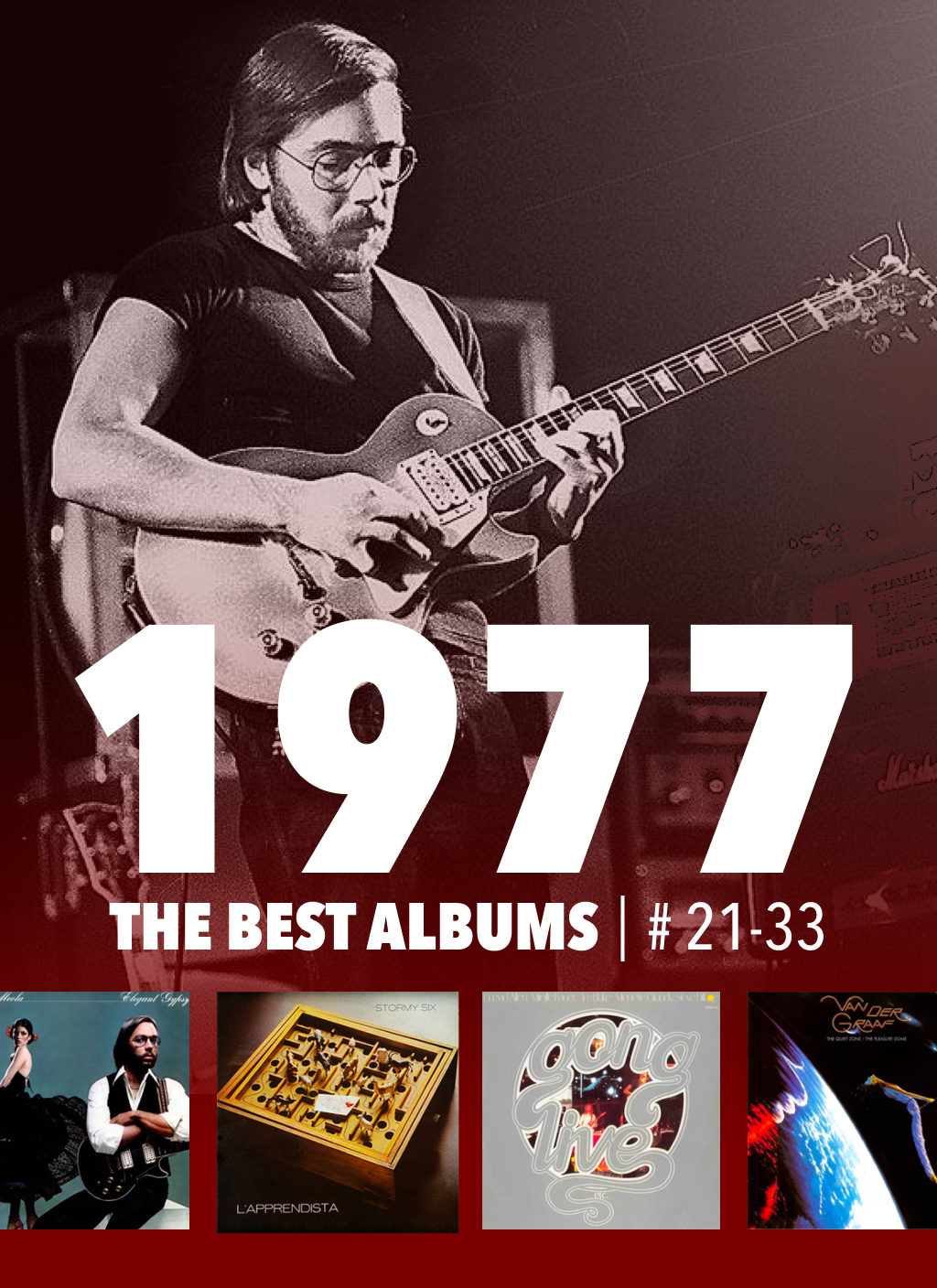
The author’s picks for the best albums of 1977, ranked 21-33.
In the Year by Year&nb sp;series, I’ll go through my favourite albums from 1969 to the present day.
21. Stormy Six: L’apprendista (IT) ****
22. Gong: Live Etc (UK) ****
23. Al Di Meola: Elegant Gypsy (US) ****
24. Van der Graaf: The Quiet Zone / The Pleasure Dome (UK) ****
25. Shakti With John McLaughlin: Natural Elements (UK/IN) ****
26. Renaissance: Novella (UK) ****
27. Gentle Giant: Playing The Fool (UK) ****
28. Maneige : Ni vent… Ni nouvelle (CA) ****
29. Tangerine Dream: Encore (DE) ****
30. Eero Koivistoinen Quartet: Labyrinth (FI) ****
31. Aksak Maboul : Onze danses pour combattre la migraine (BE) ****
32. Ralph Towner: Solstice – Sound And Shadows (US) ****
33. Michael Mantler: Silence (AT) ****
21.Stormy Six: L’apprendista
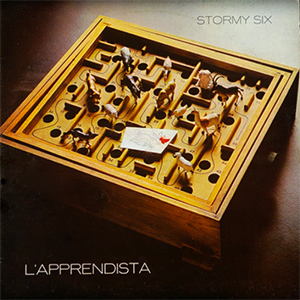
L’apprendista is the sixth studio album by the Italian band Stormy Six.
Founded in Milan in 1966, Stormy Six began their career playing psychedelic rock before shifting toward folk-influenced left-wing protest songs. By the mid-1970s, the band’s style had gradually drifted toward progressive rock. A few years later, Stormy Six’s music had become so complex and angular that the albums L’apprendista and Macchina maccheronica (1980) can easily be classified as avant-prog.
The avant-prog pioneer band Henry Cow and Stormy Six met in 1975 while Henry Cow was touring Italy and discovered that they were united not only by their political leanings but also by similar musical ambitions…
22. Gong: Live Etc

Live Etc is Gong’s first live album.
It’s interesting that Gong’s first live album wasn’t released until 1977, even though the band had already been around for nearly ten years. And that same year, the band’s second live album, Gong est Mort… Vive Gong, was released right after it. Gong Est Mort is also a high-quality release, but Live Etc is still a slightly stronger package overall.
Originally released as a double-vinyl set, Live Etc features live recordings from 1973–1975 and showcases no fewer than three different lineups of Gong (the common thread in all of them being guitarist Steve Hillage, bassist Mike Howlett, and wind player Didier Malherbe). The focus, however, is specifically on Daevid Allen’s Gong, even though he had already left the band a couple of years prior to the release of Live Etc. The second half of the vinyl features the lineup from the Shamal era—meaning Allen is no longer part of that section—but the repertoire is still drawn from the albums of his era. Allen himself is in fine form throughout the album. He plays around, gets into the groove, and jokes here and there, but when needed, he also sings quite well and effectively in the traditional sense.
The playing is wildly energetic, and the vibe is appropriately hazy and anarchic. The musicians’ performances are skillful, even if the playing isn’t always particularly precise. The arrangements of the songs feature just the right amount of deviation from the studio versions, and at times the band gets carried away with lengthy improvisational passages, without ever losing the songs’ underlying thread. The joy of playing and the anarchic energy are what Live Etc is all about. On Live Etc, Gong also sounds more like a rock band than ever before—but a damn skilled and unique one at that.
Since then, several live albums from Allen’s Gong era have been released retrospectively, but Live Etc still captures that period most effectively. On the other hand, if you have enough money to spare, you can make Live Etc unnecessary and pick up the massive Love From Planet Gong box set (2019), which includes all the concerts featured on Live Etc in their entirety, plus much more.
Best tracks: ”You Can’t Kill Me”, “Est-Ce Que Je Suis”, ”6/8 Tune”, ”Radiognome Invisible”, ”Oily Way”, ”Master Builder”
23. Al Di Meola: Elegant Gypsy

Elegant Gypsy is guitarist Al Di Meola’s second solo album.
Al Di Meola instantly rose to become one of jazz-rock’s most awe-inspiring guitar heroes after joining Return to Forever—founded by keyboardist Chick Corea—in 1974 at the age of just 19. Al Di Meola became the first serious rival to the Mahavishnu Orchestra’s guitar god John McLaughlin when it came to pyrotechnics involving a million notes per second. Di Meola’s technique—and especially his speed—was on an astonishing level, and he became an important source of inspiration for many heavy rock shredders as well.
Like McLaughlin, however, Di Meola is also, at his best, a highly accomplished composer. Di Meola’s first solo album, Land Of The Midnight Sun (1976), was already a very successful jazz-rock record, but Elegant Gypsy manages to surpass its predecessor, particularly in terms of the quality of the compositions.
Di Meola has assembled a strong group of musicians around him who keep up with him beautifully, even though at no point throughout the album is there any doubt as to who and what the album’s true star is. That is, Al and his guitar, which spits out notes at a brisk pace. On drums, the album features two talented drummers who have played with Chick Corea—Steve Gadd and Lenny White—taking turns. On keyboards, Jan Hammer, familiar from the Mahavishnu Orchestra, is in full swing, and on bass is Anthony Jackson, who was still relatively unknown at this point. Additional support comes from percussionist Mingo Lewis and flamenco virtuoso Paco De Lucia, who makes a guest appearance on acoustic guitar.
The album’s undisputed highlight is the six-minute “Race With Devil On Spanish Highway,” whose fiery guitar riffs and fast-paced tempo truly succeed in painting vivid images of a devilish race in streamlined race cars along dusty highways somewhere in the middle of nowhere. The song also perfectly encapsulates the album’s overall genre: it’s energetic jazz-rock with strong Latin influences and, every now and then, a touch of flamenco. Fortunately, the album isn’t just nonstop blasting; it also includes just the right amount of more lyrical, acoustic moments to balance out the fierier action.
With its high-quality production, Elegant Gypsy is a highly entertaining listen, but it’s still a bit too caught up in Di Meola’s obsession with being the fastest gunslinger in the West to truly reach the master class in terms of song quality.
Best tracks: ”Race With Devil On Spanish Highway”, ”Elegant Gypsy”
24. Van der Graaf: The Quiet Zone / The Pleasure Dome

The Quiet Zone / The Pleasure Dome is the eighth studio album by Van der Graaf Generator, which was founded in 1967.
If we’re being strictly literal, it’s not actually Van der Graaf Generator but Van der Graaf. After the classic VdGG lineup broke up for the second time following World Record in late 1976, vocalist/guitarist Peter Hammill and drummer Guy Evans decided to continue together, but shortened the band’s name to distance themselves from the previous group. In the ’70s, people were even more critical of band breakups and lineup changes, so shortening the name was probably partly a way to fend off the criticism that might have arisen had the band continued even though half the lineup had gone their separate ways. Today, however, The Quiet Zone / The Pleasure Dome is considered part of the VdGG canon.
Peter Hammill had a change in mind in more ways than just the name. Saxophonist David Jackson was part of the new lineup following World Record for a while, but eventually left (he appears as a guest on one track on this album). He was by no means replaced by another wind instrument virtuoso, as one might have expected; instead, the group recruited Graham Smith, a classically trained violinist who had played in String Driven Thing. Nor was Hugh Banton replaced by a new keyboardist; instead, bassist Nick Potter—who had played with the band from 1969 to 1970—was brought in to take his place. Thus, for the first time since 1970, the band once again had a bass guitarist (Banton had been handling the bass duties in the meantime using bass pedals while playing the organ). On the other hand, the band was now, for the first time, without a keyboardist fully dedicated to the role. Hammill does play the keyboards occasionally on the album, but for the most part he focuses on vocals and electric guitar.)
The band’s new lineup would inevitably have changed the style of the music due to its different instrumentation, but the songs themselves are also quite different from those on previous VdGG albums. The tracks on The Quiet Zone / The Pleasure Domen are shorter and clearly more straightforward than before. They are more like skillfully played rock songs than actual prog rock. Still, you can’t really call it basic rock—the sound is distinctive enough, thanks not only to Hammill’s vocals, of course, but also to Smith’s lively violin, which plays a significant role throughout the album. The arrangements also have enough twists and turns that, even at this stage, the band can’t quite be compared to the Clash or AC/DC.
The highlight of the album is “Cat’s Eye / Yellow Fever (Running),” which sounds a bit like ELO on steroids. A stubbornly grinding violin riff, drawing inspiration from Smith’s classical music, carries the song. Hammill’s intense and slightly punk-inspired vocals cut through every now and then, spurred on by Evans’s demonic drumming. At the end, we hear Smith’s wistful yet crisp-sounding violin solo, which he accompanies himself on a second violin track. Smith deservedly received a co-composition credit alongside Hammill for his contribution. In fact, the song was originally composed by Smith, to which Hammill added the vocal melody and lyrics. Otherwise, all the songs on the album are credited to Hammill.
Another track particularly worth mentioning is the fast-paced ”The Sphinx in the Face,” in which Potter’s characteristically buzzing bass plays a key role. This energetic and downright brutal track is more in the vein of new wave than progressive rock.
Unfortunately, the album also has a few somewhat lackluster tracks, and the overall impression is of a band that’s trying to find its own sound but hasn’t quite managed to define it. The sound of the album, which sounds good in and of itself, is also, in a way, a little too polished. This material would probably have benefited from a rougher production.
The Quiet Zone / The Pleasure Dome did not, in the end, mark a new beginning for the band, as this lineup came to an end the very next year after first releasing a live album with a truly brutal sound titled Vital. Van der Graaf Generator did not return to the stage or the studio until 2005.
Best tracks: ”Lizard Play, ”Cat’s Eye / Yellow Fever (Running)”, ”The Sphinx in the Face”
25. Shakti: Natural Elements

Natural Elements is Shakti’s (also known as Shakti With John McLaughlin) third album.
Guitarist John McLaughlin founded Shakti in 1974 with three Indian musicians: L. Shankar (violin, viola, vocals), Zakir Hussain (bongos, dholak, tabla, timbales, vocals), and T.H. Vinavakram (ghatam, kanjeera, vocals) after the first incarnation of the Mahavishnu Orchestra disbanded. Shakti’s concept was to blend Indian music with acoustic jazz-rock.
Shakti’s debut album, Shakti With John McLaughlin, was a live album released in 1976. The band went on to release two more studio albums in quick succession, of which Natural Elements is the second.
The entirely acoustic Natural Elements masterfully blends traditional Indian music with John McLaughlin’s lightning-fast guitar runs, already familiar from the Mahavishnu Orchestra. Shakti’s music is well described by the thought experiment: “What if Indian musicians played the Mahavishnu Orchestra’s music acoustically?”
Played mostly with lightning-fast riffs, the tracks are full of “wow” moments, but overall the album sometimes feels like it’s treading water a bit. Even though it’s moving at a breakneck pace! Shankar’s piercingly sharp violin squeals can also get on your nerves at times if you’re in the wrong frame of mind. Natural Elements is definitely not relaxing listening.
Natural Elements was Shakti’s final album.
Best tracks: ”Mind Ecology”, ”Get Down and Sruti”
26. Renaissance : Novella
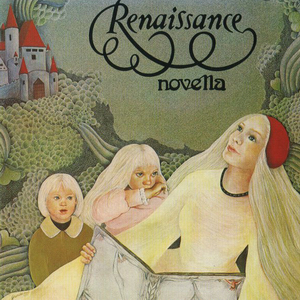
Novella is Renaissance’s seventh studio album.
Renaissance stood out in the progressive rock scene of the 1970s with its exceptionally melodic and romantic style. The band’s music combined influences from classical music, folk-inspired sensitivity, and expansive symphonic structures, but without the aggression or emphasis on technical virtuosity characteristic of many prog bands. Central to their sound was Annie Haslam’s clear, five-octave soprano voice, around which the band built expansive orchestral arrangements, piano-driven harmonies, and strongly melodic compositions.
Renaissance’s music relies on atmosphere, dynamics, and gradually building drama. The long tracks often shift between acoustic sensitivity and grandiose climaxes in a way that brings the band closer to the European art music tradition than to traditional rock. At the same time, the band maintains a strong melodic core, thanks to which even its most ambitious works remain easily accessible compared to many of the more experimental prog bands of the era.
Despite its accessibility, Renaissance never achieved the same level of popularity as the biggest names in its genre, and in the case of Novella, this seems to be a production made on a more modest budget than before. The symphony orchestra plays a clearly smaller role than before, and strings are more often simulated with synthesizers, though orchestral tones still appear here and there.
One track that clearly benefits from the orchestral arrangements is the album’s highlight, the over 13-minute “Can You Hear Me?”, which represents the band’s most ambitious expression and is on par with the best moments of Ashes Are Burning and Turn Of The Cards. At the same time, however, it doesn’t really break new musical ground.
This time, their hopes for a hit were pinned on “Midas Man,” a song that critiques the worship of money and greed. It’s a folk-pop-influenced track that comments on these themes, combining radio-friendly appeal with Renaissance’s signature majestic sound. The use of tubular bells and a rhythm section that highlights small percussion details (Terrence Sullivan jingles coin-filled shakers in a manner fitting the theme) adds effective touches to the arrangement.
Novella offers few surprises, and despite its solid quality, it begins to feel like a sign that the band’s most creative peak was behind them. The album’s sound features much that is familiar from earlier records, but the tone is even gentler and less edgy than before.
The exception is “The Captive Heart,” whose stripped-down piano-and-vocals arrangement brings out a new kind of intimacy, even though the song as a whole remains somewhat lackluster, though it deserves praise for its sophisticated vocal arrangement. The album’s overall sound also feels thin in places, even though production was once again handled by Dick Plant—who has produced some of the band’s best albums—and they spent as much as two months in the studio.
The changes of the late 1970s—the rise of punk and AOR—left many progressive rock bands in a tight spot, and Renaissance’s classically influenced folk-prog no longer fit as naturally into the shifting musical climate. The options were to stick firmly to their own style or radically change their sound, which could have diluted the band’s identity.
On their next album, A Song For All Seasons, Renaissance tenaciously continued along their own path, but after that, a period of musical compromises began, leading to rather lackluster results—both commercially and artistically.
Best tracks: “Can You Hear Me?”, “Midas Man”
27. Gentle Giant : Playing The Fool
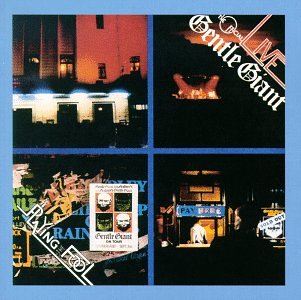
Playing The Fool is Gentle Giant’s first live album.
Recorded during the band’s 1976 European tour, the live album Playing The Fool was originally released as a double vinyl set and features songs from all of the band’s albums released to date, except for Acquiring The Taste (1971).
Gentle Giant has, in some cases, radically reworked the arrangements, and most of the songs have been linked together into a sort of medley. For example, five songs from Octopus (1972) have been condensed into a 15-minute suite. The approach is creative and works brilliantly at times, but it’s also a bit disorienting. A few tracks have at least been left as completely standalone pieces, and the most impressive of these is “Free Hand,” which races through at a truly breakneck pace.
Gentle Giant once again showcases its versatility in terms of its instrumental palette: the five-piece band plays well over 20 different instruments on the album. In addition to standard rock instrumentation, the album features, among other things, various saxophones, a cello, recorders, a vibraphone, and a trumpet. It must be noted, however, that while the recorder and vibraphone solos, combined with the visual aspect (a hairy grown man playing the recorder in the middle of a rock band), certainly provided excellent entertainment, they don’t always quite work when heard solely on the audio track. On the other hand, one has to respect the band’s bold attitude; in the 1970s, probably only Henry Cow—and perhaps to some extent King Crimson—achieved a similar level of unpredictability and versatility in their live performances. Gentle Giant’s variations on their studio material, however, do not seem to be based on improvisation like those of the aforementioned bands, but are carefully planned in advance. The band’s spontaneity on stage is thus largely a well-rehearsed illusion.
Playing The Fool is an interesting cross-section of the music the band created during its first six years, even though its montage-like format doesn’t quite win me over.
Best tracks: ”Excerpts from Octopus”, ”Funny Ways”, ”Free Hand.
In 2025, a new version of the album was released under the title Playing The Fool – The Complete Live Experience. This expanded version includes a couple of bonus tracks, and the track order has been rearranged to match the original concerts. Dan Bornemark also remixed all the music.
Read also
- Year by Year : Best Albums of 1977 – 21-33
- Levyarvio: Sakari Kukko – Virret (2001)
- Vuosi vuodelta : Parhaat levyt 1977 – Sijat 21-33
- Review: Peter Hammill – Sitting Targets (1981)
- Levyarvio: Steve Howe – Natural Timbre (2001)
- Review: Pekka Pohjola – Views (2001)
- Review: Yes – Aurora (2026)
- Levyarvio: Yes – Aurora (2026)
- Vuosi vuodelta : Parhaat levyt 2001 – Sijat 11-20
28. Maneige : Ni vent… Ni nouvelle
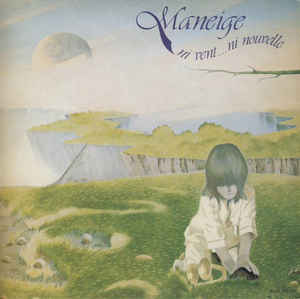
Ni vent… Ni nouvelle is the third studio album by the Canadian band Maneige.
Formed in 1972, Maneige is part of the vibrant French-Canadian “Quebec scene.” The band’s music is upbeat, fast-paced, and at times quite complex. The band’s richly arranged songs make use of a wide range of instruments, including various woodwinds and tuned percussion. Stylistically, the music on Ni vent… Ni nouvelle falls somewhere between symphonic prog and jazz-rock. At their most intricate, the songs bring to mind Gentle Giant, who were always particularly popular in Canada. The band’s jazz-rock jams, on the other hand, are reminiscent of the work of Finnish guitar virtuoso Jukka Tolonen.
Ni vent… Ni nouvelle is Maneige’s best album, but the band’s first couple of records are also well worth a listen. Maneige continued to release studio albums until 1981 and disbanded in 1983.
Best tracks: “Les folleries”, “Les epinettes”
29. Tangerine Dream: Encore
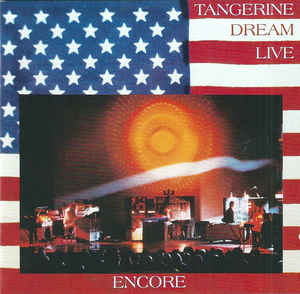
Encore is the second live album by the German band Tangerine Dream.
Recorded during their 1977 North American tour, Encore—originally released as a double-vinyl set—features four long tracks (16–19 min.). The album features the classic Tangerine Dream lineup of Edgar Froese, Christopher Franke, and Peter Baumann playing together for the last time. Baumann left the band by the time of their next studio album, Cyclone (1978).
Encore is, in essence, quite typical of Tangerine Dream from the latter half of the 1970s. On Encore, frenetically bubbling sequencers combine with hand-played Mellotrons, electric pianos, and synthesizers, creating a pleasantly raw and live-sounding vibe. Edgar Froese’s electric guitar adds a touch of novelty to the overall sound, providing a welcome change from the otherwise purely keyboard-driven sound. Froese’s epic guitar solo on “Coldwater Canyon” actually sounds surprisingly competent, even though he’s by no means a six-string virtuoso.
The long tracks do have their slow moments, but ultimately, Encore is probably Tangerine Dream’s finest live album. At its best, it manages to be both a hypnotically gripping groove and, at its wildest, an experience that’s downright orgasmic in its joy.
Best tracks:”Cherokee Lane”, ”Coldwater Canyon”
30. Eero Koivistoinen Quartet: Labyrinth

Labyrinth is saxophonist Eero Koivistoinen’s ninth studio album.
On his two previous albums, Wahoo! (1973) and The Front Is Breaking (1976), Finnish musician Eero Koivistoinen’s music had evolved into electric jazz-rock, featuring strong funk influences—perhaps inspired by Herbie Hancock’s Headhunters band.
On the Labyrinth album, Koivistoinen returns fully to acoustic jazz. The expansive lineups of his electric bands are scaled back on Labyrinth to an agile quartet. Alongside Koivistoinen, pianist Vladimir Shafranov, double bassist Pekka Sarmanto, and drummer Reiska Laine all deliver excellent performances.
Koivistoinen composed all the tracks on the album except for the ballad-like closing track “Yksi ruusu on kasvanut laaksossa”, which is a folk tune. Labyrinth comes across as a fairly tightly composed album, even though it also contains some freer moments.
Especially on The Front Is Breaking, the funk influences already felt a bit forced, and Labyrinth, with all its acoustic airiness, is considerably more pleasant to listen to. However, in the case of Labyrinth, “acoustic” does not mean lack of energy or merely light-hearted mood-setting; the album has some very intense moments, such as the excellent opening track “Stress,” which races along at a breakneck pace.
Labyrinth isn’t, ultimately, a particularly innovative or daring jazz album, and at times it feels a bit like predictable background music, but for the most part, it’s still a very pleasant listen.
Best tracks: ”Stress”, ”Arabeski”
31. Aksak Maboul : Onze danses pour combattre la migraine

Onze danses pour combattre la migraine is Aksak Maboulin’s first studio album.
Aksak Maboul (“crazy rhythms”), founded by multi-instrumentalist Marc Hollander—who previously played in the band Cos—has released only four albums over the course of four decades, each of which is very different from the others. What they have in common is mainly a fearlessness in trying everything possible and a general sense of strangeness. And their debut, Onze danses pour combattre la migraine, may very well be the strangest of all their albums.
Onze danses pour combattre la migraine (“11 Dances to Fight Migraines”) is a charmingly odd avant-prog album with a lighthearted (though at times also melancholic) and gentle style. In other words, it’s something completely different from the extremely gloomy, chamber-music-like trend being developed at the same time in Belgium and France by Univers Zero and Art Zoyd.
Onze danses pour combattre la migraine consists mostly of short vignettes—like snippets of a whole that we never get to hear. As listeners, we often find ourselves plunged into the middle of a piece of music that we hear for only a moment before being thrown into the next snippet. This is both fascinating and frustrating. Especially since some of the album’s 17 tracks last only half a minute or even less. Brian Eno used a somewhat similar technique on Another Green World, but Hollander takes the style further, as evidenced by the broader range of genres he draws from. Hollander draws inspiration from jazz, classical music, traditional French songs, lounge, and who knows what else.
One track might feature electronic bubbling sounds, while the next could be a very romantic-sounding acoustic duet for clarinet and violin, reminiscent of the 1920s. In between, we also hear a little girl’s two-minute-long, free-form babbling in French. The album as a whole is, therefore, very, very eclectic and quirky. With all its laid-back charm, however, Onze danses pour combattre la migraine is relatively easy to listen to.
Onze danses pour combattre la migraine is a completely unique work. In a way, it’s almost too unique.
Three years later, Hollander made a brilliant move and invited former members of Henry Cow—guitarist Fred Frith and drummer Chris Cutler—to join Aksak Maboul, and the revamped lineup went on to create the band’s true masterpiece, Un Peu de L’Ame des Bandits.
Best tracks: “Vapona, not Glue”, “Chanter Est Sain”, “Son of L’idiot”, “Cuic Steppe”, “The Mooche”
32. Ralph Towner, Solstice: Sound And Shadows
Ralph Towner recorded what I consider to be one of the greatest ECM albums of all time in 1975. The album was titled Solstice. Alongside guitarist/pianist Towner, the album featured saxophonist Jan Garbarek, bassist Eberhard Weber, and drummer Jon Christensen. All three are magnificent musicians. Solstice received a fair amount of attention, and as is often the case in jazz, the quartet that played on the album was later named Solstice. This explains the somewhat unusual practice of crediting this “sequel” to both Ralph Towner and Solstice.
In a way, this is a sequel. Solstice was acoustic, chamber-music-inspired jazz with the clear, open sound characteristic of ECM, in which the subtle interplay between Towner, Garbarek, Weber, and Christensen created cool, beautiful, yet emotionally resonant atmospheres. Sound And Shadows takes that same wintry, luminous, European-inspired expression in a slightly shadier and more subdued direction. The atmosphere is stealthy, mysterious, and more introspective than that of its predecessor. The album is a consistently strong whole, but at no point does it reach quite the same magical heights as Solstice.
The album features five long compositions, all written by Towner. The structures of the pieces seem largely carefully planned, but the master musicians are given plenty of room to improvise, especially in the solos. Garbarek’s long, impressionistic, and contemplative flute solo on the track “Song Of The Shadows” is particularly striking. An old track from Towner’s other band, Oregon, “Distant Hills,” receives a fine interpretation and sounds more intense than the original, thanks in particular to Garbarek’s sharply vibrating saxophone.
Sound And Shadows is extremely stylish and a pleasure to listen to, even if it doesn’t quite reach the level of its masterful predecessor.
Best tracks ”Distant Hills”, ”Song Of The Shadows”
33. Michael Mantler: Silence
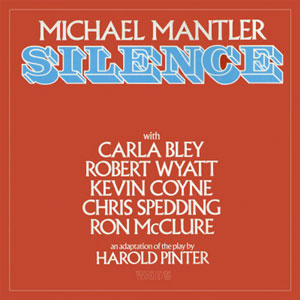
Born in Austria but having moved to the U.S. as early as 1964, composer and trumpeter Michael Mantler is one of those artists whose work is very difficult to categorize clearly. His career began in avant-garde jazz, but since then, his strongly improvisational jazz has been complemented by numerous elements of strictly composed, serious art music. On the other hand, Mantler has at times also leaned toward avant-garde progressive rock.
Mantler’s clearest foray into the prog genre was The Hapless Child and Other Inscrutable Stories, released in 1976. This concept album bombarded the listener with complex and, at times, downright manic, dark-toned music. Silence, released the very next year, is a natural continuation of Mantler’s detour into prog. There are many common threads: once again, literary texts play a central role, Robert Wyatt provides the vocals, and the music moves along the borderlands of jazz, chamber music, and progressive rock. In terms of atmosphere, however, the albums are surprisingly different.
Whereas The Hapless Child and Other Inscrutable Stories was based on Edward Gorey’s darkly humorous and grotesque stories, Silence is based on the play of the same name by British playwright Harold Pinter. Pinter was known for his sparse style, his dialogues that make use of long silences, and his themes exploring the difficulties of communication between people. Mantler’s compositional style proves to be a surprisingly natural vehicle for interpreting this kind of material. Whereas Gorey’s stories inspired Mantler to create restless and at times chaotic music, Pinter’s texts lead to a significantly more restrained, stripped-down result that at times even flirts with minimalism. On the other hand, there are also subtle funk elements scattered throughout.
The lineup also supports this shift. Alongside Wyatt, who also handles percussion, the gravelly-voiced Kevin Coyne takes on a prominent role; his earthy delivery provides an intriguing counterpoint to Wyatt’s fragile and melancholic vocals. Also featured are long-time collaborator—and Mantler’s wife at the time—Carla Bleyon keyboards and backing vocals, guitarist Chris Spedding, who is in excellent form throughout the album, bassist Ron McClure, and cellist Clare Maher. Mantler himself does not play on this album either, instead focusing strictly on his roles as composer and bandleader.
Compared to the arrangements on The Hapless Child—which at times feel quite massive—the lineup on Silence sounds smaller and more intimate, but the music is still quite oppressive. That oppressive atmosphere is lightened, however, by moments of offbeat humor. Dark humor flourished on The Hapless Child, and Silence also makes you smirk from time to time. Perhaps most deliciously in the desperate dialogue of “I Watch The Clouds,” where Wyatt’s character and Bley’s character respond to every suggestion with a curt “no.”
If The Hapless Child and Other Inscrutable Stories felt like a never-ending, nightmarish spiral, its sister album, Silence, is in its own way perhaps an even more unsettling experience. The music features more space, slower tempos, and long pauses that effectively build tension. The album’s title is not misleading: silence and empty space are just as integral to the whole as the actual notes. Silence is a perplexing album—it’s hard to decide whether it’s the height of affectation or a unique and stirring work of art. At least today, I’m leaning more toward the latter.
Best tracks: “I Walk With My Girl”, “I Watch The Clouds”, “Sometimes I See People”, “On Good Evenings”
Author: JANNE YLIRUUSI
You can find other parts of the Year by Year&nb sp;series here.
 Pienemmät Purot
Jätä kommentti