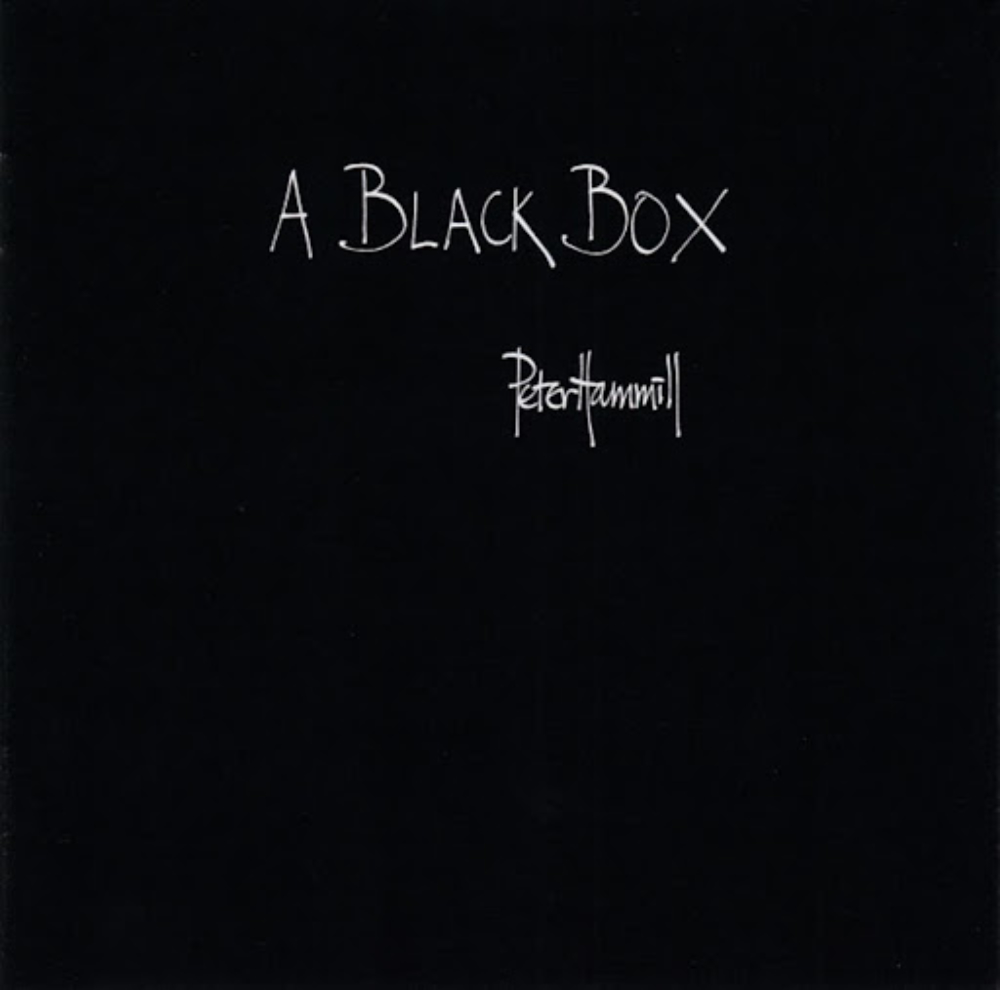
A Black Box is Peter Hammill’s ninth studio album.
Some prog musicians, such as Mike Oldfield, Carl Palmer, and Pekka Pohjola, looked down their noses at punk and new wave, which had burst onto the music scene in the late 1970s with a lot of noise. However, some progressive musicians saw punk as just one possible source of inspiration from which to draw something for their own musical concoction. Van Der Graaf Generator vocalist/composer Peter Hammill was one of these musicians.
In fact, some go so far as to consider Hammill a punk pioneer thanks to his 1975 album Nadir’s Big Chance. On that album, he performed straightforward rock under the alter ego Rikki Nadir. Personally, I consider calling Nadir’s Big Chance a punk or even proto-punk album to be quite an exaggeration, but at least it showed that Hammill was also capable of delivering boisterous basic rock.
Nadir’s Big Chance, followed by Over (1977), marked a return to a more typical Hammill style, but the 1978 album The Future Now can be considered the beginning of Hammill’s new wave-inspired art rock period. The Future Now and pH7 (1979) are clear sister albums, and A Black Box, released in 1980, can be considered the final part of the loose trilogy they form. However, A Black Box breaks new ground in relation to its two predecessors. Or new paths that also echo Peter Hammill’s past.
While Hammill’s two previous albums contained quite experimental music, they can still be loosely interpreted as rock albums. On A Black Box, Hammill delves deeper into the world of drum machines and synthesizers, and the result is at times quite avangardist.
Hammill had already used fewer and fewer outside musicians on his two previous albums, and A Black Box continues and intensifies this trend. Hammill plays almost everything on the album himself (i.e., practically all the guitars, basses, synthesizers, and drums). He is assisted only by Van Der Graaf Generator’s wind player David Jackson on a few tracks and David Ferguson from the band Random Hold (Hammill produced Random Hold’s debut album, released in 1979) on synthesizers on three tracks. Hammill handles most of the drums on drum machines, but in a new departure, he also plays the drum kit himself for the first time on the album. Or almost for the first time. Hammill made his debut on drum kit on the previous album ph7, on the track ”Mr X (Gets Tense).”
Lue myös: Levyarvio: Robert Fripp – Exposure (1979)
Golden Promises (2:56)
The album kicks off with the rocking “Golden Promises,” which is classic Hammill in a way, but this time Hammill’s aggressive and colorful vocals are backed by a strangely pumping drum machine and Hammill’s own somewhat shaky drumming. The combination of drums and drum machine reminds me of the drums on David Bowie’s ”Always Crashing In The Same Car,” processed with an Eventide H90 Harmonizer, but Hammill seems to take the effect to the extreme. The strange soundscape combined with the truly magnificent pop-like chorus sung by Hammill with defiant confidence creates a peculiar contradiction where the listener isn’t quite sure whether they’re listening to radio rock or some kind of hazy avant-garde. In any case, it’s a delightful and strong start to the album.
Losing Faith in Words (3:40)
If ”Golden Promises” had a catchy chorus, Hammill goes even further in the second track, ”Losing Faith In Words,” which deals with communication and its obstacles. The song begins with a melancholic synthesizer pattern and explodes when Hammill sings, ”we have problems with communication.” The same statement forms the basis for the song’s heroic chorus, which culminates in Hammill screaming that he is losing his faith in words. ”Losing Faith In Words” represents the most punk-influenced offering on the album and proves once again that Hammill has an incredible ability to craft not only labyrinthine prog spectacles, but also hard-hitting, straightforward rock anthems.
The Jargon King (2:43)
After two songs that could be identified as rock, the strangeness lever is turned firmly upwards. A Black Box’s third track, ”The Jargon King,” is perhaps the strangest offering on the album. Hammill’s fragmented vocals, often overlapping and intertwining, are accompanied by strangely buzzing synthesizers and jerky drum machines. At times, Hammill adds to the chaos by throwing dissonant electric guitar riffs into the mix. ”The Jargon King” is a truly fascinating and exciting song, although it feels a little unfinished, lacking the climax it deserves.
Fogwalking (4:04)
The strange atmosphere continues on the next track. The hazy, threatening and synthetically blowing ”Fogwalking” sounds like a prototype of Radiohead’s Kid A / Amnesiac era songs. Fish, the vocalist of Marillion, also seems to have borrowed more than a few ideas from this song, both lyrically and in terms of vocal style. Hammill conjures up a truly wonderful and disturbing atmosphere in this song. The song starts quietly and sparingly, gradually building tension with the addition of synthesizers that sound like warning signals or the hinges of a rusty gate. In between, strange animal-like synthesizer sounds flit from one channel to another. In the middle of it all, David Jackson’s saxophone wails discordantly. I have never really understood what the lyrics are about, but together with the music, they paint a picture, at least for me, of a lonely figure wandering the deserted streets of London, which has been turned into a radioactive wasteland by nuclear destruction (”In London – In the no-go zone”). A disconcerting song. Disconcerting and wonderful.
The first four songs on the album are truly impressive and, in their own way, rival any of Hammill’s previous releases. They are among the finest songs of Hammill’s entire career. Unfortunately, the rest of A Black Box doesn’t quite reach the level of the first fifteen minutes or so.
The Spirit (2:38)
The fifth track, ”The Spirit,” returns to a more traditional vibe, but the acoustic guitar that rings out in the major key at the beginning sounds almost exotic after the dark synthetic rumblings of the previous songs. However, the driving force behind ”The Spirit,” alongside the vocals, is Hammill’s mellifluous but slightly shaky electric guitar playing.
In Slow Time (4:07)
The swaying electric guitar of ”The Spirit” returns to more synthetic patterns in ”In Slow Time.” This eerie song plays with hazy synthesizers and a tambourine ringing in the distance. The synthesizers in ”In Slow Time” are reminiscent of the instrumentals on Bowie’s Low album, but the vocals are, of course, pure Hammill. Towards the end, the atonal electric guitar effectively combines with the swirling synthesizers.
The Wipe (1:45)
Side A ends with a short, less than two-minute experimental instrumental piece called “The Wipe,” which feels like a continuation of the style of “Jargon King.” Today, the disruptive electronic clatter of ”The Wipe” would probably be classified as glitch electronic. One could easily listen to the disturbed soundscape of ”The Wipe” for longer.
The deliciously crackling ”Fogwalking” and ”The Wipe” on side A are surprising and new territory, but A Black Box’s biggest surprise lies on side B, in a song where Hammill looks back, in a way. A Black Box concludes with the nearly 20-minute ”Flight,” which marks Hammill’s return to epic-scale music after years of hiatus. It’s a surprising and bold move, especially considering that long songs were extremely unfashionable in the late 70s and early 80s. It is also surprising because Hammill had never ventured into this territory during his solo career. Van der Graaf Generator’s history, on the other hand, includes a few magnificent mammoth tracks, such as the psychedelic electric storm ”A Plague of Lighthouse Keepers” from Pawn Hearts (1971) and the dark depiction of an artist’s crisis from World Record (1976) ”Meurglys III (the Songwriter’s Guild)”.
Read also:
- Year by Year : Best albums of 1977 – 1-10
- Levyarvio: Absoluuttinen Nollapiste – Nimi muutettu (2002)
- Review: Philip Glass – Songs From Liquid Days (1986)
- Levyarvostelu: Peter Gabriel – Up (2002)
- Review: John Greaves & Peter Blegvad: Kew. Rhone. (1977)
- Review: Flea – Honora (2026)
- Review: Pink Floyd – Animals (1977)
- Levyarvio: Flea – Honora (2026)
- Review: Yes – Magnification (2001)
Flight (19:38)
With a melancholic piano theme and Hammill’s subtly sung vocals, the lyrics of ”Flight” ostensibly deal with aviation and its heroes, but, in typical Hammill fashion, it quickly and naturally turns to explore the depths of the human mind and its built-in self-destructive mechanisms.
“Flight” is a magnificent composition in places, but Hammill’s performance does not do it justice. The soundscape feels thin, and the seven parts of this long piece do not always flow naturally into one another. The extremely complex and lengthy lyrics (over 1,100 words!) also dominate the song too much, and Hammill does not always succeed in blending the endless stream of words naturally into the music. Another significant flaw is Hammill’s decision to play the drums himself. The end result sounds, to put it nicely, rather clumsy. At its best, ”Flight” is in its more delicate passages, where Hammill sings unaccompanied, accompanied only by an electric piano. The most hectic instrumental parts of ”Flight” bring to mind the most chaotic moments of ”Meurglys III,” but unfortunately without the powerful performances of the VdGG musicians.
On the other hand, even though the best moments of ”Flight” are mainly the more subdued ones, it is the composition that would have been really interesting to hear in a version with a grander and more luxurious production style. Of course, it’s a bit ridiculous to even mention Trevor Horn or Bob Ezrin in connection with the DIY-spirited Hammill, but oh, how fascinating it would be to hear either of them produce ”Flight”! Strings! Massively sounding synthesizers! A choir! A drummer who can actually play drums! Naturally, the end result of my perverse fantasy would not have fit on A Black Box, but then again, the same can be said about ”Flight” as it is. ”Flight,” together with the short songs on the A-side, does not form a very coherent album.
If all of the above makes ”Flight” sound like a Hindenburg-class disaster, it certainly isn’t. ”Flight” has some truly wonderful moments, and its ambition is admirable. It’s just that this time around, the execution doesn’t quite live up to the music’s true potential.
There are also alternative versions of ”Flight,” as Peter Hammill & The K Group played the song live in the early 1980s and the three-piece Van der Graaf Generator in the 2010s. The K Group’s interpretation can be heard on the live album Margin (1985), and VdGG’s version can be found on Merlin Atmos (2015). Merlin Atmos’s version is probably the most impressive, thanks to the contributions of drummer Guy Evans and keyboardist Hugh Banton, but ”Flight” doesn’t quite take off (heh) even live. However, it’s clear that Hammill himself appreciates ”Flight.” Otherwise, he wouldn’t have revived a 20-minute slice of his ancient solo music for VdGG to perform.
A Black Box sounds as if Hammill had access to the most modern synthesizers and drum machines of the time, but not quite the finest ones, rather the cheapest ones on the shelf. Or perhaps he didn’t quite know how to use the equipment as intended, which led to a completely unique result. A Black Box sounds intriguingly and delightfully lo-fi and homemade. Especially on the more experimental tracks on side A, Hammill achieves something truly magical, and even the rockier material on the album hits the mark nicely. Unfortunately, Hammill’s return to the epic prog format on the B-side isn’t quite as successful, even though it does contain some truly magnificent moments. All in all, A Black Box launches Hammillinto the 80s in grand style.
Best tracks: “Losing” Faith In Words”, ”Jargon King”, “Fogwalking”
Author: JANNE YLIRUUSI
Tracks
- Golden Promises (2:56)
- Losing Faith in Words (3:40)
- The Jargon King (2:43)
- Fogwalking (4:04)
- The Spirit (2:38)
- In Slow Time (4:07)
- The Wipe (1:45)
- Flight (19:38)
Musicians
Peter Hammill: vocals, guitars, keyboards, drums, bass guitar, drum machine David Jackson: saxophone, flute (4, 8) David Ferguson: synthesizer, tambourine (4, 6, 7)


Jätä kommentti