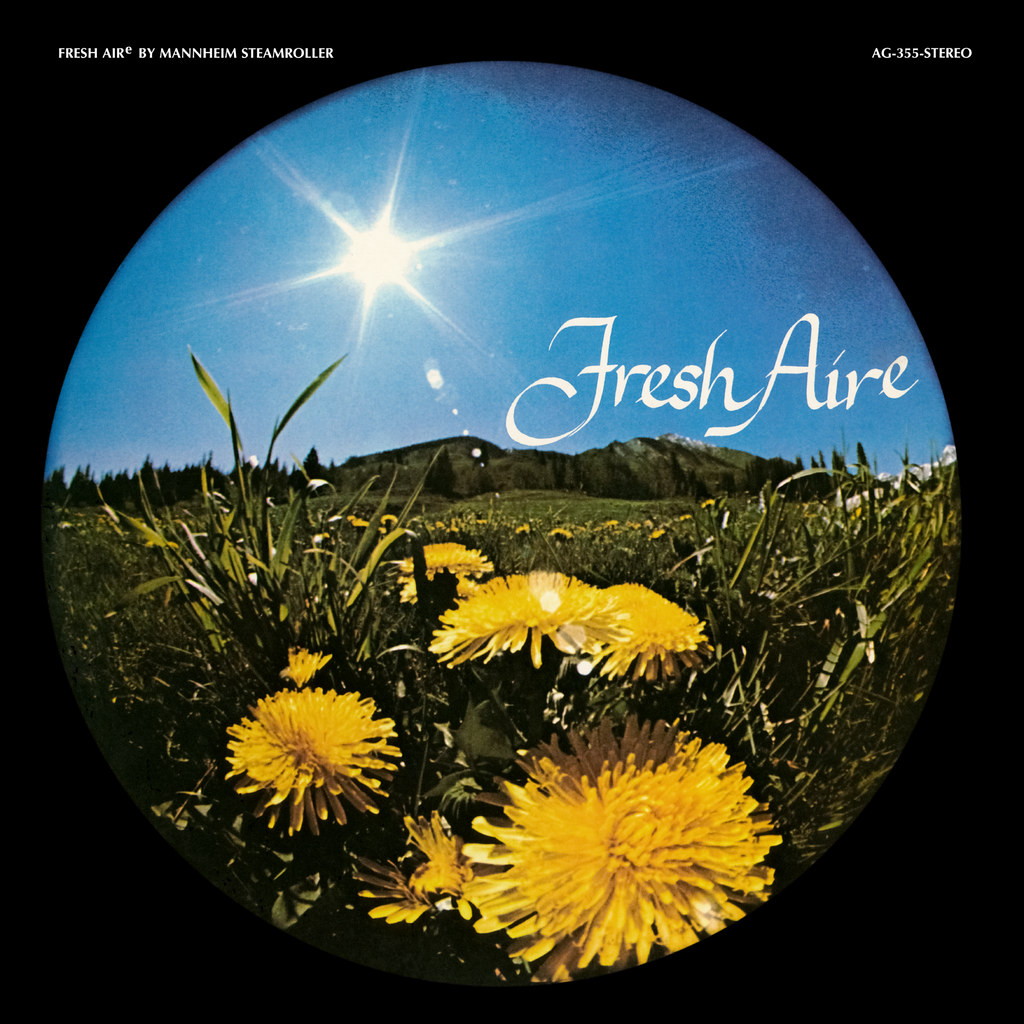
Fresh Aire I is the first album by Mannheim Steamroller, an American band formed in 1974.
The story of Mannheim Steamroller founder Chip Davis (b.1947) is probably one of the strangest in popular music history. Davis began playing the piano at the age of four and graduated from the University of Michigan’s music department, specialising in bassoon and percussion.
Early in his musical career, the classically trained Davis made a living composing music for commercials. Eventually, the jingles Davis composed for the Metz Bakery became so popular that he created a single based on them, featuring the fictional truck driver C. W. McCall, who appeared in the bakery’s advertisements. The song ”Convoy”, sung by McCall (actually country singer William Dale Fries Jr), became a huge hit in America in 1976.
Before his hit truck, however, Davis had a more ambitious vision of instrumental music that would combine modern pop/rock music with the classical music techniques he had painstakingly honed in his head and fingers at university. Sounds like the basic ingredients of progressive rock so far, but Davis was much more interested in older art music than, say, British prog rockers in general, and Davis had little or no natural feel for rock music, so his vision of combining these different trends ended up being tantalisingly original.
Davis was particularly interested in 17th century classical music and the name of the band, Mannheim Steamroller, derives from the German term for the Mannheim music school, ”Mannheim roller” (Mannheimer Walze in German). This term refers specifically to a crescendo with a rising melodic line combined with an ostinato bass line. Not so surprisingly, this method is also repeated in many of Mannheim Steamroller’s songs.
To bring his vision of ”Mannheim music” into the present day, Davis recruited another classically trained musician, Jackson Berkey , who took over not only the piano and harpsichord but also the synthesizer, which plays a major role in the band’s music. Eric Hansen (who later added a lute and guitar to his palette) was chosen as bassist, leaving Davis himself as drummer and lead guitarist. The sound on the first album is also enhanced by a trumpeter and trombonist and, at times, a full string section.
Davis couldn’t get the major labels interested in his concept so he had to set up his own label, American Gramophone (the name humorously referring of course to the famous German label Deutsche Gramophone) to release Fresh Aire. This do-it-yourself solution was still a rarity in the 70s, but it paid off because today Davis is a millionaire. But we’ll come back to this later in our story. Let’s move on to the album and the music itself.
Read also:
- Review: Tool – Ænima (1996)
- Review: Porcupine Tree – Signify (1996)
- Review: The Walker Brothers – Nite Flights (1978)
- Year by Year : Best albums of 1977 – 1-10
- Levyarvio: Absoluuttinen Nollapiste – Nimi muutettu (2002)
- Review: Philip Glass – Songs From Liquid Days (1986)
- Levyarvostelu: Peter Gabriel – Up (2002)
- Review: John Greaves & Peter Blegvad: Kew. Rhone. (1977)
- Review: Flea – Honora (2026)
Fresh Aire I (originally just Fresh Aire) is a concept album with twelve tracks, each focusing on one of the months of the year. Or so the booklet introducing the songs on the album suggests. When the album became a success and Davis decided to make a whole series of Fresh Aire albums, it was suddenly the case that this first album became, in the band’s own words, just about spring and the next three in the series were about the other three months of the year. This suggests that the conceptual integrity of the album is actually quite thin!
A fully instrumental album, it alternates between two stylistic extremes. Roughly half of the songs are upbeat, almost ELP-like prog instrumentals with glorious analogue synth solos and drums beating away in the background. Or not really in the background at all, as Davis’ drums usually ring well above the surface. Often on an equal footing with the instrument playing the main melody. At their best, these, the most energetic tracks on the album, have a great forward momentum and steam ahead irresistibly, doing credit to the band’s name. However, they never quite rock convincingly, but perhaps that’s not the point.
The other half of the pieces are light and beautiful pseudo-classical compositions with piano, strings and harpsichord. In these pieces, Davis abandons his drum kit and concentrates on the recorder (it’s a mystery why he doesn’t play the bassoon at all on the album, for which he has a degree…). Sometimes these two tendencies even clash successfully, but far too seldom, as the usually short (1-5 minutes) tracks on the album unfortunately don’t have time for such a development.
The more upbeat and electric songs are clearly the more interesting tracks, as those more lyrical and lighter songs are in danger of becoming, at times, in all their beauty, too much like pastiche of medieval or baroque classical music. The four dreamy piano interludes (’Interlude I-IV’) also annoyingly sap energy from the whole, even if they are not in themselves unpleasant to listen to.
Mannheim Steamroller’s music is actually a meeting of three different currents: classical music (and a very old one at that), progressive rock and new age, which was in its infancy. In fact, Mannheim Steamroller probably deserves the somewhat dubious honour of being something of a new age pioneer, even though the band’s music is much more upbeat and sophisticated than the output of that genre in general. Mannheim Steamroller cannot really be defined as a prog band either. The band’s music is too entertaining and unrocky for prog, and perhaps not complex enough. Mannheim Steamroller is in a way quite alone in its own category. Sky, formed in the late 70s by guitarist John Williams, perhaps comes closest to the same mood. Personally, I prefer Mannheim Steamroller because Sky was too cheesy from the beginning. Mannheim Steamroller only slowly became that way…
One of Mannheim Steamroller’s trademarks has always been great sound. In my country, Finland, I think the band is known, if known at all, especially through hifi fairs where dealers often showcased the greatness of their equipment with Fresh Aire records. The sound of the band’s records is airy, distinctive, but tight. The wide dynamic range is used to great effect and at their loudest, the band’s records thunder quite boldly. The Fresh Aire series is worth playing loud, it’s an experience that rewards.
Fresh Aire I was a surprise success when it was released, selling a number of copies in the US that were worthy of a gold record. Outside America, the popularity of the album, or Mannheim Steamroller in general, never really spread. This was probably due to the limited distribution possibilities of Davis’s own American Gramophone label. However, Davis was hardly bothered, as Mannheim Steamroller has sold more than 28 million copies in the American market alone.
Initially, Davis expanded the Fresh Aire series (which remained quite good until the sixth volume) into eight volumes, but the band’s real huge success came when they started making Christmas records. Mannheim Steamroller’s Christmas albums, including live albums and compilations, have numbered around thirty since 1984. The first sold over five million copies on its own, and subsequent albums have regularly sold either platinum or at least the equivalent of a gold disc.
In fact, Mannheim Steamroller is now more of a brand than a band, as the band has several ensembles touring across America performing their Christmas music, which consists of original compositions by Davis, but also versions of familiar classics. So Davis’ clever little musical concept eventually grew into an even cleverer money-making machine. At the same time, the band’s music gradually became full-blown kitsch. The musical equivalent of an American fake Christmas tree full of outrageous glittering ornaments.
However, the band’s first album Fresh Aire I is a lively and original take on the fusion of classical music and pop, and while it’s quite light-hearted and unedgy from the start, in the right frame of mind it’s a very enjoyable, uplifting and entertaining listen.
”Rondo”, ”Sara’s Band”, ”Fresh Aire”, ”Pass The Keg”
Author: JANNE YLIRUUSI
Tracks:
”Prelude” – 1:33
”Chocolate Fudge” – 2:54
”Interlude I” – 2:55
”Sonata” – 2:32
”Interlude II” – 2:33
”Saras Band” – 3:37
”Fresh Aire” – 5:30
”Rondo” – 2:36
”Interlude III” – 2:36
”Pass the Keg (Lia)” – 2:33
”Interlude IV” – 2:11
”Mist” – 1:47
Mannheim Steamroller:
Chip Davis: drums, percussion, recorder, toys Eric Hansen: bass Jackson Berkey: keyboards
Don Sears: synthesizer programming, string arrangements
Additional musicians:
Bill Buntain: trombone Denny Schneider: trumpet
Strings: Mortimer Alpert, Dorothy Brown, Hugh Brown, Miriam Duffelmeyer, Ginny Eldred, Lucinda Gladics, James Hammond, Jean Hassel, Joe Landes, Karl Lyon, Bob Malec, Beth McCollum, Virginia Moriarty, Dorothy Redina, Joe Rosenstein, Merton Shatzkin, Alex Sokol, Jess Stern, Larry Sutton, Paul Todd
Producer: Chip Davis ja Don Sears
Label: American Gramophone


Jätä kommentti