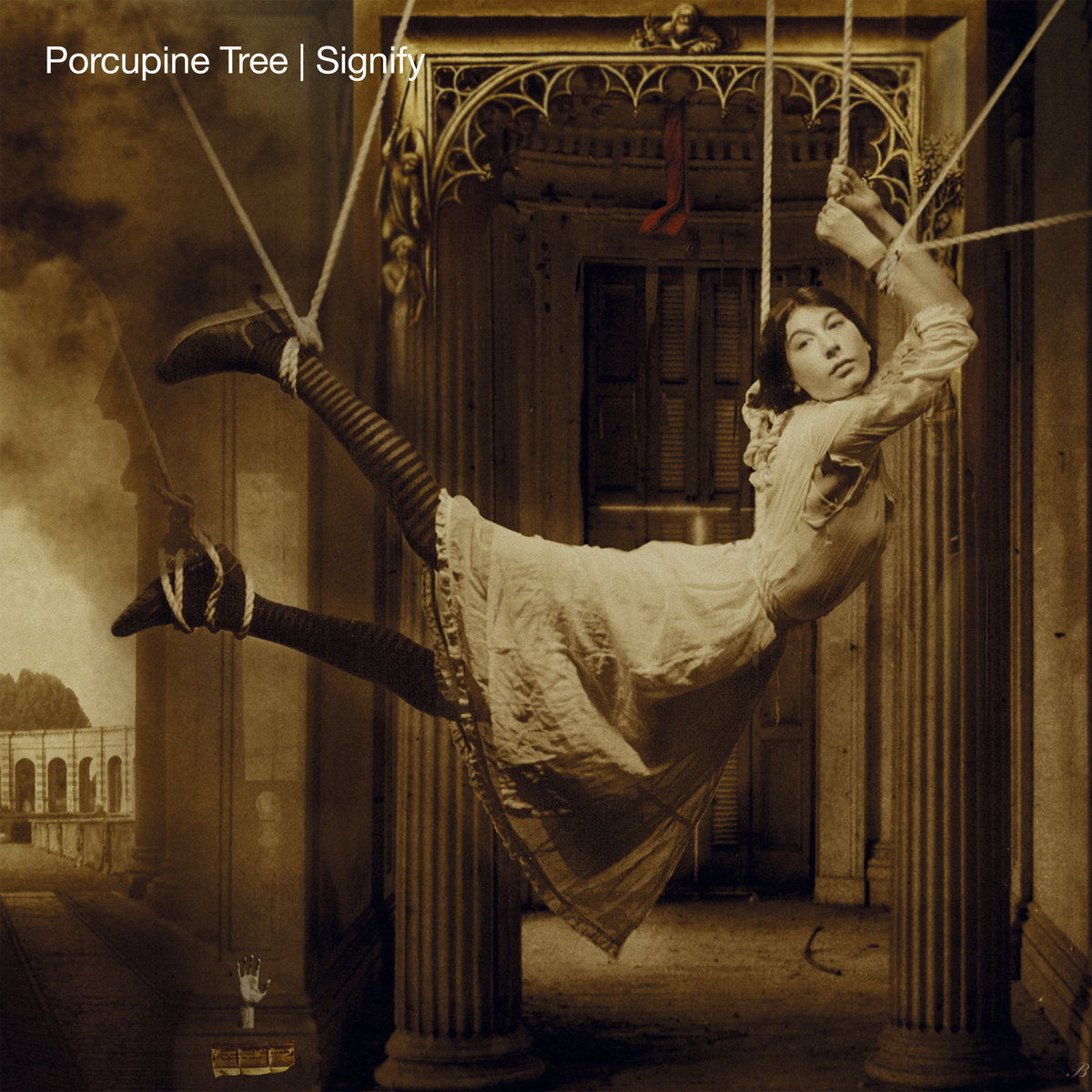
Signify is Porcupine Tree’s fourth studio album.
Porcupine Tree began as a project by Steven Wilson (b. 1967) in 1987. Around the same time, No-Man—founded with Tim Bowness—was Wilson’s main project. No-Man was aimed at a real breakthrough, while Porcupine Tree was, for a long time, just a bit of fun or a hobby.
Porcupine Tree’s first official album was On the Sunday of Life… (1992), which was built around their earlier cassette releases. Even at this stage, Porcupine Tree was still very much Wilson’s one-man project (though Alan Duffy wrote some of the lyrics). The debut is a slightly clunky but charming take—or rather, a pastiche—on the psychedelic rock and prog of the late ’60s and early ’70s. In particular, Syd Barrett’s era of Pink Floyd was likely a key inspiration for Wilson at that time.
On their next album, Up The Downstair (1993), the mood became more serious. Up The Downstair continued to draw inspiration from Pink Floyd, but now also incorporated strong influences from artists releasing experimental electronica in the 1990s. These influences were even more prominent on the 30-minute single Voyage 64, which was released around the same time.
On Up The Downstair, Wilson was backed by other musicians for the first time. However, the contributions of bassist Colin Edwin and Japan’s former keyboardist Richard Barbieri were still limited to just one song on the album.
Released in 1995, The Sky Moves Sideways marked the beginning of Porcupine Tree’s evolution into a full-fledged band. Wilson continued to dominate the band’s sound, but Edwin and Barbieri were now official members and took on a larger role as instrumentalists. The Sky Moves Sideways also featured real drums for the first time, as drummer Chris Maitland joined the band. However, The Sky Moves Sideways remains more of a one-man project augmented by other musicians than a true band album.
Read also: Review: Porcupine Tree – Closure/Continuation (2022)
By the time The Sky Moves Sideways came out, at the latest, it had become clear that No-Man’s breakthrough had not succeeded despite their best efforts (and with the benefit of hindsight, we can now say it didn’t succeed later on either). His side project, Porcupine Tree, on the other hand, had quietly become Wilson’s more successful band. This was partly due to the fact that progressive rock was experiencing a resurgence, fueled by the internet and led by many young bands. Porcupine Tree thus found itself, almost by accident, among the vibrant ranks of the “third wave” of progressive rock, whose front lines included, among others, Spock’s Beard, Echolyn, The Flower Kings, and Änglagård. The popularity of these bands (which was, of course, far from true mainstream success) fueled one another.
The new wave of progressive rock looked back with a touch of nostalgia, and its niche often stemmed from the fact that it satisfied fans’ hunger for “real prog” after the genre’s original bands had simplified their music in the early ’80s. Porcupine Tree’s popularity was also boosted by its explicit nods to Pink Floyd’s golden age. On The Sky Moves Sideways, the influences—particularly from Floyd’s mid-’70s music—were so obvious that at times it’s downright cringeworthy to listen to. Wilson himself regretted his excessive immersion in Floyd nostalgia shortly after the album’s release and decided to make significant course corrections on the next record.
A key change on the album is that Signify is no longer just a Steven Wilson show with occasional guest appearances; instead, Edwin, Maitland, and Barbieri play significant roles as instrumentalists on every track. However, many of the songs were meticulously demoed by Wilson, so in many cases, the other band members’ task was simply to reproduce—using “real” instruments—what Wilson had originally demoed with his synthesizers and programming. The contributions of the other musicians are still significant, and the rhythm section in particular brings a whole new kind of vitality and groove to the music.
A more significant change, however, was that Wilson broadened the range of his influences on Signify. Alongside the earlier Floyd- and space rock-inspired atmospheres, particularly strong influences from krautrock emerge, and the progressive rock influences seem to draw from a broader foundation than before. The variety of spoken-word samples, on the one hand, and abstract synthesizer sounds, on the other, lend the music a more avant-garde feel than before.
Pink Floyd’s influence is still evident in the music, but the impact of individual songs is no longer as clear, and there has been a shift from direct imitation to, as it were, reimagining the same experimental ethos from their own perspective. There are no direct Animals references on Signify, but there is something similar in the dark and oppressive atmosphere of both albums, and there are particular parallels in the cynical attitude of the lyrics, even though Wilson’s lyrics aren’t as political as Roger Waters’.
Signify isn’t exactly a concept album, but many of its songs allude to the human need to achieve something meaningful—to give one’s life some meaning and leave at least some small mark on this planet. Each of us, of course, strives for that sense of significance in our own way, with our own struggles attached to it.
Another new feature of Signify is the more concise format of the songs. The 62-minute album consists—if we disregard a couple of short interludes—mainly of tracks ranging from 3 to 9 minutes in length that adhere more closely to the structures of popular music, though they often stretch and distort those structures.
Read also:
- Review: Porcupine Tree – Signify (1996)
- Review: The Walker Brothers – Nite Flights (1978)
- Year by Year : Best albums of 1977 – 1-10
- Levyarvio: Absoluuttinen Nollapiste – Nimi muutettu (2002)
- Review: Philip Glass – Songs From Liquid Days (1986)
- Levyarvostelu: Peter Gabriel – Up (2002)
- Review: John Greaves & Peter Blegvad: Kew. Rhone. (1977)
- Review: Flea – Honora (2026)
- Review: Pink Floyd – Animals (1977)
The album opens with a less-than-two-minute intro titled “Bornlivedie,” in which a male voice—taken from some old radio program—says in a steady, soothing tone: “And we invite you, wherever you are, whether you’re at home, or whatever / To kick your shoes off and put your feet up, and lean back and / Get yourself a cup of coffee or something, and just relax and / Join us in enjoying some very quiet and / Romantic and relaxed music for a couple of hours.” This is, of course, classic British sarcasm, as what’s in store is definitely not relaxing or romantic music.
This is made clear by the hard-hitting title track that actually kicks off the album. “Signify” is a slightly over three-minute instrumental that clearly brings the album’s krautrock influences to the surface. The song’s original demo was apparently pure krautrock, but the band’s arrangement took it in a new direction. And in a rather interesting way. Krautrock meant nothing to Maitland in particular, and it was apparently due to his influence that the song became more energetic and took on clear Rush influences. The result is a song with fierce riffs—a rather peculiar hybrid of Neu!’s “Hallogallo” and Rush’s “YYZ.” The metallic riff of “Signify,” through which Barbier’s jagged synthesizer textures occasionally weave in a mesmerizing way, also hints at Porcupine Tree’s more metal-oriented future. With its somewhat simple structure and aggressively in-your-face delivery, the track also brings to mind King Crimson’s “Red.”
“Signify” is a prime example of how it doesn’t matter if the source of inspiration is clearly evident, as long as the inspiration is drawn from a wide enough variety of sources and blended into a sufficiently original new creation.
The next track, “The Sleep Of No Dreaming,” calms the mood at first. A dark, atmospheric mood builds over a lightly pulsing Hammond organ pattern, which explodes into intense crescendos in the choruses. Edwin conjures up a nocturnal atmosphere with his double bass, and Maitland’s energetic drumming propels the song forward satisfyingly. “The Sleep Of No Dreaming,” which takes its name from Shakespeare’s Hamlet , showcases Wilson’s darker lyrics than before, as illustrated particularly by these whimsical lines: “At the age of sixteen I grew out of hope / I regarded the cosmos through a circle of rope.” In keeping with the album’s theme, the song seems to allude to anguish—or perhaps numbness—experienced without any inherent meaning.
Following “The Sleep Of No Dreamingin” comes the short, eerie ambient instrumental “Pagan,” which leads into the album’s single, “Waiting Phase One.”
“Waiting Phase One” is the lightest track on the album, where Porcupine Tree most clearly approaches mainstream pop/rock music—albeit with a highly artistic touch. The song is carried by Wilson’s superb guitar work and a beautiful vocal melody, but especially by a killer groove that’s largely thanks to Edwin’s simple yet supple, pumping bassline. The lyrics have a slightly kinky undertone with S&M references, which ties it into the album’s overall vibe. In a photograph taken by graphic designer John Blackford, a woman dressed in 1920s clothing hangs from ropes in a rather uncomfortable position. The “Waiting Phase One” single failed to chart in the UK or elsewhere.
“Waiting Phase Two” is an instrumental track over six minutes long that serves as a prelude to the shorter “Waiting Phase One.” A superb psychedelic atmosphere builds over a hypnotic rhythm—apparently played on hand drums—which is punctuated by various noise elements created with electric guitar and synthesizers. Halfway through, Maitland jumps in to pound his drum kit, and the song’s intensity builds spectacularly as Wilson plays a guitar solo that zips back and forth like a laser beam. In a way, “Waiting Phase Two” is the track on Signify that looks most toward the band’s past, but the end result is far more satisfying than before, now that Wilson has Maitland and Edwin’s powerful rhythm section backing him up. Both are excellent musicians. They may not be front-row virtuosos, but their sense of style is spot-on, and their technique is certainly solid enough. Maitland and Edwin also get the music to groove in a tasty way, which is by no means a given in progressive rock.
“Sever” is a dark song driven by Edwin’s thick bass line. Maitland’s sharp, crashing cymbal hits create a stark contrast to Edwin’s round, resonant bass. In between, Wilson riffs on his electric guitar, and Barbieri weaves all sorts of buzzing sounds into the mix with his synthesizers. The chorus features beautiful vocal harmonies from Maitland. Toward the end, the song’s soundscape becomes quite dense as various spoken-word samples are woven in; the most striking of these is the chanting of a demonic-sounding preacher combined with maniacal laughter. “Hallelujah, hallelujah, hallelujah… that’s the only way to survive, is on your knees.”
The over-seven-minute-long “Idiot Prayer” lightens the mood a bit. The song begins as a floating ambient piece with a retro-style drum machine chugging in the background. A flute-like synthesizer cuts through the rhythms. Around the two-minute mark, the track builds to a more robust sound with programmed techno rhythms that bring a more contemporary feel—though even that feels a bit dated at this point. Amid the thump-thump rhythms, we once again hear random snippets of speech, along with Wilson’s crisp electric guitar playing and Barbier’s synthesizer sweeps. Toward the end, the tempo picks up once more, and Wilson’s frenzied, buzzing electric guitar cuts through the rhythmic thumping. Finally, the song fades out accompanied by futuristically bubbling synthesizer sounds.
“Every Home Is Wired” is a melancholic song in which Wilson sings for the first time about the corrosive aspects of internet society. This is a theme he would return to several times throughout his career. The relatively abstract and poetic lyrics are, in their own way, quite prescient. Especially when you consider just how much optimism was still associated with the internet in the latter half of the ’90s and for a long time afterward. Musically, “Every Home Is Wired” is a relatively light song. Wilson accompanies himself on acoustic guitar, with eerie synthesizer pads drifting in the background. The harmonized chorus beautifully captures the consciousness floating through computer networks. The drums don’t kick in until the very end, and it’s a great moment because they’re heavily reverb-drenched, creating a magnificent, erratic effect against which Edwin solos on his double bass. “Every Home Is Wired” is, so far, the best demonstration of Wilson’s—at times even overly—praised studio skills. Signify certainly sounds, in general, significantly better than the band’s previous albums.
“Friend, in these days you need more than advice / With this satanic invasion from the diabolical legion, you need Christ.” These dramatic words open “Intermediate Jesus.” The source is, once again, an unnamed preacher. Although Signify is Porcupine Tree’s first true band album, in practice the band couldn’t fit into Wilson’s small home studio to play together at the same time, so the music was assembled from individually recorded instrumental takes. The exception is “Intermediate Jesus,” which the band jammed together live. The sessions were so successful that they later led to the release of an entire album titled Metanoia (1998), which compiles about an hour’s worth of the band’s improvisations. Metanoia is a charming curiosity in Porcupine Tree’s discography. Stylistically, “Intermediate Jesus” once again draws on Porcupine Tree’s earlier work with its psychedelic-sounding space rock, but the end result is significantly more intense than before, now that it’s being played by a full band. Maitland’s energetic drumming, in particular, is a joy to listen to.
“Light Mass Prayers” is unique in the Porcupine Tree catalog in that it is the only song in the band’s catalog for which Wilson did not claim compositional credit. “Light Mass Prayers” was composed by Maitland (according to Maitland himself, Wilson’s contribution was so significant that he, too, deserved credit), but contrary to expectations, it is by no means a drum solo; rather, it is in fact a completely drumless ambient track based on ethereally swirling synthesizer sounds and Maitland’s own wordless vocals, which create a choir-like effect. “Light Mass Prayers” certainly wouldn’t work at all as a standalone track, but within the context of the album, it’s a relatively successful interlude—though perhaps a touch too long.
This has become a full-time career
”Dark Matter”
To die young, would take only 21 years
Gun down a school or blow up a car
The media circus will make you a star
The album concludes with the nine-minute “Dark Matter,” which is probably the best-known track from Signify, as Porcupine Tree has occasionally performed it live even into the 2000s. “Dark Matter” was originally titled “Tour Song,” and at that stage, its lyrics focused on venting about the tedium of life on tour from a rock musician’s perspective. Encouraged by the band, Wilson shifted the lyrics toward a more universal theme, though they still seem to address the themes of fame and significance (or insignificance) from a musician’s perspective. Beginning with cool-sounding synthesizer sweeps, the song is a slow and atmospheric track colored by rich vocal harmonies and, toward the end, a unison riff between the guitar and bass that seems to offer a taste of Porcupine Tree’s future flirtation with metal music.
Right at the very end, we hear a spoken sample that stands in sharp contrast to the gentler message heard at the beginning of the album: “You’ve just had a heavy session of electroshock therapy / And you’re more relaxed than you’ve been in weeks / All those childhood traumas magically wiped away / Along with most of your personality,”
Signify, which sold approximately 20,000 copies, is the first album on which Porcupine Tree created something genuinely new and significant. At the same time, however, it is a transitional album, as the band set off in a completely new direction on their subsequent albums. Of course, one can’t fault Wilson and his bandmates for this, but it is somewhat of a shame that the groundwork laid by Signify wasn’t built upon any further.
Best tracks: ”Signify”, ”Waiting Phase Two”, ”Sever”, ”Every Home Is Wired”, ”Dark Matter”
Author: JANNE YLIRUUSI
Read also: Review: Steven Wilson – Grace For Drowning (2011)
Tracks
- Bornlivedie (1:41)
- Signify (3:26)
- The Sleep of No Dreaming (5:24)
- Pagan (1:34)
- Waiting Phase One (4:24)
- Waiting Phase Two (6:15)
- Sever (5:30)
- Idiot Prayer (7:37)
- Every Home Is Wired (5:08)
- Intermediate Jesus (7:29)
- Light Mass Prayers (4:28)
- Dark Matter (8:57)
Porcupine Tree
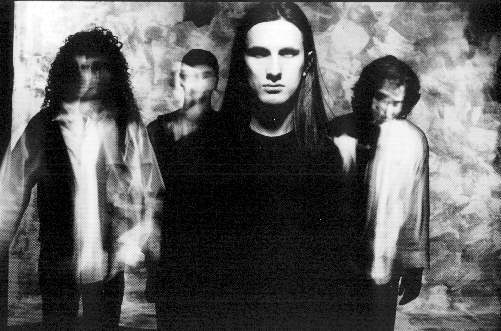
Steven Wilson: vocals, electric and acoustic guitars, samplers, tape loops, organ, Mellotron, piano, drum programming, music box Richard Barbieri: piano, Hammond, synthesizers (Prophet-V, Roland System 700), tape, sequencers Colin Edwin: bass guitar, double bass Chris Maitland: drums, cymbals, percussion, drum loops, backing vocals (5, 7, 11), keyboards (11).


Jätä kommentti