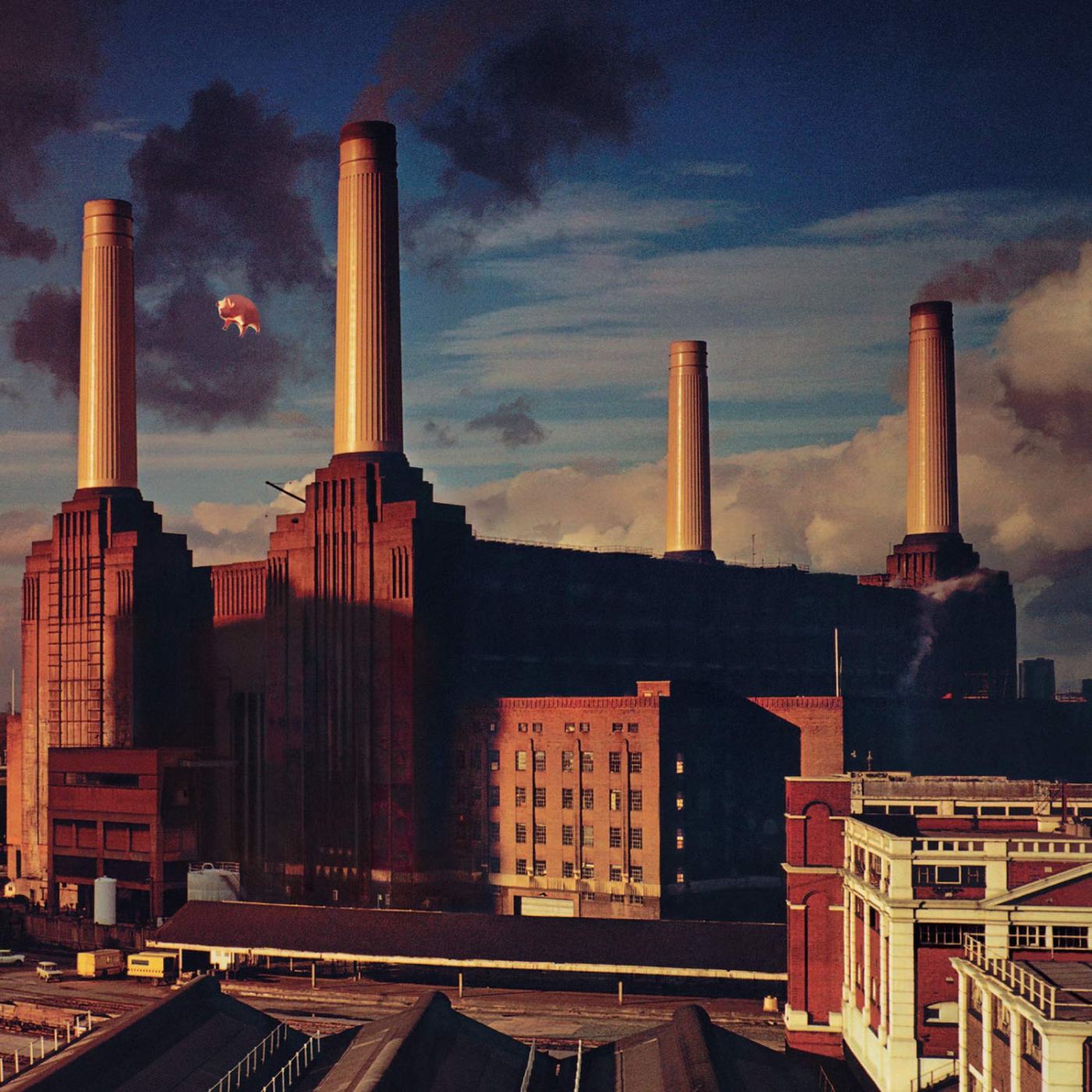
Animals is the eighth studio album by Pink Floyd, founded in 1965. It is their tenth if the soundtracks released by the band are included.
Pink Floyd’s previous album, Wish You Were Here (1975), had been a challenging project, but the resulting album was a magnificent and multifaceted work. Bassist/vocalist Roger Waters had emerged on that album even more clearly as the band’s artistic leader, and this dynamic is only reinforced on Animals. On Wish You Were Here, the band was still, to some extent, a democratic entity, but on Animals, Waters ruled with an almost dictatorial hand. With the exception of one track, all the music and lyrics on Animals are solely the work of Waters.
As I mentioned above, Wish You Were Here is a multifaceted album, but its emotional landscape can, to simplify matters somewhat, be described as tinged with a sad melancholy. Amidst the sadness, there was also a hint of anger towards the injustices of life and modern society. Animals continues naturally from this point, shifting from sadness more towards anger. The sadness is now shaded with an angry satire that burns black. At times, Animals is a downright violent album, as Waters himself has characterised it.
“Let it be said, that although the violence is tempered with sadness – and even a smidgeon of compassion here and there – Animals is very violent album.”
Roger Waters vuonna 1977.
Animals is a more stripped-back and raw-sounding album than its predecessors. However, this was by no means a rushed affair, as the album took no less than ten months to make. This was partly because Floyd’s own new studio, Britannia Row, was still in its infancy and did not quite meet the quality standards the band had become accustomed to. The difference in the end result is clear. Animals doesn’t sound quite as rich and opulent as the band’s two previous albums, but in fact the new, rougher sound suits not only the spirit of the times but also the darker style of Animals. Sarcastic commentators have sometimes even dubbed Animals ‘Punk Floyd’, but that would be an exaggeration. In fact, musically speaking, with its long tracks and structures that eschew choruses, the album fits even better under the banner of progressive rock than most of Pink Floyd’s output. However, the album’s violent and aggressive atmosphere, combined with its socially critical lyrics, makes it – if not exactly in line with punk ideology – at least very much in keeping with the spirit of the times.
The angry and pessimistic – indeed, downright nihilistic – lyrics on Animals are a powerful piece of work by Roger Waters. In my view, Animals is indeed Pink Floyd’s most emotional album, as Waters’ lyrics, which oozes paranoia and misanthropy, feel so incredibly genuine. In 1977, Waters was neither a happy nor a contented man. He was struggling not only with his role as a rock star – a role in which he felt entirely out of place – but also, on a more existential level, with the nature of humanity as a whole and the various roles people play within society. Alongside his own cynical view of humanity, Waters was inspired by George Orwell’s dystopian novel 1984 and, in particular, the same author’s Animal Farm, from which Waters drew, as it were, a basic framework for the theme of animals representing different types of people.
Read also: Review: Pink Floyd – The Dark Side Of The Moon (1973)
Pigs On The Wing (Part One)
The album begins and ends with the simple track ‘Pigs On The Wing’, which is split into two parts to frame the album. Waters sings a little love song, accompanied simply by an acoustic guitar. ‘Pigs On The Wing’ feels a little out of place compared to the album’s theme, but perhaps that isn’t quite the case. We’ll come back to this later.
Dogs
The real highlight of Animals, however, is its three long tracks in the middle, the first of which is the 17-minute-long “Dogs”. Composed jointly by Waters and guitarist David Gilmour back in 1974, “Dogs” was originally premiered on The Dark Side of the Moon tour, at which time it was still known as “You’ve Got to Be Crazy”. For Animals, the track was slightly reworked, both musically and lyrically, to bring it into line with Waters’ new concept.
‘Dogs’ effectively draws the listener into the album’s dark and gloomy world. On the surface, ‘Dogs’ depicts charming businessmen; yet, scratch just beneath the surface and you’ll find psychopaths fearfully pursuing only their own interests. These ‘dogs’ are torn by fear and paranoia about their own position, whilst at the same time driven by a manic fervour to pursue their own interests.
And after a while, you can work on points for style.
Like the club tie, and the firm handshake,
A certain look in the eye and an easy smile.
You have to be trusted by the people that you lie to,
So that when they turn their backs on you,
You’ll get the chance to put the knife in.
Musically, “Dogs” is slightly more complex than typical Floyd material; it is largely built around syncopated acoustic guitar strumming and a droning organ sound, with other instruments layered on top. Long instrumental passages alternate with vocal sections featuring very rapid lyrics. The transition from one section to the next is, without exception, admirably seamless. Gilmour handles the vocals in the first half, whilst Waters takes over towards the end.
David Gilmour plays several magnificent guitar solos on ‘Dogs’. There is a fierce intensity to Gilmour’s playing that one might not usually associate with him, but it suits this track perfectly.
The track features plenty of stylish and well-considered drumming from Nick Mason. In “Dog”, Mason once again proves himself to be a much better drummer than his reputation suggests. Admittedly, Mason is by no means a technical virtuoso, and there have been more than enough dull and lacklustre moments in his career; yet, to balance this out, there are plenty of performances in which he perfectly supports the track with his understated yet creative drumming. ‘Dogs’ is one of those tracks where Mason really comes into his own.
There are also some rather nifty and musical moments composed for the bass guitar. Incidentally, ‘Dogs’ is the only track on Animals on which Waters plays bass. Otherwise, Gilmour was responsible for the bass parts; as the more skilled instrumentalist, he handled the job more quickly and effectively than the band’s original bassist, Waters, would have been able to. Indeed, around this time, Waters used to congratulate Gilmour on the ‘best bassist’ awards that the music press bestowed upon him. The credit for Gilmour’s bass parts often went to Waters, who was still regarded as the band’s official bassist.
The song’s mid-section climax features some truly chilling lyrics, which Gilmour sings absolutely superbly:
And when you loose control, you’ll reap the harvest you have sown
And as the fear grows, the bad blood slows and turns to stone
And it’s too late to lose the weight you used to need to throw around
So have a good drown, as you go down, all alone
Dragged down by the stone (stone, stone, stone, stone, stone)
As the word ‘stone’ echoes into eternity, a slow and hazy instrumental section lasting several minutes begins, featuring Richard Wright’s synthesizers in the foreground and electronically processed dog barks in the background. Wright doesn’t have many proper solos on the album, but in these atmospheric passages he really gets to shine.
At around the 12-minute mark, the syncopated acoustic guitar returns and leads us into the final section, where Gilmour’s vocals give way to Waters’ and the dog’s self-confidence begins to waver (“Sometimes it seems to me as if I’m just being used”). Gilmour gets to play a long, two-part guitar solo, after which we reach the song’s final lines, which make it clear that, of course, not even dogs are equal amongst themselves. The song ends with a powerful ‘who was’ section in which Waters lists the ways in which dogs also subjugate one another.
Who was born in a house full of pain
Who was trained not to spit in the fan
Who was told what to do by the man
Who was broken by trained personnel
Who was fitted with collar and chain
Who was given a pat on the back
Who was breaking away from the pack
Who was only a stranger at home
Who was ground down in the end
Who was found dead on the phone
Who was dragged down by the stone
Delightfully gloomy! “Dogs” is definitely one of Pink Floyd’s finest tracks.
Pigs (Three Different Ones)
“Pigs (Three Different Ones)” begins with an electronic growl and Wright’s bright keyboard ostinato, over which the bass guitar weaves a melodic pattern whilst the electric guitar ricochets sharply all around. The brief but immensely effective intro ends as Mason’s drums kick in alongside Waters’ vocals, and the music takes on a lightly funky feel. Waters sings his taunts at the pigs in a downright playful, mischievous manner. Of course, this playful tone is mixed with a very strong undertone of contempt.
In Waters’ vision, pigs are conservatives clinging to the reins of power, seeking to subjugate others to their will. They are the cream of society: politicians who pull the strings from behind the scenes and manipulate the masses for their own gain.
As the title suggests, the song’s lyrics are about three different pigs. With the exception of the last one, it is not entirely clear who these three individuals – who fall victim to Waters’s merciless mockery – actually are. According to some theories, the pig in the first line is simply a generic politician.
Big man, pig man
Ha, ha, charade you are
You well heeled big wheel
Ha, ha, charade you are
The second verse introduces a female politician who is thought to be Margaret Thatcher, who was rising rapidly in 1977.
Bus stop rat bag
Ha, ha, charade you are
You fucked up old hag
Ha, ha, charade you are
You radiate cold shafts of broken glass
You’re nearly a good laugh
The third and final pig is the only one whose identity is known with 100 per cent certainty. Waters specifically mentions Mary Whitehouse by name. Whitehouse was a British conservative who had campaigned with great zeal for Christian morality and decency. In other words, a classic ‘prude’. Whitehouse’s moral crusade had been quite successful in England and, as a result, Stanley Kubrick’s masterful film A Clockwork Orange, amongst other things, was pulled from distribution. Incidentally, Pink Floyd were not the first rock band to take Whitehouse to task; Deep Purple had also criticised him as early as 1973 in their song ‘Mary Long’
Hey you, Whitehouse
Ha, ha, charade you are
You house proud town mouse
Ha, ha, charade you are
You’re trying to keep our feelings off the street
You’re nearly a real treat
All tight lips and cold feet
And do you feel abused?
You got to stem the evil tide
And keep it all on the inside
Mary you’re nearly a treat
Mary you’re nearly a treat
But you’re really a cry
Halfway through ‘Pigs’, there’s a long, very delicate, hypnotic and repetitive instrumental section, coloured by guitar playing with a talkbox effect. Talkbox-effect guitar work hasn’t generally stood the test of time very well, but in Gilmour’s capable hands it works a treat, especially as those quirky, pig-like effects play a relevant role in the song’s narrative.
During his solo tours in 2016 and 2017, Waters incorporated ‘Pigs’ into his campaign against Donald Trump, whom he detested intensely. The song was accompanied by visual material mercilessly mocking Trump and a macabre pig hoovering above the arena, with the words ‘Trump is a pig’ written on its side. Some of Waters’ fans, for whom his decades-old political views had become a bit too much to bear, took offence, as did a few sponsors who dropped Waters. This did not faze the stubborn Waters.
”I find it slightly surprising that anybody could have been listening to my songs for 50 years without understanding. Go see Katy Perry or watch the Kardashians. I don’t care.”
Roger Waters
Sheep
The ten-minute track ‘Sheep’, composed by Waters, made its debut – just like ‘Dogs’ – back in 1974. At that time, it was still known as ‘Raving And Drooling’.
The track begins in a serene atmosphere. Wright’s gently resonant, reverb-laden electric piano accompanies us out to the pasture to meet the song’s main characters: the sheep. Underneath the electric piano, we can hear electronically processed, eerie bleating.
After a gentle intro, the music becomes more intense as the drums kick in and Waters begins to spit out the lyrics furiously, describing sheep who blindly and meekly follow their leaders. In other words, the common folk, the great masses whom dogs and pigs exploit without mercy.
Around the six-minute mark, a bubbly section begins that pays homage to the band’s space rock past. Water sings softly, his voice buried deep within the music and filtered through a vocoder, delivering lyrics that mischievously parody Psalm 23 (i.e. ‘The Lord is my shepherd’) and tell of the sheep’s hopeless plight.
The Lord is my shepherd, I shall not want
He makes me down to lie
Through pastures green He leadeth me the silent waters by
With bright knives he releaseth my soul
He maketh me to hang on hooks in high places
He converteth me to lamb cutlets
For lo, He hath great power, and great hunger
The music becomes even more energetic once again, and the sheep finally rally, staging a violent uprising. Water depicts the sheep’s uprising using an absolutely brilliant trick in which Waters’s stretched vocal harmonies continue and continue, eventually transforming seamlessly via a synthesiser into the sound of an electric guitar. This trick is repeated many times, each time with slight variations.
Bleating and babbling we fell on his neck with a scream
Wave upon wave of demented avengers
March cheerfully out of obscurity into the dream
Have you heard the news?
The dogs are dead
You better stay home
And do as you’re told
Get out of the road if you want to grow old
So the sheep crush the dogs (i.e. the business elite – so perhaps this is a socialist revolution?), but will they ultimately become new dogs or pigs who command the masses (“you’d better stay at home and do as you’re told”)? Is it impossible to break this cycle?
On the other hand, the ending can also be interpreted to mean that the sheep’s sudden outburst of rage does not in fact lead to a genuine popular uprising, but remains merely a temporary and exceptional act on the part of a generally docile populace. Ultimately, they lack the strength and courage to truly stand up to the dogs and pigs; instead, they humbly return to their homes and their ordinary lives. Whichever interpretation one accepts, Waters seems to be cynically suggesting that real change is not possible.
‘Sheep’ ultimately had a life-changing effect, at least on Waters himself, due to an incident that took place during that song in Montreal in June 1977. Waters had long been distressed and downright angry about the band’s arena and stadium gigs, which had ballooned to massive proportions, and at which he felt he had lost any real connection with audiences that had become nothing but a noisy blur. The gigs had become events where people gathered to smoke weed, get drunk, meet up with friends and, above all, just have a good time. The music itself seemed to be of secondary importance to many, which, to put it bluntly, really pissed off the serious-minded Waters.
At the Montreal gig, Waters finally lost his temper when he turned his attention to one member of the audience who was behaving exceptionally badly. The situation escalated when this fan threw a bottle onto the stage. Waters beckoned the fan to come on stage, but just as the lad, excited by the superstar’s attention, was about to climb onto the stage, Waters spat right in his face. Reflecting on the incident later, Waters was horrified by his own behaviour. The connection with the audience had indeed been severed. Had he become a pig who despised the sheep? It was time to put up a wall…
Pigs On The Wing (Part Two)
The album ends, just as it began, with the second part of the acoustic track ‘Pigs on The Wings’. Whilst in the first part the narrator still seems uncertain about the chances of success in the new relationship, in the second part it feels as though certainty has been achieved.
You know that I care
What happens to you
And I know that you care
For me too
So I don’t feel alone
Or the weight of the stone
Now that I’ve found somewhere safe
To bury my bone
And any fool knows a dog needs a home
A shelter from pigs on the wing
It is interesting that in “Pigs on The Wings 2”, Waters honestly classifies the narrator – that is, according to my own interpretation, himself – specifically as a dog. And that is, of course, exactly what the highly competitive and domineering Waters is, on the scale he created for Animals. The comforting realisation in ”Pigs on the Wings 2”, however, seems to be that, with the help of a strong romantic partnership, an individual (be they a dog, a sheep or a pig) can remain sane even in the midst of a brutal capitalist society that pits people against one another. ”Pigs On The Wings” serves as a light-hearted framework for the album’s three intensely overwhelming central tracks and offers at least a glimmer of hope amidst all the gloom and despair.
I spent a great deal of time analysing the lyrics, as – for me, at least – they are a very central part of the charm of Animals. The music is, of course, brilliant, but at times it perhaps lacks those real standout moments, meaning the album doesn’t necessarily sweep you away completely if the lyrics (of which there are plenty!) fail, for one reason or another, to resonate with you. For me, their sharp angst, tinged with black humour, hits the spot. They’re pitch-black stuff, but in an entertaining way. And yet, their provocative entertainment value doesn’t detract from their genuine emotional impact, nor from the fact that, in my view, they genuinely succeed in reflecting—in a chilling way—this imperfect world of ours and the people struggling within it.
Read also:
- Review: Tool – Ænima (1996)
- Review: Porcupine Tree – Signify (1996)
- Review: The Walker Brothers – Nite Flights (1978)
- Year by Year : Best albums of 1977 – 1-10
- Levyarvio: Absoluuttinen Nollapiste – Nimi muutettu (2002)
- Review: Philip Glass – Songs From Liquid Days (1986)
- Levyarvostelu: Peter Gabriel – Up (2002)
- Review: John Greaves & Peter Blegvad: Kew. Rhone. (1977)
- Review: Flea – Honora (2026)
Animals received a somewhat mixed reception upon its release and sold considerably fewer copies than the band’s two previous albums – which is hardly surprising when you consider how uncommercial the material on the record is. By ordinary mortal standards, an album that has sold millions of copies cannot, of course, be considered a flop.
In 2018, James Guthrie, a sound engineer and producer who had worked with Pink Floyd for many years, produced a new remix of Animals. However, in typical Pink Floyd fashion, the release was delayed by a year whilst Gilmour and Waters argued over the album liner notes. Eventually, the remixed version, featuring new cover art, was released in September 2022. In the traditional sense, Guthrie’s remix sounds better than the original; it has a warmer, fuller sound, and the bass tracks in particular stand out much more clearly than before. On the other hand, Animals is an angry and bitter album, so I’m not entirely convinced that adding warmth is the right approach in this case. The sharpness and a certain sense of confinement in the original mix perhaps added, in just the right way, to the claustrophobic and anxious atmosphere that underpins the album’s themes.

Animals was for a long time a somewhat forgotten and sidelined Pink Floyd album, but it’s heartening to feel that its popularity and appreciation have grown steadily in recent years. Within Pink Floyd, Animals left a slightly bitter aftertaste due to Waters’ dictatorial tendencies, but in my opinion, following Waters’ vision led to the most coherent and artistically powerful work of the band’s career.
Best tracks: ”Dogs”, ”Pigs”, ”Sheep”
Author: JANNE YLIRUUSI
Tracks
Side A
- Pigs on the Wing (Part 1)” 1:24
- ”Dogs” 17:04
Side B
- ”Pigs (Three Different Ones)” 11:28
- ”Sheep” 10:20
- ”Pigs on the Wing (Part 2)” 1:24
Musicians:
David Gilmour: Lead vocals (2), electric guitar (2–4), bass guitar (3, 4), acoustic guitar (2), talk box (3) Roger Waters: Lead vocals (1–5), backing vocals (2, 3), acoustic guitar (1, 5), rhythm guitar (3, 4), bass guitar (2), tape effects (3, 4), vocoder (2–4) Nick Mason: drums, percussion (2–4), tape effects (4) Richard Wright: Hammond organ (2–4), ARP string synthesiser (2–4), Fender Rhodes (2, 4), Minimoog (2, 4), Farfisa organ (2), piano (3), clavinette (3), EMS VCS 3 (4), backing vocals (2)

