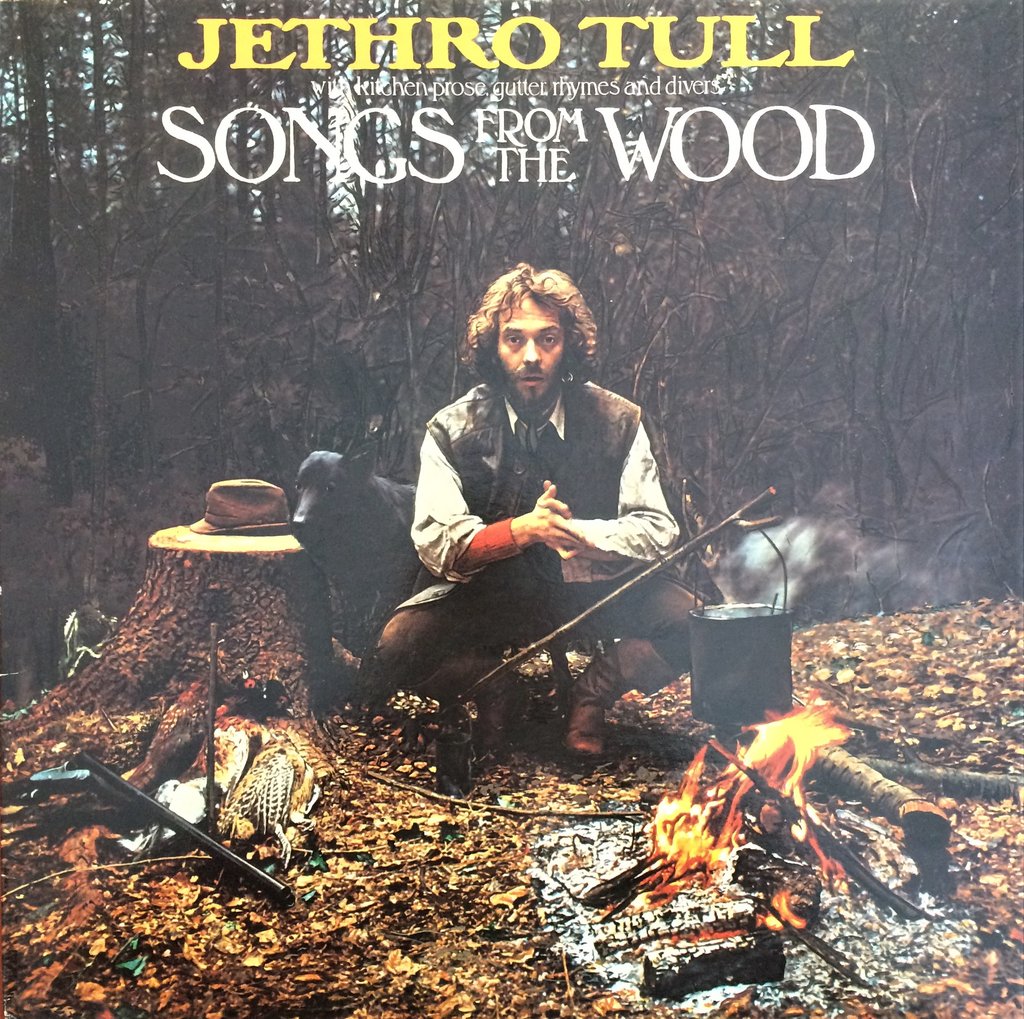
Songs From The Wood is the 10th studio album by Jethro Tull, formed in 1968.
If one is to believe the general historical narrative put forward by rock journalists, then in 1977 the music world was in the grip of the depths of the punk rock nuclear winter, and it was all over for progressive rock. The old dinosaurs had been defeated, or at least herded off to a retirement home to repent for their sins against rock orthodoxy.
In reality, most of the big names in prog, such as Yes, Genesis and Pink Floyd carried on as before and barely even noticed the new, spitting-and-swearing lot. In fact, in the late 1970s, the aforementioned bands were playing to larger audiences than ever before and releasing hit albums at a steady pace. The same applies to Jethro Tull.
Like many other successful British rock musicians, Jethro Tull’s frontman Ian Anderson had also bought a country estate, and whilst strolling through its grounds, the punk rock rumbling through London seemed a very distant affair. Unlike most other rock upstarts, however, Anderson took his role as a country squire very seriously. He developed a genuine interest in that way of life and in the customs, history and traditions of the English countryside. He also immersed himself in British folk tales and myths. The sophisticated album Songs From The Woods, born of these pastoral and, in part, even magical elements of the imagination, was as far removed from the chaos of punk as it is possible to be.
Songs From The Wood is often referred to as the first album in Jethro Tull’s folk trilogy. However, it is not strictly speaking a folk album, nor even a folk-rock album; rather, Songs From The Wood is a thoroughbred prog album that just happens to feature a wealth of folk influences. In fact, Songs From The Wood features some of the most intricate and sophisticated compositions of Jethro Tull’s career, alongside the epics Thick As A Brick and A Passion Play.
The album gets off to a powerful start with the title track ”Songs From The Wood”, which begins memorably with Anderson’s magnificent a cappella and polyphonic vocals (made possible by overdubs), the lyrics of which seem to perfectly encapsulate the ethos of the entire album:
”Let me bring you songs from the wood:
To make you feel much better than you could know”
Songs From The Wood really does make you feel better. Studies show that even a quarter of an hour’s walk in the woods significantly reduces stress, and Anderson seems to have managed to channel this power directly into his music. There is something revitalising and downright empowering about the music on Songs From The Wood.
The title track also largely sets the musical tone for the album. After a brilliant a cappella section, the vibe shifts to a quirky, rhythmic style, whilst the music remains highly melodic at the same time. Anderson’s vocals have never sounded as good as they do on this track, and indeed, he seemed to be at the peak of his vocal and physical abilities on this particular album. Alongside the complex vocal parts, the arrangement of the track is meticulously crafted, and the basic instrumentation is stylishly enriched not only by Anderson’s lively flute passages, of course, but also by various jangling percussion instruments, bells and a keyboard instrument that sounds like a harpsichord. This intricate track is so full of twists and turns that it feels like a far more epic piece than its five-minute duration would suggest. ‘Songs From The Wood’ is undoubtedly one of Anderson’s and Jethro Tull’s finest tracks.
As always, Songs From The Wood is, of course, very much an Ian Anderson show, but this time he deliberately involved the band in crafting the arrangements on a larger scale than he has done for a long time. The band rises magnificently to the challenge, and following the rather lacklustre Minstrel In The Gallery and Too Old to Rock “n” Roll: Too Young to Die! albums, Songs From The Wood feels like a proper band album once again. In particular, the rhythm section – bassist John Clascock and drummer Barriemore Barlow – make the most of the album’s many rhythmic twists and turns and play absolutely brilliantly.
The album’s two keyboardists, John Evan and the band’s long-standing arrangement guru Dee (then still known as David) Palmer, get to shine. Both deliver truly imaginative and colourful performances on a wide variety of keyboards. Palmer, who became an official member of the band with this album, plays a unique portative (a portative is, in a way, a miniature pipe organ) on several tracks, adding a distinctive patina to the band’s sound. Palmer’s classical training also comes through tastefully in the album’s ornate arrangements here and there, even though there are no actual orchestral sections on this occasion.

Although Anderson gave the band more responsibility than usual, he still couldn’t resist playing one track entirely on his own. In ”Jack-In-The-Green”, Anderson impressively plays all the instruments (flute, acoustic guitar, bass guitar, percussion) by himself. This charming little track came together so quickly and spontaneously that Anderson didn’t have time to call on the rest of the band for help.
Although Songs From The Wood is often regarded as a folk-rock album, its sound is by no means particularly dominated by acoustic instruments, as one might expect. Of course, Anderson’s flute and acoustic guitar play a significant role, as always, but on the other hand, synthesisers and various keyboards are also given plenty of space.
Guitarist Martin Barre is perhaps something of a casualty in the band’s new sound, as his electric guitar is often slightly overshadowed by the other instruments. On the other hand, when Barre finally gets a chance to shine, the impact of his edgy riffs is even more powerful than usual. Barre’s guitar really comes into its own in the fierce, marching-style rocker ”Hunting Girl”, which is one of the album’s best tracks. It skilfully combines Barre’s downright menacing, hard-rock-style guitar riffs with the track’s fluid and constantly surprising prog-rock rhythm. Barre’s guitar also wreaks havoc brilliantly on the album’s longest track, the eight-minute ”Pibroch (Cap in Hand)”; otherwise, Barre has to make do with weaving in and out amongst the rich instrumentation.
Songs From The Wood is a consistently strong album, but alongside the title track and ”Hunting Girl”, my particular favourites have become ‘Whistler’, ‘Velvet Green’ and ”Ring Out Solstice Bells”.
“The Whistler” is the most catchy track on the album. This jubilant, Celtic-influenced song is fast-paced and features an irresistible chorus. At just three minutes long, the track doesn’t waste a single moment and features lightning-fast tin whistle playing from Anderson and jangling bells from Barlow.
”Velvet Green”, which begins with the beautiful sound of a harpsichord, is, by contrast, a more devotional track and seems to blend medieval music with church music. The track does, however, have its more energetic moments and features some of Barlow’s most creative moments on the drums. With its medieval atmosphere and recorders, “Velvet Green” is strongly reminiscent of Gentle Giant, a band that Ian Anderson is known to have held in high regard.
Praise be to the distant sister sun,
Joyful as the silver planets run
Seven maids move in seven time
Sing the song the bells call, loudly chiming
“Ring Out Solstice Bells” belongs to the extremely rare category of successful Christmas songs. Despite its Christmas theme, it isn’t overly ‘Christmassy’ musically, even though it does feature the ringing and jingling of bells that are somewhat reminiscent of sleigh rides. And although the track was released as a Christmas single at the request of the record label Chrysalis, the lyrics actually tell a story from a pagan rather than a Christian perspective. The lyrics to “Ring Out Solstice Bells” contain typical prog-rock whimsy, referring in turn to seven maidens and seven druids who, of course, dance in a circle. After all, “Ring Out Solstice Bells” is in 7/4 time. Handclaps are used playfully as part of the rhythm track, and the bells played by Barlow ring out majestically during the song’s festive climax.
Read also
- Review: The Walker Brothers – Nite Flights (1978)
- Year by Year : Best albums of 1977 – 1-10
- Levyarvio: Absoluuttinen Nollapiste – Nimi muutettu (2002)
- Review: Philip Glass – Songs From Liquid Days (1986)
- Levyarvostelu: Peter Gabriel – Up (2002)
- Review: John Greaves & Peter Blegvad: Kew. Rhone. (1977)
- Review: Flea – Honora (2026)
- Review: Pink Floyd – Animals (1977)
- Levyarvio: Flea – Honora (2026)
After a couple of slightly lacklustre albums, Ian Anderson and his band managed to produce one of their finest. Songs From The Wood is the perfect blend of folk and rock and doesn’t really contain a single weak moment. If Robin Hood and his merry men were to decide to make a prog album, I’d be very surprised if it didn’t sound more or less like Songs From The Wood. Songs From The Wood is, alongside Thick As A Brick, Jethro Tull’s finest album and one of the brightest gems of folk-influenced progressive rock.
Jethro Tull’s folk trilogy continued 14 months later with the release of Heavy Horses (1978), an album that is almost as fine as its masterful predecessor.
Best tracks: ”Songs From The Wood”, ”Cup Of Wonder”, ”Hunting Girl”, ”Velvet Green”, ”The Whistler”, ”Ring Out Solstice Bells”
Author: JANNE YLIRUUSI
Tracks
Side A
- ”Songs from the Wood” 4:52
- ”Jack-in-the-Green” 2:27
- ”Cup of Wonder” 4:30
- ”Hunting Girl” 5:11
- ”Ring Out, Solstice Bells” 3:43
Side B
- ”Velvet Green” 6:03
- ”The Whistler” 3:30
- ”Pibroch (Cap in Hand)” 8:35
- ”Fire at Midnight” 2:26
Musicians:
Ian Anderson: vocals, flute, acoustic guitar, mandolin, cymbals, tin whistle Martin Barre: electric guitar, lute John Glascock: bass guitar, backing vocals John Evan: piano, organ, synthesisers Dee Palmer: piano, portative organ, synthesisers Barriemore Barlow: drums, percussion, marimba, glockenspiel, bells, naggara, tambourine

