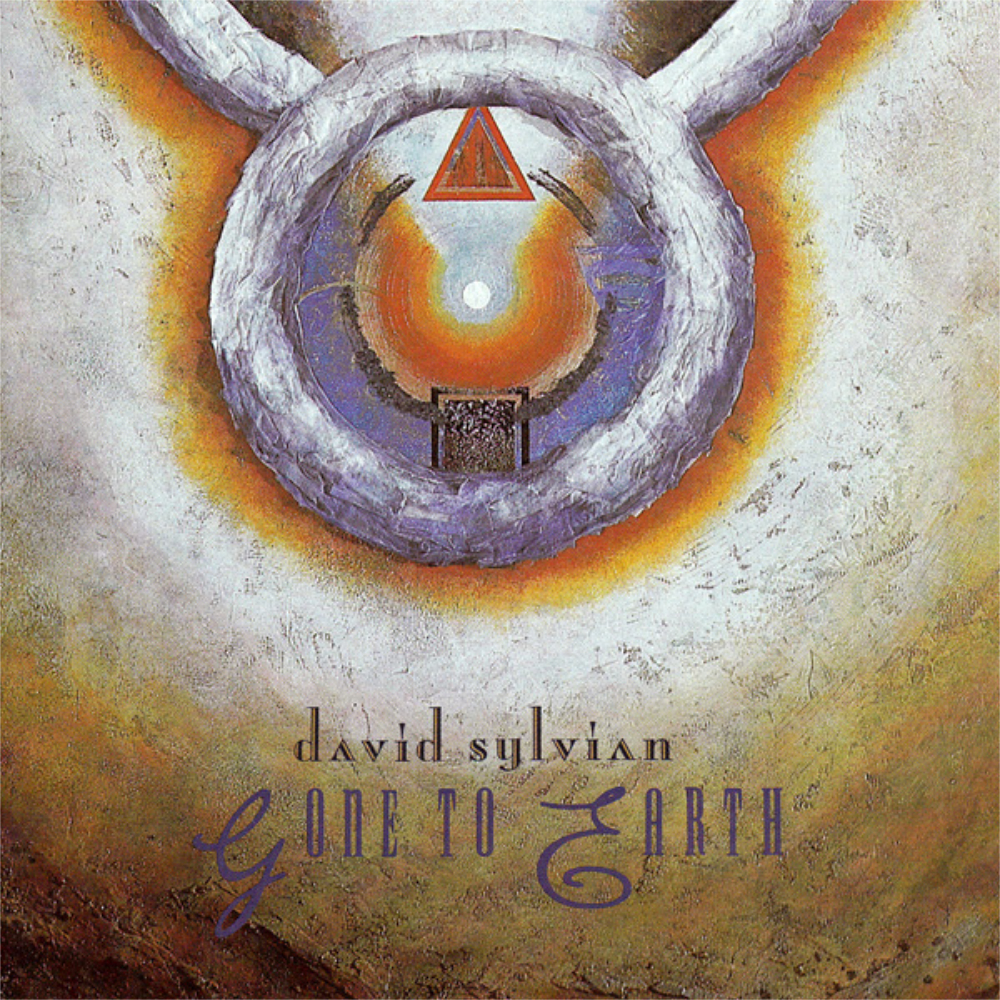
Gone To Earth is David Sylvian’s third solo album.
In 1984, David Sylvian successfully broke away from the pop sound of his former band, Japan, which he no longer believed in, with his first solo album, Brilliant Trees . Pop wasn’t entirely left behind on Brilliant Trees, of course, but it blended in a unique way with ECM-style jazz, resulting in a completely new kind of art rock hybrid.
Following his well-received debut, Sylvian released an EP featuring ambient-style instrumental music titled Words With The Shaman, in collaboration with Jon Hassell, Holger Czukay (Can), and a few other musicians who had already been part of Brilliant Trees. Shortly after this, a Japanese television network wanted to make a documentary about Sylvian. Sylvian wasn’t particularly enthusiastic about the idea, but since he was short on money, he agreed to the project—especially since it gave him the opportunity to compose music for it. For the documentary, a 19-minute ambient piece titled “Steel Cathedrals” was created, with contributions from King Crimson guitarist Robert Fripp, who would go on to become an important collaborator for Sylvian. In December 1985, the material from Words With The Shaman and “Steel Cathedrals” were released as a limited-edition C-cassette titled Alchemy: An Index of Possibilities.
Due to its esoteric nature, Alchemy: An Index of Possibilities received very little attention upon its release, but Sylvian had no intention of leaving instrumental music behind on his next album either. On the contrary, Sylvian’s third album, Gone To Earth, offers a full 40 minutes of that genre. But if you’re a Sylvian fan who especially loves his lush baritone voice, don’t worry; Gone To Earth is a double album, and the second disc contains an equal amount of art rock with vocals reminiscent of Brilliant Trees.

The record label Virgin was not at all enthusiastic about releasing more instrumental music by Sylvian and ultimately agreed to the release only on the condition that Sylvian pay for half of the production costs out of his own pocket. Gone To Earth was originally released as an 80-minute double-vinyl set, but the CD version was shortened to 68 minutes, with four instrumental tracks omitted. The full-length CD version was finally released in 2003, and it even paid homage to the original vinyl version in that the vocal and instrumental tracks were split across separate discs. As a bonus, three remixed tracks were included.
Like Brilliant Trees, Gone To Earth was also recorded with a large ensemble of musicians. Once again, rather than relying on typical studio session musicians, the lineup consists mainly of pioneers and innovators in their respective genres. With 11 different musicians contributing, this album is not, even this time, a true “band” album. Sylvian once again worked in tandem with his musicians, recording one musician’s parts at a time before moving on to work with the next. This was due in part to Sylvian’s shyness, but perhaps also to his insecurity; he had no formal training in music whatsoever, and unlike his skilled musicians, he was not particularly proficient at playing any instrument (despite this, Sylvian plays both guitar and keyboards on the album).
Of the musicians on the album, the two guitarists clearly stand out as the most significant. Robert Fripp dominates the first album in particular, playing on seven of the album’s 17 tracks. Bill Nelson, the art-rock guitarist known from Be-Bop Deluxe, plays guitar on six tracks. Pedal steel specialist B.J. Cole also plays on a couple of tracks. Gone To Earth is, in fact, a more guitar-driven album than its predecessor, which gave plenty of space to the horns.
Of course, there are wind instruments on this album as well. Norwegian ECM maestro Jan Garbarek was invited to participate in the album, but for one reason or another, he declined. Instead, another jazz veteran, Kenny Wheeler—who did a magnificent job on Brilliant Trees—returns to play the flugelhorn on two tracks. Harry Beckett also plays the same instrument on one track, and Mel Collins gets to shine on his soprano saxophone twice.
It’s interesting to note, by the way, that Collins—who played with King Crimson in the early ’70s—plays on Gone To Earth on the same tracks where his former employer, Fripp, also performs. However, due to Sylvian’s working methods, Collins and Fripp never met even once during the recording sessions, as both men recorded their parts separately. This is somewhat of a shame, as the musicians were estranged at the time, and perhaps a meeting would have helped heal the rift at that stage. Instead, the reconciliation between Collins and Fripp didn’t happen until 2014, when Fripp invited Collins to join the revamped King Crimson. Collins happily played with Crimson until the band’s farewell tour in 2021.
Read also: Review: David Bowie – Low (1977)
Gone To Earth’s first album largely follows the path laid out by Brilliant Trees. It features epic, dark-toned ballads in which jazz influences meet the spirit of art rock. When I speak of “epic,” I don’t mean the kind of grandiosity familiar from prog, but rather that the songs occasionally stretch the conventional language of pop music. And even though the music is, on the surface, restrained, there often seems to be a certain kind of restrained drama bubbling beneath the surface. The songs are also characterized by a certain seriousness and even a slightly defiant artistry. Sylvian clearly strives to create Art with a capital A. I have to admit that I haven’t delved very deeply into the lyrics of Gone To Earth, but at least on the surface, they seem to be brimming with references to Gnosticism, Buddhism, and, above all, the search for a spiritual path.
Gone To Earth, produced once again in collaboration with Steve Nye, features superb, crisp sounds—especially on the first disc, which contains more dynamic music. The sound is downright luxurious, yet it doesn’t feel sterile at all. There’s something in the sound reminiscent of Bryan Ferry’s pop masterpiece from the previous year, Boys And Girls, though the sound of Gone To Earth is more organic, rougher, and less “pop” than Ferry’s.
The seven songs on the first album—ranging from three to nearly ten minutes in length—are of fairly consistent quality. There isn’t a single weak track among them. However, in my opinion, five songs—“Taking The Veil,” “Before The Bullfight,” “Gone To Earth,” “Wave,” and “Riverman”—stand out above the rest.
“Taking The Veil” is generally the most energetic track on an album that otherwise has a fairly calm and slow tempo. The song is anchored by Steve Jansen’s solid and stylish drumming, Jennifer Maidman’s bass line—which pays homage to Mick Karn—and Fripp’s fast-paced, cyclical patterns on the electric guitar. The music is given plenty of space, and Sylvian’s soft vocals appear only now and then, as if to comment on the music. “Taking The Veil” was the album’s first single release, but it charted relatively modestly in England, peaking at No. 53 on the singles chart.
Jansen’s drumming also makes an impression on the dramatically atmospheric “Before The Bullfight.” Jansen’s drums resonate with a magnificent, massive sound—almost like a timpani—but his playing remains restrained and airy. The track, which lasts over nine minutes, is crowned by Kenny Wheeler’s flugelhorn, which at times rapsodically rattles but at the same time rings out with a clear, resonant tone.
“Gone To Earth,” a song that emerged quite spontaneously from the collaboration between Sylvian and Fripp, begins with Fripp’s offbeat electric guitar playing, to which Sylvian’s voice joins almost immediately. Sylvian’s voice carries the melody, against which Fripp’s atonal guitar playing creates a fascinating contrast. Aside from Fripp and Sylvian, no other musicians are heard on the track. The short composition suddenly collapses into a minimalist and very quiet ambient section before eventually fading away. A strange little song.
“Wave” is perhaps the most beautiful track on the album. It has a languid feel, yet still sounds fateful. The song gets its edge not only from Fripp’s electric guitar playing—which alternates between a wonderfully melancholic wail and a veritable barrage of notes—but also from Harry Beckett’s sharply resonant flugelhorn. Fripp also plays a short, tense guitar synthesizer solo with a trumpet-like sound. Sylvian’s vocal performance is also exceptionally passionate, though it doesn’t break with his characteristic aura of deliberate restraint.
In addition to the four tracks presented above, the hypnotic “Riverman” also deserves a special mention. In it, the percussion creates a kind of mystical, shamanic atmosphere; Fripp’s electric guitar sparkles like mercury; and Sylvian’s vocals dominate the track, mixed right up front, sounding gentle yet forceful.
Read also: Review: Roxy Music – Stranded (1973)
Gone To Earth’s second album is a bit of a challenge for me. Not because the music is difficult or complex—on the contrary, it’s extremely simple. I’m not a big fan of ambient music, but fortunately, Sylvian’s take on the genre offers music that’s more dynamic than average.
These gentle instrumental pieces are often based on a single simple idea and at times feel like fragments of something larger. In this sense, they are somewhat reminiscent of the instrumentals on Brian Eno’s masterful Another Green World. The instrumentation is generally built primarily around Sylvian’s atmospheric synthesizers and either Fripp’s or Nelson’s minimalist electric guitar patterns.
To be honest, I’ve never really been able to distinguish the songs on the second album from one another very well. In my mind, they blend together into one big tapestry of sound—one that’s really nice to lose yourself in when you’re in the right frame of mind, but which can even feel a little boring at the wrong moment.
At times, the music comes across as nothing more than luxuriously superficial muzak, a kind of soundscape, but here and there there are also deeper underlying currents. At times, the songs seem to depict a kind of bottomless loneliness that isn’t actually sad, but rather bittersweet.
For me, one of the standout moments on the second album is Robert Fripp’s heartbreakingly beautiful electric guitar solo in the song “Camp Fire: Coyote Country.”
Read also:
- Review: Rush – Roll The Bones (1991)
- Review: David Sylvian – Gone To Earth (1986)
- Review: David Bowie – Low (1977)
- Levyarvio: A.W. Yrjänä – Eidolon (2026)
- Review: Khatsaturjan – Monologue Of Chronos (2026)
- Review: Yes – Going For The One (1977)
- Levyarvio: Echolyn – Mei (2002)
- Review: Island – Pictures (1977)
- Levyarvio: Khatsaturjan – Monologue Of Chronos (2026)
For me, Gone To Earth’s absolute centerpiece is its first album, with its amazing art-rock songs. As for the ambient music on the second album, it’s like a bonus disc to me—something that’s nice to listen to every now and then when I’m in the mood for something really peaceful and easy on the ears.
The very different styles of the two albums make Gone To Earth a rather uneven work overall, but at its best, it features some of the finest moments of Sylvian’s solo career. After Gone To Earth, Sylvian went through one of the worst bouts of depression of his life, but managed to create his own masterpiece in the midst of it.
Best tracks: ”Taking The Veil”, ”Before The Bullfight”, ”Wave”, ”Gone To Earth”, ”Riverman”, ”Camp Fire: Coyote Country”, ”Home”
Autho: JANNE YLIRUUSI
Read also: Review: Scott Walker – Tilt (1995)
Tracks
Disc 1
A1 Taking the Veil 4:39
A2 Laughter & Forgetting 2:40
A3 Before the Bullfight 9:45
A4 Gone to Earth 3:02
B1 Wave 9:11
B2 River Man 4:54
B3 Silver Moon 6:08
Disc 2
C1 The Healing Place 5:35
C2 Answered Prayers 3:11
C3 Where the Railroad Meets the Sea 2:53
C4 The Wooden Cross 5:01
C5 Silver Moon Over Sleeping Steeples 2:25
D1 Camp Fire Coyote Country 3:45
D2 A Bird of Prey Vanishes Into a Bright Blue Cloudless Sky 3:20
D3 Home 4:35
D4 Sunlight Seen Through Towering Trees 3:00
D5 Upon This Earth 6:30
Musicians
David Sylvian: vocals, keyboards (A1, A3, B1, B2, B3), guitar (A1, A3, A4, B2), electronics (A1, A2) Robert Fripp: guitar (A1, A4, B1, B2, B3, D1, D5), Frippertronics (A4, B1, B2, B3) Steve Jansen: drums (A1, A3, B1, B2, B3) Phil Palmer: acoustic guitar (A1) Jennifer Maidman: bass guitar (A1, B2, B3) Kenny Wheeler: flugelhorn (A2, A3) John Taylor: piano (A2) Bill Nelson: guitar (A3, B1, B3, C1, C2, D4) Richard Barbieri: electronics (A3, B1) Harry Beckett: flugelhorn (B1) Mel Collins: soprano saxophone (B2, B3) B.J. Cole: pedal steel guitar (B3, C5) Joseph Beuys: voice (C1) John G. Bennett: voice (A4) Robert Graves: voice (D5)
 Pienemmät Purot
Jätä kommentti