After a series of albums in the 1980s that featured an increasing amount of Geddy Lee’s synthesizers, Rush returned to a more minimalist style with 1989’s Presto. This approach continued and evolved on Roll The Bones. The talented trio no longer created complex prog rock songs but instead focused on clear melodies. And with synthesizers no longer dominating the soundscape of the songs, fans were once again able to enjoy Alex Lifeson’s crisp, airy guitar parts. Rush was once again a guitar-driven rock band, with keyboards occasionally adding color to the songs. Neil Peart’s lyrics—which one review noted would be good enough even as wall posters—were once again full of profound ideas on this album. The lyrics often originated from a small snippet of text that Peart had jotted down over the previous two years.
After Presto, Rush had gone on a shorter tour than usual. The reason was that the band members weren’t sure how fans would react to their new style. The reception, however, was positive, and after the tour ended, everyone was eager to make new music. The songs on Roll The Bones were created in a similar way to those on Presto: Geddy Lee developed the vocal melody before any other musical elements, and Alex Lifeson approached the songs with a slightly funkier playing style.
For some reason, Roll The Bones gives me a stronger sense than Presto that perhaps Rush was suffering from a sort of hangover after the production gimmicks of the mid-1980s, which at times went a bit overboard. Although the grandeur of Rush’s music from a few years prior worked wonderfully on, for example, Power Windows’ “Manhattan Project,” the style of Rupert Hine—who had already served as producer on Presto—successfully serves the songs on Roll The Bones in a completely different way. Another factor in Rush’s stylistic shift was the emergence of grunge on the music scene in the early 1990s. Musically and in terms of production, Rush stripped away the unnecessary frills from their songs, but despite the somewhat dark lyrics on Roll The Bones, they didn’t end up taking a gloomy turn like the Seattle bands did.
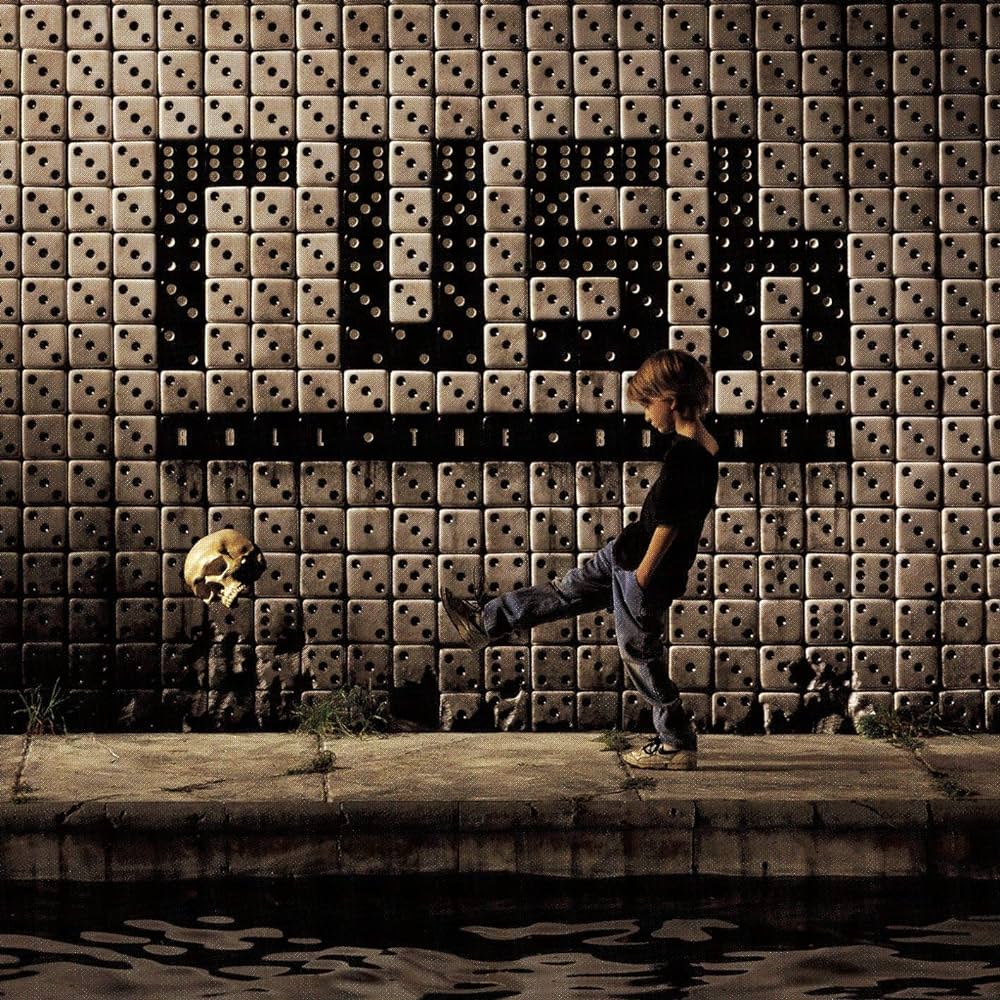
Change and randomness emerged as a loose theme that tied the album’s lyrics together. In keeping with tradition, the cover art by Hugh Symen once again plays with the meanings of words and phrases. Does “roll the bones” refer to throwing dice (traditionally made of bone) or to “getting the bones moving”? According to Neil Peart, it was both.
The members of Rush have fond memories of making the album. The recording sessions went exceptionally quickly—reportedly, they had two months more time than needed—and the album’s release was even moved up from the originally planned date. Alex Lifeson was also pleased that the album included guitar parts taken directly from his own demo recordings. Like Presto, Roll The Bones sounds like an album made specifically by the trio.
The album’s opening track, “Dreamline,” kicks things off in a stylish and energetic way. There’s very little progressive rock in this track; it sounds mostly like stadium rock stripped of all unnecessary complexity. Geddy Lee sings in a lower register, similar to Presto, which also reduces the tension found in the songs on Roll He Bones. The almost straightforward, unrhymed lyrics of “Dreamline” paint exciting pictures of traveling from one place to another—sometimes along the U.S. West Coast, sometimes somewhere in outer space.
“Bravado” gets off to a rousing start, yet—for a Rush song—it’s strangely simple. Far more instrumental parts were originally composed and recorded for the song than what’s heard on the album, but the stripped-down version was found to work best. The simplicity of “Bravado” is further emphasized by Geddy’s bass line, which is played practically only on the root notes of the chords and using only eighth notes. At least this leaves room for Alex’s superb guitar parts. Lyrically, “Bravado” feels somewhat similar in theme to the previous album, “The Pass”—you shouldn’t give up after a failure.
As the role of the keyboards was scaled back, the few chords played on them make an even greater impact. “Roll The Bones” is a good example of this. The calm vocals flow beautifully, and the interplay between the guitar and occasional keyboard parts works elegantly. “Roll The Bones” also features what is probably Rush’s most surprising musical moment—a rap section. I don’t think Rush was trying to attract a new audience with this foray into a different genre; it was simply a moment of fun. The lyrics deal with the randomness of life and fate, which would show Neil Peart its more unpleasant side later that same decade.
“Face Up” picks up the pace again, though it does have a calmer, more subdued section. It’s actually about as straightforward a pop-rock song as you’d ever expect from Rush. I wouldn’t exactly call it a filler track, but it feels like something is missing.
Roll The Bones features an instrumental track after a ten-year hiatus. “Where’s My Thing? (Part IV, ‘Gangster Of Boats’ Trilogy)” is a lively little tune that, surprisingly, isn’t filled with virtuosic playing. The style shifts several times; after the initial funk-inspired vibes, the track even ventures close to jazz. During the instrumental—which at times becomes downright playful—Geddy’s bass playing occasionally resembles Les Claypool’s style. So is it just a pure coincidence that Primus served as Rush’s opening act on the tour following Roll The Bones?
Read also:
- Review: Philip Glass – Songs From Liquid Days (1986)
- Levyarvostelu: Peter Gabriel – Up (2002)
- Review: John Greaves & Peter Blegvad: Kew. Rhone. (1977)
- Review: Flea – Honora (2026)
- Review: Pink Floyd – Animals (1977)
- Levyarvio: Flea – Honora (2026)
- Review: Yes – Magnification (2001)
- Review: Jethro Tull – Songs From The Wood (1977)
- Review: A.W. Yrjänä – Eidolon (2026)
The rather gloomy “The Big Wheel” is a simple song by Rush’s standards. Sounding like a song built around roughly three chords and driven by a simple riff, it comes across as strangely hopeless, even in its lyrics. Although the song doesn’t sound like Pink Floyd, the lyrics share a similar dark fatalism found in some of Roger Waters’ lyrics, where one simply drifts with the current or is caught up in a vast machine.
“Heresy” is once again superb in terms of its lyrics. In the lyrics, Neil Peart reflects on the post-Berlin Wall era from the perspective of East Germans. “Do we have to be forgiving at last? / What else can we do? / Do we have to say goodbye to the past? / Yes, I guess we do.” The song’s atmosphere fits the message perfectly.
“Ghost Of A Chance” is, once again, a fairly simple song, but the opening guitar melody is truly catchy. The idea behind the lyrics—that we have a small chance of finding “the one” by chance and making it work—can move even a cynic like me. “Ghost Of A Chance” seems to underscore the fact that Rush had evolved into a vocal-driven band. The lyrics no longer had to compete with the music’s complex melodies. The song is capped off by Alex Lifeson’s magnificent guitar solo, which he himself considered one of his best.
Geddy Lee stated in an interview I read recently that, in his opinion, “Neurotica” should never have been released. Admittedly, the chorus—which sounds a bit corny—makes this song seem like a slightly odd Rush track, but on the other hand, the song seems to contain familiar elements from Rush’s earlier songs. In my opinion, the beginning has moments reminiscent of the closing track “Countdown” from Signals, and at times the atmosphere takes me back to the days of Power Windows.
The pleasantly upbeat “You Bet Your Life” brings the album to a successful close, even though, according to Geddy Lee, there were problems with its recording and mixing. The song’s melody is catchy, the backing vocals aren’t distracting, and Neil Peart’s quirky lyrics leave the album with a good aftertaste. “Anarchist reactionary running-dog revisionist / Hindu Muslim Catholic creation/evolutionist / rational romantic mystic cynical idealist / minimal expressionist post-modern neo-symbolist / armchair rocket scientist graffiti existentialist / deconstruction primitive performance photo-realist / be-bop or a one-drop or a hip-hop lite-pop-metallist / gold adult contemporary urban country capitalist.” I don’t understand it either, but there’s something fascinating about it.
Released in September 1991, the album was, as usual, well received. In the United States, it climbed as high as No. 3 on the Billboard album chart—Rush’s best chart position since Moving Pictures. In my home country of Finland, it peaked at No. 6; in the UK, No. 10; and in Canada, No. 11. In retrospect, Roll The Bones has been rated as a mid-tier album among Rush’s discography. Of course, this album doesn’t quite reach the level of their most beloved classics, but this more settled and mature band certainly offers a pleasant and thought-provoking listening experience.
If one wanted to briefly describe Roll The Bones, one might call it Presto 2.0. Most of the songs are catchy, and in terms of production, the band has taken a step forward. Producer Rupert Hine, who also helped with the song arrangements, seemed to work well with the band. The new style seemed to suit Rush. After the album’s release, it was time for another long tour, but despite that, the next Rush album hit stores as early as 1993. Variety is refreshing, and in Rush’s case at least, the change in style gave the band members a significant boost of new energy.
Author: HEIKKI HEINO
Read also: Review: Rush – Grace Under Pressure (1984)


Jätä kommentti