Lateralus is Tool’s third full-length studio album.
Released in 1996, Ænima definitively elevated Tool—founded in Los Angeles in 1990—beyond the realm of alternative metal to become a phenomenon in its own right. The band had, of course, hinted at its progressive influences as early as the Opiate EP and Undertow, but it wasn’t until their third album that they truly found their own distinctive voice. With Justin Chancellor replacing Paul D’Amour on bass and David Bottrill serving as producer, Tool’s “classic lineup” was complete.
Ænima combined heavy, riff-driven metal with complex rhythmic structures, experimental soundscapes, and powerful dynamics in a way that set Tool apart from nearly all of their contemporaries. Whereas many prog-metal bands built their sound on extravagant technical solo performances, Tool drew inspiration from, for example, Pink Floyd, King Crimson, and Yes, but shaped these influences into a dark, heavy, hypnotic, and entirely unique sound based on seamless, tight band playing in which each member supports the others. Facing their next album, the band had an exceptionally challenging task: how to follow up on an album that had sold millions and was already considered by many to be a masterpiece?
The band’s massive fan base had to wait five long years for an answer. The long hiatus frustrated not only the fans but also the band itself, as the recording of the follow-up to Ænima was delayed by a legal battle the band became embroiled in in 1997. Tool’s record label and affiliated parties filed a lawsuit against the band. At the heart of the dispute were contractual arrangements under which Tool had allegedly transferred copyrights without the consent of all parties. Tool denied the allegations and filed counterclaims of its own. The dispute lasted two years, during which time the band was effectively unable to create new music because its future would have been uncertain. In the worst-case scenario, the rights could have ended up out of the hands of their creators. Eventually, the dispute was resolved in Tool’s favor in 1998, and the band was once again able to work on new material. Nevertheless, it took nearly three more years to complete Lateralus, as the band spent a great deal of time refining the compositions and developing the arrangements.
The actual recording sessions began in the fall of 2000 and proceeded in stages at several different studios. Danny Carey’s drums were initially recorded in large studio rooms to capture their natural sound as effectively as possible. Afterward, the band moved to smaller studios to finalize the guitar, bass, and vocal tracks. Unlike many rock albums of that era, the instruments were recorded primarily onto analog tape, while Maynard James Keenan’s vocals were recorded at his home studio using the digital Pro Tools environment. Tool arrived at the studio exceptionally well-prepared, so David Bottrill—who had returned as producer—was tasked less with the artistic direction of the songs and more with refining them to be as technically sound as possible.
Bottrill’s touch is most evident in Lateralus’s exceptionally spacious and balanced soundscape. Although the music is often very heavy and rhythmically dense, each instrument has plenty of room to breathe, and the whole never feels muddled. The warmth of analog tape, Carey’s naturally resonant drums, and the ambient and electronic textures subtly embedded in the background create an almost three-dimensional sense of depth on the album. The end result is significantly more cohesive and refined than on Ænima. The studio doesn’t function merely as a recording space, but as one of the album’s central instruments. Lateralus is, in my book, perhaps the best-recorded metal album of all time and, at the same time, a benchmark for any genre.
Meticulous craftsmanship and a lengthy production process are integral to Lateralus in ways that go beyond its polished soundscape. Whereas Ænima feels spontaneous and anarchic in places, Lateralus is clearly a more deliberate, structurally tighter and thematically more cohesive work.
Read also: Review: Tool – Fear Inoculum (2019)
Ænima included several short interludes that added variety to the album as a whole but also created a certain sense of fragmentation. Lateralus still features short, abstract interludes, but they are integrated more seamlessly into the flow of the album, and there are no humorous, disjointed experiments like “Die Eier Von Satan,” for example. The album thus feels more cohesive and less fragmented.
At the same time, the tone has clearly become more serious and introspective. The crude and deliberately provocative schoolboy humor that occasionally appeared on Ænima has almost entirely disappeared. In its place, alongside the previously present themes of Carl Jung’s psychology, sacred geometry, and Eastern philosophies, there emerges an even stronger, downright spiritual dimension that explores spiritual growth, the expansion of consciousness, and letting go. Depending on your perspective, one could say that Tool has either matured or become boring. Either way, with its mystical and profound lyrics, the band is stepping more clearly into the realm of progressive rock.
And the music itself is very progressive, too.
Ænima was already a progressive album, but its core still relied more often on straightforward, riff-driven structures around which experimentation and interludes were built. On Lateralus, even the basic material itself is less often directly repetitive or stable. The internal logic of the songs is more fluid and less like a typical “rock song.” Instrumental sections are given more space at the expense of vocals. Alongside this structural liberation, Tool takes the complexity of its rhythms to a whole new level on Laterus. Another new element is the bass guitar’s more central role: Chancellor does not settle for the traditional role of a metal bassist; instead, his playing often functions as much as a melodic instrument as a rhythmic one. In many songs, the bass even forms the actual backbone of the composition, around which the guitars and drums are built.
Lateralus kicks off with a bang with the song ”The Grudge,” one of the band’s heaviest and most intense tracks. This frenzied, pounding song, with its heavy riffs, deals with holding onto grudges on the one hand and breaking free from the burden of the past on the other. At the song’s mid-point—which runs over eight minutes—James Keenan lets out a blood-curdling scream that lasts nearly half a minute. Afterward, Carey unleashes a veritable drum storm, and the riffing becomes even more intense. It’s quite a breathless start.
The mood settles with the half-minute guitar instrumental “Eon Blue Apocalypse,” which leads into the next “real song,” “The Patient.” The composition begins with a minimalist, tapping guitar ostinato, joined by James Keenan’s melancholic vocals. The song gradually, almost imperceptibly, grows heavier. The initial ostinato remains the foundation, but Adam Jones varies it with different sounds, while Carey’s consistently nimble drumming ensures the music doesn’t become too monotonous. Just before the five-minute mark, a thunderous, heavy riff takes the song to a new level, and James Keenan’s voice grows increasingly desperate.
The album’s second interlude, “Mantra,” consists solely of a strangely humming and wailing abstract sound, which is reportedly constructed from heavily processed animal sounds. This, in turn, is said to come from Adam Jones’s cat. Knowing Tool, however, this information should be taken with a grain of salt, as the band has a long history of playing pranks on its fans.
The fifth track, “Schism,” is one of the album’s most central compositions. The lyrics initially described quite straightforwardly the growing distance between James Keenan and Jones, but the text was ultimately rewritten to address a situation in which two people have lost their ability to understand one another. The song is, however, even more famous for its music. The composition begins rather minimalistically, first with a few guitar chords and then with Justin Chancellor’s now-iconic bass riff, which alternates between 5/8 and 7/8 time signatures. After this, the rhythm begins to constantly shift, and according to some analyses, the time signature changes more than 40 times. Yet it all sounds surprisingly natural, even though at the same time it feels as if the rug is being subtly pulled out from under the listener—or, alternatively, as if an unsuspecting fan has been thrown into a labyrinth that is constantly shifting its shape ever so slightly. At times hypnotic, at times controlled yet ferocious, “Schism” is a particular showcase for Carey and a testament to his dazzling ability to make even the most complex time signatures groove. The song deservedly won a Grammy Award for Best Metal Performance in 2002.
The next track, “Parabol,” is a short, meditative composition carried by a scratchy guitar, James Keenan’s quiet vocals, and sporadic, crackling percussion. In effect, “Parabol” serves as an introduction to “Parabola,” which explodes into action immediately afterward. With its more straightforward structure, “Parabola” hints at Tool’s background in alternative metal, but alongside Jones’s low-tuned, massively rumbling riffs, we once again hear Carey’s exceptionally accented rhythms and the polyrhythms he and Chancellor have built. At the same time, the band plays with incredible tightness, and James Keenan’s intense vocal performance adds just the right amount of edge to the whole. Toward the end, the mood fades back into the atmosphere of “Parabol,” and Jones strums a few notes on his guitar that sound almost as if Yes’s “Roundabout” were about to begin.
Instead, it’s time for perhaps the album’s most aggressive track, “Ticks & Leeches.” It’s aimed at people who take advantage of others and drain their energy without giving anything back. Musically, the song occasionally nods toward Tool’s earlier style, and you could almost call it punk-prog, especially thanks to Maynard James Keenan’s vocals, which are practically seething with rage. However, the song isn’t just an aggressive outburst; at its center is a quiet acoustic section that lends extra power to the finale. At the end, the band accelerates once more into a full-throttle, frenzied frenzy.
The ninth track, the album’s title track “Lateralus,” was initially known as “987” in reference to its rhythmic structure. Eventually, the song took shape by drawing inspiration from the Fibonacci sequence, on which some of the syllabic patterns in the lyrics are based. “Lateralus” almost completely abandons traditional pop structures, and the composition evolves continuously, building tension. Carey’s magical, off-beat grooves and Jones’s noisily humming, growling, and dissonant guitar solo toward the end of the song crown this magnificent composition.
Following the title track comes a fairly cohesive, nearly 24-minute-long sequence consisting of three songs: “Disposition,” “Reflection,” and “Triad.” The four-minute “Disposition” serves as a calm and atmospheric introduction, from which the 11-minute “Reflection” naturally continues even deeper. “Reflection” brings the hand percussion instruments played by Carey—such as the tablas—to the forefront, and its overall sound is more open and ethereal than earlier on the album. The atmosphere is hypnotic, and the repeating rhythms create an almost ritualistic effect. Synthesizers also come to the fore more clearly than before. Whereas on earlier tracks they were used fairly discreetly as part of the textures, here we hear long, undulating, and low-sweeping synthesizer lines that at times bring to mind Rush’s “The Camera Eye” and at other times sound like ethnic wind instruments. The whole thing concludes with the energetic instrumental “Triad,” which returns to a more aggressive Tool sound.
Right at the end, after a few minutes of silence, we hear the strange two-minute track “Faaip de Oiad.” Its avant-garde and noisy sound successfully creates an oppressive and paranoid atmosphere, in the midst of which a male voice, taken from a radio program, rants about conspiracy theories involving aliens and the government’s activities.
Read also
- Levyarvostelu: Peter Gabriel – Up (2002)
- Review: John Greaves & Peter Blegvad: Kew. Rhone. (1977)
- Review: Flea – Honora (2026)
- Review: Pink Floyd – Animals (1977)
- Levyarvio: Flea – Honora (2026)
- Review: Yes – Magnification (2001)
- Review: Jethro Tull – Songs From The Wood (1977)
- Review: A.W. Yrjänä – Eidolon (2026)
- Review: Rush – Roll The Bones (1991)
Lateralus is a mammoth album with a running time of 78 minutes and 51 seconds—just a few seconds short of the maximum length of a CD. Personally, I belong to the school of thought that believes the ideal length for an album is around 40 minutes or even less. However, there are plenty of exceptions, and Lateralus is one of them.
The album holds up remarkably well, especially considering how heavy and complex the music is. Part of the credit goes to the excellent soundscape, which never becomes exhausting despite its heaviness. The music hasn’t been compressed to ear-splitting levels; instead, plenty of room has been left for dynamics. Even more important, however, is the quality of the material. There aren’t really any weak moments on the album. The short interludes aren’t particularly significant on their own, but they give the whole album a sense of rhythm and provide the listener with brief moments to catch their breath before the next onslaught.
In a way that’s harder to explain, Lateralus also benefits from its sheer length. Its long running time forces the listener to truly immerse themselves in Tool’s world in a holistic way. It would undoubtedly be possible to compile an excellent 40-minute version of the album, but then its impact might be too fleeting: “That was pretty cool, but let’s move on.” Instead, Lateralus draws the listener so completely into its own world for nearly an hour and a half that, once it ends, you don’t immediately feel like playing anything else. The experience is exceptionally intense, and the album lingers in your mind for a long time.
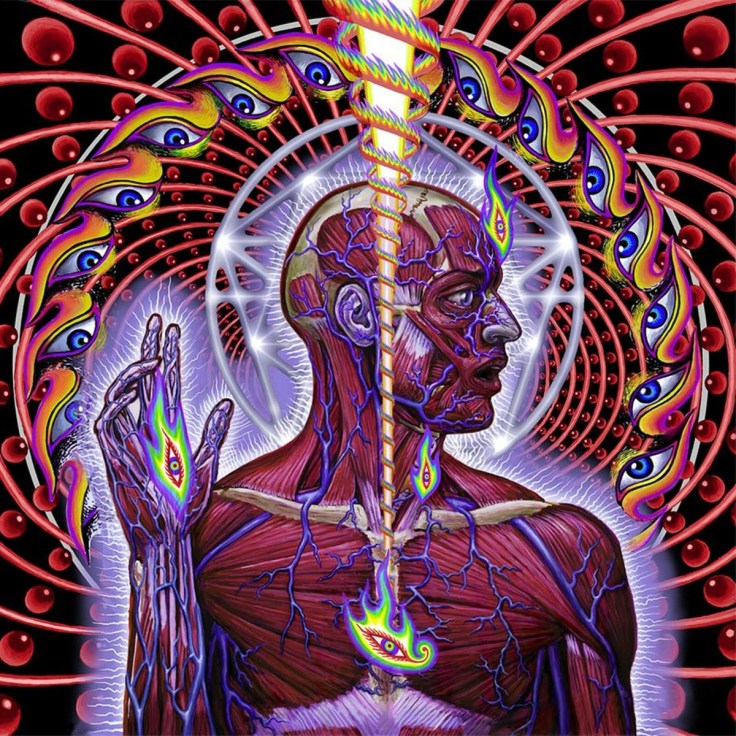
Nor did the long running time deter the general public. Tool’s fan base, which had been eagerly awaiting the new album, bought over half a million copies in the United States in the first week alone. Ultimately, Lateralus—encased in Alex Grey’s mystical and innovative cover art—sold well over three million copies. With Lateralus, Tool cemented its status as the most popular experimental rock band of the turn of the millennium, alongside Radiohead. Just as Radiohead had previously done with OK Computer, Tool also demonstrated with Lateralus that extremely ambitious, complex, and uncompromising music could rise to mainstream popularity. Few bands have managed to combine artistic ambition and great commercial success as convincingly.
Best tracks: “The Grudge”, “Schism”, “Parabola”, “Ticks & Leeches”, ”Lateralus” ”Reflection”
Author: JANNE YLIRUUSI
Read also: Review: Tool – Fear Inoculum (2019)
Tracks
- ”The Grudge” 8:36
- ”Eon Blue Apocalypse” 1:04
- ”The Patient” 7:14
- ”Mantra” 1:12
- ”Schism” 6:48
- ”Parabol” 3:04
- ”Parabola” 6:03
- ”Ticks & Leeches” 8:10
- ”Lateralus” 9:24
- ”Disposition” 4:46
- ”Reflection” 11:07
- ”Triad” 8:46
- ”Faaip de Oiad” 2:39
Tool:
Maynard James Keenan: vocals Adam Jones: guitars Justin Chancellor: bass guitars Danny Carey: drums & percussion, samples
Guests:
Statik: Machines (”Triad”)
 Pienemmät Purot
Jätä kommentti