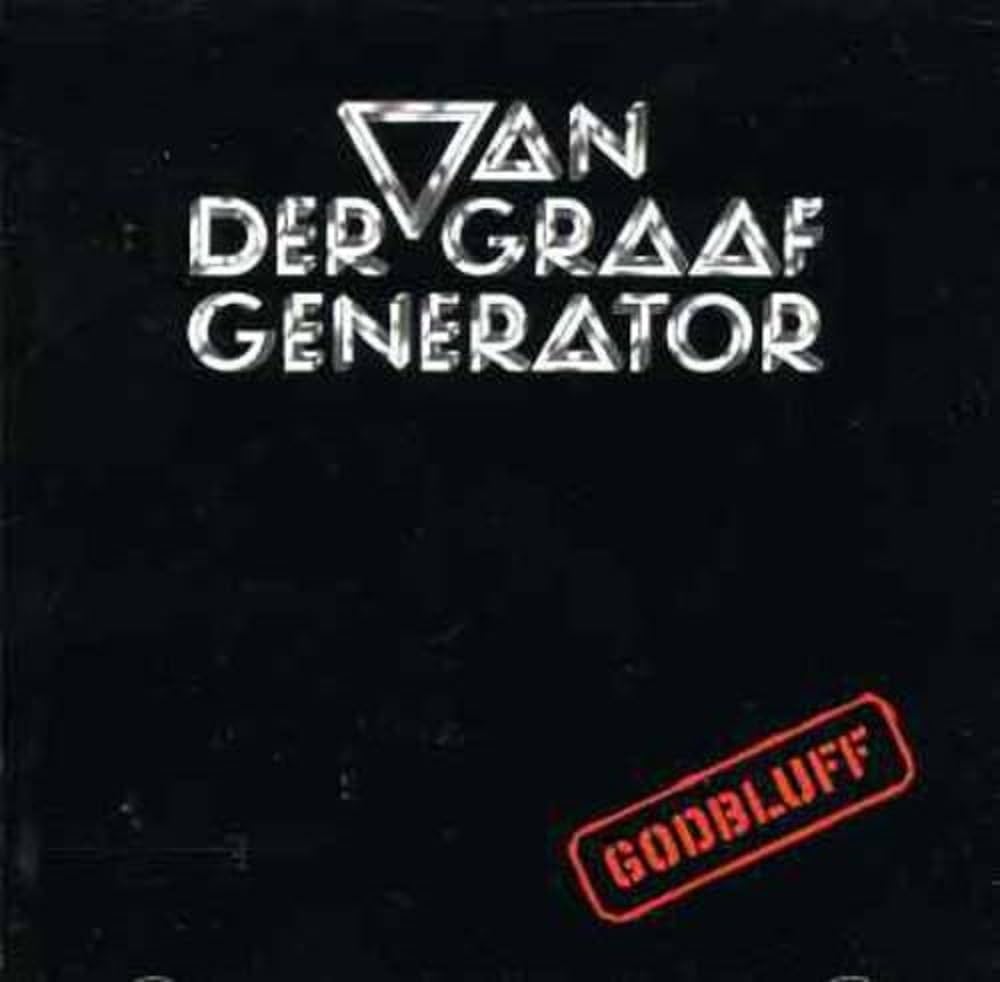
Godbluff is the fifth studio album by Van der Graaf Generator, formed in 1967.
Van der Graaf Generator broke up in the aftermath of their masterful album Pawn Hearts in the summer of 1972. The reason for the decision was general burnout and financial problems. Although the band had made a big breakthrough, especially in Italy, the fruits of their success were meager for the band members, and the band barely managed to make ends meet.
After the breakup, the members of VdGG frequently appeared on Peter Hammill’s solo albums, indicating that there was no particular friction between the members. In 1975, the quartet of Hammill (vocals, guitar, electric piano), David Jackson (flute, saxophones), Hugh Banton (organ, bass pedals, bass guitar), and Guy Evans (drums) began to feel the urge to play together in a real band again. It was time to try again. After brief negotiations, the record deal with Charisma was renewed and the band headed to Rockfield Studios to record their comeback album.
Although the lineup is the same as before, the band’s sound is now quite different from what it was three years ago. The sound is more stripped down, drier, and more live-like. The layered recordings and bursts of effects of Pawn Hearts have been replaced by tight quartet arrangements. And since the band had already rehearsed all the songs on the album live before recording, it was not difficult for them to reproduce the same sound in the studio, and all the songs were recorded more or less with the band playing the songs live directly onto tape.
The result was an extremely compact album consisting of four fairly long (7-10 min) tracks. The songs ”Pilgrims” and ”La Rossa” were also recorded during the same sessions, but they were wisely saved for the next album, Still Life, because the band realized that Godbluff formed a perfectly coherent whole in the form of these four songs.
VdGG’s music has never been particularly light or cheerful, but if anything, Godbluff’s music is even darker than before. Hammill’s rough electric guitar playing (a completely new element in the band) and Jackson’s increasingly amplified/effect-laden saxophone also bring a new electric and violent tone to the band’s sound.
Read also:
- Review: Philip Glass – Songs From Liquid Days (1986)
- Levyarvostelu: Peter Gabriel – Up (2002)
- Review: John Greaves & Peter Blegvad: Kew. Rhone. (1977)
- Review: Flea – Honora (2026)
- Review: Pink Floyd – Animals (1977)
- Levyarvio: Flea – Honora (2026)
- Review: Yes – Magnification (2001)
- Review: Jethro Tull – Songs From The Wood (1977)
- Review: A.W. Yrjänä – Eidolon (2026)
One thing that is particularly appealing about Godbluff is that even though the quartet plays complex music at full throttle, the sound does not become muddled, but rather the music breathes freely. Stripping down and simplifying the production was a brilliant move by the band at this stage. At the same time, it prepared them for the changing times when a rougher and more minimalist sound began to come into fashion (before it again swung in a completely different direction in the 1980s) with the advent of punk and, a little later, new wave.
After several solo albums, Hammill also takes on a bigger role as an instrumentalist, playing the Hohner D6 clavinet alongside Hugh Banton’s organ and taking tentative steps as a electric guitarist. However, the main instrumental focus is still on David Jackson’s fierce saxophones, clear flute interludes, and Banton’s pleasantly rough organ sound. Banton’s organ sometimes blends excitingly with Jackson’s saxophones to create a wall of sound that is difficult to distinguish between the instruments. In the background, Guy Evans pounds the drums with manic energy, yet in a controlled manner. Hammill’s vocals sound even more confident than before, and his range is once again staggering. He is able to effortlessly transition from a beautiful baritone to a screeching falsetto and from there to a snarling growl. The effect is dramatic and perhaps a little ridiculous to the untrained ear, but I feel that Hammill’s vocal flourishes seamlessly support the narrative and dramatic arc of the songs.
One of the absolute highlights of Godbluff is the moment in the album’s best track, ”Arrow,” when Hammill screams, at the climax of the violent drama, as the protagonist is impaled by an arrow, stretching out the last word in a blood-curdling manner: ”How strange my body feels, impaled upon the arroooooouw!”
How long the time seems, how dark the shadow
How straight the eagle flies, how straight towards his arrow
How long the night is – why is this passage so narrow?
How strange my body feels, impaled upon the arrow
Alongside ”Arrow,” ”Sleepwalkers” also deserves a special mention, featuring a bewildering Latin cha-cha-cha section that somehow works perfectly amid the otherwise dark and intense music. The album’s two other tracks, ”The Undercover Man” and ”Scorched Earth,” are also first-rate compositions. Godbluff is one of those albums that has no weak moments.
Van der Graaf Generator made a furious comeback to the music business battlefield with Godbluff. The album marked the beginning of an incredibly intense period for the band, and VdGG ended up releasing three masterful albums within a year, including Godbluff.
Best tracks: “Arrow,” “Sleepwalkers”
Author: JANNE YLIRUUSI
Tracks
- .The Undercover Man (7:00)
- Scorched Earth (10:10)
- Arrow (8:15)
- The Sleepwalkers (10:26)
Van der Graaf Generator:
Peter Hammill: vocals, guitars, piano, Hohner clavinet D6 Hugh Banton: organs, bass, bass pedals David Jackson: saxes, flute Guy Evans: drums, percussion


Jätä kommentti