
Harakka Bialoipokku is Pekka Pohjola’s second solo album.
Pekka Pohjola (1952-2008) left Wigwam in the summer of 1974 following Jukka Gustavson. Pohjola realised that after Gustavson’s departure Wigwam would become very much Jim Pembroke’ s band. This in turn would mean that the music would become simpler and more song-oriented. This didn’t interest Pohjola so it was time to launch a solo career for real after almost four years in Wigwam.
For a while, however, it seemed that a collaboration with Frank Zappa was on the cards before the next solo album. Zappa had been interested in Pohjola’s bass skills a year earlier when the bass ace had jammed with Zappa’s band at a gig in Helsinki. In the autumn of 1974 Pohjola and Zappa met again and discussed the collaboration more seriously. Zappa was planning an album that would feature a combination of rock band and symphony orchestra and he wanted Pohjola to join him as bassist. Eventually, however, the funding for the project dried up and the whole affair was cancelled. Zappa himself never returned to the project and his collaboration with Pohjola never materialised.
Pohjola had been composing music at a steady pace since his first album Pihkasilmä kaarnakorva (1972). Some of it ended up in the trash, but some was saved for the next solo album. During Pohjola’s last two years at Wigwam, only two of his compositions, ”Pride Of The Biosphere” and ”Planetist”, ended up on a Wigwam album. Both on the masterful Being (1974).
The album, called Harakka Bialoipokku , was recorded in Stockholm in October 1974 at the Marcus Music studio, which was considered to be of higher quality than the studios found in Helsinki at the time. Although Harakka Bialoipokku by producer Måns Groundstroem and engineer Leif Måses is not a feast of hi-fi, it sounds much more powerful and balanced than its predecessor (the 2002 remaster is the recommended version, the original CD sounds thinner).

Magpie Bialoipokku is a kind of concept album. Its cover, illustrated in a naive style by graphic artist Stan Shingler, shows a magpie hatching from an egg, while the back cover, written by Liisa Kuritu (Pohjola’s girlfriend at the time), tells the story of the same magpie. And when the song titles seem to follow the story of the magpie, the impression of Gesamtkunstwerk is complete. So why did I write that the album is only a concept album of sorts? Because it wasn’t really conceived as such in the first place, but the ”theme” was sort of retrofitted into the whole. In fact, Pohjola composed most of the music on the album before he got hold of the Kuritu story. According to Pohjola, the influence of the story was therefore limited mainly to the names of the songs and possibly to some extent to the order of the songs.
As a side note, interestingly enough, the following year the British band Camel made their own bird-themed concept album The Snow Goose based on Paul Gallico’ s short story The Snow Goose: A Story of Dunkirk. Camel’s music is also instrumental, with a similar melodic easy-listening prog feel to the Pohjola’s Harakka Bialoipokku, although the jazz influences are not nearly as clear. However, Camel cannot be accused of imitating Pohjola, as Harakka Bialoipokku was not released in England until 1975 and The Snow Goose was recorded in January of the same year. Concept albums about birds just happened to be the Zeitgeist!
But let’s forget the geese and go back to the magpie.
Read also: Levyarvio: Pekka Pohjola – Visitation (1979)
Musically, Harakka Bialoipokku largely continues along the lines of its predecessor, Pihkasilmä kaarnakorva, released a couple of years earlier, but is a more polished affair in every respect. Pohjola’s music is still melodic and upbeat progressive rock spiced with jazz, where you can also hear more pastoral tones alongside the energetic performance.
The first half of the album seems to be a bit more carefully composed prog songs and the second half is more jazz-influenced. Partly because of this, the wind instruments are even more prominent in the featured solo parts and are played by the cream of the Finnish jazz scene, Eero Koivistoinen, Baroni Paakkunainen and Pekka Pöyry. Due to the rich wind instrument arrangements, Harakka Bialoipokku strongly reminds me of Zappa’s ”big band” albums Waka/Jawaka and The Grand Wazoo. However, the music of the Pohjola is much simpler. Especially rhythmically, Pohjola’s music is much more straightforward than Zappa’s. On the other hand, Pohjola’s long, winding melodic arcs are, at least to my taste, more inspiring than those of Zappa.
In addition to Koivistoinen, Paakkunainen and Pöyry, the blowing section also includes two Swedish reinforcements. Jazz musician Bertil Löfgren, who plays the trumpet, and guitarist Coste Apetrea, who is known from Samla Mammas Manna. Tomi Parkkonen plays the drums with a firm touch, and Pohjola himself concentrates on piano and electric piano alongside the bass guitar. Playing the violin was now a thing of the past. Pohjola left the violin behind permanently after the 1972 Kuopio Violin Competition.
Read also: Review: Pekka Pohjola – Visitation (1979)
The album opens with a delicate piano played by Pohjola himself. At first, the gentle playing grows in a more classical direction, occasionally taking on a jaunty mood and then growing more dramatic and percussive. Only two minutes long, ”Alku” is a beautiful start to the album and proves that Pohjola was also quite an accomplished pianist.
The next song ”First Morning” explodes into life without a break and brings the whole band on board. The energetic song has a marchy underlying theme, with the riffing of the winds even adding a bit of old-school Finnish dance music atmosphere. Later, as the theme repeats, the sound opens up and the atmosphere becomes more jazzy. Towards the end, the gentle electric piano is a great-sounding detail. As a whole, the song is a bit repetitive, although the basic theme is varied in an interesting way.
The third track ” Huono sää / Se tanssii…” begins as an understated mood piece with a moody cello (the cellist is not credited in the liner notes, I assume it is Pohjola himself) painting mystical shades. Eventually the melancholically wailing cello quiets down and the winds bring in more resolute tones. Then the mood suddenly changes to a much more playful one as the song enters the section ’ Se tanssii…’. The music explodes into a joyous revelry reminiscent of medieval carnival music, with, among others, Paakkunaisen’s piccolo flute lilting merrily with the timpani in the background. ”Se tanssii…” reminds me a bit of Mike Oldfield’s music.
The fourth track ”…Ja näkee unta” is a bouncy chamber jazz combined with a Finnish dance music humppa. Sometimes, though, the moods become more serious, emphasised by Parkkonen’s military drumming. Especially in the first half of the song, Pohjola’s bass guitar supports the melody. The melody is effectively supported and accentuated by different wind instruments in turn.
”….Ja näkee unta” concludes the a-side which is very successful. One of the best album sides of Pohjola’s whole career. The B-side is not quite as strong, but on the other hand not as bad as the self-critical Pohjola himself has suggested in later comments. Whereas the first half of the album is a carefully composed whole, with the different parts fitting together seamlessly, the more free-form music makes up the second half. It’s certainly not free jazz, as some have claimed, but it’s more reliant on improvised solo parts. To put it simply, one could argue that the first half is prog and the second half is jazz-rock.
Read also:
- Vuosi vuodelta : Parhaat levyt 2000 – Sijat 11-20
- Review: Univers Zero – Ceux Du Dehors (1981)
- Levyarvio: Steve Walsh – Glossolalia (2000)
- Year by Year : Best Albums of 1976 – 21-29
- Levyarvio: Jimmy Page – Outrider (1988)
- Review: Brian Eno + David Byrne – My Life in the Bush of Ghosts (1981)
- Levyarvio: Gong – Zero To Infinity (2000)
- Review: Michael Oldfield – Heaven’s Open (1991)
- Review: Talk Talk – The Colour Of Spring (1986)
”Hereilläkin uni jatkuu” kicks off the B-side very successfully.It is the most energetic track on the album, offering a playful, humppa vibe combined with some tasty prog from the whole band. Pohjola’s frantically plucked bass pattern kicks the 7/8 time signature song along nicely. Eventually Pohjola’s playing escalates into an outright bass solo with Koivistoinen’s soprano sax soloing alongside as a wildly effective contrast.
Then the mood calms down considerably. ”Sekoilu seestyy” is a duet between Pohjola and guitarist Apetrea. The gently floating song is initially built on a softly playing electric piano. Pohjola builds a tasty platform with the electric piano, on which Apetrea’s sonorous electric guitar elegantly joins in. This section reminds me strongly of the ethereal section towards the end of the second half of Tubular Bells. Unfortunately, ”Sekoilu seestyy” does not end with Apetrea’s solo, but at the very end Pohjola plays a long bass solo. Skilful playing, of course, but the solo doesn’t really integrate into the song in a natural way.
Pohjola himself has mercilessly called the last three tracks on the album ”filler songs”, and he has been particularly harsh in his condemnation of the last of these, ”Elämä jatkuu”. Pohjola has even told how the jazz drummer Esko Rosnell, who otherwise liked the album, had told him ”never do this again”. Personally, I don’t have such a negative view of the song, although admittedly, at almost eight minutes, the longest track on the album feels stretched out and the repetition and variation of its beautiful theme eventually becomes a little boring. However, Paakkunaisen’s versatile soloing on baritone saxophone deserves to be appreciated. Absolutely stunning playing!
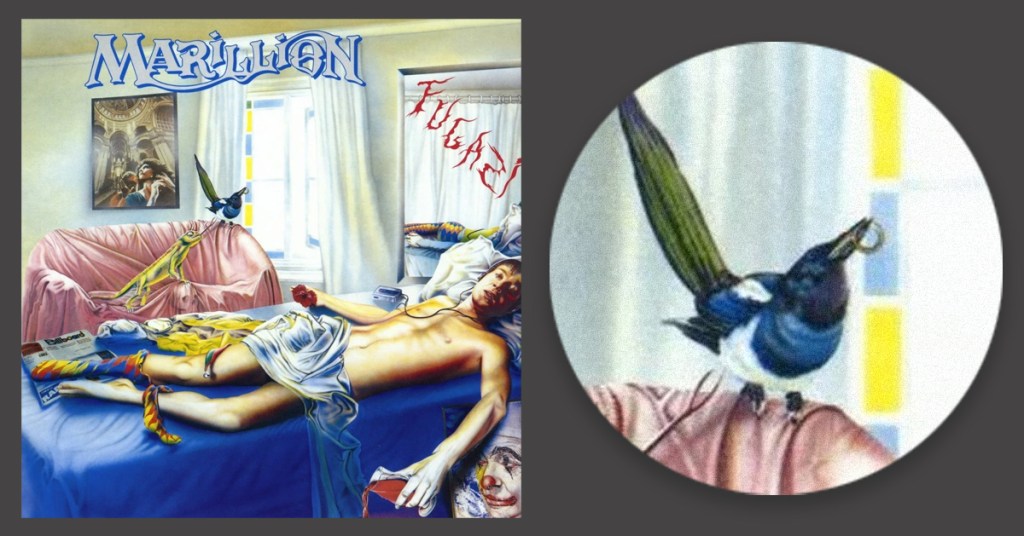
There is one interesting detail about the album cover. Exactly ten years later, the magpie lurking on it ended up on the cover of Fugazi, the second studio album by neo-prog band Marillion . Did Marillion cover artist Mark Wilkinson simply use the cover of the Pohjola album as a model for his own magpie, or is there a more interesting story behind it? That has never been clear to me. If you know more about it, feel free to add a comment at the end of this article.
When the Harakka Bialoipokku was released, it was well received in Finland and YLE (the Finnish equivalent of the BBC) even chose it as album of the year. Through Wigwam connections, the album also came to the attention of Richard Branson’s Virgin record company and was released internationally as B The Magpie. B The Magpie didn’t attract much attention worldwide and received mixed reviews in the UK, but Virgin’s contacts at least led to an offer to work with the company’s biggest star, Mike Oldfield. This idea came to fruition in the next few years in the form of the Keesojen lehto album, produced by Oldfield, and Pohjola also joined Oldfield’s large band when he embarked on his first tour in the late 70s.
The Harakka Bialoipokku is a strong continuation of Pohjola’s solo career, which has got off to a good start. Its arrangements are more compact than its predecessor’s and no longer sprawl out in such a reckless manner. In a way, this is both good and bad. It feels as if something of Pihkasilmä Kaarnkorva’s brash innocence has been lost, and there is a hint of something stiff in the first half’s prog songs at times. On the other hand, Harakka’s more controlled compositions and arrangements are at their best so delicious that there is little to really complain about. And on the other hand, the more jazzy tracks on the B-side offer a more relaxed atmosphere and more joy of playing. I think that if a vote were held among Pekka Pohjola fans on the maestro’s best albums, Harakka Bialoipoku would have a very good chance of coming in first. I don’t rate it that highly myself, but I think the album would make it into the top five in my book.
Best tracks: ”Ensimmäinen aamu”, ”Huono sää / Se tanssii…” ”Hereilläkin uni jatkuu”, ”Sekoilu seestyy”
Author: JANNE YLIRUUSI
Petri Nevainen’s biography of Pekka Pohjola, Bassokenraali (Jalava, 2003) has been a key source for this article.
Read also: Review: Wigwam – Being (1974)
Tracks
- Alku / The beginning (2:10)
- Ensimmäinen aamu / The first morning (5:35)
- Huono sää / Se tanssii… / Bad weather / Bialoipokku dances (6:55)
- …ja näkee unta / Bialoipokku’s war dream (4:35)
- Hereilläkin uni jatkuu / Bialoipokku’s war (4:42)
- Sekoilu seestyy / The madness subsides (4:18)
- Elämä jatkuu / Life goes on (6:42)
Musicians
Pekka Pohjola: bass guitar, piano, electric piano Tomi Parkkonen: drums, percussion Eero Koivistoinen: soprano, sopranino and tenor saxophones Pekka Pöyry: soprano and alto saxophones Baroni Paakkunainen: alto and baritone saxophones, flute Bertil Löfgren: trumpet Coste Apetrea: guitar
 Pienemmät Purot