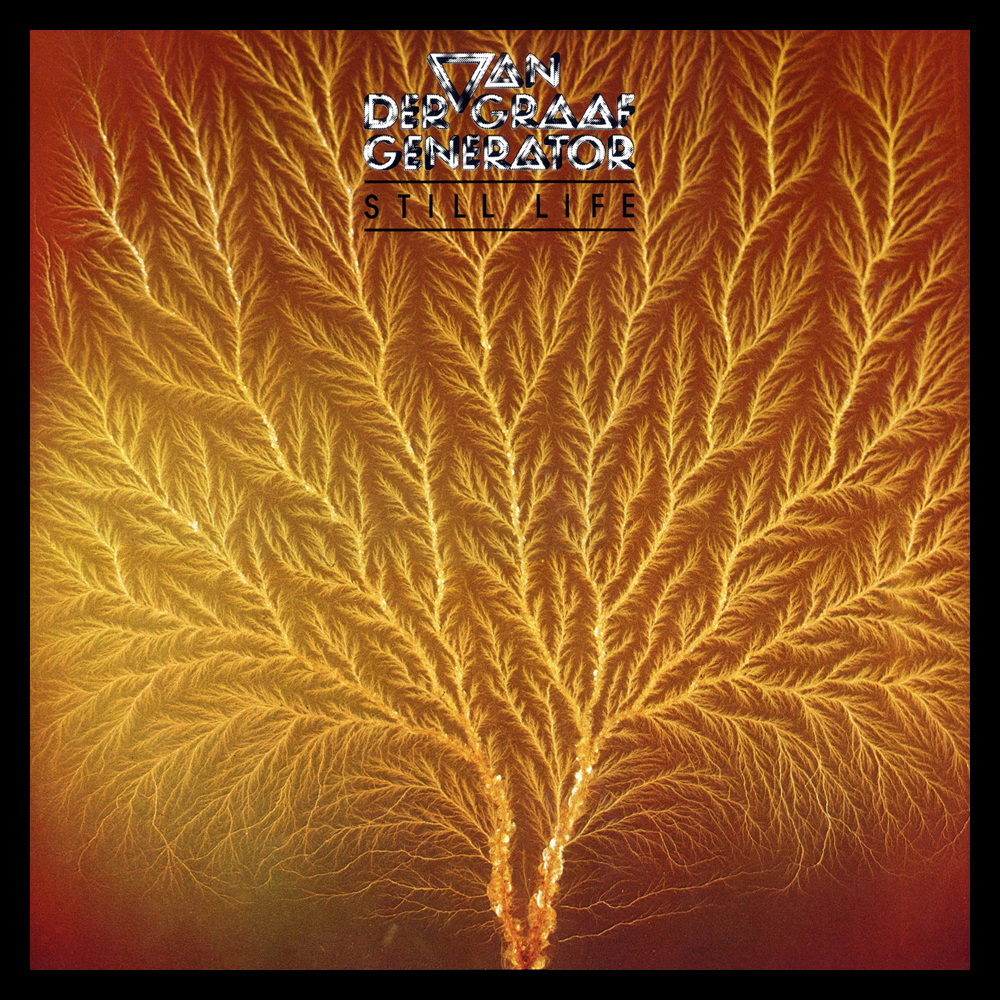
Still Life is the sixth studio album by Van der Graaf Generator.
Founded in 1967, Van der Graaf Generator underwent a radical transformation in 1975 with the release of Godbluff, which came after a hiatus of a few years.
Godbluff marked the beginning of a period lasting just over a year during which the band’s creative fire burned perhaps more brightly than ever before. The driving force behind it all was, of course, vocalist Peter Hammill , who composed incredible material at an even more incredible pace. The Godbluff sessions yielded six magnificent songs, two of which were ultimately saved for the next album, titled Still Life.
The leftover tracks—the solemn and majestic “Pilgrims” and the energetic, ferocious “La Rossa,” were by no means B-side material; they were left for the next album simply because the four tracks ultimately selected for Godbluff formed such a seamless whole that there was no reason to disrupt it with additional tracks.
Released just six months after Godbluff, Still Life is the most cosmic and grandiose of VdGG’s mid-’70s trilogy (Godbluff, Still Life, World Record). The songs on Godbluff deal mainly with war and aggression, and those on World Record with human weaknesses and insecurities, but Still Life dives straight into the cosmos. The title track ponders what immortality would mean for the human psyche (nothing good), and the album’s most epic track, “Childlike Faith In Childhood’s End,” as its name suggests, foretells humanity’s rise from its current childhood phase to an enlightenment that will dawn millennia from now, which would make humans the true rulers of the universe. The scale is vast, and none of us will be around to see the outcome, as Hammill sings in the song’s heart-wrenching yet sublime conclusion:
And though dark is the highway,
and the peak’s distance breaks my heart,
for I never shall see it, still I play my part,
believing that what waits for us
is the cosmos compared to the dust of the past…
In the death of mere humans life shall start
Hammill roars the lyrics with a furious and downright earth-shattering intensity. I get that the album’s grand themes and the band’s extremely serious approach to them, combined with Hammill’s dramatic delivery, might seem downright ridiculous to many. I can smile at the absurdity of the combination myself, but damn it, it’s also truly impressive!
It’s interesting how Hammill explores in “Childlike Faith In Childhood’s End” largely the same theme he had previously addressed in songs such as “Lemmings” (Pawn Hearts, 1971) and the following year’s World Record track “A Place to Survive.” Ultimately, all of these songs are about how a person must do their best regardless of how crushing the odds and probabilities against them may be.
Read also: Review: Peter Hammill – The Silent Corner And The Empty Stage (1974)
Hammill himself has described “Childlike Faith In Childhood’s End” as a marathon in terms of how it felt to sing. Hammill is on vocals almost the entire 12-minute track, often screaming in a frenzied manner. And the song is breathless listening for the listener as well. “Childlike Faith In Childhood’s End” surges forward with fierce energy, offering only a few serene moments as a breather. The band nimbly follows Hammill’s vocals, and “Childlike” is a prime example of how the band often built its epics directly upon Hammill’s meandering lyrics. When writing, Hammill didn’t necessarily think about how the complex verses would ultimately fit into the music; instead, the final determination of the time signatures fell to drummer Guy Evans.
The dramatic “Childlike Faith In Childhood’s End” is the album’s highlight, but overall the album is consistently brilliant and doesn’t really have a single weak moment.
The title track, “Still Life,” begins with church-like organ music, and Hammill’s vocals sound imploring, like a prayer, as they describe the hollow lives of those who have attained immortality. At the three-minute mark, the drums kick in, building rhythmic energy as Hammill’s vocals grow angrier and more aggressive. David Jackson’s saxophones wail tormentedly, accompanied by Banton’s heavenly-sounding organ. Hammill’s vocal style shifts as if cut by a knife, from a cracked howl to a pure, choirboy-like voice. “Still Life” is yet another of the countless examples from VdGG’s catalog of how skillfully the band masters the internal dynamics of their songs and knows how to naturally weave together sections that balance each other—some peaceful, others truly violent.
”’Still Life’ is a very dark song. It’s a song about immortality – dark immortality… What the song actually say is, ’it’s terrible not to be able to die. It’s much better to have a life and then finish the story.’”
– Peter Hammill about the song ”Still Life”
“La Rossa” represents the most down-to-earth and accessible side of the album. It’s a fiercely rocking track that at times surges forward with a galloping rhythm reminiscent of heavy rock, yet keeps the listener engaged with a few well-timed tempo changes. The lyrics of “La Rossa” grapple with a situation where a platonic friendship is potentially turning sexual. Will everything be ruined, or will something real and wonderful be achieved after all? Hammill and the band take this otherwise mundane theme to such extreme lengths that they build a psychological drama out of the ingredients of a basic kitchen drama (or, eh, maybe the bedroom after all) that strongly suggests the song’s protagonists won’t get through the situation simply by joining Tinder. In the song’s finale, Jackson’s saxophone solo manages to be both melodic and chaotically aggressive at the same time. An incredible musician, an incredible song.
Read also: Review: Van der Graaf Generator – The Least We Can Do Is Wave to Each Other (1970)
Still Life is for the most part a downright brutal album, but it does have its lighter moments. At its most delicate, the album shines in the beautiful track “My Room (Waiting for Wonderland),” which features perhaps the most expressive saxophone playing of David Jackson’s career. His playing on the track is both melodic and lyrical, yet still piercing. Hammill manages to rein himself in on this track and doesn’t let his vocals veer into a growl at any point this time around. Banton, quite unusually, plays piano on the track and handles it with style. In this sonically quite stripped-down track, Banton’s bass guitar also plays a significant role, which was also unusual, as Banton usually handled the band’s low frequencies with bass pedals. “My Room” is an extremely elegant song and an important breather on an otherwise intense album.
In my opinion, Still Life is the shining gem of Van der Graaf Generator’s incredible catalog. Its music is dramatic, intense, dark, moving, and dynamic. The whole band is in incredible form, and Hammill’s lyrics are probably the most compelling rock lyrics I’ve ever encountered, delivered by Hammill with unmatched intensity. Still Life is not only Van der Graaf Generator’s best album but also one of progressive rock’s most stunning masterpieces.
Best tracks: ”Still Life, ”La Rossa”, ”My Room (Waiting for Wonderland)”, ”Childlike Faith In Childhood’s End”
Author: JANNE YLIRUUSI
Tracks
- ”Pilgrims” Hammill, David Jackson 7:12
- ”Still Life” 7:25
- ”La Rossa” 9:53
- ”My Room (Waiting for Wonderland)” 8:03
- ”Childlike Faith in Childhood’s End” 12:24
Van der Graaf Generator:
Peter Hammill: vocals, guitar, piano David Jackson: tenor and soprano saxophones, flute Hugh Banton: Hammond organ, bass, Mellotron, piano Guy Evans: drums, percussion
 Pienemmät Purot
Jätä kommentti