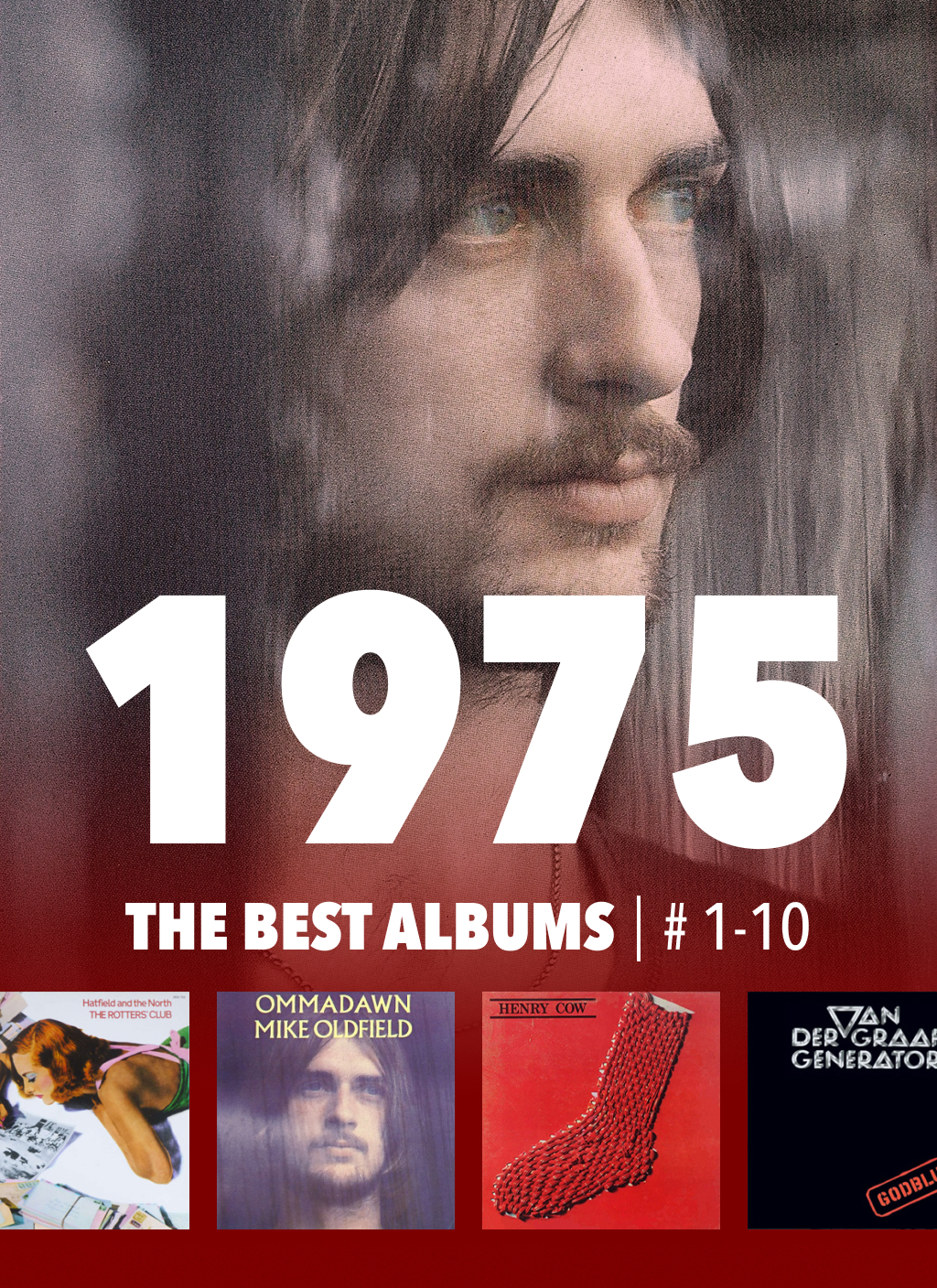
The author’s picks for the best albums of 1975, ranked 1-10.
In the Year by Year series, I’ll go through my favourite albums from 1969 to the present day.
- Mike Oldfield: Ommadawn (UK) *****
- Henry Cow: In Praise Of Learning (UK) *****
- Hatfield And The North: The Rotters’ Club (UK) *****
- Van der Graaf Generator: Godbluff (UK) *****
- Pink Floyd: Wish You Were Here (UK) *****
- Chris Squire: Fish Out Of Water (UK) *****
- Brian Eno: Another Green World (UK) *****
- Ralph Towner: Solstice (US) *****
- Area: Crac! (IT) ****½
- Terje Rypdal: Odyssey (NO) ****½
1. Mike Oldfield: Ommadawn

Ommadawn is Mike Oldfield’s third studio album.
Following Oldfield’s huge surprise success with Tubular Bells, Hergest Ridge was a challenging album to make. Oldfield had been somewhat reluctant to make the album, pressured by his record company, and although the end result was excellent, the album received a mixed reception compared to Tubular Bells. However, the sensitive Oldfield felt that the reception was not mixed, but simply judgmental.
This upset him greatly, and even though Hergest Ridge is in many ways a better album than Tubular Bells, the negative critical feedback shook Oldfield’s confidence to such an extent that he himself began to question the merits of the album and his own abilities in general. For a while… but he set out to make Ommadawn with enthusiasm. And this time he wanted to do everything himself: produce, record, and, of course, play most of the instruments. And all this in his own studio, which was installed for Oldfield in his house in Herefordshire. In the basement studio of his home, he worked alone on Ommadawn for almost a year, occasionally inviting guests to play on the album…
2. Henry Cow: In Praise Of Learning
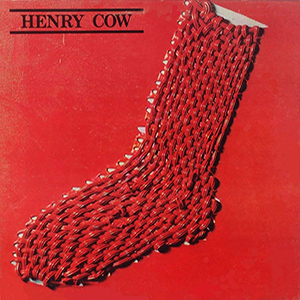
Released in May 1975, In Praise Of Learning is the third studio album by Henry Cow, formed in 1968.
In November 1974, Henry Cow participated as backing band and arrangers on the art pop band Slapp Happy’s album Desperate Straights. Henry Cow’s contribution to the album was so significant that it was released under the joint credit of Slapp Happy / Henry Cow. But most importantly, the collaboration between the two bands felt so fruitful that they decided to continue working together. The bands merged into one entity.
Slapp Happy’s Antony Moore (piano, electronics, tapes), Peter Blegvad (guitar, clarinet) and Dagmar Krause (vocals) joined forces with Henry Cow’s Fred Frith (guitar, violin, xylophone, piano), Chris Cutler (drums, percussion), Tim Hodgkinson (organ, piano, clarinet) and John Greaves (bass, piano) to make their next album in early 1975. Lindsay Cooper (oboe, bassoon), who had been dismissed from Henry Cow for personal reasons after the release of Unrest, was also asked to rejoin the band. The group now consisted of eight members, who were certainly not lacking in ideas or virtuosity…
3. Hatfield And The North: The Rotter’s Club
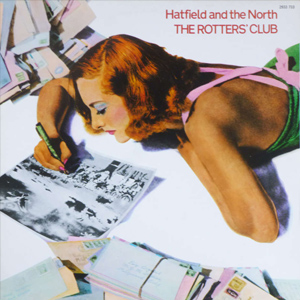
The Rotter’s Club is Hatfield And The North’s second studio album.
Hatfield And The North was founded in 1972 by Phil Miller (1949-2017), guitarist in Delivery and Matching Mole, and Pip Pyle (1950-2006), ex-drummer of Gong. After a few swift changes, the band was joined by Caravan bassist/vocalist Richard Sinclair and Egg keyboard virtuoso Dave Stewart. This first ”supergroup” of the Canterbury scene made its excellent debut album in 1974.
The debut was indeed brilliant, but The Rotters’ Club , made 13 months later with the same line-up, is actually an improvement on that album in every way. The songs are a little better, the playing more skilful, the sounds more muscular and even the album cover this time is not only aesthetically beautiful but also quite witty and funny.
The Rotters’ Club’s music is a rare combination of musical complexity, gentle melodic moments and humour…
4. Van der Graaf Generator: Godbluff
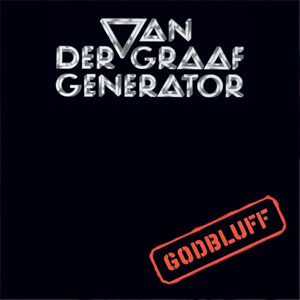
Godbluff is the fifth studio album by Van der Graaf Generator, formed in 1967.
Van der Graaf Generator broke up in the aftermath of their masterful album Pawn Hearts in the summer of 1972. The reason for the decision was general burnout and financial problems. Although the band had made a big breakthrough, especially in Italy, the fruits of their success were meager for the band members, and the band barely managed to make ends meet.
After the breakup, the members of VdGG frequently appeared on Peter Hammill’s solo albums, indicating that there was no particular friction between the members. In 1975, the quartet of Hammill (vocals, guitar, electric piano), David Jackson (flute, saxophones), Hugh Banton (organ, bass pedals, bass guitar), and Guy Evans (drums) began to feel the urge to play together in a real band again. It was time to try again. After brief negotiations, the record deal with Charisma was renewed and the band headed to Rockfield Studios to record their comeback album…
Read also:
- Review: Camel – Moonmadness (1976)
- Review: Gong – Gazeuse! (1976)
- Review: Mike Johnson – The Gardens Of Loss (2026)
- Levyarvio: Mike Johnson – The Gardens Of Loss (2026)
- Levyarvio: Led Zeppelin – Presence (1976)
- Vuosi vuodelta : Parhaat levyt 2000 – Sijat 11-20
- Review: Univers Zero – Ceux Du Dehors (1981)
- Levyarvio: Steve Walsh – Glossolalia (2000)
- Year by Year : Best Albums of 1976 – 21-29
5. Pink Floyd: Wish You Were Here

Wish You Were Here is the seventh studio album by Pink Floyd, formed in 1963. It is their ninth album if the soundtracks made by the band are counted.
Wish You Were Here is Pink Floyd’s first album after the million-selling The Dark Side Of The Moon (1973). Already quite popular, Pink Floyd became one of the world’s biggest bands after The Dark Side Of The Moon.
The band’s financial worries were suddenly a thing of the past, and as the band’s mastermind/bassist/vocalist/composer/lyricist Roger Waters put it, ”all their dreams had come true.” However, when dreams of rock stardom come true, it often ends up being somewhat disappointing, at least for intelligent people. The experience is hollow, and the prevailing feeling is ”what now?” For Waters in particular, the experience was even shocking when he realized that, as an unhappy person, he was still unhappy even after his enormous success. Waters had been struggling with alienation and bitter feelings for some time, and neither worldly riches nor the adoration of fans seemed to improve the situation, as he had at least subconsciously imagined…
6. Chris Squire: Fish Out Of Water
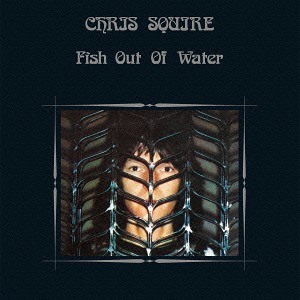
Fish Out Of Water is the first solo album by Yes bassist Chris Squire.
Yes had been working almost non-stop for years, producing successful and groundbreaking albums, immediately going on tour after each release and then repeating the same routine all over again.
After the massive Relayer tour ended in August 1975, the band decided to take a nine-month break from each other. However, Yes had been so successful and its members so talented that Atlantic Records offered each band member the opportunity to record a solo album. Of course, such an opportunity could not be passed up.
Virtuoso bassist Chris Squire (4 March 1948 – 27 June 2015) is not known for his quick movements (if we ignore the movements of his fingers on the bass strings), but surprisingly, his solo album Fish Out Of Water was the first Yes solo album on the market after guitarist Steve Howe’s Beginnings album…
7. Brian Eno: Another Green World
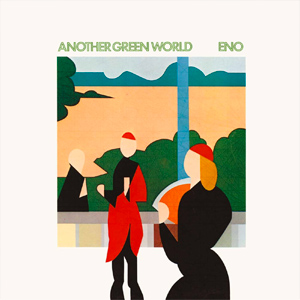
Another Green World is Brian Eno’s third solo album.
In July 1975, Brian Eno, who had previously played with Roxy Music and subsequently embarked on a solo career, calling himself a non-musician, walked into Basing Street Studios (now Sarm West, owned by Trevor Horn) without any demos or preliminary plans.
Well, he did have a vague plan: Eno’s goal was to build something from scratch in the studio and thus create something more surprising than what could be achieved with old, tried-and-tested methods. Eno had booked expensive studio time for two months, which was risky without any pre-prepared song drafts. The first few days were desperate, and nothing sensible was accomplished.
Nowadays, it is already a cliché to say that this or that artist used the studio as a compositional tool, but this definition fits Brian Eno perfectly. Eno seemed to sculpt his songs through trial and error, adding sound fragments and reacting to the additions by either removing or modifying old sections. He used many esoteric methods to aid in the process, such as relying on chance…
8. Ralph Towner: Solstice

Solstice is the fourth solo album by American pianist/guitarist Ralph Towner (born 1940). Towner is perhaps best known for his unique chamber jazz band Oregon, founded in 1970, but for me, Towner’s finest moment is this Solstice album.
Solstice, produced by Manfred Eicher for his own ECM label (with the brilliant Jan Erik Kongshaug, who has recorded over 700 albums for ECM, as sound engineer), is pure acoustic jazz. Light yet powerful. Beautiful to listen to, yet deeply poignant when needed.
Towner has assembled a formidable trio of musicians around him. The saxophones and flute are played by the sonorous Norwegian Jan Garbarek, the drums are played with feather-light touch but still with great intensity when needed by Garbarek’s compatriot Jon Christensen, and the low frequencies are handled in his familiar semi-solo style by the German Eberhard Weber. And when you remember that Towner himself is a virtuoso player on both acoustic guitar (Towner studied classical guitar for years at the Vienna Academy of Music) and piano, it’s hard to imagine a better group for this kind of acoustic jazz.
I have always thought that the music on this album has a wintery feel to it. Solstice plays in cool, bright blue tones. It is calm, but at the same time curiously active. And despite its coolness, the music never sounds unpleasantly cold (for which Eicher and Kongshaug certainly deserve a lot of credit).
Like Towner’s band Oregon’s music, Solstice also has a slightly chamber music-like feel, and despite Towner’s American roots, I think the music sounds very European. This is very typical of ECM jazz albums. In all its hi-fi brilliance, Solstice is a kind of archetype of ECM’s more acoustic music.
In 1977, Ralph Towner made another album with the same quartet, called Solstice. This ”sequel,” Sound And Shadows, is also a fine record, but it doesn’t quite measure up to Solstice.
Choosing the greatest ECM album of all time would be a challenging task, but I can say that Solstice is one of the strongest contenders for that crown, if you ask me.
Best tracks: “Oceanus”, “Nimbus”, “Piscean Dance”
9. Area: Crac!

Crac! is the third studio album by Italian band Area, founded in 1972.
Area continues largely along the same lines as Crac! as their masterful debut album Arbeit macht frei (1974). Once again, we are treated to a breathtakingly energetic, at times downright manic mix of jazz-rock, avant-garde, and progressive rock.
The North African ethnic tones heard on the previous album are served up a little less this time around. Instead, Demetrio Stratos’ virtuoso Tarzan-like vocals dominate even more. Stratos’ vocal acrobatics sound downright superhuman at times. And he was probably something of an exceptional individual in terms of his physique. When you combine that physique with a very serious desire to study the use and limits of the human voice, it’s no wonder that the end results were so impressive to hear.
”His (Demetrio Stratos) study of the voice used as a musical instrument carried him to reach for the limits of human capabilities. Stratos was able to reach 7,000 Hz, when a tenor normally reaches 523 Hz and a woman soprano 1,046 Hz (C6). He would hold notes for long periods of time, modulate them vibrato-like, and leap and dive from low to high and back again, with pinpoint accuracy. Using various overtone singing and other extended techniques, he was able to perform diplophony, triplophony, and also quadrophony, the ability to produce two, three, and even four sounds simultaneously (multiphonic) using only the human voice as the musical instrument.” Source: Wikipedia.
Fortunately, however, Crac! is not just a Demetrio Stratos show; there is still plenty of room for other instruments. For example, the energetic jazz-rock song ”Megalopoli” is almost entirely instrumental. The same goes for one of the highlights of the album, ”Nervi scoperti,” in which the band’s keyboardist, Patrizio Fariselli, gets really wild with his atonal electric piano playing, reminiscent of Keith Tippett, which is absolutely amazing to hear. The same goes for guitarist Paolo Tofani’s twisted and downright unrestrained electric guitar playing.
Every musician in Area is extremely talented, and it’s easy to imagine what kind of international heroes they would still be today if they had been British. And if they had played even slightly easier music…
Crac! is Area’s breathtakingly intense and original take on jazz rock and, alongside Arbeit macht frei, the band’s finest album.
Best tracks: “L’elefante bianco”, “La mela di Odessa (1920)”, ”Nervi scoperti”
10. Terje Rypdal: Odyssey
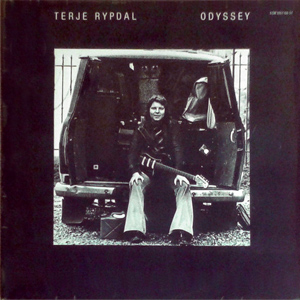
Odyssey is Norwegian guitarist Terje Rypdal’s fifth album as band leader.
Terje Rypdal seems to be something of an archetype for the ECM ethos. He perfectly embodies the label’s approach of combining jazz, art music, and rock. Of course, not all ECM artists incorporate all of these elements into their music, but Rypdal’s best albums certainly do. And this 1975 double album, Odyssey, is definitely one of Rypdal’s finest achievements.
Rypdal’s Odyssey is a quintet featuring his own electric guitar and soprano saxophone alongside Torbjørn Sunden on trombone, Brynjulf Blixin on organ, Sveinung Hovensjøen on bass, and Svein Christiansen on drums.
Odyssey is an 87-minute double album consisting of eight tracks. Four of the songs are over ten minutes long, and the album’s closing track, ”Rolling Stone,” is a whopping 24 minutes long. The music on Odyssey is not strictly jazz-rock or progressive rock, but rather a highly original fusion of those styles, rounded off with influences from modern art music.
In my opinion, the highlight of the album is the 16-minute ”Midnite,” which is a truly magnificent song. Sveinung Hovensjø’s hypnotic 9/4 bass pattern creeps repeatedly in the background like a black panther lurking in the dark night, while classically trained drummer Svein Christiansen accentuates the panther’s movement with stylish orchestral drumming. On top of this fertile ground, the band’s three soloists take turns, sometimes subtly conversing with each other and sometimes arguing with each other in a piercingly aggressive manner. With its clear-sounding vocals, the song reminds me of Miles Davis’s ”In A Silent Way,” which is similarly minimalistic but inexorably moving forward.
Another notable track on the album is the 13-minute ”Adagio,” which follows ”Midnite” and features Rypdal soloing on electric guitar over a minimalist background, making his guitar sound like a harp. ”Midnite,” the 13-minute ”Adagio,” in which Rypdal solos on electric guitar over a minimalist background, making his guitar sound at times like an entire string orchestra in the modern art music of György Ligeti and Krzysztof Penderecki. Rypdal’s crystal-clear and tense guitar sound is deservedly at the forefront of the album. Unlike many other jazz guitarists, he focuses more on melodies and atmosphere than technical virtuosity. Rypdal’s guitar playing is also very emotional. His sound is very recognizable, which to me is always the clearest sign of an interesting guitarist.
At 24 minutes, ”Rolling Stone” is the closest to a typical jazz-rock sound, while still keeping that distant, yet emotional and contradictory vibe. Of the album’s rockier tracks, the more compact four-minute ”Over Birkerot” is more effective. ”Rolling Stone” was left off the original CD release due to space constraints, but it is included again in the 2012 reissue.
The box set released by ECM in 2012 expands Odyssey into three CDs by adding the album Unfinished Highballs, which consists of compositions commissioned from Rypdal by the Swedish Radio Jazz Group. The 68-minute, seven-part ”Unfinished Highballs” suite successfully showcases Rypdal’s more energetic and rocking side, but with a 15-piece ensemble, it has a rather orchestral feel.
Odyssey is Terje Rypdal’s highly original interpretation of the jazz-rock genre and, at the same time, not only one of his best albums but also one of the most significant milestones in the entire genre.
Best tracks: ”Midnite”, ”Adagio”, ”Over Birkerot”
Author: JANNE YLIRUUSI
You can find other parts of the Year by Year series here.
 Pienemmät Purot
Jätä kommentti