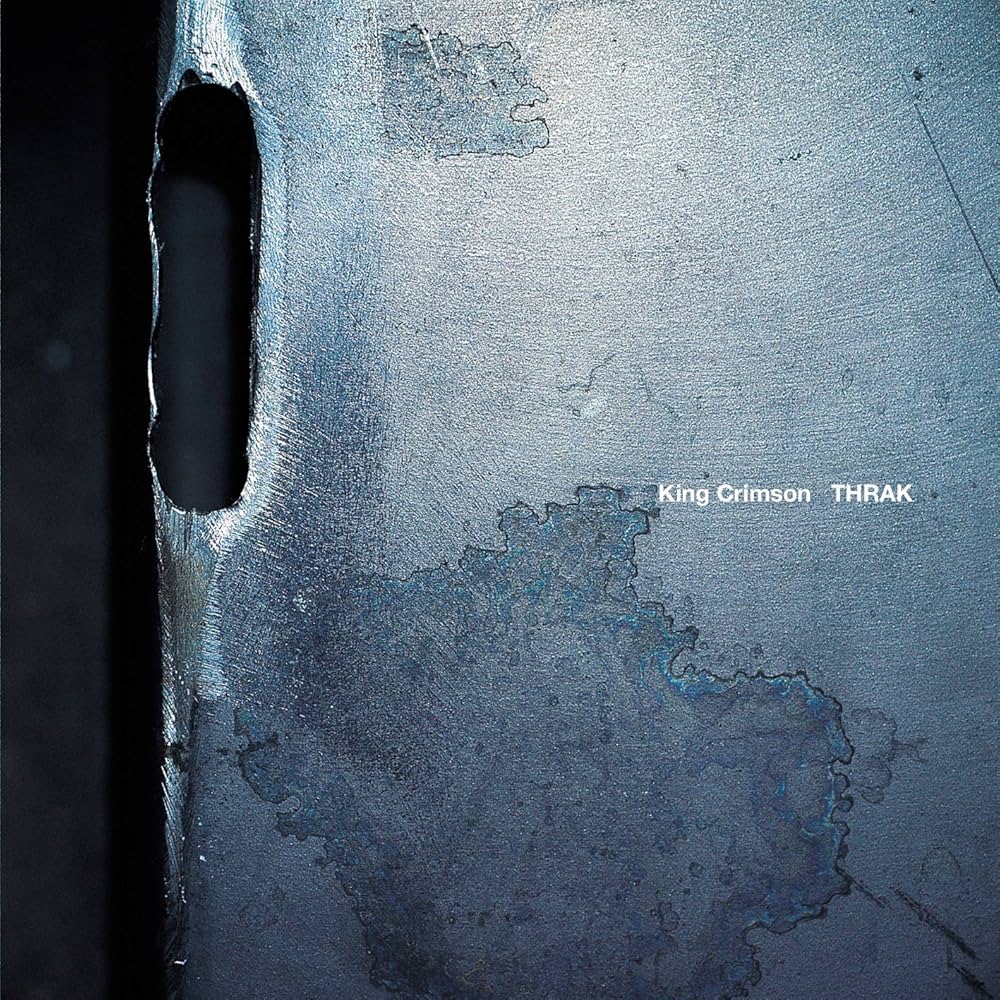
THRAK is King Crimson’s 11th studio album.
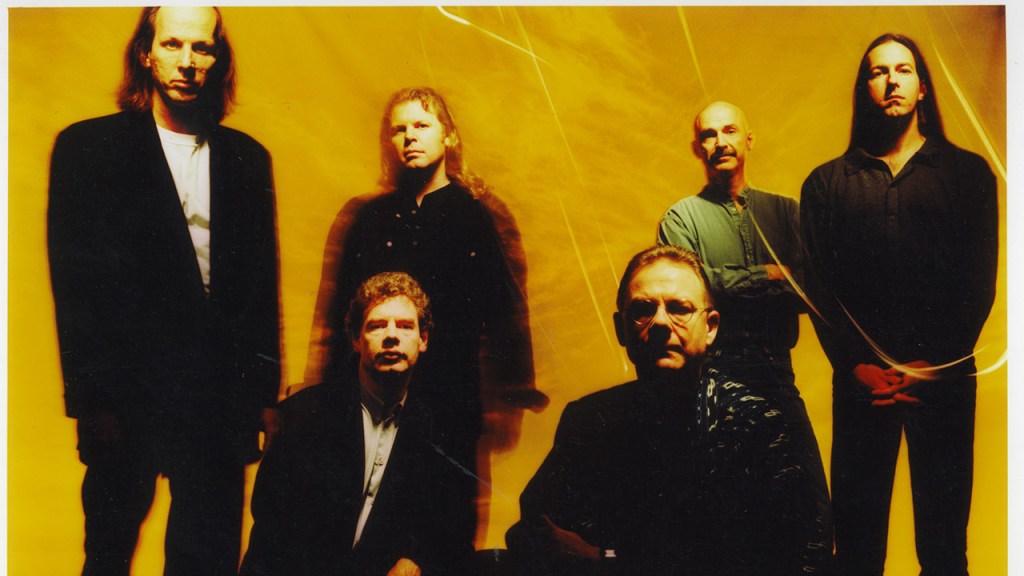
King Crimson returned in 1994 after ten years with a revamped line-up. Guitarist Robert Fripp assembled what he called a ”double trio”, a mix of old Crimson musicians and more recent names from Fripp’s immediate past. Veteran drummer Bill Bruford had joined Crimson back in 1973 and guitarist/vocalist Adrian Belew and bassist/stickman Tony Levin had been part of the band’s groundbreaking 80s trilogy.
Two American rookies Trey Gunn and Pat Mastelotto complete the mix. Gunn, who plays stick, was an alumnus of Fripp’s guitar school and had also played on Fripp and Toyah’s project Sunday All Over The World and on the album The First Day with David Sylvian. Mastelotto was the latest arrival and had come into Fripp’s sphere of influence when he took over from drummer Jerry Marotta on a joint tour with Sylvian and Fripp in early 1994.
The double trio, conceived by Fripp, was a way of shuffling the deck and an attempt to reinvent King Crimson once again. The combination of two guitarists, two bassists (both of whom also play the versatile Chapman Stick) and two drummers would open up the possibility of making even more raucous and more polyrhythmic mayhem.
The trio was launched worldwide with the 31-minute EP VROOOM. VROOOM was recorded in May 1994 in just four days with the help of producer David Bottrill. Recorded on a shoestring budget, VROOOM was intended not only to break in the new team but also to raise funds for a full-length album.
After the release ofVROOOM, the double trio headed to Argentina in October 1994 to play their first live shows in over ten years. Funnily enough, while King Crimson were practising in Buenos Aires, Bruford’s old band Yes were also in town at the same time, playing at the same Prix d’Ami club just a few days earlier. The double-trio’s three gigs at the club sold out quickly and the band’s energetic set was also recorded on the live album B’Boom: Official Bootleg – Live in Argentina.
Just eight days after their last show in Argentina, Crimson gathered at Peter Gabriel’s Real World studio to work on their first full-length album. David Bottrill was again chosen as technical producer. The artistic reins were firmly in the band’s own hands. The album was finally recorded in six weeks in late 1994.
Read also: Review: King Crimson – Larks’ Tongues in Aspic (1973)
Musically, THRAK continues in the style introduced by VROOOM, replacing the King Crimson sound of the 80’s with a heavier and dirtier sound. The new sound references not only modern metal and industrial rock, but also Crimson’s 70s albums. This is the first time that Crimson looks back into their history and it can be said that THRAK is a modernised fusion of the styles of the Red era and the 80s trilogy. The intertwined gamelan guitars of the 80’s still get some space, but now they are surrounded by drummers with a lot to say and two ”bassists” who are also very capable of filling the space with interesting patterns. So the soundscape is very crowded in places, but mostly successfully so.
Dissonance has always been an important tool in Crimson’s music, but now more than ever dissonance is cultivated, which at times takes the mood in the direction of an avant-prog bands like Univers Zero or Present. On the other hand, in contrast to the more caustic rumbles, we hear some of the most relaxed pop moments in Crimson’s history. THRAK is therefore a somewhat contradictory experience.
At 56 minutes, THRAK is Crimson’s longest studio album to date. The album consists of no less than 15 tracks. Four of them are short ambient interludes, lasting about a minute. ”Radio I-II” and ”Inner Garden I-II” serve as breathers between the more intense material. Roughly half of THRAK ’s material is familiar from the VROOOM EP, but all the tracks are new recordings and to some extent rearranged. In general, THRAK is more polished in sound and VROOOM is grittier and harsher. THRAK’s mixing is more distinctive, while VROOOM emphasises more the collective power of the six musicians.
”(THRAK is) The sound of 117 guitars almost striking the same chord simultaneously.”
Robert Fripp
The backbone of THRAK is formed by three avant-rock instrumentals ”VROOOM”, ”THRAK” and a variation of the first one ”VROOOM VROOOM”, saturated with fierce dissonance. ”VROOOM” kicks off the album, ”THRAK” is heard about halfway through and ”VROOOM VROOOM” and its accompanying separate coda powerfully brings the album to the finish line.
”VROOOM”, which starts with a disjointed Mellotron sound, and its extension ”Coda: Marine 475” are mixed in a peculiar way so that the double trio is split into two separate trios for different channels. In the left speaker, Bruford, Gunn and Fripp play the song in a more systematic way, holding it together. In the right speaker, Mastelotto, Levin and Belew fight it out in a more chaotic way. So while Mastelotto generally has a more straightforward rhythm on his album and Bruford is, in his own words, a ”rhythmic terrorist”, this time Mastelotto gets to rattle the track disruptively. ”VROOOM” is a frenetic instrumental that never really lets up and a good example of how the smooth soundscapes of the 80’s are a thing of the past and now the sounds have a dirtier and more jagged, downright industrial feel to them.
The title track ”THRAK” has been condensed to almost half the length of the VROOOM EP version. The four-minute instrumental has been stripped of its excesses and replaced by a controlled chaos of pounding polyrhythms and dissonance that purely exudes raw power. Mastelotto’s drums rattle into five, Bruford’s into seven, and between these conflicting rhythms Fripp and Belews’ electric guitars rampage with atonal crackling. Live, ”THRAK” became a starting point for wild free improvisation and the song swelled like a dough in many different directions. In 1996 King Crimson even released a whole live album called THRaKaTTaK consisting only of these ”THRAK” improvisations.
The album-closing ”VROOOM VROOOM”, which thunders along on the back of a raucous riff, not only transforms the material of the album’s first track, but also owes more than a little to the legacy of the legendary ”Red”. There’s even an interlude that was originally composed for ”Red” but was omitted. Personally, I’m one of the few Crimson fans who has never been fully enamoured with ”Red” and I find the more varied ”VROOOM VROOOM” a more interesting composition. After a short break, ”VROOOM VROOOM: Coda”, which rises slowly out of the fog, is perhaps even more impressive. The rhythmically punchy composition is supported by a very interesting drumming that is at the same time tribal-like stomping and richly dirty clattering, as well as very rhythmically rumbling electric guitars. Really impressive music.
ButTHRAK is not merely a dissonant mayhem. The most successful brand new song on the album is the epic rock song ”Dinosaur”, a collaboration between Belew and Fripp. In the 80s, King Crimson songs were usually written by either Belew or Fripp, with Belew doing most of the song-like material and Fripp doing most of the instrumentals. The band’s joint arrangements then brought to Belew’s songs, with varying degrees of success, the ”Crimson gene” that Fripp’s songs always have more or less built into them. ”Dinosaur” is a more integrated collaboration between Fripp and Belew than usual. The song was born out of Fripp’s vision to do King Crimson’s ”I Am The Walrus” and the basis of the composition was Fripp’s five chord theme which Belew developed further. The song fascinatingly combines the psychedelic period tones of The Beatles with King Crimson’s muscular sound and the epic ballad mode familiar from the song ”Epitaph”.
The ironic and mischievous lyrics of ”Dinosaur” refer to King Crimson themselves and, in a way, to Robert Fripp, who once coined (or at least took credit for) the term ”dinosaur bands” to refer to the clumsy giant bands of the 70s. The song, which successfully combines a 60s and modern sound, is crowned by a catchy chorus, Fripp’s violently lashing guitar solo and a chamber music-like interlude where the sextet shrinks to a trio for a moment as Gunn, Levin and Belew take the spotlight. The cherry on the cake at the end of the track is Belew’s electric guitar wailing like a dinosaur and the music fading away with Mellotron strings.
Mellotron is an element here and there on the album that links the modern sound of the album to the early days of Crimson. The same Mellotron unit owned by Fripp was used, which was already played on In The Court Of The Crimson King. In practice, though, some of the Mellotron-sounding sounds on the album were apparently created by guitar synthesizers.
When I look back on the past
It’s a wonder I’m not yet extinct…
I’m a dinosaur, somebody is digging my bones
Another particularly pleasant new track is ”Walking On Air”. It’s a feathery, gently floating, lovely ballad to which Fripp’s strumming, backwards electric guitar adds just the right amount of strangeness to connect the otherwise straightforward pop song with the King Crimson canon.
The ”B’Boom” drum duet also works, although it contributes to the album’s sense of fragmentation. Drum solos on studio albums are usually a source of great irritation for me, but the four-minute duet with Mastelotto, composed by Bruford, remains interesting to the end thanks to its polyrhythmic and exotic rhythms and its logically progressive structure.
Among the new versions of songs already heard on VROOOM, ”Sex Sleep Eat Drink Dream” deserves a mention. The mutant funk, which is a little more muted than the original version, is a good example of how Crimson occasionally manage to combine crunchy dissonance and virtuosic interplay with the sung songs. Or interplay, which in this case sounds at times as if everyone is playing a different song. Especially the drummers’ work in the background of the guitar solo is absolutely stunning to listen to. Bruford and Mastelotto seem to rip the rhythms in completely different directions, creating a fascinating rhythmic illusion where the song seems to strangely move forward and backward at the same time. To the unaccustomed ear, the noise that the double trio creates in ”Sex Sleep Eat Drink Dream” might sound like mere mayhem, but that’s not the case; the song is a prime example of Crimson’s controlled chaos. Bruford has said that the drum parts were in fact very carefully thought out and that he could notate every beat.
THRAK is to some extent plagued by an unnecessarily radical divergence from one genre to another. Also, not every track sounds entirely believable to me as King Crimson. The most problematic case is the prog-funk song ”People”, which is reminiscent of Primus. This song is very much Belew’s work. ’People’ is a 1992 composition of his that Belew had been saving for his next solo album. ”People” ended up on THRAK when it seemed that the album needed another fast song. Belew has regretted his decision to give the song to Crimson, and it would have been better for the overall picture if the band had had time to write something more Crimson-like in its place. The actual vocal part of ”People” is not particularly interesting, but otherwise it’s still a fun and upbeat song and its long coda with its strong percussion and Fripp’s squeaking guitar solos saves a lot.
Read also:
- Levyarvio: Porcupine Tree – Lightbulb Sun (2000)
- Review: Van der Graaf Generator – Still Life (1976)
- Levyarvio: Kevin Gilbert – The Shaming Of The True (2000)
- Year by Year : Best Albums of 1976 – 11-20
- Review: Wigwam – Lucky Golden Stripes And Starpose (1976)
- Review: Rain Tree Crow – s/t (1991)
While King Crimson introduced a completely new and mature style with Discipline in 1981, THRAK feels like a first step towards something new. In a way, it is an unfinished experiment. With THRAK, Crimson are looking forward and backwards at the same time. Perhaps a little desperately looking for a new path. There’s nothing wrong with that in itself and for the most part THRAK is a brave success. Its music is consistently engaging, played with tremendous intensity and skill and topped off with quality production. Still, I can’t shake the feeling that the album is a little uneven and schizophrenic. Its metallic, avant-garde-rock sound occasionally clashes too sharply with the pop-inspired material. After listening to the album, the controversial double-trio line-up still seems like a good and successful idea to me, but at the same time it’s clear that it doesn’t get the full effect yet. It’s a pity that THRAK remained the only full-length studio album of the double trio.
The trio played 149 concerts in 16 countries during their existence, but the studio couldn’t make it work. An attempt was made to record a follow-up toTHRAK in May 1997, but the band hit a dead end. The material that was available at the time did not seem to meet King Crimson’s quality standards and at the same time tensions between Fripp and Bruford grew so high that for a while it seemed that the whole band had reached the end of its rope. And in a way it was, but Fripp delayed the inevitable by ’fractalising’ the band into smaller units. The result was the so-called ProjeKcts concept, where the double trio was divided into smaller ”research units”. The four different Projects ensembles played mostly improvised music live with the aim of generating material for King Crimson’s next album. Eventually Bruford participated in only one fractal session (Project One) after which he left King Crimson to concentrate on his jazz band Earthworks.
After the departure of Bruford, the double trio was finished. King Crimson ended up in limbo for a couple of years, and the band finally returned to work on new material in late 1999. At this point Tony Levin was busy with his session work and Crimson shrank to a quartet of Fripp, Belew, Gunn and Mastelotto. With this line-up, the band made their last studio albums in the early 2000s.
Best tracks: ”VROOOM”, ”Coda: Marine 475”, ”THRAK”, ”Dinosaur”, ”Walking on Air”, ”Sex Sleep Eat Drink Dream”, ”VROOOM VROOOM”, ”VROOOM VROOOM: Coda” (instrumental) 3:01
Author: JANNE YLIRUUSI
Revie: Review: King Crimson – Three Of A Perfect Pair (1984)
Tracks
- ”VROOOM” 4:38
- ”Coda: Marine 475” 2:42
- ”Dinosaur” 6:37
- ”Walking on Air” 4:38
- ”B’Boom” 4:11
- ”THRAK” 3:59
- ”Inner Garden I” 1:47
- ”People” 5:53
- ”Radio I” 0:44
- ”One Time” 5:21
- ”Radio II” 1:03
- ”Inner Garden II” 1:16
- ”Sex Sleep Eat Drink Dream” 4:50
- ”VROOOM VROOOM” 5:50
- ”VROOOM VROOOM: Coda” 3:01
Robert Fripp: electric guitar, guitar synthesizer, Mellotron, soundscapes Adrian Belew: electric and acoustic guitars, guitar synthesizer, lead vocals Tony Levin: bass guitar, Chapman Stick, electric upright bass, backing vocals Trey Gunn: Chapman Stick, Warr guitar, backing vocals Bill Bruford: acoustic and electronic drums, percussion Pat Mastelotto: acoustic and electronic drums, percussion
 Pienemmät Purot
Nice review. I wish that Mastelotto wasn’t portrayed as a newbie, though – he had an impressive resume already before his days in Crimson.
TykkääLiked by 1 henkilö
I meant mainly that Mastelotto was a rookie as far as the Crimson-verse is concerned. On the other hand, it’s also a fact that Mastelotto didn’t have much experience with technically complex music at this stage. He has also described many times in interviews how he felt he was swimming in really deep waters after joining Crimson. Well anyway… it was by no means meant to disparage Mastelotto. Over the years he has grown up to be, in my opinion, one of the most creative and interesting drummers in progressive rock. All his numerous projects are always worth checking out.
TykkääTykkää