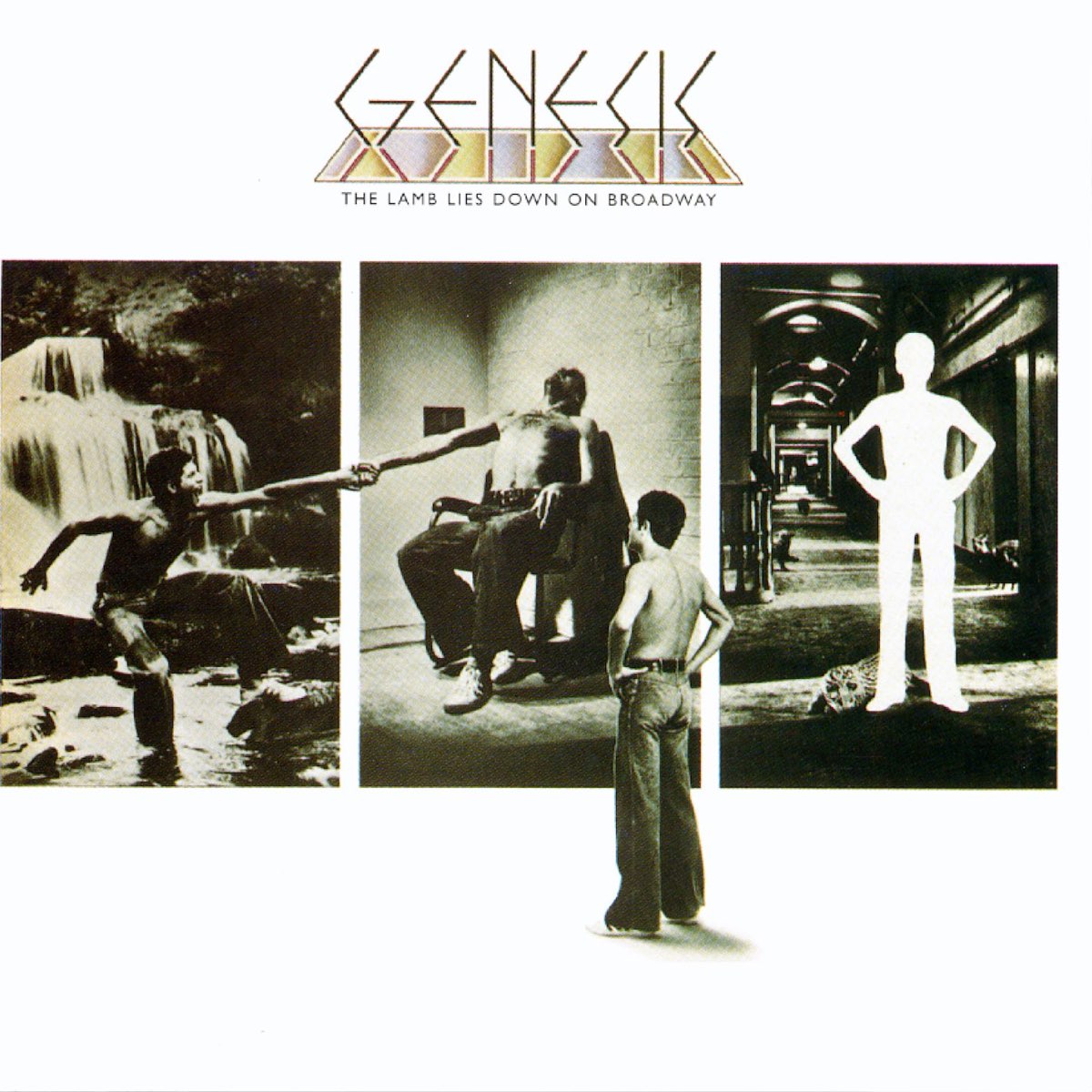
The Lamb Lies Down On Broadway is the sixth studio album by Genesis, founded in 1967.
The Lamb Lies Down On Broadway is Genesis’ first double album and the last to feature the band’s beloved quintet line-up. Vocalist Peter Gabriel left the band in 1975 after a tour based around the album was completed.
The Lamb Lies Down On Broadway is also Genesis’ first concept album. One of the suggestions on the table for the album’s theme was an adaptation of Antoine de Saint-Exupéry’s children’s book The Little Prince. However, Gabriel fought this idea, championed by bassist Mike Rutherford, feeling that the time for fantasy themes was over and the band should move on to more down-to-earth and raw themes. Gabriel got his way, but there are many opinions about the earthiness of the final theme. However, Gabriel eventually took it upon himself to write all the lyrics for the album. Many might imagine that this was always the case, but in fact Rutherford, and especially keyboardist Tony Banks , is responsible for a significant proportion of the lyrics on previous albums.
Gabriel’s concept for the album was a complex and surrealistic story of Rael, a Puerto Rican, and his adventure on the way to some kind of enlightenment or self-discovery. As such, it was standard fare for prog bands, as similar themes had been explored on albums by Yes (Close To The Edge) and Gong (Radio Gnome trilogy). Gabriel, however, takes the story to its own surrealistic levels in his own concept (although Daevid Allen’s version of the theme was also pretty out there…).
Rael, the protagonist of Gabriel’s confusing story, is a gang kid living in New York. Rael unwittingly ends up on a surreal adventure in the mysterious and menacing shadow worlds beneath Manhattan, encountering strange creatures and terrifying visions. Along the way, he is forced to confront his own fears and past, which become entwined with bizarre encounters and dangerous situations. At the end, Rael selflessly rescues his brother John, leading to a kind of enlightenment. John, however, may be just another personality of Rael who merges with Rael at the end leading to a process of healing and self-acceptance, whereby Rael becomes Real. Or something.
Having listened to The Lamb Lies Down On Broadway dozens of times and read a whole book about its making which analyses the story in great detail, I have to admit that I still haven’t really got what the whole thing is about. Maybe I’m just dumb, but the whole thing doesn’t really convince me. And if I am stupid, I am not necessarily alone, because members of Genesis have also been very critical of Gabriel’s story. To Gabriel’s credit, the story is certainly ambitious and contains witty references to ancient myths, psychological phenomenons and pop culture. Here and there, of course, the lyrics tickle the imagination. Or at least entertain. And any story in which the protagonist is castrated, then carries his severed organ in a container hanging from his neck and is eventually stolen by a raven cannot be entirely rotten!

Since Gabriel took it upon himself to write all the lyrics for the album (eventually Banks and Rutherford did help out with some of the songs when deadlines started to loom), Gabriel didn’t have much time to get involved in the composition. So the music was mainly written by the other band members and also more of a jam session, whereas before the musicians had brought their finished or almost finished ideas to the sessions to work on them together. As a result, the resulting music is a little more direct, straightforward and rocking. The pastoral meadows of previous Genesis albums are convincingly replaced by a claustrophobic landscape of urban concrete canyons and surreal underground worlds.
The sound of the album is also harder and colder although John Burns , who was also at the helm of Selling England By The Pound (1973), continues to produce. Collins’ drum sound in particular is sharper and more ”metallic” than before and it could perhaps be said that he found his own sound on this album.
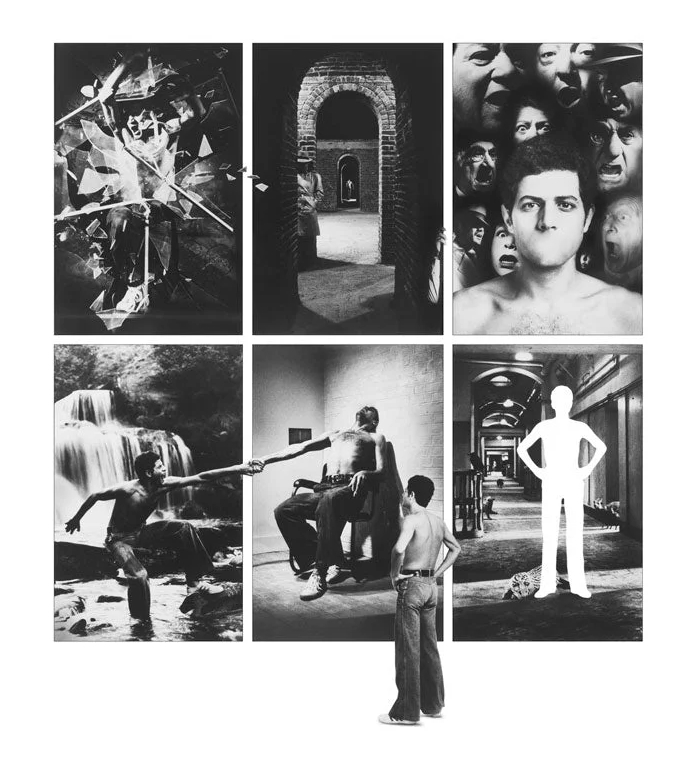
The 94 minute double album consists of 23 relatively short (2-8 min,) songs that mostly continue more or less seamlessly from one song to the next without a break. These joints are not always super-smooth and even this time Genesis is guilty of some boring fade-outs. The album was a massive project not only for its duration but also for its overall concept. While the album was being written and recorded, the band was also preparing an ambitious stage show under Gabriel’s direction, which was a multimedia spectacle. In the end, the album was completed in a real rush and was worked on in several ”shifts”, with some musicians working on it at night and others during the day.
Rael Imperial Aerosol Kid
Exits into daylight, spraygun hid,
And the lamb lies down on Broadway.
The lamb seems right out of place,
Yet the Broadway street scene finds a focus in its face.
The Lamb Lies Down On Broadway’s first album is clearly its stronger half. And more approachable. Its songs are the album’s catchiest and most poignant offering. The hit parade starts right away with the title track, which kicks off with a fast, pearly piano roll, and actually continues throughout the album, going from the handsome prog-anthem ”In the Cage” to the briskly rocking ”Back in N.Y.C.” and from there to the rather odd take on pop music of ”The Carpet Crawlers”.
The porcelain mannequin with shattered skin fears attack
And the eager pack lift up their pitchers, they carry all they lack
The liquid has congealed, which has seeped out through the crack
And the tickler takes his stickleback
The carpet crawlers heed their callers
”We’ve gotta get in to get out
We’ve gotta get in to get out
We’ve gotta get in to get out”
”The Carpet Crawlers” does follow the normal verse-chorus structure of pop and for Genesis music it is harmonically very simple, but it still manages to grow as if unnoticed with its constant variations of vibrant timbres, different textures and bubbling synthesizer bursts creating a quite magical and atmospheric sound that is beautifully delicate and at the same time very strange. It’s also intrinsically funny that although the song has a very addictive earworm-like chorus, it too ends up being the same kind of surrealistic dada as the album’s lyrics on average.
Read also:
- Levyarvio: Porcupine Tree – Lightbulb Sun (2000)
- Review: Van der Graaf Generator – Still Life (1976)
- Levyarvio: Kevin Gilbert – The Shaming Of The True (2000)
- Year by Year : Best Albums of 1976 – 11-20
- Review: Wigwam – Lucky Golden Stripes And Starpose (1976)
- Review: Rain Tree Crow – s/t (1991)
- Review: John G. Perry – Sunset Wading (1976)
- Levyarvio: Black Sabbath – Master Of Reality (1971)
- Review: Henry Cow – Concerts (1976)
The more experimental second album (i.e. the third and fourth half of the vinyl) is of a more uneven quality than the first, and you can hear that Genesis got busy with their big project. However, the second disc also offers many delicious moments. The brightest gem is ”The Lamia” which is one of the band’s finest tracks. Beautiful and at times ethereal and at other times powerful, ’The Lamia’ is a moody nod to Nursery Cryme (1971) and even Trespass (1970). Guitarist Steve Hackett plays one of the most valiant solos on the album, which manages to be both melancholic and heroic. Even Gabriel’s flute quickly takes centre stage at the end. Manna for the old Genesis fans! The ending of ”Lamia” is disappointing, though; a song that would have deserved a handsome finale just fades away.
One of The Lamb’s most interesting curiosities is ”The Waiting Room”, which immediately follows the straightforward rock song ”Lillywhite Lilith” (which is, by the way, mostly composed by Collins). A significant number of Genesis fans will probably loathe this free improvisation, but as a big fan of avant-garde music I enjoy it, even if I don’t count it among the album’s real highlights. Genesis is certainly not known as an improvising band. On the contrary, the band performed their songs live in a very slavish way, following the original compositions. The free improvisation-based abstract rattling and buzzing soundscape of ”The Waiting Room” is more like something you would expect from King Crimson or Henry Cow. The band aimed to create ”scary” sounds and the track, also called ”Evil Jam”, starts off with rattling drums, buzzing guitars, weird synth sounds and a flute through Echoplex until the music eventually grows from abstract sound painting to a more structured sounding section which unfortunately is not very interesting. Genesis also improvises live during ”The Waiting Room” and if Genesis had had the insight to record all their gigs like King Crimson, they could have used these improvisations to build an interesting ”The Waiting Rooms” bonus disc for The Lamb Lies Down On Broadway.
Halfway through the second album, The Lamb goes into standstill. Immediately following ”Lamia”, ”Silent Sorrow in Empty Boats” is a sketchy instrumental mood piece that recalls the lesser tracks on Popol Vuh or perhaps Brian Eno’s 70s solo albums. In a way it’s interesting ambient rock, but in this context it feels like a bit of extra padding. The double album was a commitment and there was enough material to go around. It’s also problematic that the following track ”The Colony Of Slippermen” continues for a couple of minutes in the same shaky way, rambling on in a vaguely Asian atmosphere until the song finally comes to life with energy. The few instrumental tracks on the album were also motivated by the fact that for a stage show it would be essential to have breaks in the music during which Gabriel could change from one outfit to another. The most complex of the costumes is the Slipperman outfit seen during ”The Colony Of Slippermen”, which looks like a sexually transmitted disease that has taken the form of a human figure.
Speaking of Brian Eno. The Lamb features a very rare artist guest appearance on the Genesis album, as the former Roxy Music sound artist, who recently embarked on a solo career, was invited by Gabriel to appear on the album. He added some exotic electronic effects here and there on the album. Clearly Eno’s contribution can be heard in Gabriel’s bubbly treatment of his vocal on the track ”The Grand Parade of Lifeless Packaging”. As payment for these ”Enossifications”, as the credits put it, Phil Collins was sent to play on an Eno album that was in the works at the same time. Collins eventually played drums on the Eno song ”Mother Whale Eyeless” on the album Taking Tiger Mountain (By Strategy). Eno and Collins continued to collaborate on a few more albums. Eno and Gabriel have also continued to collaborate occasionally since then.
The opening fourth, and final half of ”The Colony Of Slippermen” is by far its weakest. At over eight minutes, ”The Colony Of Slippermen” itself is an uneven track, although it does contain some great moments. The highlight of the fourth half is ”The Light Dies Down on Broadway”, despite the fact that it is based almost entirely on a recycling of the musical material from the title track and ”Lamia”. However, the recycling is cleverly done and acts as a kind of thematic glue. The long rhythmically complex instrumental section of ”Riding The Screen” is also handsome and features some amusing jittery keyboard playing from Banks.
The closing ”it” leaves me a little cold. In terms of the story, the threads are pulled together too hastily and the song, loaded with lyrics, doesn’t really make much of an impact musically. The cheerful atmosphere seems forced and the references to The Rolling Stones (Cause it’s only knock and know all, but I like it…) seem silly.
Read also: Genesis – Selling England By The Pound (1973)
The Lamb Lies Down On Broadway received mixed reviews when it was released, but sold slightly better than the previous album Selling England By The Pound, reaching number 10 in the UK and number 41 in the US. Yes had played their own double album Tales From Topographic Oceans in its entirety on tour and Genesis decided to take the same bold step by playing their new epic in its entirety on tour. Despite the fact that the album hadn’t even been released in all regions at the time of the shows. Apart fromThe Lamb, only a few old songs were played. This was a tough break for some fans and in the end the tour made a real loss. Partly because some shows had to be cancelled due to poor ticket sales and partly because the sold out UK tour had to be postponed after Hackett broke his arm in a wine glass accident.
The tour was Peter Gabriel’s last with Genesis, as he had announced that he was leaving the band in the middle of the tour. It was decided to keep the news under wraps until the end of the tour, but eventually the press got wind of it and Gabriel wrote an open letter to the media in which he expressed his disappointment with the music industry and his desire to spend more time with his family. However, Gabriel did not become a farmer, as he briefly considered, and released his first solo album in 1977. The remaining Genesis crew, meanwhile, went on without Gabriel the very next year with the excellent A Trick Of The Tail.
It’s a cliché to say of double discs that a little compression would have made them a real gem. To some extent, this cliché holds true for The Lamb Lies Down On Broadway. It’s an elusive piece of work, but despite some of its weak moments and unsatisfactory storytelling, I think it’s clearly more than the sum of its parts. The Lamb is an album that’s a little hard to give five stars to, but at the same time all the other options feel wrong. In the end, however, the best moments of The Lamb Lies Down On Broadway are so great that for me the album rises up to fight with Foxtrot (1972) for the title of Genesis’ best album. The bold The Lamb Lies Down On Broadway is a wonderful end to Genesis’ Peter Gabriel era.
Best tracks: ”The Lamb Lies Down on Broadway”, ”Carpet Crawlers”, ”Back In NYC”, ”In The Cage”, ”The Lamia”, ”Riding The Scree”
Author: JANNE YLIRUUSI
Tracks
Disc 1
- The Lamb Lies Down on Broadway (4:50)
- Fly on a Windshield (4:23)
- Broadway Melody of 1974 (0:33)
- Cuckoo Cocoon (2:11)
- In the Cage (8:15)
- The Grand Parade of Lifeless Packaging (2:45)
- Back in N.Y.C. (5:42)
- Hairless Heart (2:13)
- Counting Out Time (3:42)
- The Carpet Crawlers (5:15)
- The Chamber of 32 Doors (5:40)
Disc 2
- Lillywhite Lilith (2:42)
- The Waiting Room (5:24)
- Anyway (3:07)
- The Supernatural Anaesthetist (2:59)
- The Lamia (6:57)
- Silent Sorrow in Empty Boats (3:07)
- The Colony of Slippermen (8:13) :
i. The Arrival
ii. A Visit to the Doktor
iii. Raven - Ravine (2:04)
- The Light Dies Down on Broadway (3:32)
- Riding the Scree (3:57)
- In the Rapids (2:26)
- it (4:15)
Genesis
Peter Gabriel: vocals, flute, oboe Steve Hackett: guitars Mike Rutherford: bass guitar, 12-string guitar Tony Banks: keyboards Phil Collins: drums, percussion, backing vocals
 Pienemmät Purot
If you would like another perspective on the album here is a link to the webpage ’Medium’ and my essay on this Genesis concept album.
TykkääTykkää
If you would like another perspective here is a link to the webpage ’Medium’ and my essay on this Genesis concept album. It is entitled ’The Lamb Lies Down on Broadway: Nightmare or Nirvana’
Link: https://medium.com/@rickkress/nightmare-or-nirvana-bf7ccf7987dd
TykkääLiked by 1 henkilö