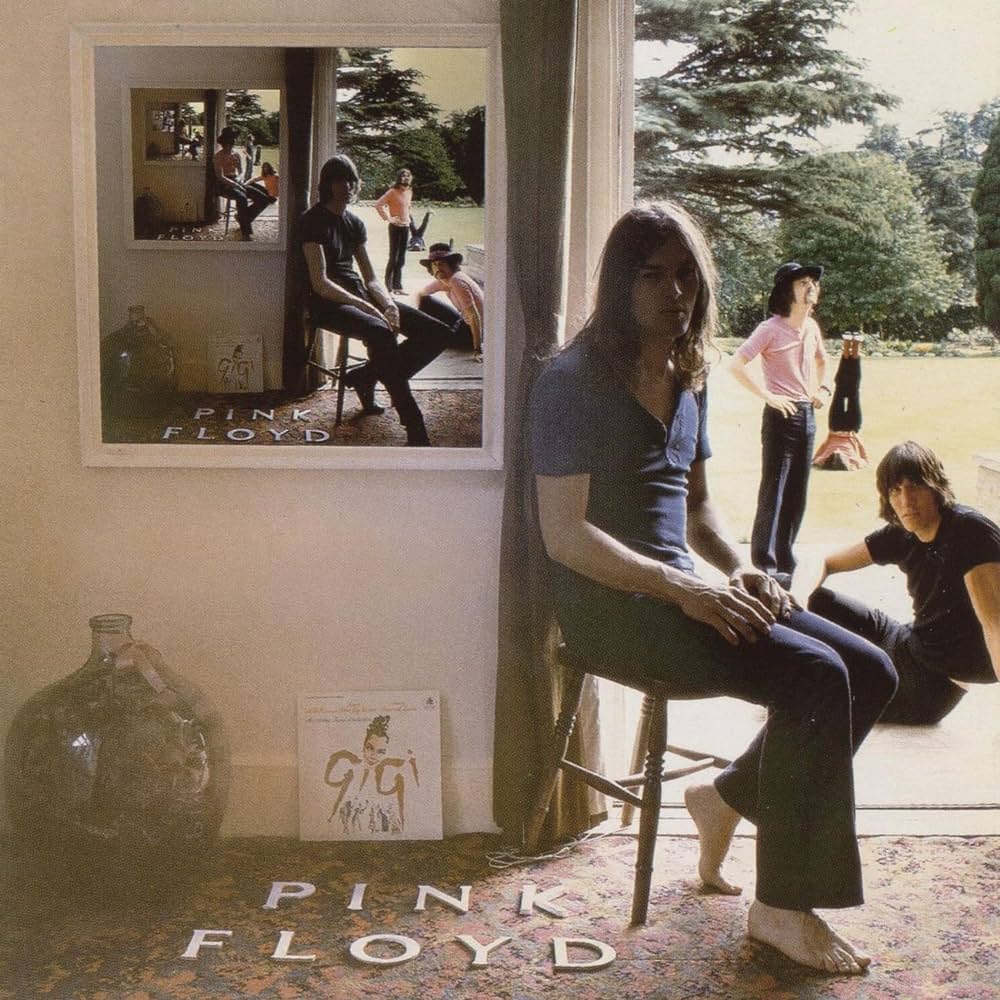
Ummagumma is the fourth album by Pink Floyd, formed in 1965.
Pink Floyd had made only one album (the soundtrack album More) before Ummagumma entirely without their original artistic director Syd Barrett, and the band was obviously still looking for direction in 1969, still feeling a little lost. Perhaps a certain lack of faith in the present was also reflected in Ummagumma’s rather unusual and partly backward-looking format. The first disc contains four live tracks while the second disc contains five new songs that are the individual work of the band members, both in terms of composition and execution.

Recorded live at two different gigs in the spring of 1969, the live album is about forty minutes long. The repertoire includes four of the band’s old songs ”Astronomy Domine”, ”Careful with That Axe, Eugene”, ”Set the Controls for the Heart of the Sun” and ”A Saucerful of Secrets”. All the songs are slightly stretched compared to the original studio versions, but there’s no excessive jamming as was sometimes the case in the very early days of the band.
The band plays with energy and vigour, and the live sounds are better than many bands were able to achieve even in the studio at this time. The Floyd never became virtuoso players, but playing is adequate enough, and drummer Nick Mason in particular played much more creatively and intensely than in the band’s later years.
Especially bassist/vocalist Roger Waters’ composition ”Set the Controls for the Heart of the Sun” gets a great interpretation on the live disc and might even be the definitive version of the song. Also a rougher interpretation of the old Syd Barret song ”Astronomy Dominee”, twice as long as the original version, is a real winner.
Ummagumma’s live album is excellent and probably the most interesting and stirring concert recording Pink Floyd have ever released. The brilliant Live At Pompeii concert film (1972), though, may be even more relevant for its wider repertoire.
Read also: Review: Pink Floyd – The Wall (1979)
Ummagumma’s studio album has received a relatively negative reception. Many Floyd fans downright hate it, and the band themselves don’t seem to appreciate the songs much in retrospect. After Syd Barrett’s departure, Floyd was still a relatively democratic band at this stage and Roger Waters had not yet emerged as a dominant force. However, the band was not a very coherent and close-knit community, as evidenced by the fact that all of Ummagumma’s new songs are solo compositions. Two of the songs were written by Roger Waters and the other members, keyboardist Rick Wright, guitarist/vocalist David Gilmour and drummer Nick Mason, each contributed a song to the album. Although this might suggest that Waters would have wanted more space for himself at this stage, it’s really just that his songs are slightly shorter than the others. In terms of minutes, each gets almost the same amount of space, with Gilmour trailing with a few minutes less.
Wright was the band member most excited about the possibility of composing his own music, as he dreamed of writing his own symphony and serious art music. Ummagumma provided an opportunity to reach out in this direction. The four-movement Wright composition ’Sysyphus’, which opens the studio album, is a definite leaning towards modern art music. The 13-minute ’keyboard concerto’ features mellotrons that dramatically imitate the power of an orchestra, as well as atonal piano rolls. In addition to the keyboards, Wright also plays percussion in the work. The dark-toned ’Sysyphus’ contains impressive moments, but as a whole it doesn’t quite carry through to the end after a promising beginning. Wright himself denounced his composition as pretentious, but I find it an interesting experiment. I would have liked to hear what Wright would have achieved in this genre if he had bothered to try again.
After Wright’s sombre sound sculpture, the mood becomes more pastoral with Waters’ seven-minute ode to nature. Waters’ ”Grantchester Meadows” opens with a lark’s voice and a slightly shaky acoustic guitar strumming. After a while, it becomes clear that the loop of tape with the lark’s song was by no means just an intro, but rather runs quite loudly throughout the song. A bold solution! Waters sings about the simple joys of nature and is accompanied not only by acoustic guitar but also by a variety of sound effects such as swan wings flapping and bees buzzing, which move cleverly around the stereo image. ”Grantchester Meadows” is a charming nature ballad, but a little overlong. And perhaps the guitar playing should have been outsourced to Gilmour…
Waters’ contribution continues with the quirkily titled ”Several Species of Small Furry Animals Gathered Together in a Cave and Grooving with a Pict” which is pure musique concrète. The whole piece consists of nothing but very avant-garde tape loops and effects. The end result is full of all kinds of weird banging, buzzing, whistling, buzzing and bleeping. For all its strangeness, ’Several Species’ is actually a relatively musical and fascinating piece of work, but it’s still not often that you want to listen to Waters’ concrete sonic poetry.
Gilmour’s three-part, 12-minute ”The Narrow Way” is the most conventional music on the studio album, which is not to say that it is ”One Slip”. There’s a gentle acoustic guitar, a wavering electric guitar, psychedelic effects and a lazy-sounding vocal section that, like ”Grantchester Meadows”, has a rather pastoral feel to it. The lyrics, however, are more ambiguous. Or just pure nonsense, which is probably more likely. Gilmour also plays bass guitar, drums and various keyboards in the song, so he transforms himself into a one-man psychedelic rock band. Quite a progressive idea in 1969. But the whole remains fragmented and ’The Narrow Way’ is the least interesting track on Ummagumma’s studio album.
The studio album closes with Mason’s nine-minute percussive odyssey ”Grand Vizier’s Garden Party”, divided into three parts. ”Grand Vizier’s Garden Party” is not your typical virtuoso drumming solo, which Mason couldn’t do, but rather he uses the drums as a tool to create a variety of strange sound effects. Unlike the other members, Mason did not play his piece entirely alone, but enlisted his wife Linda Mason to play the flute for a few passages. ”Grand Vizier’s Garden Party” has some passing moments of interest, but if Gilmour’s ”The Narrow Way” was Ummagumma’s least interesting offering, Mason’s shrieking and frying is its most boring part.
Ummagumma’s studio album is a bewildering affair, not only in terms of its content. On the one hand, its very strange music would suggest that the Pink Floyd quartet were making exactly the kind of music they wanted to make, free from commercial demands. However, none of the members have really expressed their satisfaction with their output in retrospect. Perhaps in some strange way they succumbed to the internal and perhaps unspoken pressures within the band to make strange music without any of them being fully committed to the project.
Read also
- Levyarvio: Spock’s Beard – V (2000)
- Review: Cos – Viva Boma (1976)
- Levyarvio: King Crimson – The ConstruKction Of Light (2000)
- Review: Camel – Moonmadness (1976)
- Review: Gong – Gazeuse! (1976)
- Review: Mike Johnson – The Gardens Of Loss (2026)
Pink Floyd became a commercial giant only a few years later with The Dark Side Of The Moon, but it’s funny to think that at the time of Ummagumma, Floyd could well have ended up as a fringe group for experimental rock bands like Can or Faust, and faded away to enjoy mostly critical acclaim and moderate cult popularity. At the same time, however, it is worth remembering that even Floyd’s avant-garde albums such as Ummagumma and the subsequent Atom Heart Mother sold surprisingly well; both reached the top ten in the UK album charts. The latter even reached number one! So Pink Floyd seemed unstoppable even at their most experimental. And when they finally decided, a few years later, to straighten out the corners of their music, the sky was the limit.
Best tracks: ”Astronomy Dominee”, ”Set the Controls for the Heart of the Sun”, ”Saucerful of Secrets”, ”Sysyphus, Pt. 1”, Sysyphus, Pt. 2”, ”Grantchester Meadows”
Author: JANNE YLIRUUSI
Read also: Review: Porcupine Tree – Closure/Continuation (2022)
Studio album
- Astronomy Domine (8:29)
- Careful with That Axe, Eugene (8:50)
- Set the Controls for the Heart of the Sun (9:12)
- Saucerful of Secrets (12:48)
Live album
- Sysyphus, Pt. 1 (1:08)
- Sysyphus, Pt. 2 (3:30)
- Sysyphus, Pt. 3 (1:49)
- Sysyphus, Pt. 4 (6:59)
- Grantchester Meadows (7:26)
- Several Species of Small Furry Animals Gathered Together in a Cave and Grooving with a Pict (4:59)
- Narrow Way, Pt. 1 (3:27)
- Narrow Way, Pt. 2 (2:53)
- Narrow Way, Pt. 3 (5:57)
- Grand Vizier’s Garden Party: Enterance, Pt. 1 (1:00)
- Grand Vizier’s Garden Party: Entertainment, Pt. 2 (7:06)
- Grand Vizier’s Garden Party: Exit, Pt. 3 (0:38)
Pink Floyd
David Gilmour: solo guitar, vocals (live album); acoustic and electric guitars, bass guitar, keyboards, drums and vocals on ”The Narrow Way” Nick Mason: drums (live album); percussion, effects on ”The Grand Vizier’s Garden Party” parts 1 & 2 Roger Waters: bass guitar, vocals (live album); acoustic guitars and vocals on ”Grantchester Meadows”, all vocals on ”Several Species of Small Furry Animals. ..”. Richard Wright: keyboards, vocals (live album); organ, piano, Mellotron and percussion on ”Sysyphus”.
Guest
Linda Mason: flute
 Pienemmät Purot
Jätä kommentti