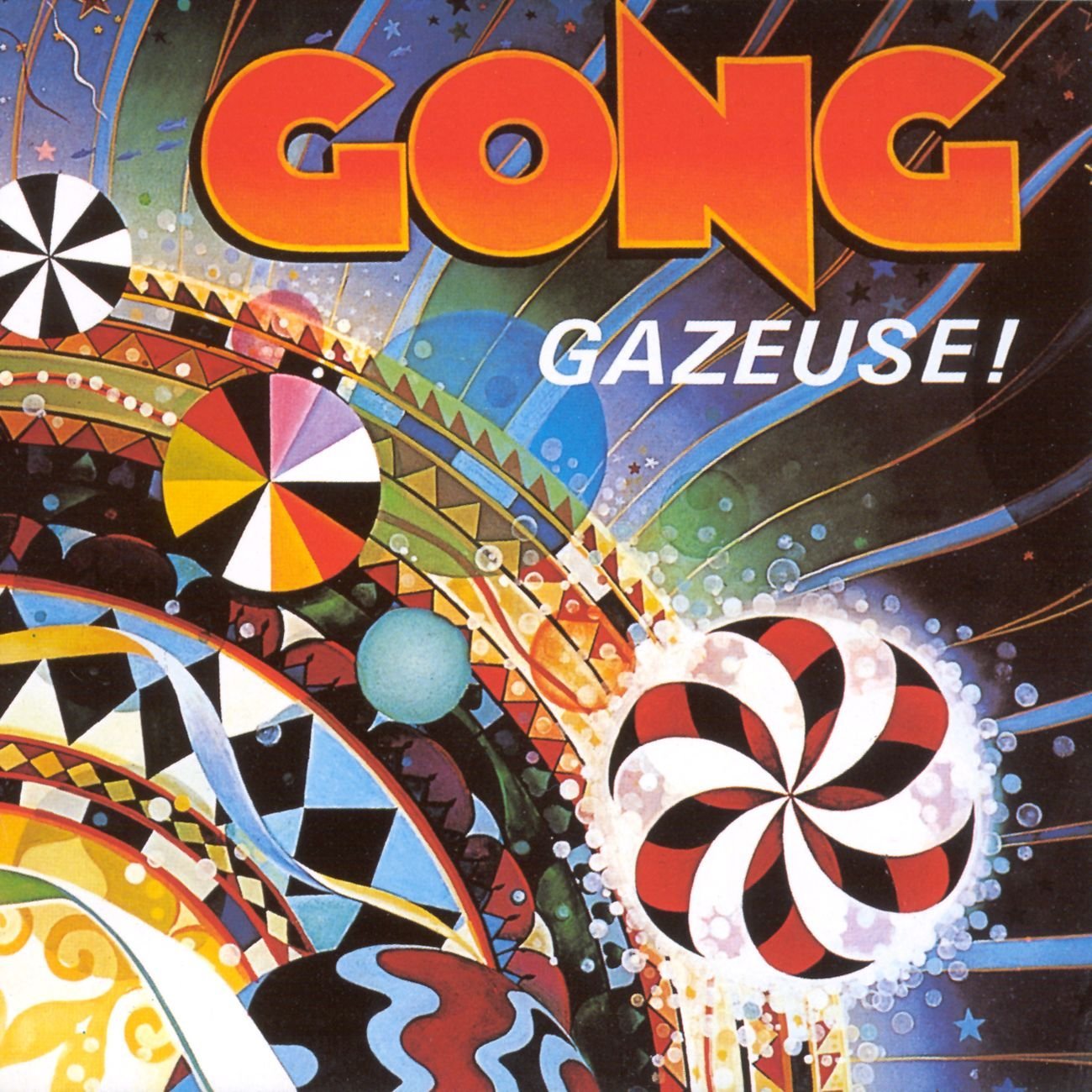
Gazeuse! is Gong’s seventh album, but it can also be considered the first album by Pierre Moerlen’s Gong, even though it isn’t officially referred to by that name. In the U.S., Gazeuse! (the word “gazeuse” is French and roughly translates to “sparkling” or “bubbly”) was released under the title Expresso.
Gong’s previous album, Shamal, was a brilliant transitional album that struck an interesting balance between Gong’s earlier style and the direction continued by Gazeus!. However, the Shamal lineup could not withstand the musical conflicts that had been simmering within the band for several years, dating back to the sessions for the You album (1974).
Guitarist Steve Hillage had only participated in Shamal as a guest musician, and now he left the band entirely. Bassist Mike Howlett, who had remained an important link to the old Gong sound on Shamal, eventually decided to leave the band as well. Or rather, he was forced to do so. Howlett wanted to make more vocal music going forward, while drummer Pierre Moerlen wanted to focus purely on instrumental music. The conflict escalated so badly that the decision ultimately fell to the record label Virgin.
Surprisingly, Virgin chose (A record label choosing instrumental music over vocal music? Huh?) Moerlen’s instrumental direction. Howlett left the band and began a career as a producer. To replace Howlett, they recruited Francis Moze, who had previously played in Magma. However, one member of the original Gong lineup remained: wind player Didier Malherber, though he only plays on three tracks on Gazeuse!.
Gazeuse! clearly breaks away from the space-rock-style prog of earlier Gong albums and shifts toward the jazz-rock sound that was booming in the mid-70s. Since Moerlen had studied percussion instruments at a high level and composed for them, it’s no wonder that various percussion —especially the vibraphone and marimba—play a major role on the album now that he was able to steer the band’s direction. Pierre’s brother Benoit Moerlen, a clear virtuoso on the instrument, was hired to play the vibraphone. In addition to Benoit, Mireille Bauer also plays tuned percussion, and Mino Cinélu plays a variety of other percussion instruments. Including Pierre Moerlen (who, in addition to drums, also plays the vibraphone, marimba, and glockenspiel), the band thus features no fewer than four musicians focused solely on percussion. This nicely sets the album apart from the usual jazz-rock crowd and their guitar and synthesizer solos. Gazeusella! makes no use of keyboard instruments at all, with the exception of the electric piano on the final track; instead, that liberated solo space is given over to the marimbas and vibraphones, which are capable of playing melodies. And, of course, to the band’s new guitar virtuoso as well.
Steve Hillage is certainly not one of the clumsiest guitarists around, but a true guitar virtuoso was brought in to replace him. Hillage was replaced by Allan Holdsworth, who had previously played with bands such as Nucleus and Soft Machine. Holdsworth, dubbed the “John Coltrane of the guitar,” is one of the world’s most celebrated and undeniably technically skilled guitarists, but in my opinion, he has always been at his best when he’s just been part of a band rather than responsible for the entire show, as he was during his solo career. On “Gazeuze!”, we get to hear some of his most stylish solos, such as the mercurial, strange yet melodic solo on the track “Night Illusion.” Which, by the way, also happens to be Holdsworth’s own composition.
Although Moerlen is gradually taking on the role of band leader, on Gazeuse! the songwriting duties are shared quite equally among the other members as well. Four of the tracks were written by Moerlen, two by Holdsworth, and one by Francis Moze.
Read also:
- Levyarvio: Kevin Gilbert – The Shaming Of The True (2000)
- Year by Year : Best Albums of 1976 – 11-20
- Review: Wigwam – Lucky Golden Stripes And Starpose (1976)
- Review: Rain Tree Crow – s/t (1991)
- Review: John G. Perry – Sunset Wading (1976)
- Levyarvio: Black Sabbath – Master Of Reality (1971)
- Review: Henry Cow – Concerts (1976)
- Levyarvio: Spock’s Beard – V (2000)
- Review: Cos – Viva Boma (1976)
Gazeuse! kicks off with perhaps its most powerful track: Moerlen’s composition “Espresso”. It showcases the album’s best qualities, being both powerfully rhythmic and pleasantly melodic. Moze’s fretless bass playing is a delight to hear, and Holdsworth delivers a skillful yet understatedly elegant guitar solo. The percussion naturally plays a significant role in this track as well, though more in a supporting capacity. Pierre Moerlen doesn’t show off on the drums at any point, content to serve the song. Malherbe also gets to play his saxophone softly. A magnificent track!
Holdsworth’s magnificent “Night Illusion” is followed by the album’s outright tour de force of percussion instruments in the ten-minute, two-part track “Percolations.” In this composition, all the music is played on percussion instruments, and the track features truly virtuosic vibraphone and marimba playing, whose cyclical themes are at times reminiscent of the music of Steve Reich or Philip Glass. The track culminates in an epic drum solo performed by Pierre Moerlen. This drum solo is one of the few that were worth recording on a studio album. It must be said, however, that while “Percolations,” with its drum solo, is one of the finest performances of its kind, it still takes up perhaps a slightly too large portion of the album.
After Moerlen’s drumfest, the track transitions into Holdsworth’s eight-minute composition “Shadows Of,” which he later recorded on his solo album under the title “Velvet Darkness” (on his self-titled debut album). The track is carried by Holdsworth’s unique guitar work, which at times sounds both wistful and almost triumphant. Moerlen’s drumming is also intense on this track, and Malherbe plays a fine flute solo that adds a touch of ethnic flair. Midway through the track, Holdsworth launches into some impressive guitar work that surely left many of his contemporary guitarists in awe. Toward the end, there’s also a brief snippet of quite astonishing acoustic guitar playing. What a shame that Holdsworth didn’t play the instrument more often!
“Esnuria” is a Moerlen composition and, once again, features quite powerful percussion with a slight Latin vibe. The track also features surprisingly heavy and gritty riffing from Holdswort, with Malherbe stylishly playing his saxophone in the background. Malherbe’s role is at its peak on “Esnuria,” and stylistically, the track perhaps most closely resembles the style of its predecessor, Shamal, among Gazeuse!’s songs. Moerle downright unleashes a barrage of drum fills in the latter half of “Esnuria,” but with such skill and good taste that one can’t help but admire it. If played by a slightly less skilled drummer, those same sections would probably have sounded nothing short of ridiculous.
The album concludes with Moze’s intimate “Mireille,” a duet between Holdsworth’s nimble acoustic guitar and Moze’s impressionistic piano and electric piano. It may not be a particularly significant track on its own, but it serves as a pleasant closing piece within the context of the album.
Gazeuse! is crowned by magnificent sounds crafted by one of the best producer/engineer duos of the 1970s, Dennis Mackay and Stephen W. Taylor. The album sounds crystal clear, yet remains solidly balanced.
Gazeuse! marked a bold stylistic departure for Gong. The decision divided opinions strongly then and continues to do so today. For some fans, leaving behind the hazy spacerock vibe was a outright betrayal, while on the other hand, some fans of the jazz-rock Gong cannot stand the original, whimsically playful Daevid Allen-led Gong. Personally, I greatly appreciate the best albums from both camps, and Gazeuse! is definitely the best album by Moerlen’s Gong. I would also dare to claim that Gazeuse! holds its own in comparison to almost any jazz-rock album from the latter half of the 1970s and surpasses many releases by more famous bands such as Weather Report or Return To Forever.
Gong returned in 1978 under Moerlen’s leadership with the album Expesso II, after which the band’s name was changed to Pierre Moerlen’s Gong. The name change was apparently linked to a switch in record labels (from Virgin to Arista), but it also conveniently distinguished the band from other Gong-related projects that were beginning to emerge at that time.
Best tracks: ”Espresso”, ”Shadows Of”, ”Esnuria”
Author: JANNE YLIRUUSI
Tracks:
Side A
1. ”Expresso” (Pierre Moerlen) – 5:58
2. ”Night Illusion” (Allan Holdsworth) – 3:42
3. ”Percolations (Part I & II)” (Moerlen) – 10:00
Side B
4. ”Shadows Of” (Holdsworth) – 7:48
5. ”Esnuria” (Moerlen) – 8:00
6. ”Mireille” (Francis Moze) – 4:10
Pierre Moerlen: drums, vibraphone, marimba, snare drums, glockenspiel Didier Malherbe: tenor saxophone (1,5), flute (4) Allan Holdsworth: guitars, violin, pedal steel Mireille Bauer: vibraphone, marimba, glockenspiel, tom-toms Benoît Moerlen: vibraphone Francis Moze: fretless bass, gong, piano, electric piano Mino Cinélu: percussion
Producer: Dennis MacKay
Label: Virgin
 Pienemmät Purot
Jätä kommentti