The author’s picks for the best albums of 176, ranked 21-29.
In the Year by Year series, I’ll go through my favourite albums from 1969 to the present day.
- Eberhard Weber : Yellow Fields (DE) ****
- Pavlov’s Dog: At The Sound Of The Bell (US) ****
- Bob Dylan: Desire (US) ****
- Tomasz Stanko: Balladyna (PO) ****
- Iceberg: Coses nostres (ES) ****
- Gentle Giant: Interview (UK) ****
- Barre Phillips : Mountainscapes (US) ****
- Chick Corea: My Spanish Heart (US) ****
- John Abercrombie & Ralph Towner : Sargasso Sea (US) ****
Top 20 coming soon!
See the best albums of 1975 here
21. Eberhard Weber : Yellow Fields
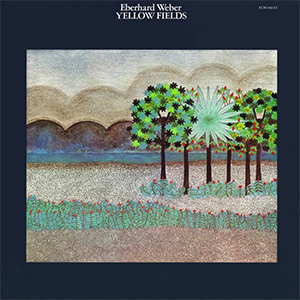
Yellow Fields is the second album by German jazz double bassist Eberhard Weber (b. 1940) as band leader.
Yellow Fields is a follow-up to the magnificent 1974 album The Colours of Chloë. The Colours of Chloë was a dreamlike, lingering combination of jazz and art music. Yellow Fields continues along roughly the same lines, but its music is more energetic and fast-paced. The result is jazz-rock that once again sounds a bit like chamber music. And very European.
Yellow Fields also introduces Weber’s new band, known as Colours. The name is probably derived from The Colours Of Chloë tour.
Colours keyboardist Rainer Brüninghaus is the only remaining member of the band that played with Chloë. Classically trained, Brüninghaus uses synthesizers and electric piano a little more on Yellow Fields than before, but he mainly plays a supporting role, leaving most of the solo space to the new wind player, Charlie Marino (Supersister), who brings with him slightly ethnic tones from somewhere in India and Asia. Weber also confidently takes the lead on bass at times, playing with extreme elegance and virtuosity with a handsome dark sound. Norwegian master drummer Jon Christensen, who mostly sticks to cymbals on the album, completes the quartet and acts as an effective counterpart to Weber’s low frequencies.
Yellow Fields contains one five-minute track and three long ten-minute tracks. At times, Weber’s view of jazz, filtered through art music, is not far removed from progressive rock, and the most serene moments of the Canterbury scene come to mind. Gilgamesh’s 1975 debut album often comes to mind when listening to Yellow Fields.
Although Yellow Fields is formally competent in every respect, and although I can’t really find anything to complain about, something is still missing. Perhaps the album lacks a certain element of surprise or edge. The longest tracks on the album would also have benefited from being shortened slightly. Yellow Fields is an excellent album, but it doesn’t quite manage to reach the magical heights of The Colours Of Chloë.
After Yellow Fields, Colours recorded two more albums with almost the same lineup. Only drummer Christensen was replaced by John Marshall, who had left Soft Machine. Colours played together until 1981, when Weber joined Jan Garbarek’s band.
Best tracks: “Touch”, “Yellow Fields”
22. Pavlov’s Dog: At The Sound Of The Bell
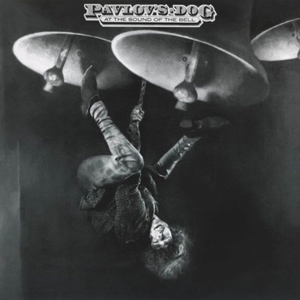
At The Sound Of The Bell is the second studio album by Pavlov’s Dog, an American band formed in Missouri in 1972.
Pavlov’s Dog released their debut album Pampered Menial last year, and At The Sound Of The Bell continues largely along the same lines, effectively combining pop and progressive rock. At The Sound Of The Bell takes the band’s music in a slightly lighter direction, however. The rock influences have been replaced by more pop-oriented and beautifully melodic atmospheres. At times, one could even speak of a kind of proto-AOR. The mood of the album is melancholic and mournful, and the lyrics seem to express a constant longing for the good old days. ja pieni kuoro..
At The Sound Of The Bell, the band’s lineup underwent changes when the violinist and drummer left, and the music was made even more by studio musicians led by vocalist/composer David Surkamp. The booklet lists nine guest musicians plus a string section and a small choir. Among the guest musicians are some big names, such as guitarist Elliot Randall, saxophonist Michael Brecker, Roxy Music horn player Andy MacKay, and most famously, Bill Bruford, who plays all the drums on the album…
23. Bob Dylan: Desire
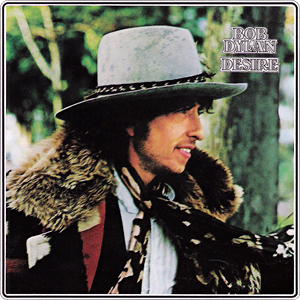
Desire is Bob Dylan’s 17th studio album.
In my review of Blood On The Tracks, I praised it as one of Dylan’s strongest musical works. I am delighted to say that its successor, Desire, is of roughly the same high caliber.
Desire was born after the excellent Rolling Thunder Revue tour, and its communal, almost carnival-like spirit is also reflected in the content of the album, which was largely recorded with the musicians from that tour. Desire is one of Dylan’s most band-like and communally made albums. This is even reflected in the songs to such an extent that most of the lyrics were written together with Jacques Levy.
The highlight of the album can be heard right at the beginning. The first track, ”Hurricane,” is truly impressive. The fiercely rolling ”Hurricane” tells the story of black boxer Rubin Carter, who was convicted of triple murder, apparently motivated by racism. The star of ”Hurricane,” and indeed the entire album, is Scarlet Rivera, whose intensely played violin brings a strong gypsy romanticism to the song. Rivera’s slightly exotic-sounding violin solos and riffs, combined with Dylan’s blues-tinged folk rock and intricate lyrics, make some of the songs sound, dare I say, almost prog.
Other gems on the album include “Isis” and “One More Cup of Coffee (Valley Below).”
”Isis” is one of the most famous songs on the album, and rightly so. Its hypnotic, rocking rhythm, Rivera’s jangling violin, and mythical story reminiscent of ancient Egypt make it one of Dylan’s most fascinating narrative songs.
“One More Cup of Coffee (Valley Below)”, which begins with a spontaneous little bass solo, is one of the most atmospheric moments on the album. The duet with Emmylou Harris is built around a dark melody and Rivera’s melancholic violin. Harris’s clear voice forms a beautiful counterpoint to Dylan’s rough interpretation, and together they create an almost eerie atmosphere for the song.
The 56-minute Desire contains a hint more musical idling than its predecessor Blood On The Tracks, but for the most part Dylan’s narrative and musical offerings remain balanced, and the compositions do not become mere vehicles for the lyrics. At its best, Desire is an energetic, narrative, and uniquely sounding whole, which ranks among Dylan’s strongest albums of the 1970s.
Best tracks: ”Hurricane”, ”Isis”, ”One More Cup of Coffee (Valley Below)”
24. Tomasz Stańko : Balladyna
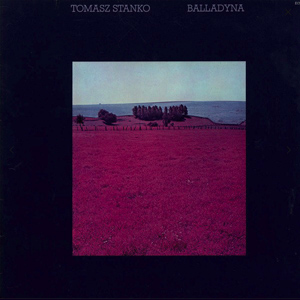
Balladyna is Polish trumpeter Tomasz Stańko’s fifth album as bandleader and his first recording for the ECM label.
Balladyna is a good example of ECM’s power to unite cultures. Alongside Stańko (1942–2018), Balladyna features his fellow countryman and namesake Tomasz Szukalski on saxophone, Englishman Dave Holland, familiar from Miles Davis’s band, on bass, and Finnish avant-garde jazz specialist Edward Vesala on drums.
Stańko’s trademark was combining highly melodic trumpet playing with free improvisation, and this is largely what the album Balladyna is all about.
The highlight of Balladynan is heard right at the beginning. The album opens with ”First Light,” which starts with a seductive bass line and Vesala’s light cymbal clatter, over which Stańkocomposes distant, ethnic-sounding trumpet notes. The ten-minute track continues relentlessly to the end. Lightly, but still intensely. Heavy, intense music is easy to make, but this kind of feather-light yet powerful-sounding music is more difficult. Stańko’s quartet succeeds perfectly in this challenge with the opening track.
Unfortunately, there is no other track quite like it on Balladyna, and the rest of the album consists of jazz ballads more in line with the album title. That’s fine, but the excellent opening track perhaps sets expectations too high. However, these are excellent free jazz ballads, and Stańko’s sharp trumpet playing keeps things sufficiently edgy. These are not old jazz standards either, as all the songs are new compositions/improvisations by Stańko or the band members.
Balladyna is an extremely stylish album.
Best tracks: ”First Song”, ”Balladyna”, ”Nenaliina”
25. Iceberg: Coses nostres
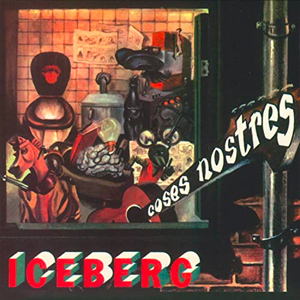
Coses nostres is the second studio album by Spanish band Iceberg.
Founded in Barcelona in 1973, Iceberg released their debut album Tutankhamon in 1975. This pharaoh-themed concept album combined elements of symphonic progressive rock with jazz rock.
Coses nostres sees the band moving more towards jazz rock, and at the same time the band gave up their vocalist, meaning that the album is completely instrumental. Coses nostres’ energetic and powerfully played jazz rock clearly owes a debt to Mahavishnu Orchestra, but Iceberg is not content to simply copy John McLaughlin’s band’s intense riffing in irregular time signatures and fast tempos, but adds a pleasant melodiousness that was sometimes lacking in the Mahavishnu Orchestra.
Alongside the fiery electric guitar of Joaquím Sunyer and the electric piano/synthesizer dialogues of Josep Mas, Coses nostres offers a pleasantly melodic listening experience. However, some of the solo sections are too long, making the songs a little vague. And although Coses nostres offers many delightful moments, it lacks any real highlights. Perhaps the closest is the raucous nine-minute ”Nova (Música de la llum),” which, however, also fizzles out a bit towards the end. A few songs also contain, perhaps unsurprisingly, a bit of local flavor in the form of flamenco influences, which work best in the lively acoustic guitar solos of ”L’acústica.”
Despite its weaknesses, Coses nostres is mostly very tasty melodic jazz-rock and recommended listening for fans of the genre who have already waded through the most obvious names.
Best tracks: ”Nova (Música de la llum)”, ”L’acústicassa”.
Read also:
- Review: Gong – Gazeuse! (1976)
- Review: Mike Johnson – The Gardens Of Loss (2026)
- Levyarvio: Mike Johnson – The Gardens Of Loss (2026)
- Levyarvio: Led Zeppelin – Presence (1976)
- Vuosi vuodelta : Parhaat levyt 2000 – Sijat 11-20
- Review: Univers Zero – Ceux Du Dehors (1981)
- Levyarvio: Steve Walsh – Glossolalia (2000)
- Year by Year : Best Albums of 1976 – 21-29
- Levyarvio: Jimmy Page – Outrider (1988)
26. Gentle Giant: Interview
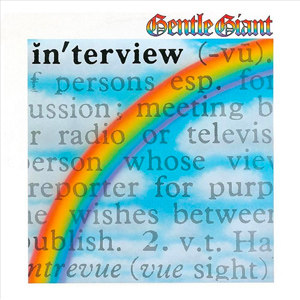
Interview is the eighth studio album by Gentle Giant, formed in 1970.
Interview is supposed to be a concept album, and its vague theme is a dialogue between a rock band and music journalists in the form of a radio interview. Short, staged interview clips are interspersed between the three songs, but otherwise the theme remains thin. However, the lyrics on the album seem to deal more generally with life in a rock band.
Gentle Giant, who had been churning out albums at a tremendous pace, began to falter slightly with Interview. The music is still mostly high quality, but the sharpest inspiration and innovation began to fade. Interview is competent Gentle Giant music in every respect, but it feels somewhat repetitive. Interview is a good album, but all seven of the band’s previous albums are even better.
The only completely new touch on Interview is the reggae beat of ”Give It Back.” Reggae and Gentle Giant’s prog don’t seem like a very compatible combination, but the result is surprisingly fun. And without being humorous in any way. 1976 seemed to be the year when prog artists discovered reggae: Van der Graaf Generator’s World Record also features reggae.
However, I consider the songs ”Design” and ”Another Show” to be the real highlights of Interview, as they conveniently showcase the extremes of Gentle Giant’s style.
”Design” represents the band’s more devout side in the form of medieval-sounding vocals, eventually turning into a lively percussion piece in which the entire band plays various percussion instruments. ”Another Show,” on the other hand, is one of Gentle Giant’s best when it comes to properly rocking songs. Fast-paced and intense, with a dizzying tempo in 5/4 time, ”Another Show” was certainly an important influence on the American prog band Echolyn, which started out in the 1990s.
After the interview, a few years’ break would probably have done the band, which had been working almost non-stop since 1970, a world of good. However, frustrated by their commercial success, Gentle Giant decided to press on and began making compromises in their music in order to increase their success. Unfortunately, this decision backfired in every way. The end result of these compromises was that the band’s previously unique music became watered down and even their old fans drifted away.
After Interview, Gentle Giant released three more albums, each worse than the last, before calling it quits for good (which is very rare!) in 1980.
Before its anticlimactic end, Gentle Giant produced at least two masterpieces (Acquiring The Taste and Octopus) and six other excellent or at least good albums. Not a bad achievement!
Best tracks: ”Interview”, ”Design”, ”Another Show”
27. Barre Phillips : Mountainscapes
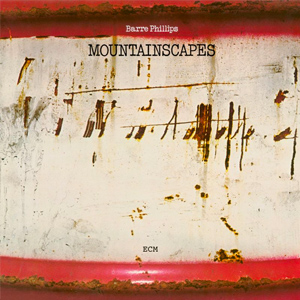
Mountainscapes is American double bassist Barre Phillips’ (b. 1934) fourth album as bandleader and his second recording for ECM.
A dark-toned album that is at times lingeringly meditative, but at other times also quite aggressively clattering. At times, the moods are surprisingly avant-garde for an ECM album, with clanging percussion and wrenching saxophones (John Surman).
Guitarist John Abercrombie makes a guest appearance on the last track, but otherwise the lineup consists of a quartet of bass, drums, saxophone, and synthesizer. Phillips’ double bass rumbles darkly and impressively throughout the album (he also plays with a bow at times), and Dieter Feichtner’s synthesizers create space-like atmospheres. I don’t know what mountains Phillips had in mind when naming the album, but for me it conjures up images of the red mountain ranges of Mars.
Mountainscapes is a fascinating and unfortunately little-known avant-garde jazz album.
Best tracks: “Mountainscape 1”, “Mountainscape 3”
Read also:
- Review: Gong – Gazeuse! (1976)
- Review: Mike Johnson – The Gardens Of Loss (2026)
- Levyarvio: Mike Johnson – The Gardens Of Loss (2026)
- Levyarvio: Led Zeppelin – Presence (1976)
- Vuosi vuodelta : Parhaat levyt 2000 – Sijat 11-20
- Review: Univers Zero – Ceux Du Dehors (1981)
- Levyarvio: Steve Walsh – Glossolalia (2000)
- Year by Year : Best Albums of 1976 – 21-29
- Levyarvio: Jimmy Page – Outrider (1988)
28. Chick Corea : My Spanish Heart

My Spanish Heart is the 14th solo album by jazz keyboardist Armando Anthony ”Chick” Corea Jr.
Chick Corea (1941–2021), who began playing the piano at the age of four, rose to prominence as one of the keyboardists on Miles Davis’ groundbreaking albums of the late 1960s (including Filles del Kilimanjaro, In A Silent Way, and Bitches Brew). He began his solo career in 1968 and in the early 1970s he founded the avant-garde jazz band Circle and, a little later, the jazz-rock band Return To Forever, which became one of the most popular bands of its genre alongside Mahavishnu Orchestra and Weather Report.
My Spanish Heart was born after the classic lineup of Return To Forever broke up in 1976. Corea suddenly found himself with extra time on his hands and decided to use it to travel to Spain to study Spanish, African, and Cuban music culture in greater depth.
Although Corea is American and his family roots are in northern Italy, Latin influences often play a central role in his music. These influences came to the fore in particular on the excellent Captain Marvel album made with Stan Getz, but My Spanish Heart is an album on which Corea embraces these influences wholeheartedly.
The instrumentation on the 67-minute album, originally released as a double vinyl, is largely semi-acoustic, and Corea plays mostly grand piano on the album, occasionally resorting to synthesizer solos with slightly corny sounds. The electric piano, which Corea usually favors, plays a rather minor role.
The core band on the album consists of bassist Stanley Clarke and drummer Steve Gadd. In addition, three trumpeters and a trombonist, as well as a string quartet, can be heard on several tracks. Violinist Jean-Luc Ponty makes a guest appearance on one track (two if you count the bonus track ”Clouds” on the CD version). Corea’s wife, Gayle Moran, also adds her wordless vocals to spice up a few tracks.
The album kicks off impressively with the crisp and clear four-minute jazz-rock gem ”Love Castle,” ending with the epic 20-minute, four-part, colorful semi-orchestral ”Spanish Suite,” in which Corea plays his grand piano pompously, accompanied by a string quartet, among others. Throughout the album, Corea balances somewhere between the beautiful and the corny, fortunately leaning more towards the former. This is especially true in the excellent first half of the album, after which the quality fluctuates more.
My Spanish Heart is a somewhat confusing whole, and at times Corea’s taste fails him and the album drifts into questionable solutions. The worst example of this is the synthesizer-driven, 12-minute, four-part suite ”El Bozo,” which plays around ”humorously” and ultimately sounds rather silly with its funny Moog buzzes and whines. There are good moments in this song, but without ”El Bozo,” My Spanish Heart would clearly be a more balanced whole.
My Spanish Heart is at its best when it’s awesome Latin-flavored jazz-rock with virtuoso performances, but Corea paints with a slightly too broad palette, and the whole thing ends up a bit shaky and the album is hopelessly overlong.
Best tracks: ”Love Castle”, ”The Gardens”, ”Day Danse”, ”Wind Danse”
29. John Abercrombie & Ralph Towner : Sargasso Sea
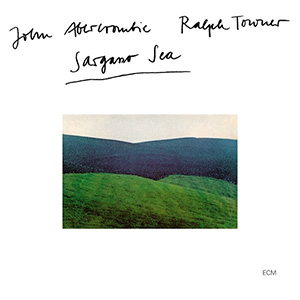
Sargasso Sea is the first studio album by John Abercrombie and Ralph Towner.
Before Sargasso Sea, Ralph Towner was already known as a distinctive composer-guitarist whose background in classical music set him apart from many of his jazz colleagues. The band Oregon made him internationally famous: acoustic sound, modal harmony, and chamber music sensitivity were at the core of his expression. Early recordings for ECM Records reinforced the image of a composer who moved between jazz and European art music.
John Abercrombie, on the other hand, rose to prominence in the jazz-rock and fusion circles of the early 1970s, with the electric guitar as his main instrument. The move to ECM brought more space, tonal sensitivity, and restrained expression to his playing. Modern jazz harmony and textural thinking made him a natural counterpart to Towner’s acoustic aesthetic.
Abercrombie plays electric and acoustic guitar on the album, while Towner plays 12-string and classical guitar. Sargasso Sea is essentially music for two guitars, although Towner does slip in some subtle piano motifs here and there. The composition credits are divided fairly evenly between the two musicians, which is also reflected in the nature of the album: it is not so much a relationship between composer and accompanist as a conversation between two equal musicians.
Musically, the album moves between beautiful impressionistic moods and occasionally very lively moments. The open sound and rich space make the whole thing airy, but beneath the surface there is constant movement.
The highlight is the nearly nine-minute opening track “Fable,” composed by Abercrombie, in which his electric guitar wanders with a bright sound over the ever-changing harmonies created by Towner’s acoustic guitar. At times, the roles are reversed and Towner gets to solo while Abercrombie accompanies him. The pleasantly formless song moves unpredictably, creating a contemplative and enigmatic atmosphere that envelops the listener in an almost hypnotic way. It is an impressive performance, especially considering that the instrumentation consists of only two guitars.
Among the lively tracks, Abercrombie’s ”Avenue” stands out, a nimble-fingered acoustic duo that at times even veers toward flamenco.
The two tracks on the album that received joint credits sound more spontaneous and are probably largely based on improvisation. Of these, the title track, “Sargasso Sea,” is particularly appealing to listen to: a fragmented, contemplative dialogue in which Towner responds to Abercrombie’s electric guitar, sometimes also on the piano.
I don’t want to give the impression that Sargasso Sea is some kind of ambient album. There are some pretty intense moments, and our guitar heroes often conjure up notes from their instruments at such a pace that it’s terrifying for the faint-hearted. Still, there is something very comforting and relaxing about the open sound of the album. For me, Sargasso Sea is above all a light and airy treat. It’s a great album to start a relaxed Sunday morning with.
Best tracks: “Fable”, “Avenue”, “Sargasso Sea”
Author: JANNE YLIRUUSI
Other parts of the Year by Year series can be found here
 Pienemmät Purot
Jätä kommentti