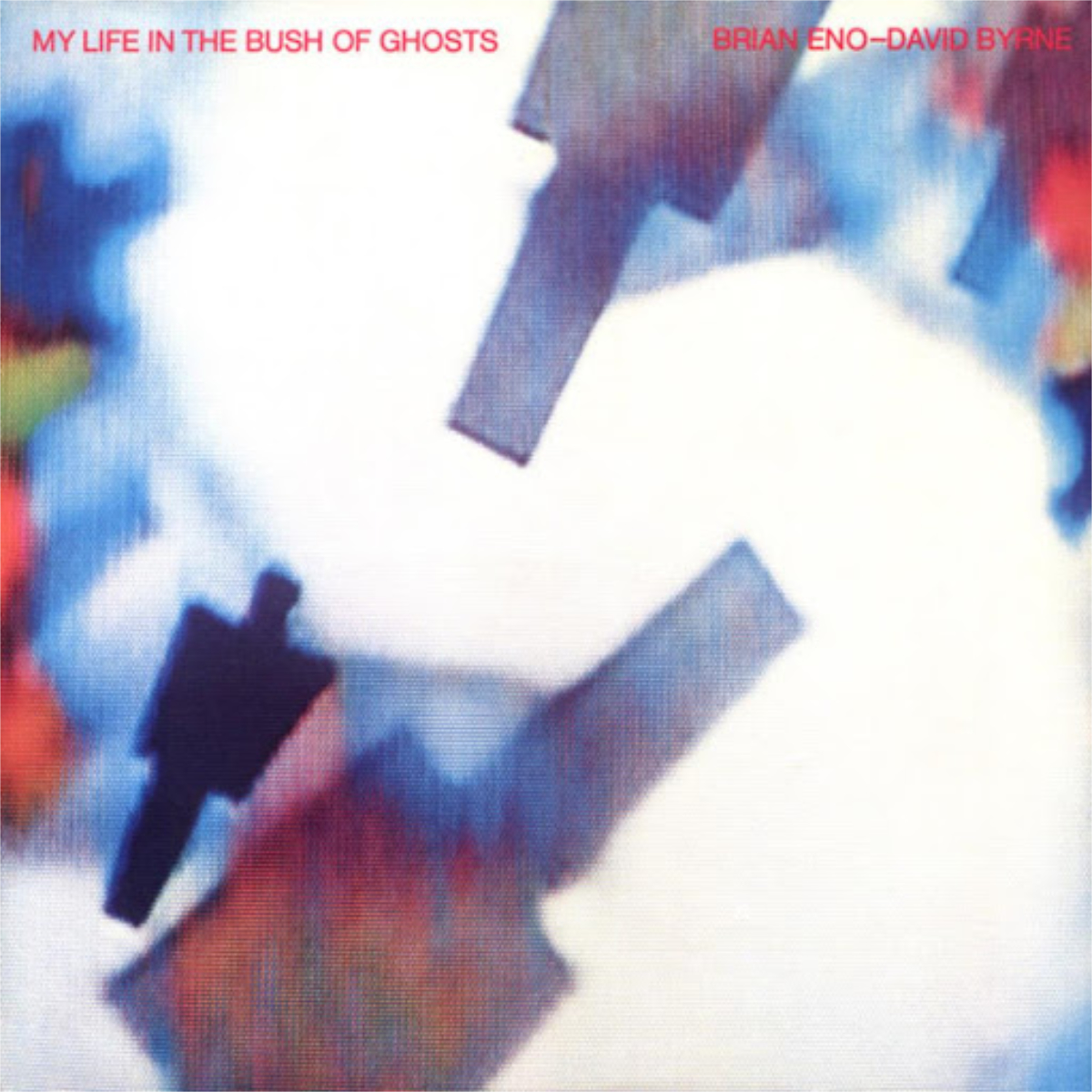
My Life in the Bush of Ghosts is the first studio album by Brian Eno and David Byrne.
Englishman Brian Eno and American David Byrne first crossed paths on Byrne’s band Talking Heads’ second studio album, More Songs About Buildings And Food (1978), which Eno produced. Their fruitful collaboration continued in 1979 with Fear Of Music and the hugely successful Remain In Light (1980). My Life in the Bush of Ghosts was recorded between Fear Of Music and Remain In Light, but because it took so long to arrange the rights for the numerous samples used on the album, it was not released until after Remain In Light.
Eno’s and Byrne’s original idea was to make a concept album that would sound like a unified, foreign, fictional culture. The intention was to go so far as to not even reveal Byrne and Eno’s identities as the creators of the album upon its release. In the end, the theme of ”invented culture” was abandoned, but in a sense, My Life does sound like that. Certainly, certain parts of it are clearly associated with, for example, North Africa or the Deep South of the USA, but the fusion that Byrne and Eno construct from these parts feels so natural as a whole that it is quite easy to get caught up in the fantasy of listening to a strange pop album from a previously unfamiliar culture. Or ”psychedelic dance music” from a foreign culture, as Byrne has described the album. Eno, on the other hand, sees the album as a ”psychedelic vision of Africa,” which is also a very apt interpretation.
The core idea behind My Life in the Bush of Ghosts, named after the 1954 book of the same name by Nigerian author Amos Tutuola, seems to be the collision of ”primitive” and ”futuristic” sounds with different ethnic music styles. The concept is somewhat similar to that of trumpeter/composer Jon Hassell’s albums, which he called ”fourth world” music. Eno and Hassell collaborated on an album in 1980 called Fourth World, Vol. 1: Possible Musics, which in some ways foreshadowed the style of My Life. Hassell was also supposed to participate in the making of My Life, but in the end he couldn’t afford to fly to California for the recordings. After hearing Eno and Byrne’s finished album, Hassell was furious and claimed that the duo had stolen his style. This is an exaggeration, because although My Life is a clear continuation of Possible Musics, it is also a very different album. My Life is considerably heavier and more intense sounding, and the rhythms play a much greater role than in Hassell’s more lightly floating music.
Read also:
- Review: Rain Tree Crow – s/t (1991)
- Review: John G. Perry – Sunset Wading (1976)
- Levyarvio: Black Sabbath – Master Of Reality (1971)
- Review: Henry Cow – Concerts (1976)
- Levyarvio: Spock’s Beard – V (2000)
- Review: Cos – Viva Boma (1976)
- Levyarvio: King Crimson – The ConstruKction Of Light (2000)
- Review: Camel – Moonmadness (1976)
- Review: Gong – Gazeuse! (1976)
My Life In The Bush of Ghosts has a rich and dark sound. And it is extremely powerful. Often downright intrusive. Unlike many later albums built on samples, there is nothing clinical or sterile about My Life. It sounds wild and vibrant. Its hypnotic grooves draw the listen in, but the polyrhythms and occasional sharp effects keep the listener constantly on their toes. It is possible to immerse oneself passively in the music of My Life In The Bush of Ghosts or to actively marvel at its rich detail.
The vitality of My Life can be partly explained by the fact that actual samplers did not yet exist, so all the samples on the album were made by trial and error, recording from one tape to another. It was not possible to polish anything to perfection on computers, as would be possible just a few years later. This resulted in a human roughness and inaccuracy that only benefits the album.
The album does not feature any conventional pop songs; instead, Eno and Byrne extremely effectively elevate sampled sounds from various sources to the role of lead vocals. The spotlight is on African radio hosts, Lebanese singers, shamans, and manic preachers, whose speeches and songs take on an interesting tension when placed in a completely new context alongside Eno and Byrne’s music.
In addition to the found sounds, Eno’s and Byrne’s original instrumentation was also exceptional, as they and the other musicians on the album often played cardboard boxes, tin cans, and whatever else happened to be lying around in the studio. In addition to hand-played percussion and drums, early drum machines and tape loops were also used. All in all, the rhythm tracks that Eno and Byrne and their musicians conjured up on the album are truly impressive to listen to, and even decades later, they don’t sound outdated at all.
“Regiment” is the most intriguing track on the album. It layers different rhythms on top of a clattering and rattling percussion track, dramatic-sounding Lebanese female vocals, Michael Jones’s thick, funky bass guitar track, Robert Fripp’s Frippertronics guitar, and Eno’s synthesizer solo. Talking Heads drummer Chris Frantz also plays on the track. The four-minute “Regiment” is brimming with ideas. It is a true melting pot of cultures, and the combination is nothing short of magical. Unfortunately, the fade-out ending feels like a slightly lazy solution.
Read also: Review: Brian Eno – Another Green World (1975)
Alongside ”Regiment”, the songs on side A of the album, ”America Is Waiting,” ”Mea Culpa,” and ”This Jezebel Spirit,” are all masterful works. The rest of the album doesn’t quite measure up to the wonders of side A. The song ”Qu’ran,” which originally started side B, was left out of the second edition released in 1981 because the Islamic Sharia Council in England took issue with the verses from the Koran quoted in it. ”Qu’ran” was replaced by ”Very, Very Hungry,” which was originally the B-side of the single ”This Jezebel Spirit.” ”Qu’ran” has not been included on any subsequent reissues of the album, not even the expanded CD edition released in 2006.
The material on side B is not necessarily significantly weaker than that on the first half, but the listener becomes somewhat numb to the intense pounding of polyrhythms and the generally overwhelming atmosphere and begins to crave a little more variety. The album could have benefited from additional instrumentation. It would have been nice to hear what would have happened if, in addition to Robert Fripp’s cameo on ”Regiment,” the songs had featured more experimental guitar work, perhaps from Fred Frith or Adrian Belew, both of whom had previously worked on Eno’s projects, and the latter also on Byrne’s Talking Heads. On the other hand, some of the songs could have used a little more space and serenity in their production. As it is, the sound throughout the album is a little too full and downright manic. Fortunately, the slightly lighter ”The Carrier” on the B-side brings at least a hint of contrast to the dark whole.
Upon its release, My Life in the Bush of Ghosts received a rather mixed reception and was not a big hit. This is not surprising, as My Life in the Bush of Ghosts is a rather avant-garde recording, even though the revolutionary technology used at the time has since become commonplace. The album’s reputation grew rapidly, and it influenced numerous notable artists, from Massive Attack to Moby, and although some of the album’s ideas have become commonplace (e.g., the Middle Eastern-style ”wailing female voice” in ”Regiment” is now a cliché in film music), its manic rhythms and clever manipulation of sounds are still thrilling.
In 2008, Eno and Byrne returned to record an album together, Everything That Happens Will Happen Today, but its gospel art rock was a world away from My Life In The Bush of Ghosts, as befits gentlemen who are constantly changing their style.
Best tracks: ”America Is Waiting”, ”Mea Culpa”, ”Regiment”, ”This Jezebel Spirit”
Author: JANNE YLIRUUSI
Tracks
- ”America Is Waiting” 3:36
- ”Mea Culpa” 3:35
- ”Regiment” 3:56
- ”Help Me Somebody” 4:18
- ”The Jezebel Spirit” 4:55
- ”Qu’ran” 3:46
- ”Moonlight in Glory” 4:19
- ”The Carrier” 3:30
- ”A Secret Life” 2:20
- ”Come with Us” 2:38
- ”Mountain of Needles” 2:35
Musicians
David Byrne and Brian Eno: guitars, bass guitars, synthesizers, drums, percussion, found objects John Cooksey: drums (”Help Me Somebody” and ”Qu’ran”) Chris Frantz: drums (”Regiment”) Robert Fripp: Frippertronics (”Regiment”) Michael ”Busta Cherry” Jones: bass guitar (”Regiment”) Dennis Keeley: bodhrán (”Mea Culpa”) Bill Laswell: bass guitar ”America Is Waiting” Mingo Lewis: batá, sticks (”The Jezebel Spirit” and ”The Carrier”) Prairie Prince: can, bass drum (”The Jezebel Spirit” and ”The Carrier”) José Rossy: congas, agong-gong (”Moonlight in Glory”) Steve Scales: congas, metals (”Help Me Somebody”) David Van Tieghem: drums, percussion (scrap metal, found objects) ”America Is Waiting” and ”Regiment” Tim Wright: click bass (”America Is Waiting”)
 Pienemmät Purot
Jätä kommentti