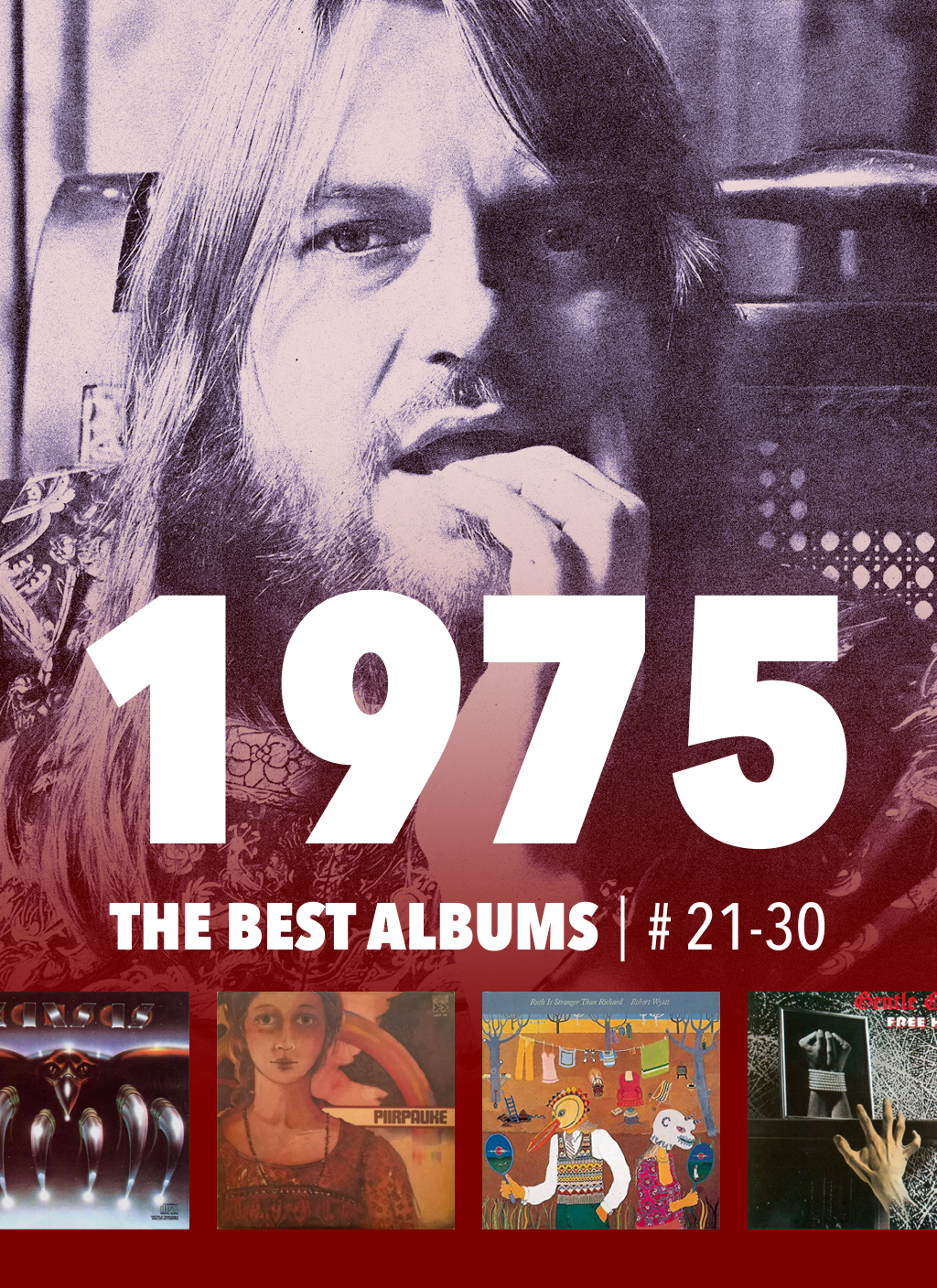
The author’s picks for the best albums of 1975, ranked 21-30.
In the Year by Year series, I’ll go through my favourite albums from 1969 to the present day.
21. Piirpauke: s/t (FI) ****
22. Robert Wyatt: Ruth Is Stranger Than Richard (UK) ****
23. Kansas: Song For America (US) ****
24. Gentle Giant: Free Hand (UK) ****
25. Tangerine Dream : Rubycon (DE) ****
26. Atoll: L’araignée-mal (FR) ****
27. Harmonium: Si On Avait Besoin D’Une Cinquième Saison (CA) ****
28. Wigwam: Nuclear Nightclub (FI) ****
29. Renaissance: Scheherazade And Other Stories (UK) ****
30. Mike Oldfield / David Bedford : The Orchestral Tubular Bells (UK) ****
21. Piirpauke: s/t

Wind player/multi-instrumentalist Sakari Kukko, who studied at the Sibelius Academy, founded Piirpauke in 1974, and the band released their debut album about a year later.
From the outset, Kukko’s vision for Piirpauke has been a combination of folk music, jazz, and progressive rock. The mix ratio and the geographical area of folk music in question have only varied over the decades.
There is, of course, variety within the albums themselves. For example, this instrumental debut album features a version of a Balinese dance in the song ”Legong” and a Karelian folk tune in the song ”Konevitsan kirkonkellot” (The Church Bells of Konevitsa). The latter song is particularly beautiful and became Piirpauke’s most popular and well-known song. An interesting detail is that the young conductor student Esa-Pekka Salonen plays the French horn as a guest musician on the track. ”Konevitsan kirkonkellot” is a truly beautiful song in which Kukko’s piano resonates in perfect harmony with Hasse Walli’s stylish electric guitar.
The album also features music of Romanian and Chinese origin, as well as one original composition by Kukko, the nearly 11-minute-long ”Cybele,” which allows listeners to enjoy Walli’s delightful electric guitar playing.
All the songs are richly arranged and make use of not only instruments typical of the songs’ geographical origins, but also instrumentation typical of jazz and rock. All of these come together naturally. Kukko is supported by the aforementioned Hasse Walli on guitar, Antti Hytti on bass, and Jukka Wasama on drums. All of them are skilled musicians.
Each member of the band also plays numerous percussion instruments, which play a major role on the album. Each song features a creative use of various types of clinking and clanking sounds. The music is acoustic, with the exception of Hytti’s electric bass and Walli’s two electric guitar solos.
The album, recorded by Paul Jyrälä at Finnvox Studios, sounds excellent. Few Finnish albums from the 1970s sound as rich and full-bodied.
Over the decades, Piirpauke has released more than twenty albums with varying lineups (with Sakari Kukko as the only constant member), containing a lot of great and distinctive music, but for me, the band’s strong debut album remains my favorite.
Best tracks: ”Konevitsan kirkonkellot”, “Cybele”
22. Robert Wyatt: Ruth Is Stranger Than Richard

Ruth Is Stranger Than Richard is the third solo album by Robert Wyatt, founder of Soft Machine and Matching Mole.
Robert Wyatt had been a prominent and respected figure in the progressive music scene since the late 1960s, but by 1974, after being paralyzed from the waist down in an accident and then returning triumphantly with the masterful album Rock Bottom, he had become something of a semi-legend, with bands such as Henry Cow and Piccio Dal Pozzio even dedicating albums to him.
After the acclaimed Rock Bottom, Wyatt felt apprehensive about his next move. Wyatt dreaded repeating himself above all else, and at the same time, he also had some kind of block when it came to composing. In the end, Wyatt did not compose a single new song for Ruth Is Stranger Than Richard. However, he wrote all the lyrics for the album…
23. Kansas: Song For America
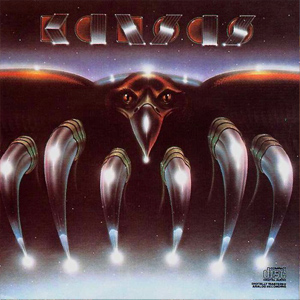
Song For America is the second studio album by American band Kansas.
From the outset, Kansas’s forte has been to combine British-influenced progressive rock with a generous helping of American boogie rock, AOR and even a touch of country rock. This has been both the band’s weakness and strength. At times, this mixture has led to uneven albums, with these different elements clashing uncomfortably, but at its best, the result is quite powerful and original.
Song For America showcases this Kansas mix at its most effective. The band’s main songwriters, Steve Walsh (keyboards/vocals) and Kerry Livgren (guitars/keyboards), complement each other perfectly, with Walsh’s earthier rock tracks supporting Livgren’s more ambitious prog-rock excursions, and vice versa…
24. Gentle Giant: Free Hand

Free Hand is the seventh studio album by Gentle Giant, formed in 1970.
Gentle Giant made seven albums in five years, and with such a tight schedule, it would have been no surprise if the band had run out of steam by the time they released Free Hand. But no, Free Hand is still Gentle Giant at its consistently high quality. Admittedly, it doesn’t contain any significant new visions or breakthroughs. The band does its own thing, which in itself is fortunately so original compared to any other band that Gentle Giant’s kind of self-repetition is easy to overlook.
Like the previous two albums, Free Hand continues the band’s journey in a slightly more conventional direction in terms of instrumentation and song structure. A good example of this is the opening track, ”Just The Same,” which is a really powerful start to Free Hand. The song is almost a conventional rock song in terms of structure and sound. Of course, even when playing ”conventional” rock, Gentle Giant brings its own twist to the music, which in this song is evident in the challenging rhythms, with the bass and drums playing in 6/4 time while the rest of the band plays in 7/4.
On the other hand, more exotic instruments have not been completely abandoned by Free Hand, as demonstrated by the medieval-style ”Talybont.” With its hand drums, harpsichord, and recorders, Talybont is in danger of becoming a slightly too cute pastiche of medieval music, but it is ultimately a charming interlude among the more robustly sounding tracks. ”Talybont” was created as a demo with an eye on the soundtrack for the planned Robin Hood movie (Robin And Marian). In the end, Gentle Giant didn’t get the job, which went to the much more experienced legend John Barry.
Alongside ”Just The Same,” the highlight of Free Hand is the strongly contrapuntal ”On Reflection,” which once again features the band’s stunning polyphonic vocals. The song is, in a way, very clichéd Gentle Giant, but still so wonderful to listen to.
Free Hand is not a particularly significant album in Gentle Giant’s catalog, but it does offer a solid collection of excellent and original prog rock tracks.
Best tracks: ”Just The Same”, ”On Reflection”
25.Tangerine Dream: Rubycon

Rubycon is the sixth studio album by German band Tangerine Dream, founded in 1967.
Rubycon largely follows in the footsteps of its predecessor, Phaedra (1974), and is musically just as high quality. However, it does not feel quite as groundbreaking, as Rubycon faithfully repeats the tricks of its predecessor.
However, Rubycon offers a sufficiently diverse selection of eerie atmospheres and haunting sequences to feel like a relevant follow-up to Phaedra. This time, the format is familiar from the Zeit album: one long track per half of the album. In other words, the album has only two tracks, each slightly over 17 minutes long. This epic form suits Tangerine Dream’s somewhat formless meditations, which at times turn into hypnotic bubbling.
Best track: ”Rubycon Part Two”
26. Atoll : L’araignée-mal

L’araignée-mal (”The Evil Spider”) is the second studio album by French band Atoll, founded in 1972.
Atoll’s music successfully combines dark and brooding progressive rock with jazz-rock vibes. At times, the atmosphere is downright demonic, such as in the truly magnificent nine-minute opening track, ”Le photographe exorciste,” which features more than a hint of King Crimson. Atoll is also linked to Crimson’s Larks’ Tongues In Aspic era by the relatively large role played by the fiery violinist Richard Aubert. The Mahavishnu Orchestra, which brought the violin strongly into jazz-rock, has certainly also been an important influence on the six-piece Atoll.
A certain theatricality and dramatic vocals are also reminiscent of another French band from the same era, Ange. Atoll’s vocalist, André Balzer, also sounds a bit like Ange’s singer, Christian Décamps, but Balzer’s expression is more aggressive. At times, the gloomy atmosphere is lightened up a bit with funky jazz-rock jams, but even those parts don’t get too cheesy.
The B-side of the album is filled with the title track, which is over 21 minutes long and divided into four parts. The first part is ethereal and floating, while the second part is built around a repeating keyboard phrase in 7/8 time and gradually develops from a relaxed mood into something more aggressive. The third part is dominated by a space-rock-like synthesizer sound, and finally, in the last section, the mood shifts to jazz-rock as the synthesizer, guitar, and violin take turns fighting for the spotlight. The epic ”L’araignée-mal” works well as a long song in the sense that the music transitions quite naturally from one section to the next, but on the other hand, the music perhaps lacks a clear guiding theme that would tie everything together perfectly. Nevertheless, ”L’araignée-mal” is great music.
After L’araignée-mal, Atoll released two more albums in the 1970s. At the very end of the decade, the band experimented with a somewhat confusing collaboration with John Wetton, which resulted in a few songs that ended up being used by Wetton’s AOR giant Asia in the 1980s. The songs made with Wetton were not originally released under the name Atoll, but they have since ended up as bonus tracks on the reissues of the 1979 album Rock Puzzle.
Best tracks: ”Le photographe exorciste”, ”L’araignée-mal ”
Read also:
- Review: Camel – Moonmadness (1976)
- Review: Gong – Gazeuse! (1976)
- Review: Mike Johnson – The Gardens Of Loss (2026)
- Levyarvio: Mike Johnson – The Gardens Of Loss (2026)
- Levyarvio: Led Zeppelin – Presence (1976)
- Vuosi vuodelta : Parhaat levyt 2000 – Sijat 11-20
- Review: Univers Zero – Ceux Du Dehors (1981)
- Levyarvio: Steve Walsh – Glossolalia (2000)
- Year by Year : Best Albums of 1976 – 21-29
27. Harmonium: Si On Avait Besoin D’Une Cinquième Saison
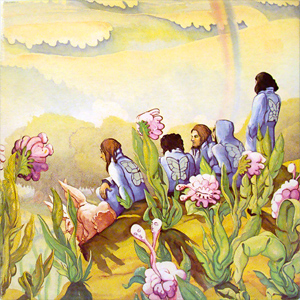
Si On Avait Besoin D’Une Cinquième Saison is the second studio album by Harmonium, formed in Montreal, Canada, in 1972. The album is also known as Les cinq saisons.
In the 1970s, the predominantly French-speaking province of Quebec in Canada had a strong progressive music scene. This group included bands such as Maneige, Pollen, Et Cetera, and, of course, Harmonium, which was perhaps the most popular band of the group.
Originally starting out as a folk rock band, Harmonium moved more clearly towards progressive rock on this album. The five tracks on the album depict the seasons of the year. The fifth is an imaginary new season, to which the album’s title refers. Musically, however, the theme of the album does not particularly resonate with me in terms of the style of the songs, and on the other hand, I do not know French, so I cannot assess how interestingly Harmonium deals with the somewhat worn-out theme of the seasons in their lyrics.
The music on the album is mainly light, semi-acoustic, and richly orchestrated. The band skillfully varies its instrumental palette (guitars, bass, keyboards, percussion, flute, clarinet), giving each instrument its turn in the spotlight. The entire range is rarely used at once. The band’s background as a folk band is evident in the acoustic nature of the songs and a certain ”campfire-like melody,” but on the other hand, the varied instrumentation (including electric instruments), extended song structures (the longest songs are 17 and 10 minutes long), and music that is slightly more complex than folk clearly place the album in the progressive rock sector. On the other hand, the folk background is clearly audible in the music, for example in the fact that there are no drums on the album. That is, the drum set typical of rock and jazz bands. Instead, the rhythm is often maintained by an acoustic guitar, and of course the foundation is laid by an electric bass guitar, which, however, also plays quite subdued. Si On Avait Besoinin’s music is more floating and melodic than rhythmically powerful.
Si On Avait Besoin D’Une Cinquième Saison is a delightfully lighthearted album that, even in its moments of melancholy, sounds cheerful and friendly, offering a highly original take on progressive folk rock.
Best tracks: “Vert”, ”Depuis l’automne”
28. Wigwam : Nuclear Nightclub

Nuclear Nightclub is the fifth studio album by Finnish band Wigwam, formed in 1968.
If Wigwam was Finland’s Henry Cow for a while on their previous album, Being, then on Nuclear Nightclub, the band’s new lineup makes a 180-degree turn toward the mainstream, sounding more like a cross between Steely Dan and Wishbone Ash than avant-garde prog. In my opinion, Nuclear Nightclub is also quite reminiscent of some of Manfred Mann’s Earth Band’s albums from the same era. Wigwam themselves named this new era ”deep pop.”
The driving force behind the change was, of course, significant changes in the band’s lineup. Being’s challenging birth process sowed seeds of discord within the band, the most significant of which, but not the only one, was a difference of opinion about the band’s musical direction…
29. Renaissance: Scheherazade And Other Stories

Scheherazade And Other Stories is the fifth studio album by Renaissance, formed in 1969.
Scheherazade and Other Stories continues very much in the vein of its predecessor, Turn Of The Cards. The music is still melodic symphonic progressive rock with a hint of folk music in the background. However, this time everything is a little bigger, more orchestral, and more beautiful.
At times, it is almost too beautiful. It feels as if the slight edges and dark tones that Renaissance music used to have have been eliminated, at the latest with Scheherazade And Other Stories. Fortunately, the band’s compositions still have enough dynamics and variation. The album never becomes boring or monotonous.
The album kicks off with ”Trip To The Fair,” an 11-minute narrative song that is as Renaissance as Renaissance can be. On the other hand, the song has a jazzy part with bells that brings something new to the package. ”Trip To The Fair” is, as far as I know, quite a popular song among Renaissance fans, but for me it doesn’t rank very high among the band’s songs, thanks to its particularly annoying and overly repetitive clumsy rhyming chorus (”A trip to the fair, but nobody was there”).
Fortunately, the album gets off to a good start with the catchy second track, “The Vultures Fly High,” whose lyrics apparently criticize critics (ouch… ”Trip To The Fair” isn’t that bad…). The three-minute ”The Vultures Fly High” has the kind of tight beat that the album needed more of. If the world were fair, ”The Vultures Fly High” would have been the band’s first hit single. However, the band had to wait a few more years for that.
After ”The Vultures Fly High,” we hear the more ethereal Renaissance song ”Ocean Gypsy,” which is wistfully beautiful. Annie Haslam sings the song really beautifully (have you noticed how often the word ”beautiful” appears in this review?), and the symphony orchestra plays successfully in the background.
The album concludes with the nearly 25-minute epic ”Song of Scheherazade,” in which the symphony orchestra plays a larger role than ever before on a Renaissance album. Contrary to what one might imagine given Renaissance’s history, the song is not based on Nikolai Rimsky-Korsakov’s composition ”Scheherazade” (1888), although the band cannot resist quoting it a few times.
The epic, divided into nine parts, offers some truly wonderful moments (the interplay between the band and the orchestra is at its best when it is truly effective), but in my opinion, it still fails to fully justify its epic length. ”Song of Scheherazade” offers one of the few surprises on the album, as bassist Jon Camp is allowed to sing the lead vocals in the epic section ”The Sultan” instead of Haslam. Camp copes with the challenge quite reasonably, especially with Haslam helping in the background. ”The Sultan,” like a few other sections of ”Song of Scheherazade,” also makes successful use of a choir.
Fortunately, the song is not all pomp and circumstance, as pianist John Tout plays a few delicate piano interludes that provide a pleasant contrast to the song’s more grandiose sound. However, a certain amount of schmaltz is unavoidable in some of the string sections, and at times the mood verges on that of a poor movie soundtrack. ”Song of Scheherazade” is therefore only a partial success, but at least the best parts are really great (for example, Haslam’s magnificent vocals in the section ”The Young Prince and Princess as told by Scheherazade”).
Scheherazade And Other Stories is very pleasant to listen to, but at the same time shows that Renaissance’s tricks are starting to repeat themselves a bit.
Best tracks: ”The Vultures Fly High”, ”Ocean Gypsy”
30. Mike Oldfield / David Bedford : The Orchestral Tubular Bells

The Orchestral Tubular Bells is, as its name suggests, Mike Oldfield’s Tubular Bells, originally composed for a ”one-man rock band,” arranged for a large symphony orchestra.
David Bedford’s successful arrangement of Oldfield’s composition is not just a standard ”London Symphony Orchestra plays music of random rock band” setup. As an accomplished composer of classical music who also understood rock music, Bedford succeeded almost perfectly in this project.
Bedford’s orchestrated Tubular Bells does not sound overly simplistic and entertaining like many similar projects, but rather like delightfully credible orchestral art music. At times, it is reminiscent of film music. By 20th-century standards, The Orchestral Tubular Bells may be somewhat conservative orchestral music, but melodiousness is no sin in art music! Oldfield himself was a big fan of Sibelius, but this arrangement by Bedford, with its majestic fanfare, is often more reminiscent of the American composer Aaron Copland. Many passages are easy to imagine as the soundtrack to a Western, with horses galloping across open terrain under a vast sky.
In addition to Bedford’s expertise, the success of the project was aided by the fact that no rock instruments were forced into the mix (especially since drum kits and orchestras together almost always sound ridiculous) and, of course, the fact that Oldfield’s original music is considerably more symphonic than average rock music.
The orchestra on the album is The Royal Symphony Orchestra, conducted by David Bedford himself. Oldfield himself plays briefly on the album towards the end. First, he strums the acoustic guitar and then plays a subtle electric guitar solo. The album was recorded live, with the exception of Oldfield’s guitars.
The Orchestral Tubular Bells project also toured concert halls in England. Oldfield declined to participate due to his stage fright, and his place as guitarist was taken by another rising star from Virgin, Steve Hillage, a space cadet from Gong who was just starting his solo career. These concerts also featured an orchestral version of Oldfield’s 1974 album Hergest Ridge. The Orchestral Hergest Ridge was not released as an album until 2025.
Niin vahva oli Tubular Bellsin voima vielä helmikuussa 1975 melkein kaksi vuotta julkaisunsa jälkeen että The Orchestral Tubular Bells nousi Englannin albumilistoilla sijalle 17. Varsin poikkeuksellista orkesterimusiikille.
Parhaat biisit: ”Tubular Bells Part One”
Author: JANNE YLIRUUSI
You can find other parts of the Year by Year series here.
 Pienemmät Purot
Jätä kommentti