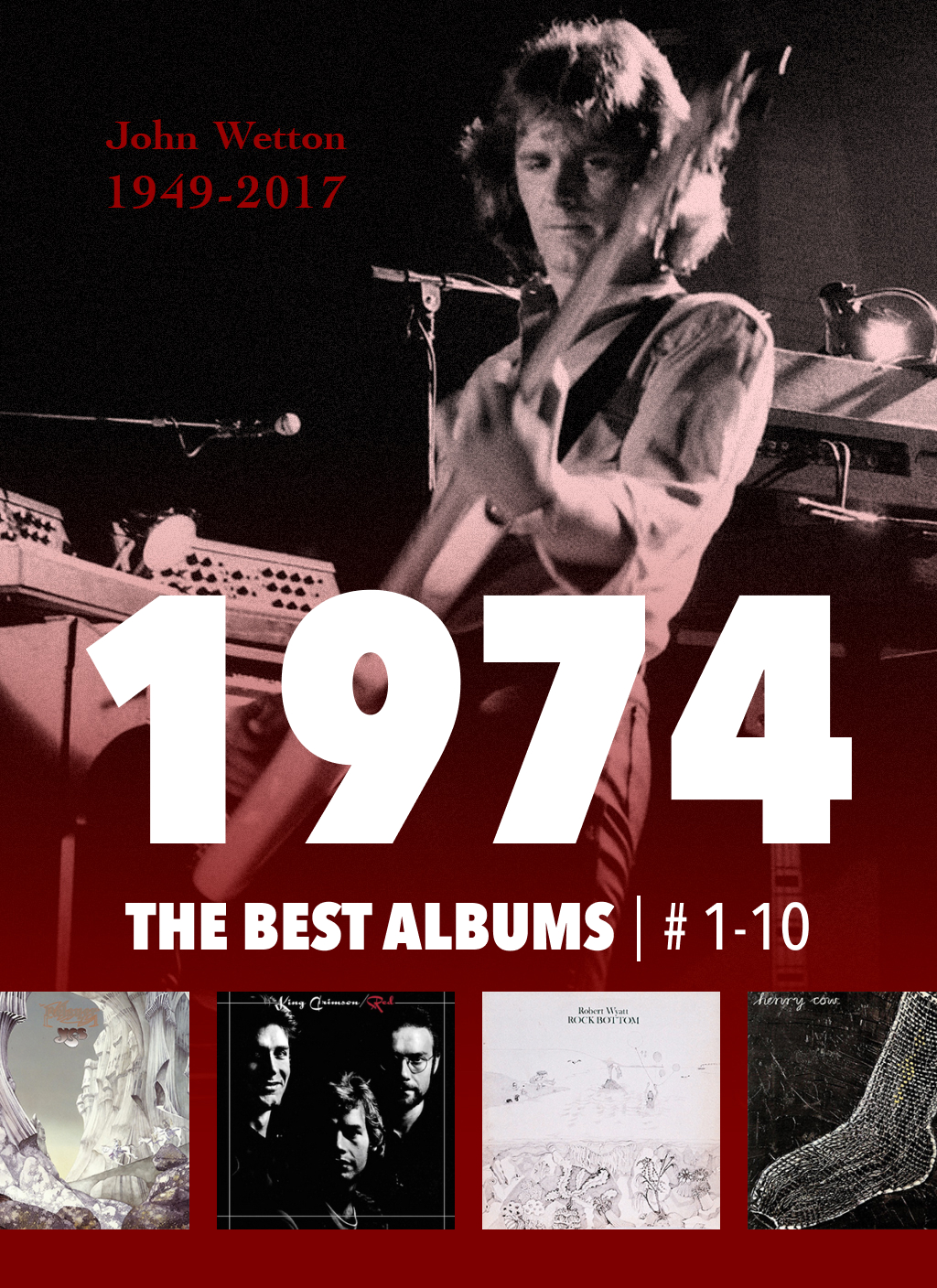
The author’s picks for the best albums of 1974, ranked 1-10.
In the Year by Year series, I’ll go through my favourite albums from 1969 to the present day.
1. King Crimson: Red (UK) *****
2. Robert Wyatt: Rock Bottom (UK) *****
3. Yes: Relayer (UK) *****
4. Henry Cow: Unrest (UK) *****
5. Mike Oldfield: Hergest Ridge (UK) *****
6. Magma: Köhntarkösz (FR) *****
7. Gong: You (UK/FR) *****
8. Wigwam: Being (FI) *****
9. Peter Hammill: In Camera (UK) *****
10. Genesis: The Lamb Lies Down on Broadway (UK) *****
1. King Crimson: Red
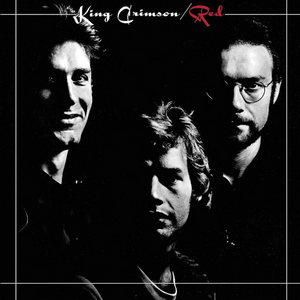
Red is the seventh studio album by King Crimson, formed in 1969.
Violinist David Cross was sent packing just before the Red recordings so Crimson continues on the album as a trio of Robert Fripp (guitar/Mellotron), Bill Bruford (drums) and John Wetton (bass/vocals). Although, where on the previous couple of albums no extra guests were heard, on Red the sound is reinforced by several additional musicians. Most of whom already had a history with King Crimson.
Whereas Red’s predecessors Larks’ Tongues In Aspic (1973) and Starless And Bible Black (1974) were quite avant-garde, experimental and angular albums, Red is a somewhat more straightforward and even conventional album…
2. Robert Wyatt: Rock Bottom
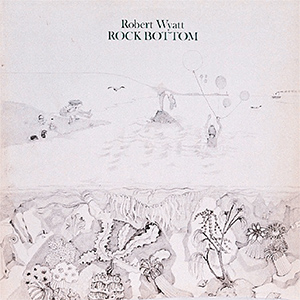
Rock Bottom is Robert Wyatt’s second studio album.
Rock Bottom is the greatest album by Canterbury legend Robert Wyatt (b.1945). However, this statement is not meant to belittle Wyatt’s other output, which for the most part is of very high quality. But with Rock Bottom he achieved something truly magical.
Robert Wyatt’s career really took off in the late 60s as a singing drummer in the pioneering avant-garde psychedelic-jazz combo Soft Machine, as a member of which he recorded four major albums.-.
3. Yes: Relayer
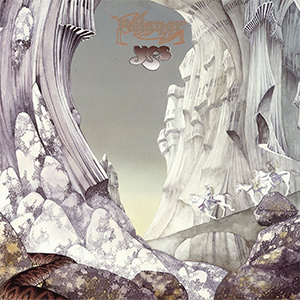
Relayer is the seventh studio album by Yes, founded in 1969.
After the massive double album Tales From Topographic Oceans (1973), Yes returns to the format familiar from Close To The Edge (1972) with Relayer. That is, the first half of the vinyl is filled with a 22-minute epic and the second half with two tracks of around ten minutes.
Yes decided to record the album in a home studio in the garage of bassist Chris Squire’s mansion home, with the help of an old acquaintance, producer Eddie Offord. But before the recording sessions could begin, the band had to solve one small problem: Rick Wakeman, the band’s keyboardist wizard, had defected from Yes after Topographic Oceans because he was unhappy with the band’s musical direction and was attracted by a solo career that was off to a good start. So where can we find a new and talented enough keyboard player to replace Wakeman…
4. Henry Cow: Unrest
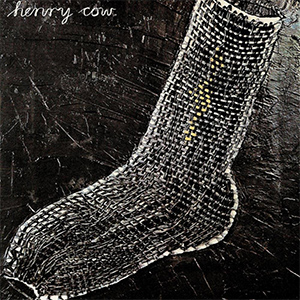
Unrest is the second studio album by the British band Henry Cow, formed in 1968.
Henry Cow continues on Unrest with the same line-up as the band made their debut Leg End previous year, with one exception. Saxophonist Geoff Leigh is absent.
Geoff Leigh’s decision to leave Henry Cow was the sum of many reasons. Firstly, he had been unhappy from the start with the band’s deal with Virgin Records, but the musical reasons were still the main reason. Leigh felt that Henry Cow’s compositions were becoming too complex and, on the other hand, although he enjoyed free jazz jamming, he did not feel at home with the band’s increasingly abstract and experimental improvisations, which the band wanted to play more and more, especially live…
5. Mike Oldfied: Hergest Ridge

Hergest Ridge is Mike Oldfield’s second studio album.
Mike Oldfield’s debut album Tubular Bells was released just a week after the young multi-instrumentalist’s 20th birthday. Against all expectations, the almost entirely instrumental Tubular Bells became a phenomenal success and Oldfield himself found himself in the bright spotlight of the music world. Oldfield had dreamed of success, but now that he had achieved it, he realised it didn’t make him happy. On the contrary. An inward-looking introvert, he was downright terrified of the attention and adoration he received. Oldfield also flatly refused to go on tour and played only two live shows with Tubular Bells under intense pressure. The second of these was in the BBC studio for the 2nd House programme…
Read also:
- Levyarvio: Steve Walsh – Glossolalia (2000)
- Year by Year : Best Albums of 1976 – 21-29
- Levyarvio: Jimmy Page – Outrider (1988)
- Review: Brian Eno + David Byrne – My Life in the Bush of Ghosts (1981)
- Levyarvio: Gong – Zero To Infinity (2000)
- Review: Michael Oldfield – Heaven’s Open (1991)
- Review: Talk Talk – The Colour Of Spring (1986)
- Levyarvio: Jeff Wayne – Jeff Wayne’s Musical Version Of The War Of The Worlds (1978)
- Review: Gong – Shamal (1976)
6. Magma: Köhntarkösz
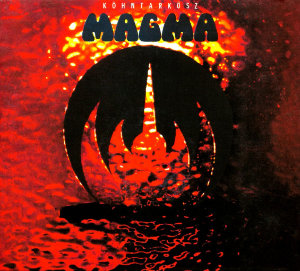
Magma made a breakthrough with their previous album Mëkanïk Dëstruktïw Kömmandöh and really found their own style. MDK’s follow-up Köhntarkösz continues to build on that style in a subtle way, but doesn’t remain a prisoner of it. Köhntarkösz is the middle part of the Köhntarkösz trilogy. The first part of the series is K.A (Köhntarkösz Anteria) from 2004 and the final part is Ëmëhntëhtt-Ré from 2009.
The biggest difference compared to MDK is that Köhntarkösz is a mostly instrumental album where the predecessor’s fiercely pronounced Kobaian language played a central role. Of course, there is plenty of wordless singing on this album as well…
Read also: Year by Year: Best Albums of 1974 – 11-20
7. Gong: You
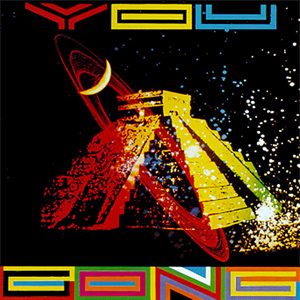
You is the fifth studio album by Gong, founded in 1968, and the final part of the Radio Gnome trilogy.
On You, Gong continues with the same line-up that played on the previous album Angel’s Egg (1973). This was very unusual for Gong, and this little bit of continuity clearly did the usually chaotic band good as You is the band’s first 100% success.
With You, the band achieves a fine balance between the humorous and psychedelic wackiness of founder vocalist/guitarist/visionary Daevid Allen (1938-2015) and the virtuosic jazz-rock direction of the rest of the band at this stage…
8. Wigwam: Being
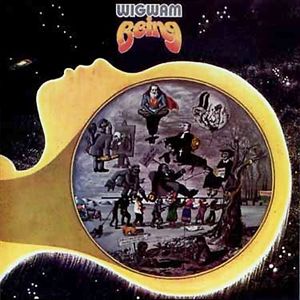
Being is the fourth studio album by Wigwam, founded in Finland in 1968.
Wigwam’s first three albums contain many great moments, but each of them is rather uneven as a whole.
Being transforms all of this into a full set of one exquisite composition after another, forming a very coherent whole. Being is a theme album, but it represents the section of concept albums where the actual theme is very difficult to sum up in a few words. It is a kind of study of the clashes between different social classes and ideologies. With a strong sarcastic and black humour touch. Some of the lyrics, which mocked communism, were rejected by the Love Records label, which had a very strong left-wing slant…
9. Peter Hammill: In Camera
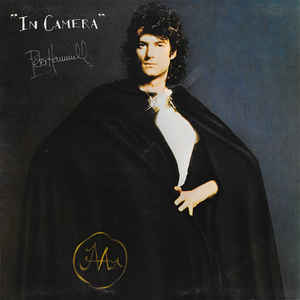
In Camera is the fourth solo album by Peter Hammill, known from Van Der Graaf Generator.
Peter Hammill’s fourth solo album is one of his best and roughly on par with its predecessor, The Silent Corner and the Empty Stage, released less than six months earlier in the same year. As one might expect from Hammill at this stage in his career, this album is also filled with dark existentialism.
In Camera is Hammill’s most authentic solo album to date, as he plays most of the instruments himself. Hammill plays guitar, bass, and various keyboards on the album, and what he loses in virtuosity, he makes up for in pure originality. Many of the synthesizer sounds in particular are really interesting to hear. Recording engineer David Hentschell helped with the programming of the ARP synthesizer, and the album’s original synthesizer buzzes and whirrs are a significant part of its charm.
In addition to Hentschell, drummer Guy Evans also contributed to a few tracks, and artists Paul Whitehead and Judge Smith also helped with the music in small roles.
In Camera also has its peaceful moments, such as the beautiful and simple ”Again,” but the album’s aggressive trio of ”(No More) The Sub-Mariner,” ”Tapeworm,” and ”Gog Magog (In Bromine Chambers)” are particularly successful.
Hammill sings ”(No More) The Sub-Mariner” with a wonderfully rough and nasty voice. In my opinion, this is one of the most interesting vocal performances of all time. From anyone, anywhere. Relatively minimalistic, yet dramatic, accompanied mainly by small and various buzzing synthesizers, the song is also musically interesting and opens up completely new avenues for Hammill. In the lyrics, Hammill interestingly returns to his childhood fantasies of heroic deeds on imaginary battlefields.
The intensity increases even further in ”Tapeworm,” where Hammill growls even more angrily and Guy Evans pounds the drums like a madman. In terms of style, ”Tapeworm” foreshadows the birth of a new, harder-hitting Van Der Graaf Generator.
At its best, the album reaches a demonic climax in the 17-minute closing track, “Gog Magog (In Bromine Chambers),” which is fitting, as according to Hammill, the song is about a dark god that operates beyond the comprehension of the human mind. There is something diabolical going on in the song, as the names Gog and Magog refer to two kingdoms in the Bible that the old devil himself calls upon for help in the final battle in the Book of Revelation. In the concluding ”Magog” section of the two-part song, Hammill successfully dives into an industrial musique concrète nightmare. I don’t know what else this section could describe other than the cries of the souls of all humanity in eternal hell after Satan’s victory with the help of Gog and Magog.
Some call me SATAN others have me GOD
Some name me NEMO… I am unborn.
Some speak of me in anagrams,
Some grieve upon my wrath…
The ones who give me service
I grant my scorn.
In Camera and The Silent Corner and the Empty Stage seem like obvious sister albums, but In Camera is the more experimental, artistic, and avant-garde of the two. On the other hand, In Camera doesn’t rock as hard as its predecessor and maybe doesn’t have quite as many awesome moments as The Silent Corner at its best. Still, In Camera is such a weird and fascinating album that I’d say it’s a bit more interesting than The Silent Corner.
Best tracks: (No More) The Sub-Mariner, ”Tapeworm”, “Faint-Heart And The Sermon”, “The Comet, The Course, The Tail”, Got Magog (In Bromine Chambers)”
10. Genesis: The Lamb Lies Down On Broadway

The Lamb Lies Down On Broadway is the sixth studio album by Genesis, founded in 1967.
The Lamb Lies Down On Broadway is Genesis’ first double album and the last to feature the band’s beloved quintet line-up. Vocalist Peter Gabriel left the band in 1975 after a tour based around the album was completed.
The Lamb Lies Down On Broadway is also Genesis’ first concept album. One of the suggestions on the table for the album’s theme was an adaptation of Antoine de Saint-Exupéry’s children’s book The Little Prince. However, Gabriel fought this idea…
Author: JANNE YLIRUUSI
You can find other parts of the Year by Year series here.
 Pienemmät Purot
Thank you for sharing! I’m loving all the music I’ve found here so far.
TykkääLiked by 1 henkilö