
On the album Captain Marvel, saxophonist Stan Getz (1927-1991), who had already recorded dozens of albums as a band leader, joined forces with the Return To Forever ensemble led by keyboardist Chick Corea.
The 1962 album Jazz Samba made Getz almost a pop star, and he got stuck making bossa nova albums for years while jazz was changing fast, pushed forward by Miles Davis, John Coltrane, Ornette Coleman, and other innovators.
By the early 1970s, Getz was, if not quite a has-been, then at least a lower-middle-tier player who had fallen far from the forefront of jazz. Despite his substance abuse problems, however, Getz’s playing skills were still intact, as can be heard on this album, where Getz wisely teamed up with young talents.
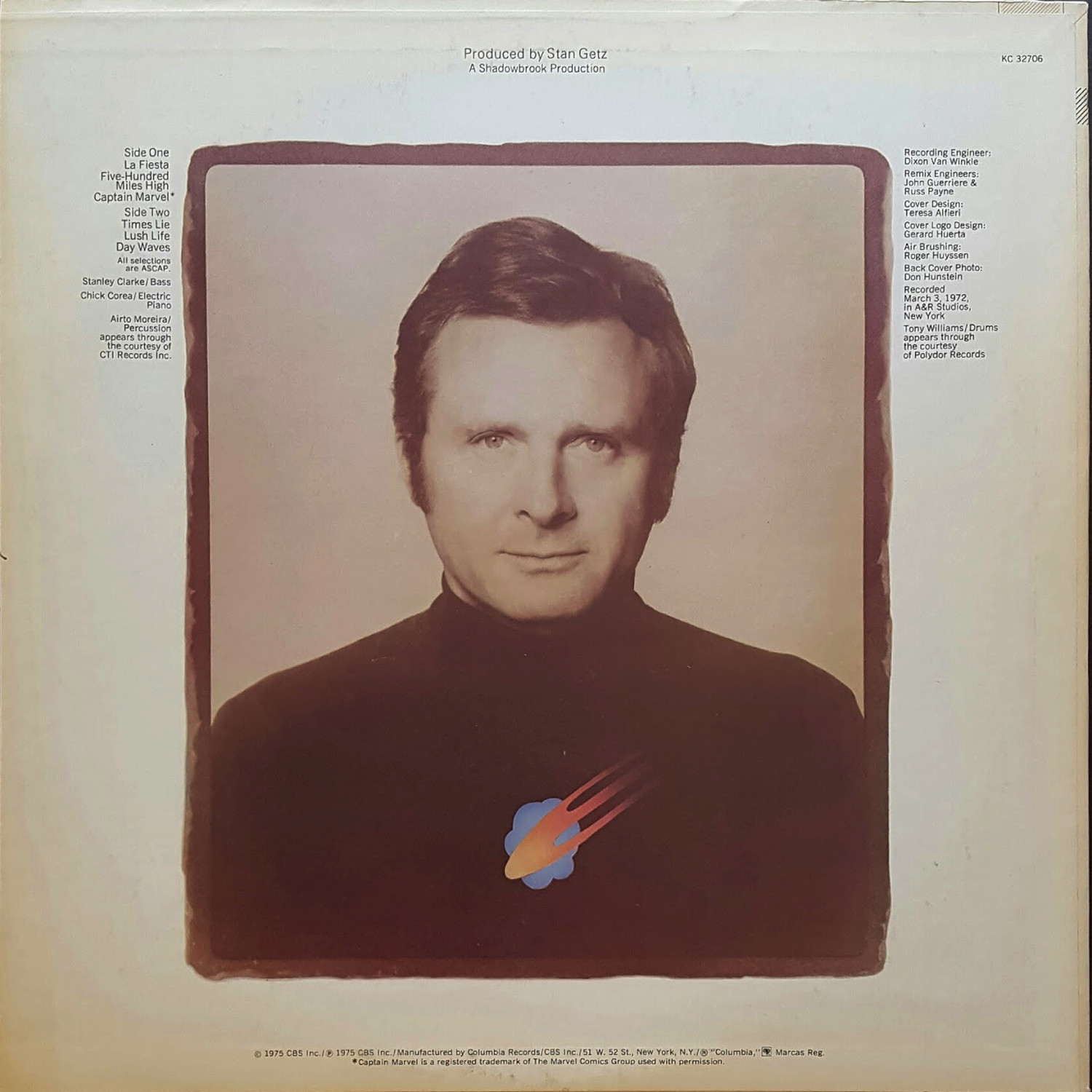
Keyboard virtuoso Corea (who had already played with Getz in 1966) was a natural collaborator for Getz because, like his older colleague, he had also recently begun to draw inspiration from Latin music in his band Return To Forever, which had started shortly before the Captain Marvel sessions.
Corea brought bassist Stanley Clarke and drummer/percussionist Airto Moreira from Return To Forever to Captain Marvel. Young drummer Tony Williams, who completed the quartet, was added to the lineup at the last minute at Getz’s request.
With one exception, all six tracks on the album were composed by Corea. The exception is ”Lush Life,” composed by Billy Strayhorn in the 1930s, premiered in 1948, and has since become a jazz standard. The songs were originally composed for Return To Forever, but Getz was so enthusiastic about the material that it was decided to record them for Captain Marvel.
Captain Marvel was recorded in March 1972, but for some reason it was not released until 1974 (some sources also mention 1975 as the year of release). It is interesting to note that Return To Forever’s next album, Light As Feather (1973), which includes a few of the same songs, was released almost two years earlier than Captain Marvel. I have not been able to determine why this happened. Could it be that the record company decided to focus on new talent and shelve the veteran’s album for fear that overlapping material would take the wind out of Return To Forever’s sails?
The album begins with the cheerfully sparkling ”La Fiesta” (also featured on Return To Forever’s first album), whose boisterous and upbeat mood reflects the overall feel of the album well. Getz himself solos with a fast-paced melody and strong rhythm. He may not always phrase 100% perfectly or accurately, but there is a constant positive energy in his playing. The music on Captain Marvel is joyful and light, without being saccharine.
One of the highlights of the album is the wistful yet energetic ”Five Hundred Mile High,” which is also one of the highlights of Return To Forever’s album Light As A Feather. On that album, the song was titled ”500 Miles High.”
Perhaps the most enjoyable rhythmic delight on the album is the nine-minute ”Times Lie,” on which Tony Williams truly lives up to his reputation as one of the greatest drummers of all time. Airto Moreira’s creative percussion skills are also nothing to sneeze at. Moreira effectively colors the songs with his versatile percussion skills throughout the album. He was also heard in a similar role in Weather Report.
The only song on the album that was not written by Corea, ”Lush Life,” is a quiet and sensitive moment on the album. It may not be particularly interesting as a single song, but it is nevertheless a pleasant moment of calm amid all the boisterous roar.
Corea deserves praise not only for the album’s fine compositions, which strike just the right balance between carefully planned patterns and spontaneity, but also for his stunning performances. Corea’s Fender Rhodes playing is absolutely magnificent throughout the album. It flashes mercurially and nimbly, sometimes accompanying the background, but often taking the lead role with gusto. Corea plays some of the finest solos of his long and distinguished career on this album. For example, in the song ”Times Life,” his serpentine playing is dizzying to listen to. On the other hand, Corea also knows when to step back and leave room for the other musicians.
Captain Marvel is one of the brightest gems of Latin-influenced fusion jazz, but unfortunately, the album has remained relatively unknown. This may be partly due to its originally delayed release date. And as great as its sister album Light As Feather is, I personally enjoy Captain Marvel a little more. Credit for this goes not only to Tony Williams’ powerful drumming, but also to Getz’s emotional yet intense saxophone playing.
Best tracks: ”La Fiesta”, ”Five Hundred Mile High”, ”Times Lie”
Author: JANNE YLIRUUSI
Tracks:
Stan Getz: tenor saxophone Chick Corea: electric piano Stanley Clarke: bass Airto Moreira: percussion Tony Williams: drums
Producer: Stan Getz
Label: Columbia
 Pienemmät Purot