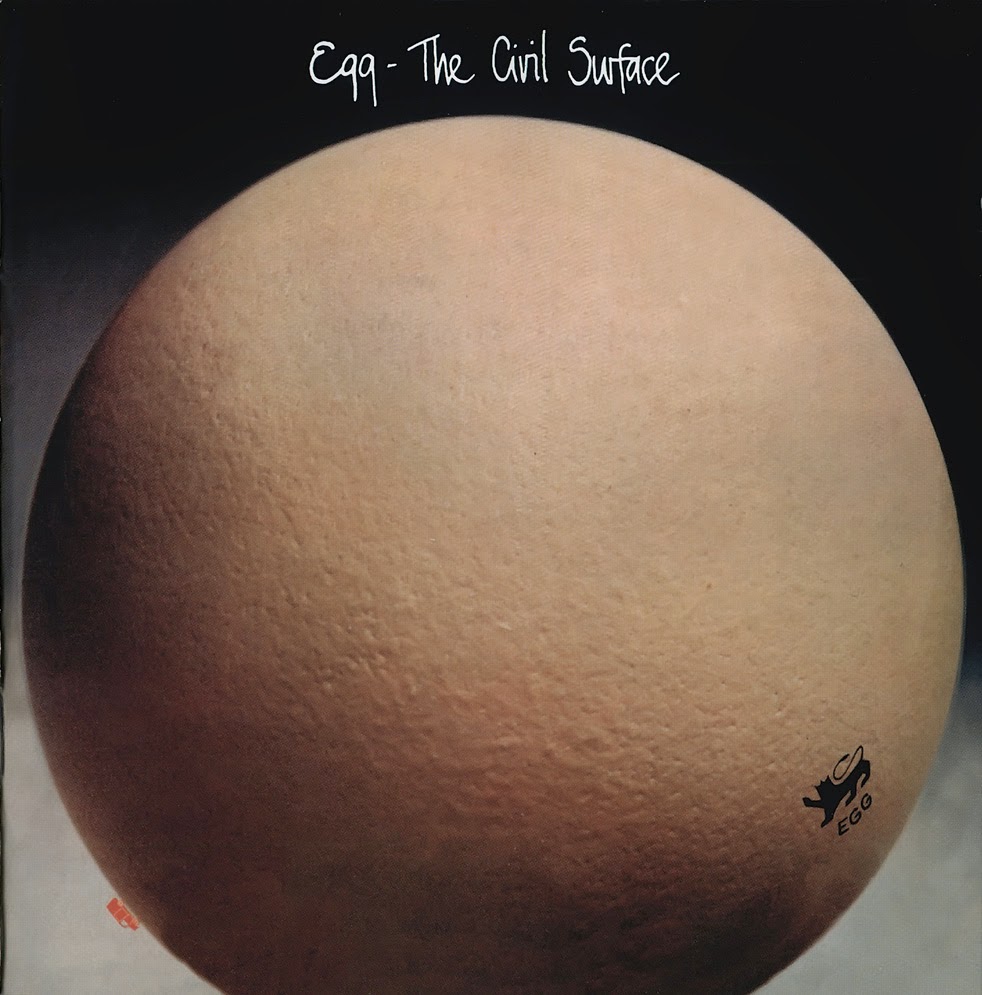
The Civil Surface is the third studio album by British band The Egg, formed in 1968.
The trio consisting of Dave Stewart (keyboards), Mont Campbell (bass/vocals), and Clive Brooks (drums) is one of the pioneering bands of progressive rock, whose first two albums, Egg (1970) and The Polite Force (1971), contributed to the genre reaching new levels of complexity. Classical music influences and shifting time signatures were an essential part of the band’s style.
However, Egg’s challenging and somewhat strange albums were not successful, and the band was dropped by their record label in 1972 and decided to disband shortly thereafter.

In 1974, however, the trio unexpectedly received an offer for a new record deal from Caroline, a subsidiary of Virgin Records. Egg’s live repertoire included a few unreleased songs that had been very well received by fans, so the band decided to seize this opportunity to record them.
However, the band did not have enough Egg compositions ready, so they enlisted the help of a few of Campbell’s compositions for wind instruments, which were his practice pieces from his conservatory studies, which he had focused on when Egg originally broke up.
These short pieces, ”Wind Quartet 1” and ”Wind Quartet 2,” which mix world music and classical music, are quite pleasant art music, but they have nothing to do with progressive rock and make The Civil Surface an incoherent whole. Stewart and Brooks don’t even play on these tracks. Fortunately, these tracks only take up a little less than 8 minutes of the album’s running time. On the other hand, Campbell’s three-minute composition ”Nearch” combines his art music aspirations with band playing in a very interesting and experimental way.
However, the album’s highlights are the two longer tracks, the 8- and 9-minute ”Germ Patrol” and ”Enneagram,” which Egg had already had a chance to try out live before the band broke up.
”Germ Patrol” is a great start to the album, successfully mixing jazz and classical music with an excitingly heavy yet airy rock vibe. Stewart’s raw organ playing and the song’s overall pounding feel make it interesting to listen to. The song features guest appearances by Henry Cow’s Tim Hodgkinson on clarinet and Lindsay Cooper on oboe and bassoon, but unfortunately they are not given a very significant role. At times, ”Germ Patrol” also sounds surprisingly similar to the slightly heavier sound of Hatfield And The North. Stewart had joined Hatfield And The North after Egg broke up.
The nine-minute ”Enneagram” is a rhythmically very complex composition. The song starts off with a bang and is the track on the album that most reminds me of Egg’s best early songs. After a thunderous zigzag rhythms, the song shifts to an almost space rock-like mood before picking up speed again for a new rise. The band plays tightly and precisely.
Read also:
- Levyarvio: King Crimson – The ConstruKction Of Light (2000)
- Review: Camel – Moonmadness (1976)
- Review: Gong – Gazeuse! (1976)
- Review: Mike Johnson – The Gardens Of Loss (2026)
- Levyarvio: Mike Johnson – The Gardens Of Loss (2026)
- Levyarvio: Led Zeppelin – Presence (1976)
- Vuosi vuodelta : Parhaat levyt 2000 – Sijat 11-20
- Review: Univers Zero – Ceux Du Dehors (1981)
- Levyarvio: Steve Walsh – Glossolalia (2000)
The Civil Surface is an almost entirely instrumental album. However, in the highly experimental organ-led interlude ”Prelude,” we hear the wordless vocals of The Northettes, a female trio familiar from Hatfield And The North, and in ”Wring Out the Ground (Loosely Now),” there are actual lyrics. As usual, the vocals are skillfully performed by Campbell, who sings with a slightly thin voice. ”Wring Out the Ground (Loosely Now)” also features guest guitarist Steve Hillage, who had previously played with members of Egg in the band Uriel in 1968.
The drums are mixed too loudly, making The Civil Surface’s sound a little unbalanced, but on the other hand, this brings a new kind of punch to the music that was perhaps lacking in places on Egg’s first two albums. Dave Stewart’s keyboard sounds have also improved greatly since the early days.
The Civil Surface is stylistically rather fragmented, but the best tracks on the album are fully on par with Egg’s best songs and make the album, if not quite a Canterbury classic, then definitely a work worth listening to.
The Civil Surface did not fare any better than its predecessor in the sales charts and failed to keep Egg together. Dave Stewart returned to Hatfield And The North, through which he continued to National Health and, in the late 1970s, to Bill Bruford’s band. Campbell completed his classical music education and was involved in the original lineups of Gilgamesh and National Health (with Stewart). However, Campbell grew tired of the rock world before the end of the 1970s and focused on world music. He eventually became a sought-after specialist in ”exotic” wind instruments and has played on the soundtracks of many films, including Harry Potter series. Drummer Clive Brooks ended up as Pink Floyd’s drum technician for over 20 years and continued in similar roles with other bands until almost the 2010s. Brooks died in 2017.
Egg’s story was ultimately short-lived, but it did produce three excellent and unique albums that will still be listened to decades later.
Best tracks: “Germ Patrol”, “Enneagram”
Author: JANNE YLIRUUSI
Tracks:
1. ”Germ Patrol” 8:31
2. ”Wind Quartet I” 2:20
3. ”Enneagram” 9:07
4. ”Prelude” 4:17
5. ”Wring Out the Ground (Loosely Now)” 8:11
6. ”Nearch” 3:22
7. ”Wind Quartet II” 4:48
Dave Stewart: organ & piano, electric piano, bass Mont Campbell: bass, vocals, French horn, piano Clive Brooks: drums
Guests:
Steve Hillage: guitar Lindsay Cooper: bassoon, oboe Tim Hodgkinson: clarinet Jeremy Baines: flute Amanda Parsons: vocals Ann Rosenthal: vocals Barbara Gaskin: vocals Maurice Cambridge: clarinet Stephen Solloway: flute Chris Palmer: bassoon
Producer: Egg
Label: Caroline Records
 Pienemmät Purot
Jätä kommentti