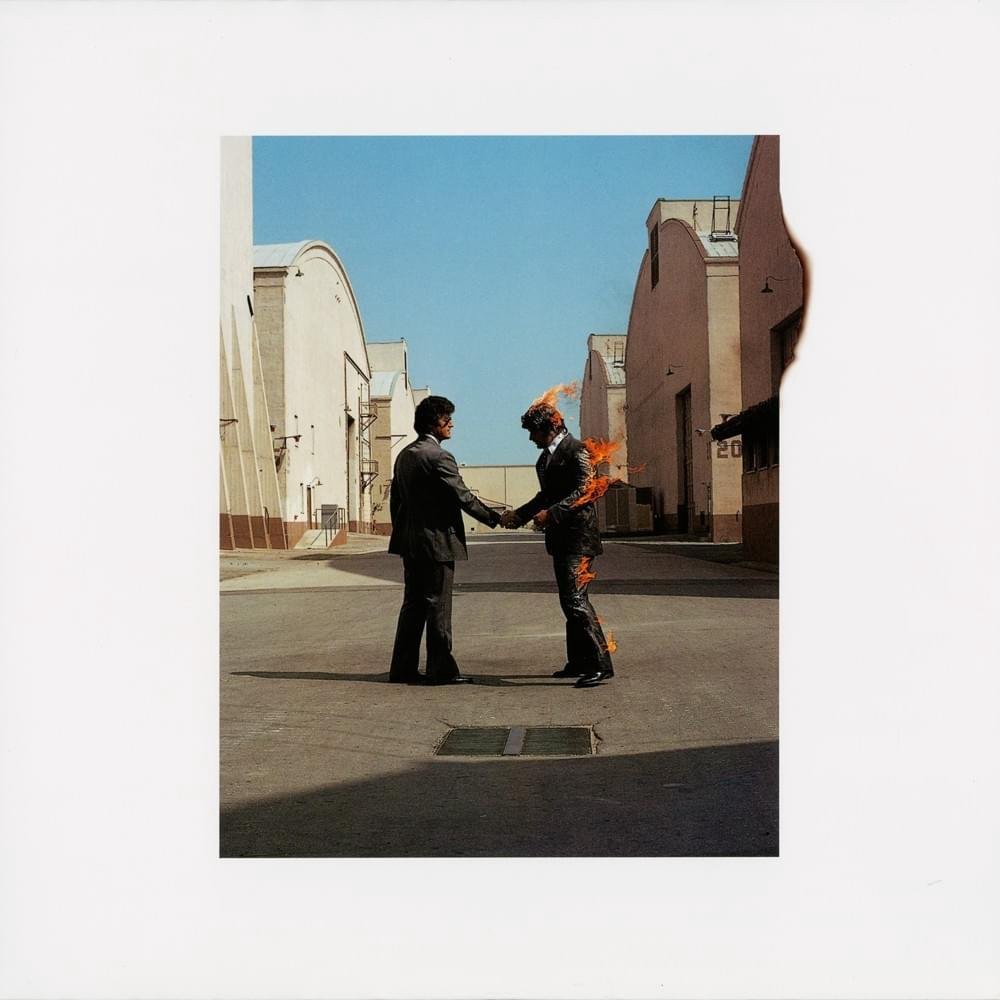
Wish You Were Here is the seventh studio album by Pink Floyd, formed in 1963. It is their ninth album if the soundtracks made by the band are counted.
Wish You Were Here is Pink Floyd’s first album after the million-selling The Dark Side Of The Moon (1973). Already quite popular, Pink Floyd became one of the world’s biggest bands after The Dark Side Of The Moon.
The band’s financial worries were suddenly a thing of the past, and as the band’s mastermind/bassist/vocalist/composer/lyricist Roger Waters put it, ”all their dreams had come true.” However, when dreams of rock stardom come true, it often ends up being somewhat disappointing, at least for intelligent people. The experience is hollow, and the prevailing feeling is ”what now?” For Waters in particular, the experience was even shocking when he realized that, as an unhappy person, he was still unhappy even after his enormous success. Waters had been struggling with alienation and bitter feelings for some time, and neither worldly riches nor the adoration of fans seemed to improve the situation, as he had at least subconsciously imagined.
After their huge success, the pressure to repeat the feat of The Dark Side Of The Moon was enormous. Especially since Pink Floyd received a record-breaking million-dollar advance from Columbia Records in the US for their next album. The band had to deliver something to justify that sum, even though they had complete artistic freedom. It would have been easy for Pink Floyd to become paralyzed, and for a while they did, but under Waters’ leadership, the band ultimately managed to turn their feelings of alienation into a brilliant concept album.
So what is the concept behind Wish You Were Here? Like The Dark Side Of The Moon, it is somewhat difficult to define. The concept of the album is not very concrete or clearly explicit. It does not tell a story or describe a single phenomenon. However, the theme that connects the songs on the album is absence. At times, the album describes more literally the absence of founding member Syd Barrett (from the band and, more generally, his mental absence due to mental health issues) and the conflicting emotions associated with it. Guilt that they were unable or unwilling to help Barrett, and on the other hand, relief. Better him than me. On the other hand, absence or absence is also more abstract on the album and is related to the alienation of individuals from other people, communities, and society as a whole. Either for mental health and financial reasons, or through rock stardom, which Pink Floyd knew firsthand, where you are put on a pedestal but at the same time isolated from ”ordinary” people. It was also about the fact that, at least according to Waters, the members of Pink Floyd did not always seem to be mentally present in the studio, but were only there out of habit or because music and being in a band happened to be their job. This attitude infuriated Waters, and he wanted to shake the band out of it. The album could just as well have been called Wish We Were Here.
“Syd is a symbol for all the extremes of absence some people have to indulge in because it’s the only way they can cope with how fucking sad it is—modern life.”
– Roger Waters
Pink Floyd is now easy to see as a lumbering dinosaur, especially after the extremely safe and calculated albums and tours of the 80s and 90s led by David Gilmour, but Floyd was still a bold and progressive band in the mid-70s. It would have been very easy for Pink Floyd to endlessly play songs from The Dark Side Of The Moon in stadiums around the world, but very soon the band began to play completely new, still somewhat unfinished compositions live. These songs, which were tested on the road in 1974, ended up on Wish You Were Here, but also on 1977’s Animals. Along the way, the songs evolved in interesting ways, changing in terms of their details and sometimes even their structure. Roger Waters also radically changed some of the lyrics along the way.
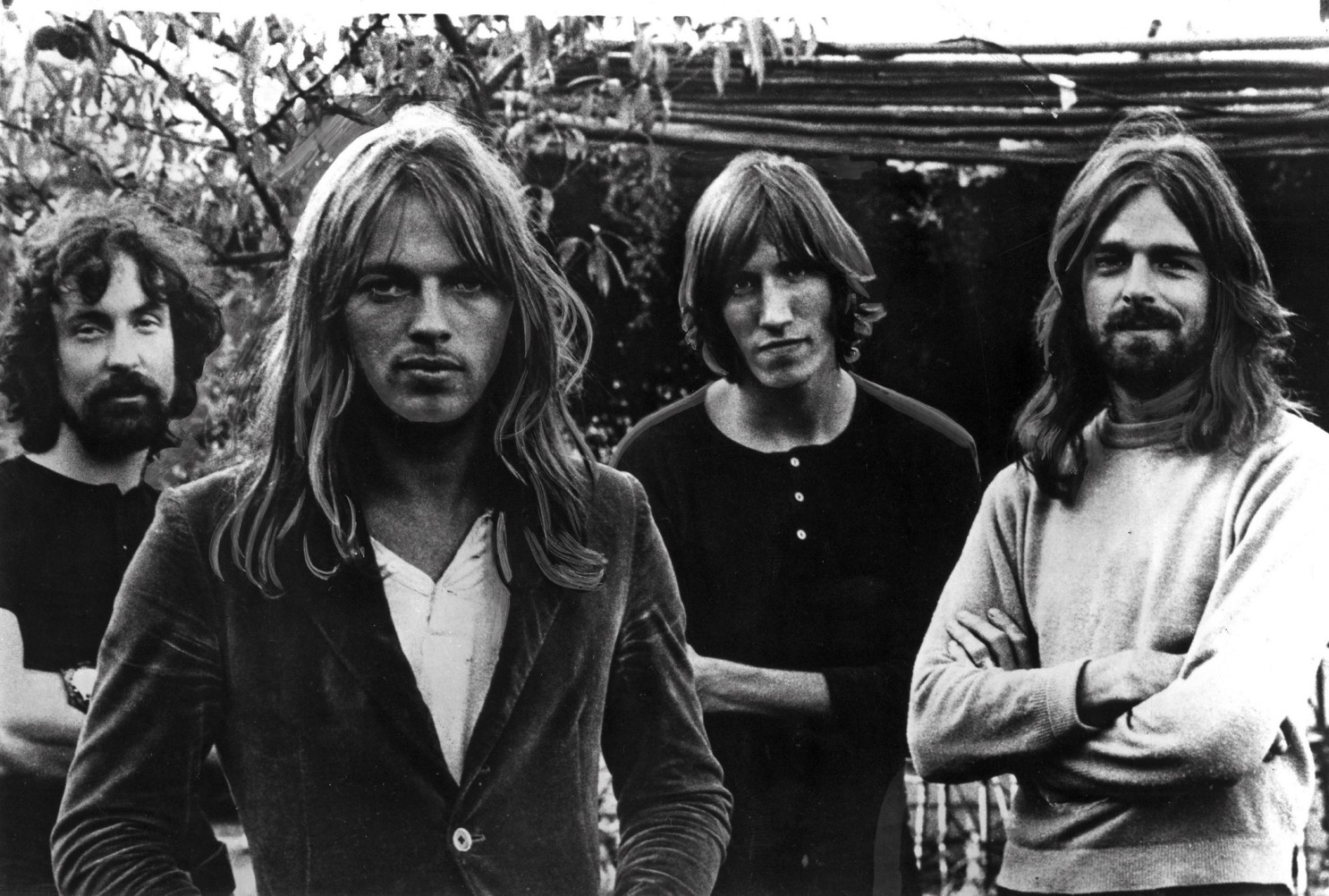
”Shine On You Crazy Diamond (Parts I–V)”
”Shine On You Crazy Diamond” was originally intended to be a 25-minute epic filling an entire side of the vinyl record, but it was ultimately divided into two parts with three shorter songs inserted between them.
”Shine On You Crazy Diamond (Parts I–V)” begins with a calm, seductive sound created by several synthesizers recorded on top of each other. The intro also features one of the few surviving moments from The Household Objects project (Floyd’s avant-garde attempt to make music with everyday household objects) in the form of a ”wine glass harp” whistling among the synthesizers. David Gilmour’s magically beautiful, crisply sounding guitar comes in after a couple of minutes and introduces the song’s melodic main theme. At the four-minute mark, the song sharpens with the addition of Nick Mason’s crisp drums. The music sways pleasantly in 6/8 time, and Gilmour plays a short, punchy solo, followed by Richard Wright’s extremely stylish and melancholic solo on the Minimoog synthesizer. Gilmour responds with an even more intense solo, occasionally stretching the sound tastefully with a vibrato bar.

Waters’ vocals finally kick in at the nine-minute mark, with Wright and Gilmour providing effective support in the form of background harmonies. A few female vocalists also shine deep in the mix. Waters’ lyrics are a simple yet powerful ode/lament in honor and memory of Syd Barrett, the space cadet who lost his mind. There is an eerie synchronicity to the recording sessions, as one day the band members noticed a strange-looking bald, fat, and vacant-eyed man loitering in the studio. After a moment of wonder, a shocked Wright realized that it was their former bandmate Barrett, about whom they were just mixing a song. Barrett said that the song sounded ”pretty old.” Barrett attended Gilmour’s wedding party at the studio after the sessions and then disappeared without saying goodbye. The story sounds too incredible to be true, but apparently it is!
”Remember when you were young, you shone like the sun
Shine on you crazy diamond
Now there’s a look in your eyes, like black holes in the sky
Shine on you crazy diamond
You were caught on the crossfire of childhood and stardom
Blown on the steel breeze”
Around the 11-minute mark, Dick Parry, familiar from The Dark Side Of The Moon, plays a relaxed, rumbling baritone saxophone solo. As the tempo changes to 12/8, the baritone is replaced by a sharper-sounding tenor saxophone, adding a nice boost of rhythmic energy. Personally, I would have liked to hear a slightly edgier saxophone performance. The song fades into Parry’s solo, and the soundscape is filled with a machine-like hum that leads into the next song.
”Welcome To The Machine”
Composed and written by Waters, ”Welcome To The Machine” is the darkest and perhaps the finest track on the album. In fact, I consider it one of the band’s greatest songs.
“Welcome To The Machine” is a unusually electronic-sounding Floyd song with roaring synthesizers. The song is defined by aggressively piercing synthesizers, which, together with mechanical factory-like effects, create a truly powerful impression. The atmosphere is intrusive and oppressive. Downright claustrophobic.
The end result was so impressive that even German electronic music pioneer Tangerine Dream drew inspiration from it and outright plagiarized it on his album Force Majeure.
On the other hand, amid all the synthetic Sturm und Drang, Gilmour’s rhythmic strumming on the acoustic guitar also plays a central role, creating an interesting contrast in the music that also works thematically. The acoustic guitar can easily be thought of as representing an individual struggling in the midst of a machine, whether it be the music industry or society at large.
Waters’ compact, only two verses, effectively attack the music industry, which wants to commodify music and musicians as part of the machine, but on the other hand, the lyrics also question, on a more general level, the illusions of success and its imagined blissful effects. The second verse, together with the oppressive music, makes it clear that the protagonist who dreamed of rock stardom in the first verse has indeed achieved his dream, but in the end, it is just a scam that the system has sold him. A game in which the machine always wins in the end.
Welcome my son, welcome to the machine
What did you dream?
It’s alright we told you what to dream
You dreamed of a big star
He played a mean guitar
He always ate in the Steak Bar
He loved to drive in his Jaguar
So welcome to the machine
(The second verse of “Welcome To The Machine”)
The chilling song eventually fades into the sounds of celebration, which could superficially be interpreted as a positive thing: perhaps our protagonist is doing well after all and life is one big party, but in fact Waters has explained that the celebrations at the end of the song represent the ultimate form of emptiness and meaninglessness. Superficial and soulless cocktail parties where people exchange empty pleasantries. In Waters’s bleak worldview, human encounters do not guarantee liberation. At least not if these encounters are not genuinely human.
“Welcome To The Machine” is a genius level song.

”Have A Cigar”
From the nihilistic mood of ”Welcome To The Machine,” we move on to the rock song ”Have A Cigar.” And it really is a great rock song. Probably Floyd’s most successful ”fast-paced” (relative to Floyd’s slow pace…) rock-oriented song.
”Have A Cigar” swings seductively, carried by a 7/4 riff (probably the band’s most rhythmically complex song), and guest vocalist, legendary folk rocker Roy Harper, sings the song with strong authority. Hiring Harper as a vocalist was a strange decision, considering that the band already had three highly capable singers in Gilmour, Waters, and Wright. Apparently, however, Waters’ voice was so damaged after the vocal parts of ”Shine On You Crazy Diamond” that he couldn’t sing the song to his own satisfaction. Gilmour declined the honor because he considered the lyrics too negative. And Wright’s voice was probably just too soft for such a bitter song.
Since then, Waters has regretted the decision to outsource the vocals to Harper. Not because Harper did a poor job, but because he feels they should have tried harder themselves. The 2011 Experience Edition release features the original version sung by Waters, which isn’t bad either, but at this point I wouldn’t trade it for Harper’s version, which I’ve been happily living with for twenty years.
The lyrics of ”Have A Cigar” continue the theme of ”Welcome To The Machine” about the seductive trap of success. ”Have A Cigar” describes the paradoxical golden cage of huge success, in which musicians are under enormous pressure to repeat the formulas of their previous success. The sarcastic, downright cynical mood of the song is well summed up by the words written in the mouth of the record company’s A&R man:
And did we tell you the name of the game, boy?
We call it ”Riding The Gravy Train”
On the other hand, the record company is making hollow and deceitful attempts at flattery in an effort to manipulate:
I’ve always had a deep respect and I mean that most sincere;
The band is just fantastic, that is really what I think,
Oh, by the way, which one’s Pink?
The last verse and its concluding question are straight out of real life and represent the kind of empty bullshit the band had to get used to when traveling around the world and meeting record company people.
”Have A Cigar” is a truly powerful song, both lyrically and musically, and is definitely one of Pink Floyd’s best rock songs.
“Wish You Were Here”
The title track is a simple and beautiful semi-acoustic, almost country-style ballad. The song has become one of Pink Floyd’s most beloved and well-known songs, which is a bit funny because it differs so much from the band’s typical sound. The lyrics seem to express a longing for Syd Barrett, which adds extra resonance to the simple yet powerful lyrics, although they can also be interpreted more universally as a longing for a lost friend. Waters has said that the lyrics also describe him and different aspects of his personality.
Waters and Gilmour wrote the song together. Unusually for Floyd, Waters wrote the lyrics first, and Gilmour mainly composed the music around them. Gilmour also handles the vocals in a straightforward and impressive manner. The popularity and simplicity of ”Wish You Were Here” is evident in the fact that the song can be heard played by a troubadour strumming his guitar in the subway or covered by a random pop star like Miley Cyrus. The same cannot be said for many other Pink Floyd songs.
The famous French jazz violinist Stéphane Grappelli was invited to add a short violin solo at the end of the song, but in the end, Grappelli’s part was left out (or at least the remaining part was buried deep in the mix). However, it is now possible to hear the version spiced up with Grappelli’s violin on the aforementioned Experience Edition release. This version is interesting due to its slightly more complex arrangement, but Floyd probably made a wise decision in keeping the song simple and straightforward. Grappelli’s version would hardly have become quite as iconic.
”Shine On You Crazy Diamond (Parts VI–IX)”
Gilmour wanted to release ”Shine On You Crazy Diamond” as a single 25-minute piece, but the rest of the band voted against it and the epic was split in two. In my opinion, this was the right decision, as a harmonically very simple song would probably have felt tedious if heard in one go, but now it’s a pleasure to return to its moods after hearing three other songs in between.
”Shine On You Crazy Diamond (Parts VI–IX)” repeats the themes of the first half and contains slightly more aggressive tones than before. In ”Part VIII,” the band even flirts a little with jazz rock in the form of a syncopated bass line and Wurlitzer electric piano accompaniment. At the end, the song turns into a march, offering a kind of funeral march for the absent, though still living (at the time of the song) Syd Barrett (1946–2006).
The music in ”Shine On You Crazy Diamond (Parts VI–IX)” does not flow quite as smoothly and logically as the first half of the song, but it still brings this wonderful album to a fitting conclusion.
”Shine On You Crazy Diamond” is now considered iconic music that has been imitated by numerous bands since its release. The German C-class prog band Eloy has even incorporated excerpts from it directly into their own music, and British neo-prog bands of the 1980s in particular owe a huge debt to the sound of this song. Examples include Marillion and, in particular, Pendragon.

Wish You Were Here is a complete work. Each song is brilliant in its own right and quite different in style from the others, but when brought together on the album, they grow into something even greater as part of the whole. Roger Waters’ lyrics, conceptual thinking, and edginess perfectly complement Gilmour and Wright’s dreamy, atmospheric melodies. Although the creation process of Wish You Were Here was challenging, in hindsight it is clear that it was created during Pink Floyd’s most creative period.
Wish You Were Here, wrapped in Hipgnosis design company’s ingenious cover art, has sold a staggering 13 million copies over the years, and although that is a little compared to the massive sales figures of its predecessor, it still easily ranks among the top progressive rock albums in terms of popularity.
The album was also popular with the band members, and at least Gilmour and especially Wright usually ranked it among their favorites. I myself consider Wish You Were Here to be one of the band’s three best albums, alongside The Dark Side Of The Moon and Animals (1977).
Best tracks: ”Shine On You Crazy Diamond (Parts I–V)”, ”Welcome To The Machine”, ”Have A Cigar”
Author: JANNE YLIRUUSI
Read also:
- Vuosi vuodelta : Parhaat levyt 2000 – Sijat 11-20
- Review: Univers Zero – Ceux Du Dehors (1981)
- Levyarvio: Steve Walsh – Glossolalia (2000)
- Year by Year : Best Albums of 1976 – 21-29
- Levyarvio: Jimmy Page – Outrider (1988)
- Review: Brian Eno + David Byrne – My Life in the Bush of Ghosts (1981)
- Levyarvio: Gong – Zero To Infinity (2000)
- Review: Michael Oldfield – Heaven’s Open (1991)
- Review: Talk Talk – The Colour Of Spring (1986)
Tracks:
Side A:
1. ”Shine On You Crazy Diamond (Parts I–V)”
David Gilmour Richard Wright Waters
Waters 13:32
2. ”Welcome to the Machine” Waters, Gilmour 7:32
Side B:
1. ”Have a Cigar”Waters 5:08
2. ”Wish You Were Here” Gilmour, Waters 5:35
3. ”Shine On You Crazy Diamond (Parts VI–IX)” Wright, Gilmour, Waters 12:30
Pink Floyd:
David Gilmour: guitar, keyboards, vocals, EMS Synthi AKS synthesizer Roger Waters: bass, electric guitar, keyboards, vocals, VCS 3 synthesizer, tape effects Richard Wright: Hammond organ, ARP String Ensemble, Minimoog, Steinway piano, EMS VCS 3, 5), Hohner Clavinet D6, Wurlitzer EP-200 electric piano , glass harmonica, backing vocals Nick Mason: percussion, drums, tape effects
Guests:
Dick Parry: tenor and baritone saxophone Roy Harper: vocals Venetta Fields: backing vocals Carlena Williams: backing vocals
Producer: Pink Floyd
Label: Harvest
 Pienemmät Purot
Jätä kommentti