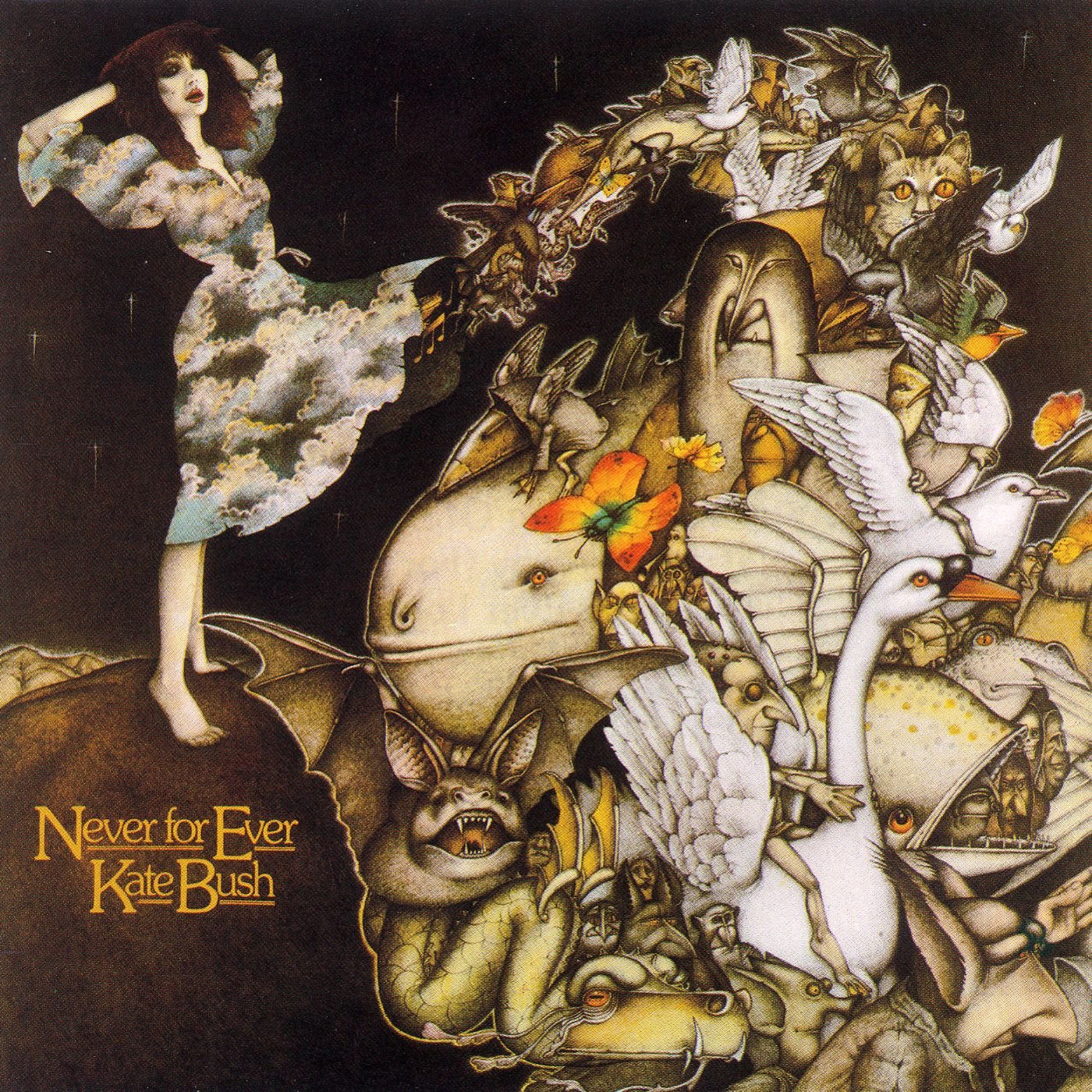
Never For Ever is Kate Bush’s third studio album.
ad patiently allowed Kate Bush to mature for years before the release of her first album, The Kick Inside (1978), which was not only an artistic success but also a commercial hit, but then pressured Bush to release her next album quickly. The follow-up to The Kick Inside, Lionheart, was a disappointment, consisting mainly of leftover tracks that had not made it onto the debut album.
After Lionheart, Bush took control of her career more firmly than before, and since then no one has been able to tell her to do anything she doesn’t want to do. Never For Ever was Bush’s chance to prove herself and claim her new, more independent role.
Bush’s rise to empowerment took place across all axes of creativity, and one of the most significant factors was that on his third album, Bush also took on the role of producer. On Never For Ever, Bush began to use the studio to a significant extent as part of his artistic expression for the first time. Bush’s previous albums were innovative in many ways, but they were still based mainly on traditional band playing, which was then embellished with an orchestra and other additional instruments from time to time.
Never For Ever is more clearly a studio creation, with the Fairlight CMI synthesizer, capable of sampling, playing a significant role. Bush became fascinated with this new, almost magical tool while participating in the recording sessions for Peter Gabriel’s third album (1980). The Fairlight was an extremely expensive instrument: only a few musicians in Britain owned one, and for a time it became a key tool not only for Gabriel and Bush, but also for Mike Oldfield and Trevor Horn, among others. The first version of Fairlight cost over £90,000 in 1979, and a new model released a few years later doubled that price.

On his next album, The Dreaming (1982), Bush jumps fully into the 80s, but Never For Ever is a transitional album. Synthesizers do not yet dominate, as more than twenty musicians participated in the making of Never For Ever, and the album features quite exotic instruments such as the psaltery and the lirone. The large orchestrations of the two previous albums are no longer heard, but a string orchestra is still used sparingly in a few songs. Never For Ever charmingly combines the baroque pop of Bush’s first two albums with art rock informed by new technology.
Never For Ever includes a few songs that would have fit seamlessly on The Kick Inside or Lionheart. This is especially true of ”Blow Away (For Bill),” a beautiful pop song with strings, but also the theatrical ”The Wedding List,” which represents the more energetic side of the album and would have fit well with the style of previous albums. ”The Wedding List” feels a bit old-fashioned among the other material on Never For Ever, but it is still a pleasant song, enhanced by Bush’s passionate vocals. The magnificent ”The Infant Kiss,” which deals with pedophilia in a surprisingly lighthearted manner, is also easy to imagine on Bush’s previous albums.
The more modern side of the album is represented by the powerful opening track ”Babooshka” and the waltz-like ”Army Dreamers.” John Giblin’s (Brand X) magnificent bass lines, played on a fretless bass, provide a wonderful counterbalance in ”Babooshka” to the brightly ringing piano and Bush’s alternately subtle and alternately quite fierce vocal performance. The sounds of breaking glass sampled on the Fairlight blend beautifully with Stuart Elliot’s crisp drumming. At the end, the Fairlight even plays a short melody using the sounds of breaking glass recorded on the Fairlight. ”Babooshka” is a brilliant combination of catchy pop and progressive spirit.
”Army Dreamers,” sung by Bush in a strangely whiny voice, also makes creative use of the Fairlight’s sampling capabilities, effectively using the clicking of a rifle’s bolt in the song. From a certain perspective, Bush’s use of the Fairlight could be considered frivolous gimmickry, but I think it’s an excellent part of the songs’ storytelling.
The new Bush is also represented by ”Delius (Song of Summer)” and ”All We Ever Look For.” ”Delius (Song of Summer)” is an ethereal and strangely jangly song that alternates between Bush’s extremely high vocals and her older brother Paddy Bush’s strange deep bass growls. The staccato programmed drum track on ”Delius” also introduces a drum machine to Bush’s music for the first time. The playfully tapping ”All We Ever Look For,” on the other hand, gives synthesizers and a harpsichord-like instrument a central role. There are no drums to be heard on the track, but Morris Pert (Brand X, Mike Oldfield) does a few rolls on the snare drum. Drums play a relatively minor role on Never For Ever, but the songs are so cleverly arranged that you don’t really miss them.
Somewhere between the new and the old, ”Egypt” and ”Violin” strike a balance. ”Egypt” is a beautifully evolving song that is excellently arranged with constantly changing instrumentation. ”Violin” is the rockiest song on the album, with its slightly punkish drum track giving the song momentum and folk violinist Kevin Burke’s menacing violin riffs creating a unique atmosphere. The violin riff in ”Violin” always reminds me of Jethro Tull’s song ”Uniform” from their album A, released in the same year, but the connection is probably just a coincidence. Bush’s own vocal performance on ”Violin” is the most unrestrained performance on the album.
Lue myös: Levyarvio: Kate Bush – The Kick Inside (1978)
However, the most impressive composition on the album is the magnificent and dramatic mini-epic ”Breathing.” I have always thought that there was something very Pink Floyd-esque about this song, and I was not at all surprised when I finally read that it was specifically inspired by Pink Floyd’s album The Wall (1979). The Wall made such a big impression on Bush that he momentarily thought there was no point in making any more music, as Roger Waters and his bandmates had already achieved perfection with their strange and gloomy concept album. However, after recovering from his initial shock, Bush wrote the song ”The Breathing” inspired by The Wall.
Whereas Bush’s songs have generally been short, three-minute bursts of energy, the tempo of ”Breathing,” which lasts just over five minutes, is quite slow in the style of Pink Floyd, and Bush carefully builds the atmosphere. And the atmosphere Bush creates is quite chilling. The song’s post-apocalyptic story is told from the perspective of an unborn fetus who absorbs not only nicotine through his mother’s bloodstream, but also the radioactivity spread by a nuclear bomb.
Giblin’s melodic, fretless bass once again plays an important role in ”Breathing,” and Bush’s emotionally sung vocals are effectively contrasted at the end with his idol, folk rocker Roy Harper’s monotonous, insistently repeated question, ”What are we going to do without?” Bush responds to Harper with an increasingly desperate and desperate voice. The spoken section in the middle of the song about the effects of a nuclear bomb raises the chill factor.
Bush has called ”Breathing” his own mini-symphony, which may be a slight exaggeration (despite the ”mini” prefix), but it is indeed a truly magnificent piece, and ”Breathing” is one of those songs that feels much more epic than its actual length. In just over five minutes, Bush manages to construct an entire believable world into which the listener can immerse themselves completely. Around the time Never For Ever was released, Bush said that ”Breathing” was the best song of her career so far, and I couldn’t agree more.
What are we going to do without? (Ooh, please)
What are we going to do without? (Oh, let me breathe)
What are we going to do without? (Ooh, quick, breathe in deep)
We are all going to die without (oh, leave me something to breathe)
What are we going to do without? (Oh, leave me something to breathe)
We are all going to die without (oh God, please leave us something to breathe)
What are we going to do without? (Oh, life is)
Never For Ever was a huge success and Bush made history once again. The Kick Inside’s song ”Wuthering Heights” had been the first song composed by a woman to reach the top of the UK singles chart, and now Never For Ever became the first studio album by a female artist to reach the top of the album chart. When the album received mostly excellent reviews, it was clear that Bush had earned herself artistic freedom with Never For Ever and no longer had to look over her shoulder, as her freedom to work was guaranteed by her record company, EMI.
With Never For Ever, Bush took a giant leap forward while retaining the lighthearted playfulness of her previous albums. The album features numerous beautiful melodies, carefully crafted arrangements, and stunning vocal performances. Never For Ever was not only the best album of Bush’s career to date, but also one of the finest art rock albums of the 1980s.
Best tracks ”Babooshka”, ”All We Ever Look For”, ”The Infant Kiss”, Army Dreamers”. ”Breathing”
Author: JANNE YLIRUUSI
Tracks
- ”Babooshka” 3:20
- ”Delius (Song of Summer)” 2:51
- ”Blow Away (For Bill) ” 3:33
- ”All We Ever Look For” 3:47
- ”Egypt” 4:10
- ”The Wedding List” 4:15
- ”Violin” 3:15
- ”The Infant Kiss” 2:50
- ”Night Scented Stock” 0:51
- ”Army Dreamers” 2:55
- ”Breathing” 5:29
Musicians:
Kate Bush: vocals, piano, keyboards, Fairlight CMI synthesizer, Yamaha CS-80 synthesizer (1, 4) John L. Walters and Richard James Burgess: Fairlight CMI programming Max Middleton: Fender Rhodes (1, 3, 5, 6, 11), Minimoog (5), string arrangements (3, 6) Duncan Mackay: Fairlight CMI (4, 10) Michael Moran: Prophet 5 synthesizer (5) Larry Fast: Prophet synthesizer (11) Alan Murphy: electric guitar (1, 2, 6, 7, 8, 11), electric guitar solo (7), acoustic guitar (4, 10), bass guitar (10) Brian Bath: electric guitar (1, 6, 7, 11), acoustic guitar (3, 4, 10), backing vocals (6, 10) Paddy Bush: backing vocals (1, 4, 5, 6, 10), balalaika (1), sitar, bass vocals and ”Delius” voice (2), koto (4), psaltery (5), harmonica and saw (6), banshee (7), mandolin (10) Kevin Burke: violin (7) Adam Skeaping: viola (8), string arrangements (8) Joseph Skeaping: lirone (8), string arrangements (8) John Giblin: bass guitar (1), fretless bass guitar (11) Del Palmer: fretless bass guitar (3), bass guitar (5, 6, 7) Stuart Elliott: drums (1, 11), bodhran (10) Preston Heyman: percussion (2, 3, 5), drums (3, 5, 6, 7), backing vocals (4, 6) Roland: percussion (2) Morris Pert: snare drums (4), percussion (11) Ian Bairnson: bass vocals (2) Gary Hurst: backing vocals (1, 4) Andrew Bryant: backing vocals (4) Roy Harper: backing vocals (11) The Martyn Ford Orchestra: strings (3, 6)
 Pienemmät Purot
Jätä kommentti