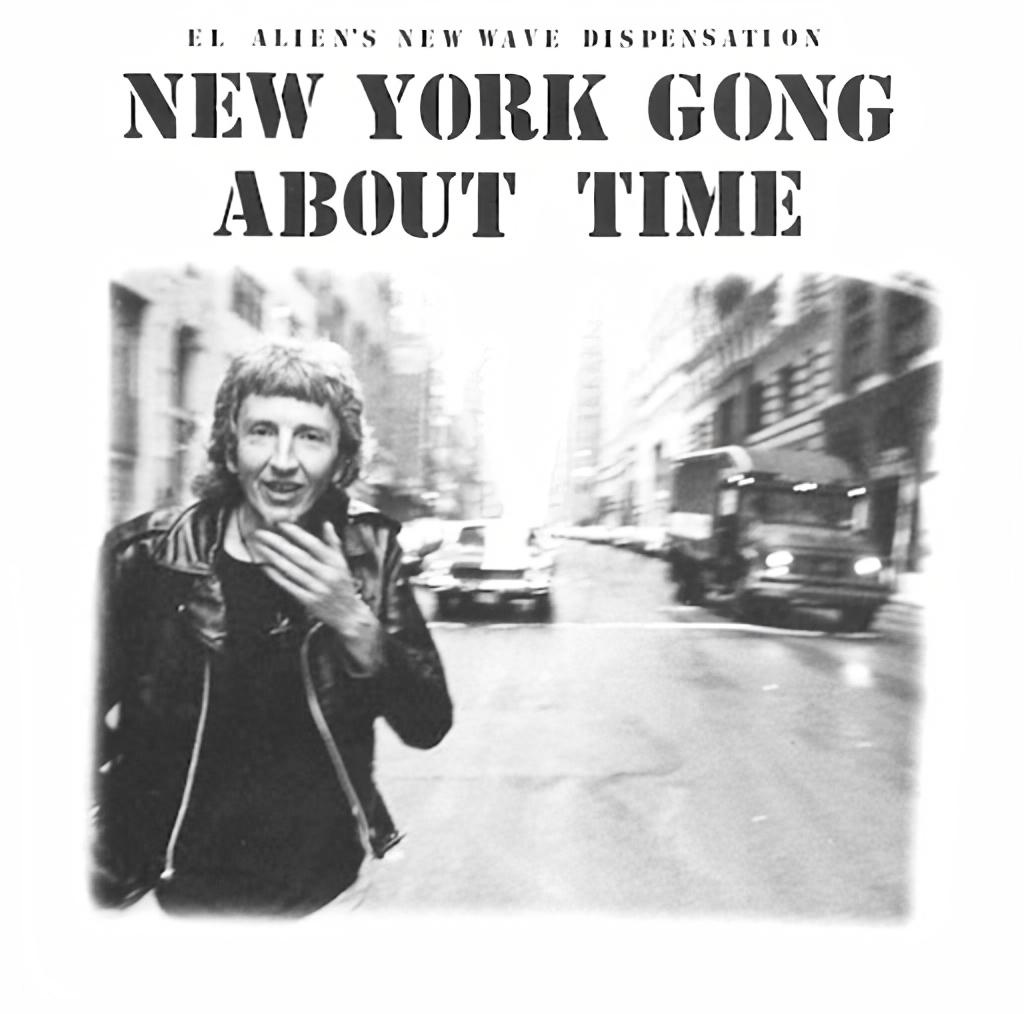
About Time is New York Gong’s first and only album.
Sophisticated and complex progressive rock and simple, brutal punk rock are often seen as opposites. The music press has repeatedly pitted these two genres against each other. However, many prog musicians did not see it this way and were interested in blending elements of punk and, in particular, the new wave that emerged in its wake into their own music, just as they had previously drawn influences from jazz, folk, and art music. In the late 1970s, a vibrant music scene emerged in New York, cheerfully mixing punk, new wave, and various forms of avant-garde rock. Many curious prog musicians headed to New York in search of a new direction for their music. At the turn of the 70s and 80s, Brian Eno, Robert Fripp (King Crimson), Fred Frith (Henry Cow) and Daevid Allen, known from Gong, were all active in New York for shorter or longer periods.
Born in Australia but moving to Europe in the early 1960s, Daevid Allen appeared on the progressive music scene in the late 1960s, first with Soft Machine (he was already pursuing his own path when the band released their first album) and later as the leader of Gong, which he founded in 1967. In Gong, Allen combined psychedelia and jazz rock into a new kind of wild progressive space rock in which his Dadaist humor played a strong role. Allen left Gong in 1974 when jazz-rock influences became too dominant in the music. Gong ended up in the hands of virtuoso percussionist Pierre Moerlen and eventually became Pierre Moerlen’s Gong, playing streamlined jazz-rock. Allen himself released a few solo albums in the late 1970s that received little attention and made a brief return to Gong music under the name Planet Gong.
New trends always intrigued the curious Allen. And when music impresario Giorgio Gomelsky invited him to New York in 1978 to check out what the new generation of musicians was up to there, the old hippie (Allen was 41 at the time) gladly accepted the invitation.
Born in the Georgian Soviet Socialist Republic but moving to the West in the 1940s, Gomelsky was a multi-talented figure in the music business who had done almost every job imaginable behind the scenes. He had produced records, worked as a manager, organized concerts, and run clubs. Gomelsky also played a significant role in progressive music, launching the careers of Soft Machine, Gong, and Magma, among others. Gomelsky moved to New York in 1978 after receiving a large sum of money for his services as manager of The Yardbirds.
In New York, Gomelsky’s goal was to pave the way for European prog and jazz musicians. There, he also met 24-year-old bassist Bill Laswell and encouraged him to start a band. This is what happened, and Laswell’s band, which later became known as Material, began rehearsing in the basement of Gomelskyn’s Zu Club (the band used to play challenging songs by Art Bears, among others. Apparently with varying degrees of success). Laswell’s band initially operated under the unofficial name Zu Band, and the group’s function was to serve as a backing band for European musicians whom Gomelsky brought to his club to introduce to New Yorkers. The name changed when Gomelsky brought Allen into the group and it became clear that the collaboration would be more long-lasting than the one-off gigs that Zu Band had usually done with European musicians. With Allen, the band’s name changed to New York Gong, and they played their first gig in October 1978 with Gilli Smyth, Fred Frith, and Chris Cutler (Henry Cow). Allen returned to New York in March 1979, and New York Gong went on tour playing music from Gong’s Radio Gnome trilogy.
In the fall, New York Gong began recording a studio album titled About Time, featuring Allen (vocals, rhythm guitar), Laswell (bass), Cliff Cultreri (guitar), and two drummers, Fred Maher and Bill Bacon. The album also features organist Mark Kramer, synthesizer player Michael Beinhorn, and two saxophonists, Don Davis and Gary Windo. It is worth noting that Maher was only 15 years old at the time of the recordings, 26 years younger than Allen!

Musically, About Time is an interesting combination of progressive rock, psychedelia, punk, and new wave with an avant-garde twist. This eclectic mix can probably also be linked to the no wave scene that was gaining ground in New York at the time. If I understand correctly, no wave music was essentially a more avant-garde, raucous, and nihilistic version of new wave rock.
The album begins with a strange sound collage constructed from crackling and jerking tape loops and synthesizer sounds, over which Allen’s intense monologue seems to have been influenced by Travis Bickle from the film Taxi Driver. The intro, titled ”Preface,” makes it clear to the listener that this is no longer the familiar, always cheerful and playful hippie from Gong’s albums. This is not entirely true, however, as About Time contains plenty of Allen’s familiar hilarious verbal banter. Even jazz-rock’s number one keyboardist, Chick Corea, gets a jab from Allen when he is humorously compared to diarrhea (”Get diarrhoea from Chick Corea”) in the energetic second track, ”Much Too Old.” The punchy ”Much Too Old” is an energetic and fun track overall, featuring a few edgy guitar riffs reminiscent of Fripp. And be warned: at least for me, the catchy chorus ”New Yoooork you suck!” got stuck in my head like an earworm.
Read also: Robert Fripp – Exposure (1979)
At first glance, it may be difficult to associate the super-hippie Allen with punk rock or anything related to it, but in fact, his anarchistic attitude also translates well into the rougher musical expression of About Time, and he was also a beatnik in his day.
About Tim Allen seems to embrace new wave and punk influences while also gently mocking them. And as much as the energy of New York in the late 70s and early 80s has been praised in retrospect, based on About Time, Allen wasn’t just excited about the dirty and restless city of that time, but also gave the Big Apple a piece of his mind (one of the delicious moments: ”You can look for a place, but space is rare / Better take up smoking cause there ain’t no air”).
(Funny, by the way, that Robert Fripp’s New York-made ”new wave” album Exposure also began with a song called ”Preface”…)
“Black September” effectively continues the aggressive line of “Much Too Old,” with Allen ranting against chemical warfare in a spoken-word style. Allen’s vocals usually play a central role on About Time, but there is also one entirely instrumental track. The instrumental track ”Materialism,” composed by Laswell and Cultret, sounds surprisingly Zeuhl-esque. Its rough sound in particular brings to mind Swedish band Kultivator’s interpretation of Magma’s unique musical style. The song is dominated by Laswell’s powerful bass and Cultret’s tightly ticking electric guitar. Allen’s role is to play rhythm guitar in the background and create a few ethereal effects with his glissando guitar. The Magma influences may seem a bit confusing on a no-wave album like About Time, but it’s not that surprising, since Zu Band had played as a backing band for Magma members on a few occasions.
The fifth track, ”Strong Woman,” is the most laid-back song on the album, and with its hand drum accompaniment, it is more reminiscent of Allen’s earlier solo albums than the rest of the music on About Time. On the other hand, its cyclical rhythms and Allen’s glissando guitar make it sound a bit like a rough prototype of the music King Crimson would make a few years later in the early 1980s.
“I Am A Freud” picks up the pace again, and its neurotic vibe brings to mind Talking Heads. At less than two minutes, it’s not one of the best tracks on the album, but luckily “O My Photography” follows right after and immediately raises the bar. The nine-minute ”O My Photograph” is the longest song on the album and one of its best. Cultrer’s twisted guitar playing is reminiscent of Fred Frith’s style. Frith himself was active in New York at the time, combining the city’s new wave energy with his own avant-garde rock (he also appears on Material’s first album). On the other hand, ”O My Photograph” is at times almost suspiciously reminiscent of David Bowie’s song ”Red Sails” from the album Lodger (1979), with Cultrer torturing his electric guitar in a very Adrian Belew-esque manner. Towards the end, the song turns into an exciting avant-garde-meets-krautrock jam.
The penultimate track, “Jungle Windo(w),” was originally known as “Big City Energy,” but Allen couldn’t resist playing with the name of guest saxophonist Gary Windo. Windo (the only European musician on the album) plays a huge role in this jerky, groovy song. His violent yet subtle tenor saxophone playing, which elegantly accompanies Allen’s vocals, is the driving force behind this addictive track. Similar ingenious playing from Windon can be heard on Hugh Hopper’s strange solo album 1984, released in 1973.
The last track on the album, “Hours Gone,” starts off a bit dull, but then comes to life nicely with the power of Allen’s most emphatic vocals. The ”oo-oo” background harmonies transport the listener to the 1960s, or perhaps even further back, while the roughness of the music connects it to the 1980s. The end result is a tantalizing cognitive dissonance. And that’s really what the whole album is about.
About Time succeeds quite well in its cross-pollination of several different genres. It naturally combines genres that, in principle, should not be compatible. The result is an entertaining mess, but also a surprisingly coherent one. At no point does the album fall into the trap of having one song be prog and another punk, for example; instead, the ingredients are combined in a fairly even mix in each song. The material is consistently strong, but the individual songs don’t quite reach their highest peaks. Allen’s songwriting may not have been at its sharpest at the time, and the production of the album also lacks punch and dynamics. On the other hand, I must admit that I was a little surprised when I glanced at the album cover and saw that Allen was listed as the sole producer: a stranger in New York has managed to capture the city’s no wave spirit quite effectively! Despite the official credits, I suspect that Laswell also played a major role in the overall sound of the album.
Read also:
- Review: Gong – Gazeuse! (1976)
- Review: Mike Johnson – The Gardens Of Loss (2026)
- Levyarvio: Mike Johnson – The Gardens Of Loss (2026)
- Levyarvio: Led Zeppelin – Presence (1976)
- Vuosi vuodelta : Parhaat levyt 2000 – Sijat 11-20
- Review: Univers Zero – Ceux Du Dehors (1981)
- Levyarvio: Steve Walsh – Glossolalia (2000)
- Year by Year : Best Albums of 1976 – 21-29
- Levyarvio: Jimmy Page – Outrider (1988)
After About Time, New York Gong embarked on a tour of France, which was cut short when the American members of the band realized they couldn’t stand the ”European lifestyle.” That’s what has been reported, but I’m still wondering what on earth that could have meant in practice! In any case, the interrupted tour marked the end of New York Gong.
After New York Gong broke up, Laswell and Cultreri renamed the remaining band Material. The band’s name was, of course, taken from the About Time song ”Materialism”. Material released their first album, Memory Serves, in 1981 and continued until the late 1990s. At some point, however, Material evolved from a real band into more of a brand for Laswell’s various projects.
Daevid Allen returned to his native Australia after decades away, having first recorded a solo album, Divided Alien Playbax 80, in New York. In Australia, Allen performed and supported himself by driving a taxi, among other things. Allen left music behind completely for a while. Those were tough times for Allen, and he has said that he even considered suicide. However, the birth of his third son, Toby, in 1982 gave him a new lease on life.
However, Allen did not return to music in earnest until the late 1980s. At the turn of the 1980s and 1990s, Allen had many different projects related to Gong, such as Magick Brothers, Gong Maison, and the re-formed Planet Gong. In 1992, Allen adopted the name Gong for the album Shapeshifter, and Gong continued to tour and release albums under Allen’s leadership on a regular but irregular basis until his death. Christopher David Allen left this plane of existence at the age of 77 in 2015. However, Gong’s life did not end with Allen, as he chose guitarist/vocalist Kavus Torabi (Knifeworld, Guapo, Cardiacs, among others) as his successor, who has led the band forward and made several excellent studio albums since Allen’s death. To paraphrase the title of one of Gong’s live albums: Allen est Mort, Vive Gong!
Best tracks: ”Much Too Old”, ”Materialism”, ”Jungle Window”, ”O My Photograph”
Author: JANNE YLIRUUSI
Tracks
- Preface (Allen/Beinhiorn) (1:28)
- Much Too Old (Allen/Laswell) (2:43)
- Black September (Allen/Cultreri) (4:03)
- Materialism (Laswell/Cultreri) (3:12)
- Strong Woman (Allen/Bacon) (4:30)
- I Am A Freud (Allen) (1:46)
- My Photograph (Allen) (9:10)
- Jungle Windo(w) (Allen) (6:19)
- Hours Gone (Allen) (4:05)
New York Gong
Daevid Allen: rhythm and glissando guitar, vocals Cliff Cultrer: electric guitar (2, 3, 4, 8, 9) Bill Laswell: bass guitar Bill Bacon: drums Fred Maher: drums
Other musicians
Michael Beinhorn: synthesizer (1) Mark Kramer: organ (9) Don Davis: alto saxophone (6) Gary Windo: tenor saxophone (8)
 Pienemmät Purot
Jätä kommentti