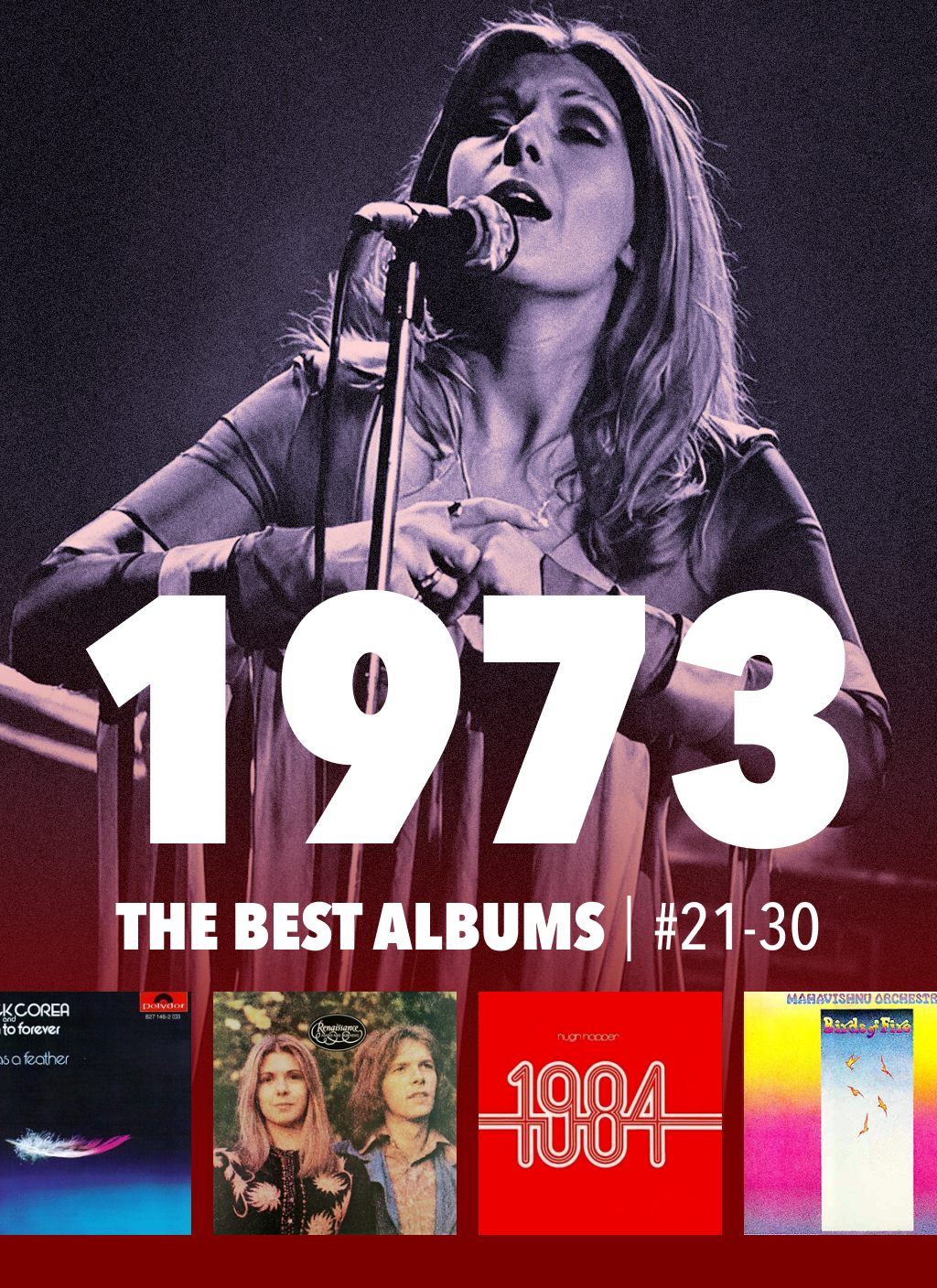
The author’s picks for the best albums of 1973, ranked 21-30.
In the Year by Year series, I’ll go through my favourite albums from 1969 to the present day.
21. Renaissance: Ashes Are Burning (UK) ****
22. Hugh Hopper: 1984 (UK) ****
23. Chick Corea And Return to Forever: Light As A Feather (US) ****
24. Mahavishnu Orchestra: Birds Of Fire (UK) ****
25. Gong: Angel’s Egg (UK) ****
26. Stevie Wonder: Innervisions (US) ****
27. Rahsaan Roland Kirk: Prepare Thyself To Deal Wih A Miracle (US) ****
28. Lou Reed: Berlin (US) ****
29. Jethro Tull: A Passion Play (UK) ****
30. Led Zeppelin: Houses Of The Holy (UK) ****
11-20
31-43
21. Renaissance: Ashes Are Burning

Ashes Are Burning is the fourth studio album by Renaissance, founded in 1969.
The history of Renaissance is so complicated that Ashes Are Burning no longer has any of the original band members remaining. The band’s most beloved core line-up was first assembled on the previous album, Prologue, and the same four-piece of Annie Haslam (vocals), Jon Camp (bass, acoustic guitar), John Tout (keyboards) and Terrence Sullivan (drums) also play on Ashes Are Burning.
Somewhat unusually, the longest history with the band is with two outside members, composer Michael Dunford and poet Betty Thatcher, who together are responsible for the music and lyrics on all but one track of the album…
22. Hugh Hopper: 1984
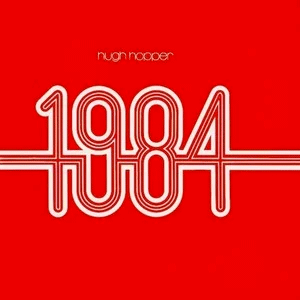
1984 is the first solo album by Soft Machine bassist Hugh Hopper (1945–2009).
1984 was recorded in 1972, when Hopper was still with Soft Machine. Hopper left Soft Machine after the album Six in 1973.
The album is inspired by George Orwell’s sci-fi novel 1984 (published in 1949), which depicts totalitarianism, but the connection between Hopper’s abstract instrumental pieces and the book remains a mystery to me. But does it matter, since the music itself is fascinating regardless of context?
Recorded in six days at Advision Studios, the album is stylistically divided into two parts. It features two long, highly avant-garde tracks influenced by Terry Riley, focusing on tape loops, which Hopper created mainly on his own. The other side of the album is represented by shorter, edgy jazz-rock songs made with the band. Although the tape loop songs buzz and hum in places in a very interesting way, they are a bit too long at 14 and 17 minutes. On the other hand, the songs performed with the band, which last between 1 and 5 minutes, could have been listened to for longer.
According to Hopper, the musicians he recruited are top notch. On drums/percussion on the album is Hopper’s Soft Machine colleague John Marshall. On trombone are another musician familiar from Soft Machine, Nick Evans, and Malcolm Griffiths. The saxophones on the album are played by two British masters of the instrument, Gary Windo and Lol Coxhill. Surprisingly, Pye Hastings, guitarist with Caravan, also features, although he is not usually heard in such experimental music.
The wind instruments play a leading role as solo instruments in several tracks. The best example is the compact, James Brown-inspired three-minute ”Minipax I,” featuring Lol Coxhill’s tortured soprano saxophone solo, accompanied delightfully by Gary Windo on tenor saxophone.
1984 is challenging to listen to in all its experimentalism, but it rewards the open-minded listener who is willing to give a chance to both the twisted mix of R&B and jazz-rock AND the avant-garde clanging.
Best tracks: ”Miniluv”, ”Minipax I”, ”Minipax II”, ”Miniluv Reprise”
(Note: ”Miniluv Reprise” is a bonus track on the 1998 CD release that was not included on the original vinyl. It is a five-minute jazz-rock version of the 14-minute tape loop experiment ”Miniluv” that opens the album. ”Miniluv Reprise” is an excellent addition to the album. Few jazz-rock songs feature trombones playing so deliciously.)
23. Chick Corea and Return to Forever : Light As A Feather

Light As A Feather is the second studio album by Return To Forever, led by keyboardist Chick Corea and bassist Stanley Clarke. Chick Corea and… The title, however, suggests that a) Corea was more of a leader than Clarke, or b) Corea had a bigger ego…
As its name suggests, Light As A Feather is music that floats as lightly as a feather. Light, but by no means empty or simplistic. The rhythm section, Stanley Clarke and Airto Moreira (drums), is particularly impressive with its light yet crisp playing. Of course, the star of the album, Chick Corea, who previously made a name for himself in Miles Davis’s band, is also wonderful to hear on the Fender Rhodes electric piano. Joe Farrell also does a solid job on the horns (saxophones, flute), although he doesn’t quite have the same impact as his colleagues. Another delight on the album is the high-floating vocals of Brazilian Flora Purim (Moreira’s wife), which fit the music perfectly. They also bring a pleasant uniqueness to the band’s fusion jazz, which Is usually instrumental.
Personally, I usually prefer the term ”jazz-rock” to ”fusion jazz,” even though I think they mean pretty much the same thing. In the case of Light As A Feather, however, fusion jazz seems like a more appropriate term. The album is more clearly jazz than jazz-rock albums in general, but on the other hand, the electric sound and strong Latin influences clearly take it away from ”real” jazz, so fusion jazz seems like the right name for music that is such a mixture of different influences.
The highlight of this evenly balanced album is the fast-paced and extremely agile Latin-inspired ”Captain Marvel,” which is a truly magnificent song and one of the finest moments of its genre. The album’s closing track, the fast-paced 10-minute ”Spain,” is also an impressive song.
Best tracks: ”Captain Marvel”, ”500 Miles High” ja ”Spain”
24. Mahavishnu Orchestra: Birds Of Fire

Birds Of Fire is the second studio album by the Mahavishnu Orchestra, led by guitarist John McLaughlin.
Behind McLaughlin (and at times even alongside him) plays the same talented quartet as on the debut album: Billy Cobham on drums, Jan Hammer on keyboards, Jerry Goodman on violin, and Rick Laird on bass. Stylistically, Birds Of Fire continues the successful formula of the debut album, The Inner Mounting Flames (1971). The music is once again extremely fast-paced and almost heavy rock-like jazz rock with plenty of room for virtuoso solo performances. This is especially true of McLaughlin’s guitar solos, but the other musicians also get their moments to shine. Once again, there is at least five times as many notes played as on an average rock album.
The material on the album is roughly as good as on the debut. McLaughlin is still not particularly interesting as a composer, but there is something so captivating about the band’s energetic playing and punch that it largely makes up for the other shortcomings of the songs. It’s hard to say which of the band’s first two albums is ultimately better. Perhaps the honor goes to The Inner Mounting Flame, if only because it came first.
Birds Of Fire remained the last studio album by the original lineup for decades, as the band members’ egos grew as large as their musical talents. The quintet attempted to make a third album, but relations between the members became so strained that the unfinished project was not released until 1999 under the title The Lost Trident Sessions.
However, the Mahavishnu Orchestra continued in 1974 with McLaughlin gathering new musicians around him. The raw and powerful atmosphere of the first albums was never achieved on the band’s later albums. Perhaps that was not the intention.
Best tracks: ”Birds Of Fire”, ”Miles Beyond”, ”Thousand Island Park”, ”One Word”, ”Sanctuary”
25. Gong : Angel’s Egg
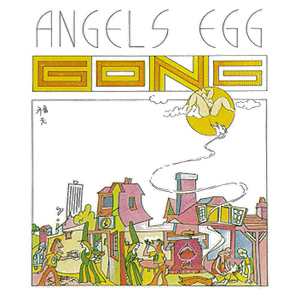
Gong didn’t rest on their laurels in 1973, as Angel’s Egg was the second album the band released that year. Angel’s Egg, the second part of the Radio Gnome Invisible trilogy, was released in December 1973, just seven months after its predecessor, Flying Teapot.
The lineup of Gong underwent further changes with the release of Angel’s Egg, with bassist Mike Howlett and drummer/percussionist Pierre Moerlen (1952-2005) joining the band. With these changes, Gong’s most beloved and skilled lineup was complete. The playing on the album is more agile than before. It’s quite amusing that Moerlen had hardly played the drum set before joining Gong, but was a classically trained percussionist. Mike Howlett has said that Moerlen had to teach him how to play rock. Well, Moerlen was clearly a quick learner, because even though he may not have been at his best on Angel’s Egg, within a few years he became one of the best prog drummers of all time.
Two short tracks are credited solely to frontman Daevid Allen (1938–2015), but otherwise the songwriting credits on Angel’s Egg are fairly evenly distributed among the various band members. Newcomer Moerlen makes his debut as a composer on a few tracks, and one of the best songs on the album, “Love Is How Y Make It,” was written by Allen and Moerlen and gives a glimpse of the future when Moerlen eventually took control of the entire band. The album has no fewer than 14 tracks, the longest of which is only seven minutes long, and the shortest are interludes lasting less than a minute. Angel’s Egg is a more uneven and disjointed whole than its predecessor. The short songs make the album feel a bit fragmented.
Angel’s Egg is one of those albums where the B-side is clearly stronger than the A-side. Most of the album’s strongest tracks are on the second half, while the A-side has a bit too much of a floating, spacey feel that doesn’t always lead anywhere. This makes the listening experience a little unbalanced.
Angel’s Egg is a pleasant and enjoyable album, but the compositions lack a certain edge this time around. The following year, Gong would bounce back strongly with the release of their first true masterpiece.
Best tracks: ”Sold To The Highest Buddha”, ”Oily Way”, ”Love Is How Y Make It” ja ”I Never Glid Before”
26. Stevie Wonder : Innervisions
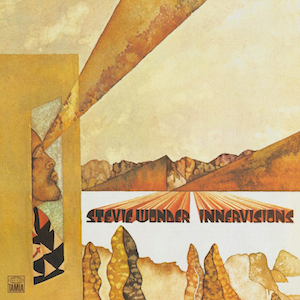
Innervisions is the 16th studio album by multi-instrumentalist/composer/songwriter/singer/producer Stevie Wonder (born 1950), who began his career as a child star. However, most of his previous albums were made under the strict guidance of record companies and producers. It was not until the early 1970s that he was able to truly realize his own artistic vision.
Innervisions is Wonder’s strongest album, and Wonder was at the height of his creative powers at the time. Innervisions is an impressive combination of soul, funk, jazz, and even progressive rock. Wonder often tends to fall into schmaltzy ballads, but Innervisions largely avoids that pitfall. ”All in Love is Fair,” however, comes dangerously close.
Wonder plays almost all the instruments on the album by himself. The instrumentation is relatively modest, with various keyboard instruments and drums playing the main role. However, Wonder conjures up a satisfyingly rich soundscape from his keyboards, and the thick ARP synthesizer sounds are a treat for the ears. An electric bass is only heard on a couple of tracks, with Wonder usually handling the bass on a Moog synthesizer. Wonder’s drumming works well for the most part, but at times a more nuanced and skilled drummer might have done these fine songs better justice. The drumming on the ballad ”All In Love Is Fair” in particular is a bit dull and heavy-handed.
Wonder’s vocals are skilful throughout the album, and he sings his socially conscious lyrics (about racism, drugs, politics, etc.) with effortless charisma, singing rock and soul songs with equal ease.
The best track on Innervisions is the seven-minute mini-epic ”Living For The City,” which clearly flirts with progressive rock. ”Living For The City” effectively uses the sounds and dialogue of the big city to tell a story about racism in the metropolis.
The album, produced by Wonder himself, sounds rich and warm. The sound is excellent.
Innervisions was both a critical and commercial success upon its release, and today the album regularly ranks high in various polls of the best albums of all time. And rightly so. Innervisions is a dazzlingly powerful album that pushes the boundaries of soul music in an open-minded way.
Best tracks: ”Too High”, ”Living Fot The City”, Golden Lady”, ”Jesus Children Of America”, ”He’s Mistra Know-It-All”
27. Rahsaan Roland Kirk: Prepare Thyself To Deal Wih A Miracle
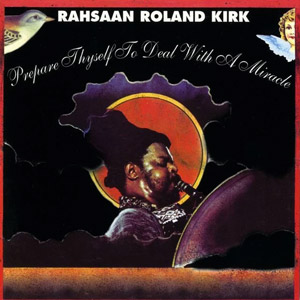
Prepare Thyself To Deal With A Miracle is one of the most highly regarded solo albums by Rahsaan Roland Kirk (1935–1977), who made his first recordings in the 1950s.
The album is a spicy mix of spiritual jazz, ethnic tones, avant-garde and orchestral sounds. Kirk’s compositions are complex and make powerful use of orchestral effects. Kirk himself is a virtuoso player of many different wind instruments, from saxophones and clarinets to flutes and even the Polynesian nose flute.
The manic, stormy 21-minute “Saxophone Concerto” that closes the album is particularly impressive. Although Kirk’s 16-piece orchestra is not as large as Ornette Coleman’s Skies Of America (1972), Prepare Thyself To Deal With A Miracle is easily on par with Coleman’s better-known work in terms of composition in the realm of avant-garde jazz. ”Saxophone Concerto” is also a true demonstration of Kirk’s power as a saxophonist: he practically solos on his tenor saxophone throughout the 21-minute piece without a single break. An astonishing performance.
I’m not super familiar with Roland Kirk’s work, but Prepare Thyself To Deal With A Miracle is one of his most experimental albums, as far as I know. It’s definitely a gem of avant-garde jazz.
Best tracks: “Salvation & Reminiscing”, “Saxophone Concerto”
28. Lou Reed : Berlin
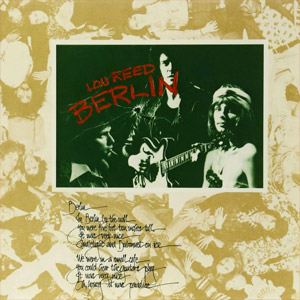
Berlin is the third studio album by Velvet Underground legend Lou Reed (1942–2013).
Reed’s previous album, Transformer (1972), made with David Bowie, is a little gem of glam rock and, with its many hit songs, a very accessible album. The chillingly dark Berlin is something else entirely.
Berlin is a dark rock opera that tells the tragic story of Jim and Caroline (both fictional characters) and their relationship and struggles with drugs, domestic violence, prostitution and suicide. A truly cheerful subject matter, then. And Reed, together with his producer Bob Ezrin, certainly doesn’t try to lighten the mood at all. Berlin is undoubtedly one of the darkest albums ever made…
Year by Year: Best Albums of 1973 – 31-43
29. Jethro Tull : A Passion Play
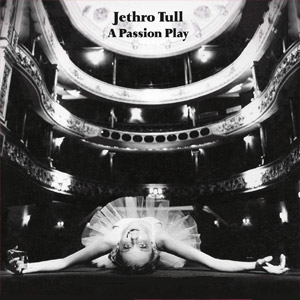
A Passion Play is the sixth studio album by Jethro Tull.
Jethro Tull’s previous album, Thick As A Brick (1972), was a concept album and contained only two long songs, each half an album in length. The album was a huge success, and Ian Anderson decided to continue with the proven formula. A Passion Play was also a concept album and again contained only two (or three, in a way) long tracks.
The concept behind A Passion Play is more vague than its predecessor. Apparently, it’s about some kind of post-death adventure experienced by the protagonist, Ronnie Pilgrim. What exactly this adventure entails remains unclear to me. But never mind that, what about the music?
Stylistically, A Passion Play is quite similar to Thick As A Brick in that it is a complex work that jumps from one direction to another (the music is probably even more complex than its predecessor).
The band’s lineup remained unchanged, and they play the album skillfully and with great intensity. However, Ian Anderson’s compositions seem to lack their usual common thread this time around. The album contains some truly wonderful moments, but the whole doesn’t really convince. On the one hand, the music seems to jump around without much logic, and on the other hand, it sometimes dwells on the same themes for too long. For the most part, however, the band’s fast-paced ensemble playing is entertaining to listen to. But where Thick As A Brick felt fresh and fun, A Passion Play too often feels a bit forced. The mood of A Passion Play is also considerably more serious and solemn. Except, of course, for the interlude between the two halves of the album, ”The Story of the Hare Who Lost His Spectacles,” which resembles children’s musical theater.
This extremely unfunny piece of humor literally tells the story of a hare who lost his glasses. The agonizing spoken voice and ”funny” children’s music last for about four minutes, but feel much longer than their actual duration… ”The Story of the Hare…” unfortunately ruins the mood of the album, and the B-side fails to win me over, even though the music is roughly of the same quality as on the A-side.
In terms of instrumentation, what is new on A Passion Play is that Ian Anderson plays quite a lot of saxophone on the album. Anderson’s work on the instrument is not particularly impressive, although it certainly does not detract from the album.
A Passion Play received a frosty reception from critics upon its release, but still sold relatively well on the back of its predecessor’s success. Even Ian Anderson himself didn’t seem particularly pleased with the album. Over the decades, however, A Passion Play has gained more appreciation, and although it does not reach the heights of its predecessor, it is still an entertaining, albeit imperfect, collection of ambitious music.
Best tracks: “A Passion Play 1”
30. Led Zeppelin: Houses Of The Holy

Houses Of The Holy on Led Zeppelinin viides studioalbumi.
Houses Of The Holy is Zeppelin’s most coherent and balanced album. It may not contain the band’s brightest gems, but overall the songs are very strong. The sound is also clearly better than on the band’s previous albums. Houses Of The Holy no longer features the most tired blues (which is, of course, always at the core of the band) nor does it descend into the most mindless heavy metal riffs. The songs seem to have more melody and nuance.
The highlight of the album is the semi-acoustic seven-minute mini-epic ”The Rain Song,” where John Paul Jones gets to create atmosphere with the Mellotron. The funky ”The Grunge,” where the band channels James Brown, is also a fun song, even though most Zeppelin fans seem to hate it. On the other hand, the reggae-influenced ”D’yer Mak’er” sees the band straying too far from their comfort zone. The world didn’t need to hear this. Of the more traditional Zeppelin tracks, the opening song ”The Song Remains The Same” is quite effective. ”No Quarter,” the most progressive song on the album, is also impressive and at times reminiscent of Pink Floyd.
Zeppelin’s golden age was short-lived. The band’s next album, the double album Physical Graffiti, was a very uneven release, and after that, the decline only accelerated.
Best tracks: ”The Song Remains The Same”, ”The Rain Song”, ”The Grunge”
Author: JANNE YLIRUUSI
Other parts of the Year by Year series can be found here.
- Review: Camel – Moonmadness (1976)
- Review: Gong – Gazeuse! (1976)
- Review: Mike Johnson – The Gardens Of Loss (2026)
- Levyarvio: Mike Johnson – The Gardens Of Loss (2026)
- Levyarvio: Led Zeppelin – Presence (1976)
- Vuosi vuodelta : Parhaat levyt 2000 – Sijat 11-20
- Review: Univers Zero – Ceux Du Dehors (1981)
- Levyarvio: Steve Walsh – Glossolalia (2000)
- Year by Year : Best Albums of 1976 – 21-29
 Pienemmät Purot
Jätä kommentti