
Gravity is the second solo album by guitarist Fred Frith.
Fred Frith (born 1949) has been a member of numerous bands and projects, but he is still best known for his career-defining avant-prog band Henry Cow, which he co-founded with Tim Hodgkinson in 1968.
Frith made his first solo album, Guitar Solos (1974), while still a member of Henry Cow. Guitar Solos featured Frith playing music on his own, on prepared guitars without overdubbing. The highly experimental Guitar Solos did not sell well, but its completely unique approach to the guitar attracted a lot of attention from musicians and the British music press. In the wake of Guitar Solos, Frith also curated the albums Guitar Solos 2 and Guitar Solos 3, which featured other guitarists alongside Frith, most notably avant-garde guitarist Derek Bailey.
After Guitar Solo, Frith planned his next solo album to be a more grandiose affair, inspired by Mike Oldfield’s Tubular Bells. Frith’s intention was to compose an epic piece that he would perform with a large ensemble of experimental musicians. In the end, however, the ambitious project never came to fruition, and Frith focused mainly on Henry Cow until the end of the 1970s, making a few guest appearances on solo albums by Robert Wyatt and Brian Eno, among others.
Henry Cow broke up in the late 1970s, releasing their last album, Western Culture, in 1979. Frith formed a new band from the ashes of Henry Cow, together with drummer Chris Cutler and singer Dagmar Krause. The trio, Art Bears, made challenging and experimental music similar to Henry Cow, but focused on short, song-oriented pieces. Art Bears released three excellent studio albums between 1978 and 1981. In 1979, Frith also released an album with another experimental guitarist, Henry Kaiser, called With Friends Like These. That album was entirely improvised music.
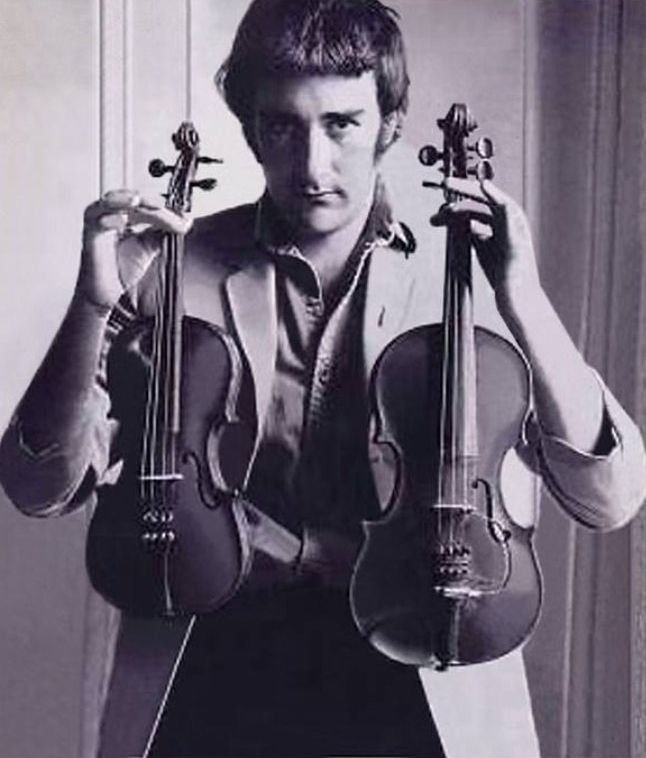
Frith’s second solo album, Gravity, chronologically falls roughly in the middle of the Art Bears era. Part of the reason for the demise of Henry Cow was Frith and Cutler’s desire to make songs rather than instrumental music, so it is somewhat surprising that on Gravity Frith returns to making entirely instrumental music.
Although Gravity marks a return to instrumental music, it also opens up a whole new direction for Frith’s career. Whereas Frith had made very serious and at times quite dark music with Henry Cow and the Art Bears, the mood of Gravity is considerably lighter. The music on Gravity is downright jubilant and life-affirming, and although it is by no means comedy music, it is very humorous at times.
However, Frith’s new style did not come out of nowhere, as he had already begun exploring Balkan folk music in the 1970s, and influences from this music could already be heard on the first two Art Bears albums. Gravity delves even deeper into these folk music influences. However, Gravity does not sound like ethnic music, as Frith manages to weave these influences so naturally into the music that the end result is a unique blend of folk music and complex rock music that is more accurately described as progressive rock than world music.
Frith himself has called Gravity ”dance music,” which is extremely intriguing when you consider the rhythmic complexity of the songs. But many of the songs on the album do indeed have a very danceable feel, which can of course be explained in part by the fact that the compositions draw on cultures where danceability is not viewed in such a one-dimensional, rigid way as in the West.
If everything I’ve said so far makes Gravity sound like silly, light-hearted dance music, don’t worry. To counterbalance all the cheerfulness, delicious melodies, and strange danceability, Gravity also offers a generous helping of the numerous meter and key changes familiar from Frith’s earlier compositions, as well as a healthy dose of dissonance.
The A-side of Gravity was mainly recorded in Uppsala, Sweden, in August 1979. Frith recruited Samla Mammas Manna, Sweden’s most famous avant-prog band, as his backing band for the first half of the album. Frith and Samla Mammas Manna had already crossed paths in the Rock In Opposition movement founded by Henry Cow. Samla Mammas Manna often combines folk music and complex rock in their rather bizarre music, so the band was a perfect choice for Gravity. In fact, it is very likely that Samla Mammas Manna’s albums served as a source of inspiration for Frith.
A small surprise awaited Frith in Uppsala. He arrived with detailed sheet music for his complex compositions, but it turned out that the members of Samla Mammas Manna couldn’t read music! This came as a complete surprise to Frith, as much of Henry Cow’s music was written in notation, and he automatically assumed that Samla Mammas Manna, who played music that was almost as complex, would do the same. This did not cause a major problem, however, as Samla Mammas Manna learned the songs by ear under Frith’s guidance, and at this point Frith was amazed once again at how quickly the Svea mammas’ boys learned his complex compositions. Frith was particularly impressed by Samla Mammas Manna’s understanding of rhythmic details. And there are plenty of those in Gravity!
Samla Mammas Manna members Gravity features keyboardist/accordionist Lars Hollmer, guitarist Eino Haapala, who also plays mandolin on the album, and drummer Hans Bruniusson. Additional reinforcement comes from Marc Hollander, known from the Belgian band Aksak Maboul, who plays alto saxophone and clarinet. As far as I know, Hollander’s parts were recorded separately in Switzerland at Sunrise Studio, where Art Bears’ albums were also recorded. Frith himself plays electric guitar, bass guitar, violin, and occasional percussion, so the instrumentation on Gravity is quite rich overall.
Read also: Review: Aksak Maboul – Un Peu de L’Ame des Bandits (1980)
Side A begins with ”The Boy Beats the Rams (Kluk Tluce Berany),” which starts with boisterous laughter. It’s easy to imagine the laughter announcing to the listener that instead of gloom, joyful and boisterous music is in store. This is largely true for the album as a whole, but the jerky and rather dissonant ”The Boy Beats the Rams (Kluk Tluce Berany)” represents the most challenging and darkest part of the album, even though it also contains playful moments and light acoustic guitar alongside the oppressively creaking electric guitar.
The next track, “Spring Any Day Now”, sweeps away the heaviness and brings folk influences to the surface. It is a truly charming, melodic song in which Frith’s clean guitar sounds meet Hollander’s rugged saxophone. The end result sounds like a strange hybrid of folk music and surf rock.
In the intensely percussive and rhythmically twisted “Don’t Cry For Me,” Haapala’s nimble mandolin playing meets Frith’s electric guitar patterns, played with a magnificent sound. The song ends in a chaotic, multi-layered storm of clapping.
The most delicious track on side A is the twisted “Hands Of The Juggler.” Hollander plays the clarinet in an Eastern-sounding irregular time signature over a jumping rhythm until Frith plays a highly complex pattern on the acoustic guitar. Suddenly, the tempo quickens and the time signature changes. Frith weaves eerie, atonal patterns on his electric guitar over the fast rhythm of the drums and percussion in different time signatures. The juxtaposition of these two contrasting elements creates a really strong tension that is released in the final minutes as the rhythm changes again and Hollmer’s harmonica and Hollander’s clarinet twist around each other. A truly breathtaking and magnificent piece!
Read also:
- Review: Cos – Viva Boma (1976)
- Levyarvio: King Crimson – The ConstruKction Of Light (2000)
- Review: Camel – Moonmadness (1976)
- Review: Gong – Gazeuse! (1976)
- Review: Mike Johnson – The Gardens Of Loss (2026)
- Levyarvio: Mike Johnson – The Gardens Of Loss (2026)
- Levyarvio: Led Zeppelin – Presence (1976)
- Vuosi vuodelta : Parhaat levyt 2000 – Sijat 11-20
- Review: Univers Zero – Ceux Du Dehors (1981)
The fifth track, the deliciously melodic ”Norrgården Nyvla,” is also one of the highlights of the album. With its magnificent electric guitar, ”Norrgården Nyvlan” became one of Frith’s most beloved songs and a good example of how skilled Frith is at constructing surprisingly accessible music that is at the same time quite complex. The song is led by a repetitive electric guitar pattern in 15/8 time, with Hollmer’s electric piano tinkling in the background. Frith plays two short but extremely effective guitar solos.
”Norrgården Nyvlan” doesn’t really end, but instead transitions unexpectedly into ”Year Of The Monkey,” which starts with a discordant violin and brings Hollmer’s twisted piano ostinato to the forefront. At times, the mood is carnivalesque, then jumps into a pressing rhythm colored by recorders. A very strange song!
The B-side of the album was recorded in Maryland in November 1979 after Frith moved to the US. The backing band on the B-side is the American avant-prog band The Muffins, once again reinforced by Hollander. Frith had also become acquainted with The Muffins through the RIO scene.
The B-side is slightly rockier than the first half and perhaps even more experimental in sound. This style is well illustrated by the rough, atonal opening of ”What A Dilemma,” which brings to mind Frith’s own, soon-to-be-formed band Massacre’s violent math rock or some of King Crimson’s rougher moments. On the other hand, the song also features a rather relaxed bass line that adds an interesting contrast to the atmosphere.
“Crack In The Concrete” is a short, just over a minute long, strange duet between bass guitar and drums in some indecent time signature. This is followed by perhaps the finest track on the B-side, the playful but intense ”Come Across”. It pulsates and jerks forward in a truly mesmerizing way, supported by a thick bass riff. The rhythmic pulse of the song, complemented by clattering percussion, is pierced not only by Frith’s magnificent electric guitar patterns, but also by Hollander’s bass clarinet and Dave Newhouse’s organ, as well as piercing saxophones. At less than three minutes long, the song proves once again that imaginative progressive rock with a lot going on is also possible in a short format.
The tenth track on the album is a combination of a cover song and a composition by Frith. The song begins with a very strange interpretation of the classic ”Dancing in the Street” by Marvin Gaye, William Stevenson, and Ivy Jo Hunter. The song first became a hit in 1964, performed by Martha and the Vandellas, and again in 1985 in a rather corny version by Mick Jagger and David Bowie. Frith’s interpretation, on the other hand, has no hit potential, even though it was the only track from Gravity to be released as a single, surprisingly enough. Frith’s version is instrumental, and the main melody is played with a strange sound that I’m not even sure is an electric guitar or an organ. Something strange is going on beneath the innocent melody. The background track consists of a hellish buzzing and noise, some of which may be radio interference, or maybe not. Eventually, the buzzing noise just gets louder and louder until the song turns into a light reggae-style section called ”My Enemy Is A Bad Man.”
“Slap Dance” takes the album back to the folk dance scenes of Eastern Europe and features some really quirky and crazy-sounding guitar riffs. Frith’s tasty bass pattern anchors the rhythmically twisted song. The Balkan vibe continues in ”A Career In Real Estate,” which features several tempo changes and frenzied violin riffs reminiscent of Art Bears’ song ”Moeris Dancing.” The long violin melody is effectively alternated with a more ominous electric guitar pattern.
The album ends with ”Dancing in Rockville, Maryland,” which starts with wild avant-garde jazz, briefly reminiscent of Henry Cow’s early music, until the other instruments fall silent, leaving only the piano playing a broken melody. The piano plays alone for a moment, until a percussion instrument (or perhaps it is popcorn!) begins to pop in the background. The piano falls silent and the strange popping is joined by barking dogs until the album ends.
Read also: Review: Slapp Happy / Henry Cow – Desperate Straights (1975)
Gravity has become one of Frith’s most beloved albums, and apparently it is also one of his own favorites. Frith is generally an artist who rarely looks back nostalgically on his past, but he has returned to Gravity on several occasions. Most memorably in 2014, when he assembled the Gravity Band to play the album in its entirety at a few festivals.
The early 80s were an extremely fruitful period for Frith. Gravity was followed by another solo album, Speechless(1981), which largely continued in the same vein as its predecessor, but Frith also formed several new bands around this time, including Massacre and Skeleton Crew. However, Gravity can be considered Frith’s brightest gem of the 1980s, even though Massacre’s Killing Time (1981) may be a more influential album.
Gravity combines avant-garde complexity with accessible, catchy melodies in a rare and delicious way. Gravity manages to make listening to challenging music really fun. And that’s usually easier said than done!
Best tracks: ”Spring Any Day Now”, ”Don’t Cry For Me”, ”Hands Of The Juggler”, ”Norrgården Nyvla”, ”Come Across”, ”Slap Dance”
Author: JANNE YLIRUUSI
Tracks
- ”The Boy Beats the Rams (Kluk Tluce Berany)” 4:54
- ”Spring Any Day Now” 3:04
- ”Don’t Cry For Me” 3:28
- ”The Hands of the Juggler” 5:31
- ”Norrgården Nyvla” 2:54
- ”Year of the Monkey” 4:11
- ”What a Dilemma” 3:11
- ”Crack in the Concrete” 1:24
- ”Come Across” 2:47
- ”Dancing in the Street” 3:20
- ”My Enemy is a Bad Man” 1:22
- ”Slap Dance” 2:32
- ”A Career in Real Estate” 4:42
- ”Dancing in Rockville Maryland” 3:04
Side A band:
Fred Frith: kitarat, bassokitara, viulu, perkussiot Lars Hollmer: piano, urut, harmonikka Hans Bruniusson: rummut Eino Haapala: kitara, mandoliini Marc Hollander: alttosaksofoni, klarinetti
Guests:
Olivia Bruynhooghe: tap dancing, hand clapping Chris Cutler: snare drum, maracas (3), hand clapping
Tina Curran: clapping Catherine Jauniaux: clapping Frank Wuyts: whistling (6), clapping Michel Berckmans: clapping Etienne Conod: clapping Denis van Hecke: clapping Veronique Vincent: clapping
Side B band:
Fred Frith: guitar, bass guitar, violin, percussion, drums (tracks 7, 11, 13) Dave Newhouse: alto saxophone, organ Thomas Scott: soprano saxophone (12) Paul Sears: drums (7, 8, 10, 13, 14) Billy Swann: bass guitar (tracks 8, 10, 12, 14) Marc Hollander: alto saxophone, bass clarinet
Guests:
Hans Bruniusson: drums (4) Tina Curran: subliminal bass guitar (track 1) Frank Wuyts: drums (9)
 Pienemmät Purot
Jätä kommentti