
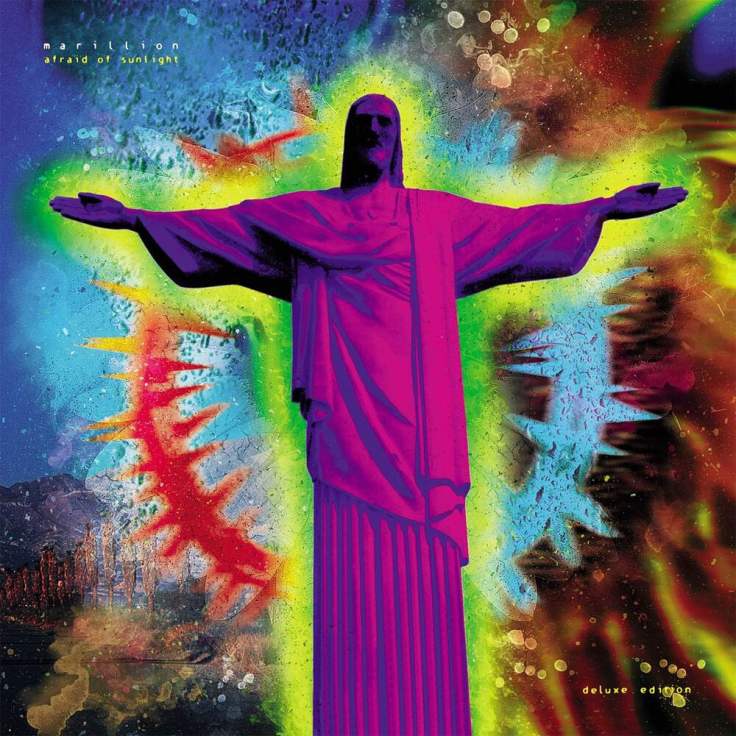
Afraid Of Sunlight is Marillion’s eighth studio album.
Marillion, formed in 1979, and vocalist Fish parted ways on hostile terms in 1988, shortly after the tour celebrating their last studio album together, Clutching At Straws.
The remaining four members, Steve Rothery (guitars), Pete Trewavas (bass guitar), Mark Kelly (keyboards) and Ian Mosley (drums), decided to continue as Marillion, even though many doubted they could do so without Fish. In the end, they managed to persuade the initially reluctant Steve Hogarth, who had previously been a member of the bands The Europeans and How We Live, to become their new singer.
The charismatic Fish was difficult to replace, but Steve Hogarth was an inspiring choice. As a vocalist, he did not follow in the footsteps of Peter Gabriel and Peter Hammill, who were admired by the neo-prog school, but instead developed his own unique style. Hogarth was not only a skilled and expressive vocalist, but he was also a talented lyricist and, as a competent keyboardist, he was able to contribute to the songwriting process more effectively than Fish.
The first album with Hogarth, Seasons End, continued the transition away from the band’s typical neo-prog sound that had begun with Clutching At Straws. Most of the material on Seasons End had been composed before Hogarth joined the band (some of the songs had even been demoed during Fish’s time), and the lyrics were mostly written by John Helmer, who had been hired earlier.
Seasons End sold around 500,000 copies, which did not satisfy the record company EMI. The next album, Holidays In Eden, was deliberately made to sound much more commercial at EMI’s request. However, Holidays In Eden did not sell any better than its predecessor, quite the contrary. Marillion themselves were not at all satisfied with the album, and, determined not to repeat the experience, the band decided that next time they would make exactly the album they wanted to make.
The album Marillion wanted to make was a challenging and dark concept album called Brave. The ambitious Brave rekindled the interest of prog fans whose faith in the band had waned after the previous two albums. However, for a more casual audience and many fans of the Fish era, the album was too much to handle. The expensive Brave did not sell well, which led to tensions between Marillion and their record company EMI. EMI even considered dropping Marillion from their roster after Brave, but ultimately decided to give the band one more chance. This time, however, with a strict deadline. Brave was made in eight months, and this time it would work.
Finally, Brave’s follow-up album was written and recorded in about six months, and this time the recordings were not made in Stewart Copeland’s castle in France. The album, titled Afraid Of Sunlight, was produced by Dave Meegan, who had joined Brave and was also the recording engineer for Fugazi. The band was very pleased with his work, and for good reason. Brave sounded good, but Afraid Of Sunlight is even better. A significant part of the album’s charm is its luxuriously rich soundscape. I would argue that this is still Marillion’s best-sounding album.
Read also: Review: Marillion – Misplaced Childhood (1985)
Brave was a full-length concept album. At first glance, Afraid Of Sunlight consists of separate songs that have nothing to do with each other, but upon closer inspection of the lyrics, loose themes emerge that connect them. The lyrics often seem to probe dark undercurrents that rage beneath sunny facades. Many of the lyrics deal with this theme through the lens of successful and famous people. People who have achieved and done something great and, by all accounts, should have everything going for them in life. And maybe they did for a while, but then came the collapse, or at least it lurks just around the corner, bringing with it a vague sense of dread.
John Helmer once again provided much of the direction for the lyrics. Many of the original ideas came from this external member of the band, and Hogarth then developed the lyrics further, editing them to make them more personal and better suited to himself. Only two of the songs, ‘Beautiful’ and ‘Beyond Me’, were written entirely without Helmer’s input.
For me, Afraid Of Sunlight is defined, perhaps more than any other Marillion album, by its extremely strong emotional charge. This comes not only from the powerfully played, beautiful and emphatic music, but especially from Hogarth’s truly committed vocal performances. And it doesn’t hurt at all that the lyrics on the album are, without exception, excellent. Afraid Of Sunlight is one of those albums where it’s really worth paying attention to the lyrics. And Hogarth gets everything out of them.
Musically, Afraid Of Sunlight could be described as cinematic, wide-screen art rock rather than progressive rock. Of course, there is also a healthy dose of prog-rock grandeur, which never, however, descends into tasteless bombast. Afraid Of Sunlight is sophisticated and intelligent rock for mature tastes.
Read also: Review: Marillion – An Hour Before It’s Dark (2022)
The first track on the album, ‘Gazpacho’, effectively introduces us to the overall theme of the album. Starting with a boxing announcer’s call, the seven-minute song deals with the downward spiral of a public figure, with the reference to Spanish tomato soup in the title serving as a metaphor for blood. The lyrics were inspired by the highly publicised downfall of sports hero/actor O.J. Simpson in 1994, when he was accused of murdering his wife and her lover. On the other hand, the song’s theme of domestic violence also seems to draw inspiration from Martin Scorsese’s brutal boxing film Raging Bull.
Musically, the song is quite lively and downright cheerful, which creates an exciting contrast to the dark lyrics. This is certainly intentional, as the lyrics of this song in particular deal with the darkness that lurks beneath the glittering facade. The bright guitars are counterbalanced by Trewavas’s rumbling bass guitar, which is the real star of the song. Trewavas’ playing is wonderful throughout the album. I would argue that Afraid Of Sunlight is the album that proves, even to the most uninitiated, just how great a bassist he is.
Did you carry out those threats I heard
Or were you only playing macho?
And the stains on her Versace scarf
Were they really just Gazpacho?
The second track on the album, the playful ‘Cannibal Surf Babe’, stands out from the overall touching, dignified and downright dark style.‘Cannibal Surf Babe’ is a snappy and effective rock song that seems to annoy many Marillion fans who are not necessarily the most humorous people in general. I think it’s an excellent song, although I can understand the objections to it from the point of view that it doesn’t quite fit perfectly with the overall style of the album.
However, the lyrics of ‘Cannibal Surf Babe’ continue the album’s overall theme of the curses of fame, referring directly to the mentally unstable genius of the Beach Boys, Brian Wilson. Musically, too, its mutant surf rock with Dick Dale-esque guitars refers to those beach boys and the whole scene. The Theremin, which whines like a UFO here and there, adds a touch of spice reminiscent of B movies from the 50s and 60s.
Hogart’s Marillion isn’t usually at its best in these kinds of briskly rocking songs (remember the awkward ‘Paper Lies’ from Brave? Ugh.), but ‘Cannibal Surf Babe’ is an excellent effort from the band in this sector.
She was singing: I was born in nineteen sixty weird
I’m your nightmare surfer babe
Mr. Wilson where’s your sandbox and your beard
’You still looking for the perfect microwave?
‘Beautiful’ is a song that Hogarth wrote with extreme passion. It begins as a light ballad but eventually grows into a magnificent anthem for introverts and those who are more sensitive than most. The lyrics urge people to put their cynicism aside for a moment and instead appreciate the small, beautiful things in life. It would be easy to dismiss the lyrics of ‘Beautiful’ as corny and saccharine, but for me at least, Hogarth’s powerful and sincere delivery makes them work. ‘Beautiful’ is not a direct continuation of the album’s theme, but some of the lyrics can also be interpreted as referring to the toxic atmosphere associated with celebrity culture. People and the media first put individuals on a pedestal and then take malicious pleasure in watching them fall from grace. Sometimes with tragic consequences.
‘Beautiful’ was the only track from the album that EMI bothered to release as a single in England. It quickly peaked at number 29 on the charts, which didn’t exactly help the album’s cause.
Everybody knows that we live in a world
Where they give bad names to beautiful things
Everybody knows that we live in a world
Where we don’t give beautiful things a second glance
The fourth track, “Afraid Of Sunrise”, is the lighter sister of the album’s title track. The understated, semi-acoustic song paints images of a car driving through a dusty desert at night. Something fateful awaits at dawn. Kelly’s synthesizer flutes elegantly accompany the jangling 12-string guitar. Trewas’ bass guitar snaps powerfully, supported by Mosley’s light drumming. A wonderful atmosphere.
So how do we now come to be afraid of sunlight
How do we now come to be afraid
Afraid of sunlight
Read also:
- Review: Cos – Viva Boma (1976)
- Levyarvio: King Crimson – The ConstruKction Of Light (2000)
- Review: Camel – Moonmadness (1976)
- Review: Gong – Gazeuse! (1976)
- Review: Mike Johnson – The Gardens Of Loss (2026)
- Levyarvio: Mike Johnson – The Gardens Of Loss (2026)
- Levyarvio: Led Zeppelin – Presence (1976)
- Vuosi vuodelta : Parhaat levyt 2000 – Sijat 11-20
- Review: Univers Zero – Ceux Du Dehors (1981)
Afraid Of Sunlight is one of those albums where the second half is stronger than the first. There’s nothing wrong with the A-side, but the closing trio of ‘Afraid of Sunlight’, ‘Beyond You’ and ‘King’ take the album to such a climax that it couldn’t be better. The sequence formed by these three songs is definitely some of the best Marillion music ever.
Before that trio, however, we hear the longest track on the album. The eight-minute ‘Out Of This World’ tells the story of Donald Campbell, who broke speed records on land and sea. In the end, Campbell died as he lived. An accident in a boat travelling at 500 kilometres per hour killed the daredevil in 1967.
The song starts slowly and quietly, growing stealthily before kicking into high gear around the three-minute mark, carried by Rothery’s stylishly twanging electric guitar. Kelly’s electric piano takes over from Rothery’s solo, and Hogarth’s drawn-out vocals carry the song to its impressive emotional climax. Only love will turn you around. ‘Out Of This World’ ends with a stylish ambient section.
Three hundred miles an hour on water
In your purpose-built machine
No one dared to call a boat
Screaming blue
Out of this world
Make history
This is your day
Blue BirdAt such speeds, things fly
The album’s nearly seven-minute title track kicks off its three-song final sprint. ‘Afraid Of Sunlight’ recycles the musical material and lyrics of ‘Afraid Of Sunrise,’ but with a much heavier and more progressive arrangement. Like many other tracks on the album, ‘Afraid Of Sunlight’ begins as a deceptively slow and beautiful ballad, but occasionally swells into grandiose bursts where Hogarth gets to sing his heart out. Mosley’s drums sharply accentuate Hogarth’s majestic vocals, and Trewavas’ bass creates a lush foundation for Kelly’s fateful synthesizers. The song builds to a magnificent stormy crescendo that is ultimately explosive, before fading into a quiet and delicate coda. In a way, it would be easy to imagine the album ending here, but fortunately it doesn’t, as the last two tracks are at least as good.
Day-Glo Jesus on the dash
Chalk marks on the road ahead
Friendly fire in hostile waters
Keep the faith
Don’t lose your head
‘Beyond Youn’ is said to pay homage to Phil Spector’s famous ‘Wall Of Sound’ in terms of arrangement and production. Spector would also have been a fitting character for the album’s theme, as a famous person whose dark side is eventually revealed. However, as far as I understand, the lyrics dealing with painful cries for help are not related to Spector, whose very public downfall was still ahead of him in 1995 (Spector shot actress Lana Clarkson in the face in 2003).
The song, which oscillates between delicate and fateful, builds to a richly arranged pop symphony in which castanets click, timpani rumble and tubular bells chime majestically. In the middle of it all, Rothery’s electric guitar wails quietly but emphatically. Unfortunately, the song’s fade-out ending is a bit of a disappointment.
However, the disappointment quickly fades away, as the entire album finishes strongly with its best track.
The seven-minute ‘King’ is in a way the key track of the album, summarising its main themes. The lyrics deal with the pitfalls of fame in a raw and intense manner, and how a former success story eventually slips away. The lyrics seem to be a mixture of the tragic stories of Elvis, Michael Jackson and Kurt Cobain. However, the lyrics could in principle describe anyone who succeeds beyond their wildest dreams but eventually finds themselves caught in a downward spiral created by their own fame, which ultimately becomes unbearable.
Musically, this is the heaviest track on the album. Rothery’s electric guitar alternates between growling and demanding riffs, Kelly’s synthesizers strike sharply out of nowwhere, and Mosley pounds his drums vigorously. Then the music quiets down again, leaving only the menacing sound of the electric piano or simple electric guitar riffs until Hogarth’s pain-filled vocals take the music to a new level.
The song eventually builds up to a magnificent finale, in which Hogarth fully embraces the fate of a star caught in a downward spiral. The richly humming sub-basses, the atonally buzzing electric guitar and the frantically pounding drums build and build in intensity until the music seems to explode inwards and finally breaks off as if hitting a wall. Some have interpreted this ‘final burst’ as a reference to Kurt Cobain’s shotgun, which tragically brought this suffering star his final release.
An absolutely stunning ending to a great album.
And you’re sick to your stomach
At the sound of your voice
And the shape of your face
And the sound of your nameThey send you pictures of yourself
It’s someone you don’t know
And they call you a genius
Cause you’re easier to sell
But the fire in your belly
That gave you the songs
Is suddenly gone
And you feel like a fake
Marillion’s albums had been selling steadily less and less since Fish’s departure, and unfortunately Afraid Of Sunlight continued the trend. Brave had sold around 300,000 copies, but even though Afraid Of Sunlight offered more accessible material than its gloomy predecessor, it sold only around 100,000 copies, falling short of its predecessor’s sales. This was not enough for EMI. They were fired without any redundancy negotiations. Marillion was without a record deal for the first time since 1982.
For a band with an established fan base like Marillion, it was not a problem to secure a new deal, but now the band had to settle for the much smaller Castle Communications. The three albums released during the Castle era were Marillion’s most challenging artistically and commercially, but ultimately led to the band’s complete independence and a new renaissance in the early 2000s.
I bought Afraid Of Sunlight when it first came out, and I have to admit that I wasn’t particularly excited about it at first. As a young prog fan, it didn’t really live up to my expectations after Brave. It just wasn’t PROG enough. Since then, I’ve grown wiser and realised how skilfully and ambitiously constructed and simply moving the songs are. Music doesn’t always have to be filled with long solos, complex time signatures or exotic keys. Today, my love for Afraid Of Sunlight has grown so much that, at least on certain days, I can even declare it the peak of Marillion’s extensive and high-quality catalogue.
Best tracks: ”Cannibal Surf Babe”, ”Beautiful”, ”Afraid Of Sunlight” ”Beyond You”, ”King”
Author: JANNE YLIRUUSI
Read also: Review: Marillion – Fugazi (1984)
Tracks
- ”Gazpacho” 7:28
- ”Cannibal Surf Babe” 5:45
- ”Beautiful” Hogarth, Rothery, Kelly, Trewavas, Mosley 5:12
- ”Afraid of Sunrise” 5:02
- ”Out Of This World” 7:54
- ”Afraid Of Sunlight” 6:50
- ”Beyond You” Hogarth, Rothery, Kelly, Trewavas, Mosley 6:11
- ”King” 7:03
Marillion
Steve Hogarth: vocals, additional keyboards and percussion Steve Rothery: guitar Mark Kelly: keyboards Pete Trewavas: bass and backing vocals Ian Mosley: drums and percussion
 Pienemmät Purot
Jätä kommentti