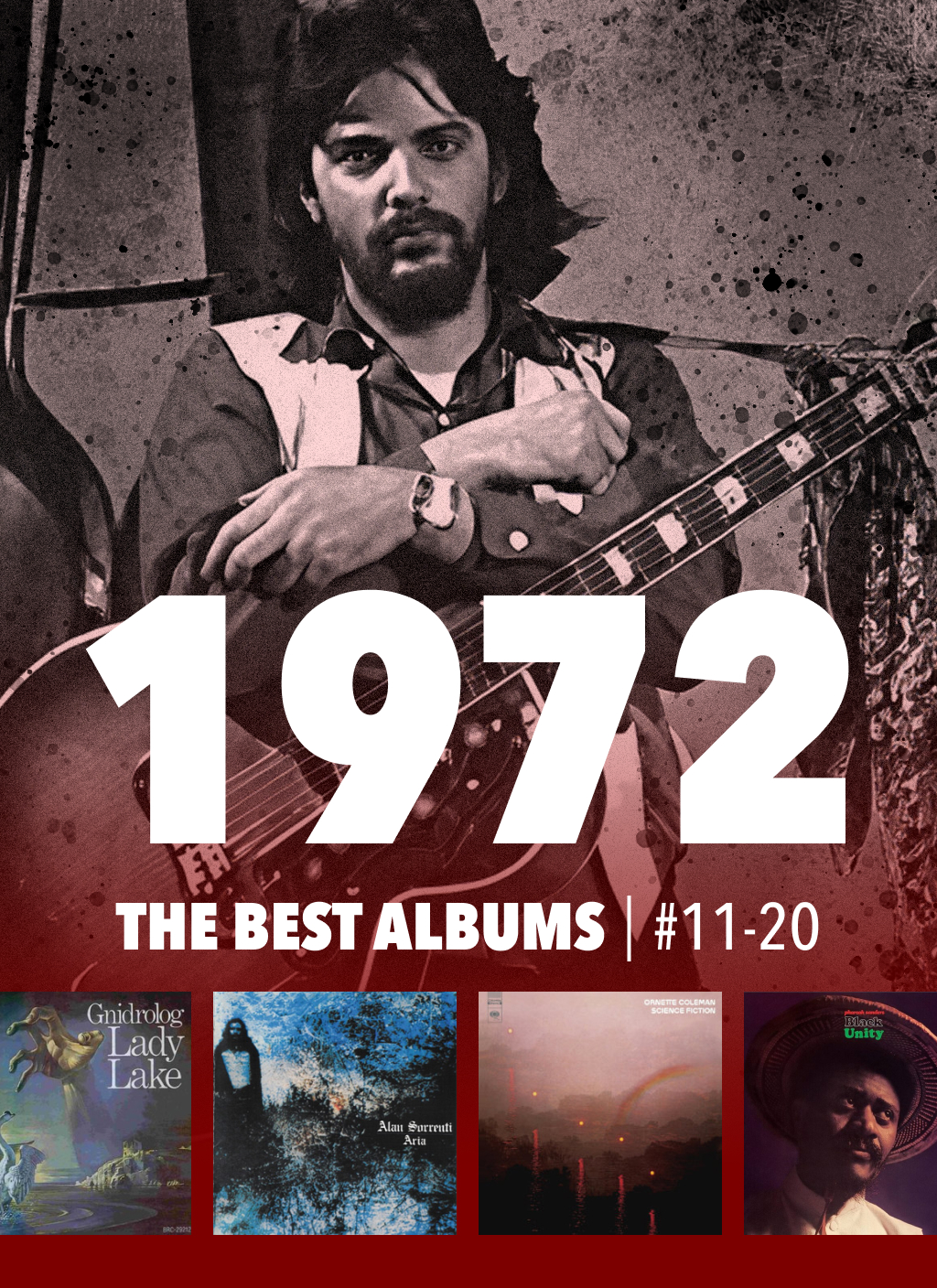
The author’s picks for the best albums of 1972, ranked 11-20.
In the Year by Year series, I’ll go through my favourite albums from 1969 to the present day.
- Alan Sorrenti: Aria ****½
- Ornette Coleman: Science Fiction ****½
- Pharoah Sanders : Black Unity (US) ****½
- Gnidrolog: Lady Lake ****
- Matching Mole : Little Red Record (UK) ****
- Frank Zappa: The Grand Wazoo ****
- Pekka Pohjola: Pihkasilmä kaarnakorva ****
- Banco del Mutuo Soccorso: Darwin! ****
- Gentle Giant: Three Friends (UK) ****
- Banco del Mutuo Soccorso: s/t ****
11. Alan Sorrenti : Aria

Aria is the debut album by the Neapolitan singer/composer Alan Sorrenti. And although I haven’t heard nearly all of his more than a dozen albums, it is by general consensus by far Sorrenti’s best and most progressive. Later in his career, Sorrenti started making disco music and even ended up representing Italy in the Eurovision Song Contest in 1980.
But let’s quickly shake off the horrors of the Eurovision Song Contest and return to Sorrenti’s fine debut album Aria.
Aria is gorgeous and very very emotional and theatrical singer-songwriter prog. The songs on the album are dark in tone and have a claustrophobic, oppressive feel…
12. Ornette Coleman: Science Fiction

Science Fiction is one of the most highly regarded albums by saxophonist Ornette Coleman, who began his career in the 1950s, and it is definitely my favourite of all the albums I have heard by Coleman. I must admit that there are many I have not heard.
Ornette Coleman is known for his fiery and sometimes downright furious free jazz. Science Fiction is generally not quite as intense as Coleman’s usual work, and the songs also feel relatively clear and, at least in part, premeditated. This impression is reinforced by the modest length of the tracks, which vary from three to six minutes.
The album begins gently with the beautiful song ‘What Reason Could I Give,’ sung by Indian-born Ashra Puthlin. Puthlin also sings on another track, and these lighter moments provide a pleasant contrast to the otherwise wild vibe of the album. However, I think ‘What Reason Could I Give’ would have worked better as a contrast somewhere else on the album rather than as the opening track.
On the second track, which represents the album’s more typical direction, the agile rhythm section of bassist Charles Hayden and drummer Billy Higgins make a big impression with their fast-paced and nimble playing on what is perhaps the album’s best song, ‘Civilization Day’. Coleman’s typically boisterous saxophone and trumpet playing is, of course, wonderful to hear throughout the album.
The title track effectively uses a baby’s cries and speech to create a disturbing atmosphere, accompanied by chaotic music.
Science Fiction is a magnificent avant-garde jazz album that never becomes too abstract or chaotic.
Best tracks: ”Civilization Day”, ”Street Woman”
13. Pharoah Sanders : Black Unity

Black Unity is Pharoah Sanders’ seventh album as band leader.
Saxophonist Pharoah Sanders (1940–2022) earned his stripes in John Coltrane’s band and went on to become one of the most important pioneers of free jazz and spiritual jazz.
Recorded with a large, eight-piece ensemble, Black Unity represents Sanders’ freer and more collective phase. The album combines free jazz, Afro-Cuban rhythms, spirituality and even funk influences. Entirely acoustic, Black Unity is a hypnotic and pulsating tapestry in which repeating riffs and rhythms carry the music forward, fuelled by the collective energy of the large ensemble.
The album consists of a single, approximately 37-minute track, which has been divided into two parts due to the limitations of vinyl.
Black Unity’s music is not pure free jazz, but a mixture of composed sections and collective improvisation. In particular, the patterns woven by the two bassists, Stanley Clarke and Cecil McBee, seem to be pre-composed and arranged. Perhaps some of the overlapping polyrhythmic drum patterns of the two drummers, Norman Connors and Billy Hart, are also pre-determined. On top of this often hectic rhythmic foundation, Sanders, saxophonist Carlos Garnett, trumpeter Marvin Peterson, pianist Joe Bonner and two percussionists, Lawerence Killian and Chief Bey, build their improvisations, which form a breathing organism in constant motion. Black Unity’s music is a delicious combination of hypnotic repetition and wild, controlled chaos.
Black Unity is one of Sanders’ finest albums and proof of how great music collective improvisation can be at its best when the boundaries are set in the right way.
Best track: ”Black Unity Part One”
14. Gnidrolog: Lady Lake

Brothers Colin and Stewart Goldring founded Gnidrolog back in 1969, but the band’s debut album wasn’t released until April 1972. After that, things moved quickly, with their second album, Lady Lake, appearing in December of the same year.
Lady Laken’s music shows influences from Van Der Graaf Generator, Gentle Giant and especially Jethro Tull. The Tull influence is particularly evident in the extensive use of flutes, but also in Stewart Goldring’s vivid electric guitar solos, which bring to mind Martin Barre. On the other hand, the rich instrumentation of the five-piece band, with its cello and various wind instruments, is reminiscent of Gentle Giant. The saxophones sometimes roar as aggressively as VdGG’s David Jackson. Gnidrolog does not use any keyboards, which makes it a relatively unusual prog band.
The Goldring brothers have cooked up a unique and truly delicious combination of the above influences. Lady Lake’s music combines catchy melodies and powerful instrumental parts with just the right amount of twists and turns, without ever becoming overly complex. Lead singer Colin Goldring (who also plays the flute and alto horn) has a pleasantly rough and distinctive voice with a slightly ‘sheepish’ vibrato.
The highlights of the album are the beautifully growing 11-minute ‘I Could Never Be A Soldier’ with its pacifist message and ‘Ship’ with its utterly charming and catchy chorus (why wasn’t this a hit?). The 9-minute instrumental title track is also excellent, with a great three-minute instrumental intro where the wind instruments take centre stage and the mood becomes quite jazzy.
The weakest track on the album is the last song, “Social Embarrassment”. It’s actually a pretty decent, slightly Gentle Giant-esque song, but it falls flat because, for some inexplicable reason, the lead vocals are handled by the band’s saxophonist, John Earle, who doesn’t do a very good job.
Both of Gnidrolog’s 1972 albums are solid efforts, but Lady Lake is clearly the stronger of the two, thanks to its more sophisticated style and more complex compositions.
Gnidrolog never achieved great popularity, remaining mainly a support act (for bands such as David Bowie, King Crimson, Magma, Gentle Giant, etc.). The band broke up shortly after Lady Lake and only reunited in 2000 to record their third album, Gnosis.
Best tracks: ”I Could Never Be A Soldier”, ”Ship”, ”Lady Lake”
15. Matching Mole: Little Red Record

The debut album by Robert Wyatt’s Matching Mole was released in April 1972 and in July of the same year the band returned to the studio to record their sophomore album, Little Red Record.
Dave Sinclair left the band after the release of their debut album and was replaced by keyboardist Dave MacRae. Otherwise the line-up remained the same, with Phil Miller on guitar, Bill MacCormick on bass and Robert Wyatt on drums and vocals. In 1972, the still relatively unknown Brian Eno played keyboards on one track ”Gloria Gloom” that starts in a slightly ambient way.
Robert Fripp of King Crimson was chosen as producer. The idea was bassist MacCormick’s, but Wyatt and Fripp had also crossed paths the previous year during the recording of Keith Tippett’s Centipede album, which Fripp produced and on which Wyatt drummed as part of the big band…
Read also:
- Year by Year: Best Albums of 2024
- Year by Year: Best Albums of 2024 – 11-20
- Year by Year: Best Albums of 2023
- Year by Year: Best Albums of 1972: 11-20
- Year by Year: Best Albums of 1972: 21-30
- Year by Year: Best Albums of 1971
- Year by Year: Best Albums of 1971: 11-27
- Year by Year: Best Albums of 1970: 1-10
- Year by Year: Best Albums of 1970: 11-22
- Year by Year: Best Albums of 1969
16. Frank Zappa: The Grand Wazoo

The Grand Wazoo is the eighth album by Frank Zappa, recorded with his backing band The Mothers.
An epic combination of big band jazz and progressive rock. The Grand Wazoo is a natural follow-up to Hot Rats (1969) and Waka/Jawaka (1972), but as a whole it is slightly stronger than either of the aforementioned albums.
The songs on The Grand Wazoon offer tasty grooves and virtuoso playing performed by really large ensembles. The 13-minute title track, which sounds almost orchestral in places, and ‘For Calvin’ feature nearly twenty musicians. The other tracks feature an eight-piece core group, which also manages to create a commendable racket. I’m not a big fan of Frank Zappa’s guitar playing, so I really like the fact that the lead role on this album is played by a large number of different wind instruments instead of the guitar.
As someone who dislikes Zappa’s humour, I am particularly delighted that The Grand Wazoo is almost entirely instrumental. The song ‘For Calvin’ briefly features the rather unique and entertaining vocals of Janet Neville-Ferguson, but Frank Zappa himself manages to refrain from his usual unfunny jokes for once. The listener can blissfully concentrate on the wonderful music without it being constantly interrupted by silly and childish banter. The album does offer some pleasant musical humour in the form of the funny song ‘Cletus Awreetus-Awrightus’, which also features amusing wordless vocals. The harpsichord-like sound of George Duke’s keyboards is also an important part of the song.
The Grand Wazoolle deserves praise for its excellent sound and distinctive mixing. The sound never gets muddled, even in the most massive passages. Despite its clarity, the album never sounds sterile, but warm and rounded. Excellent work for a 1972 recording.
Although The Grand Wazoo is one of Zappa’s absolute best albums, the problem with this one is that it doesn’t touch me in any deeper way. The music is technically impressive and entertaining in many ways, but it doesn’t evoke any deep feelings. In my opinion, this is typical of Zappa’s music. Even Zappa’s cynical and humorous banter, which fortunately is not heard on this album, seems to be aimed more at making Zappa himself laugh than at entertaining the audience.
The Grand Wazoo is an excellent choice for those interested in Zappa’s music who don’t want stand-up comedy or endless guitar solos mixed in with their music.
Best tracks: ”The Grand Wazoo” ja ”Cletus Awreetus-Awrightus”
17. Pekka Pohjola: Pihkasilmä kaarnakorva

Pihkasilmä kaarnakorva is the first solo album by bassist/composer Pekka Pohjola, who had previously made a name for himself in Wigwam.
Bass virtuoso Pekka Pohjola (1952-2008) was still playing in Wigwam at the time of the Pihkasilmä kaarnakorva. In Wigwam, Pohjola had not got (or taken) much space as a composer, although the few songs he had composed for the band had already shown that he had skills in that area too. With Pihkasilmä kaarnakorva, Pohjola’s idiosyncratic style continues to take shape, although the influence of his idol Frank Zappa is still very much in evidence on several tracks.
The fully instrumental, upbeat and often rather complex music of the bushy-eyed bark-eared eagle sounds very friendly and approachable throughout. There was also something very Finnish sounding in Pohjola’s music already on this album…
18. Banco del Mutuo Soccorso: Darwin!

Italian band Banco del Mutuo Soccorso released this second studio album, Darwin!, only about six months after their debut. Founded in 1969, BMS is one of the three best-known Italian prog bands. Whereas the first albums by Premiata Forneria Marconi and Le Orme were strongly influenced by certain British bands in the genre, BMS was from the outset a little more idiosyncratic in its rough, ornate operatic style.
As the album title suggests, this is a concept album about the legendary natural scientist Charles Robert Darwin (1809–1882) and, more generally, the theory of evolution. However, due to my limited language skills, it remains a mystery to me how well Banco utilises this theme in its Italian lyrics.
Stylistically, Darwin! continues largely in the vein of their debut, with music that is still richly intricate and colourfully ornamental. The music on Darwin! is perhaps a little more complex than on the debut album, and a new sound is brought to the album by the synthesiser acquired by the band’s second keyboardist, Vincenti Nocenzi, who unfortunately conjures up some rather jarring sounds at times. Fortunately, the Nocenzi brothers, who are responsible for most of the keyboards, generally stick to the piano and organ.
Banco is definitely not shy on Darwin! instead, they splash ideas into their songs at such a pace that it’s terrifying for the faint-hearted. And sometimes, less would have been enough. But among those ideas there are also some truly delicious moments, even if they don’t always form a coherent whole.
The nine-minute ‘La conquista della posizione eretta’, which begins with an instrumental section lasting almost six minutes, is the highlight of the album. When the Demis Roussos lookalike Francesco Di Giacomo finally starts singing, it’s even a bit anticlimactic. On this album, Di Giacomo’s dramatic and emotional vocals slowly start to get a bit over the top. Fortunately, this is only momentary, and he does sing beautifully at times, such as in the song ‘Cento mani e cento occhi’, which ends with a fun umma-hummah chant reminiscent of the strange vocal parts in Ennio Morricone’s western scores.
Another highlight of the album is the short, jazzy three-minute instrumental piece ‘Danza dei grandi rettili’ (‘Dance of the Great Reptiles’), which is a nice light interlude between all the heavy stuff and offers a welcome break from Di Giacomo’s vocals.
Darwin! is a worthy follow-up to their debut album, and these two albums are very evenly matched, but in my opinion, Darwin! is just that little bit better.
Best tracks: ”La conquista della posizione eretta”, ”Danza dei grandi rettili”
19. Gentle Giant: Three Friends

Three Friends is Gentle Giant’s third album and the band’s first concept album. The theme of the album is three school friends whogrew up and went into different career paths. One became a businessman, another a labourer and the third an artist. The concept is loose, but it does provide some kind of framework for songs that work perfectly on their own.
Musically, Three Friends is not quite as eclectic and experimental as its predecessor, Acquiring The Taste. On average, the album is a little more rock-oriented and less ambiguous. The arrangements are more straightforward and less rich in instrumentation than before. Of course, even the music on Three Friends is miles away from average rock in terms of complexity.
With the exception of the drummer, the band’s line-up remained the same as before. New drummer Malcolm Mortimore does a decent job on the album, but he is nowhere near as interesting and creative a player as his predecessor Martin Smith. Smith was apparently let go mainly because he didn’t get along with the band’s unofficial leader, Phil Shulman (saxophones, vocals). Mortimer’s time with the band was short-lived, as he was injured in a motorcycle accident shortly after the completion of Three Friends. Smith was not permanently disabled, but due to touring commitments, GG hired John Weathers to fill in. Things worked out so well with him that Weathers was soon made a permanent member of the band. This was unfortunate for Mortimer, but good news for the band and their fans, as Weathers turned out to be the perfect drummer for Gentle Giant. Mortimer returned to Gentle Giant’s music in the 2000s, playing in a spin-off band called Three Friends, which also featured Gary Green and Kerry Minnear at times.
The highlight of Three Friends is the powerful, mostly instrumental opening track ‘Prologue’, which introduces the themes of the later songs, and the lighter ‘Schooldays’, which effectively utilises the band’s trademark polyphonic vocals. The versatile ‘Mister Class And Quality?’ is also a great song for the most part, but it is slightly marred by drummer Mortimer’s occasionally tedious drumming.
The weakest track is ‘Peel The Paint’, where Derek Shulmann’s ‘hard rock vocals’ are a little uncomfortable to listen to, and Gary Green’s electric guitar riffs in the instrumental section and the uninspiring middle section don’t really get you going.
Unlike the two previous albums, which were produced by Tony Visconti, Gentle Giant did the job themselves with Three Friends. Not necessarily a smart move, as the album sounds somewhat muddier and duller than its predecessor, Acquiring The Taste.
The cover art is also a bit of a mess, with Rick Breach’s original painting of three vaguely scribbled figures crouching around a seagull being rather creepy. In the United States and Canada, the album was released with a slightly modified version of the debut album cover. A strange decision, to say the least.
Three Friends is a worthy album, but a slight disappointment after the magnificent Acquiring The Taste. However, Three Friends was slightly more successful than its predecessors and even made it onto the US album charts for the first time. Admittedly, it only reached a modest 197th place.
Three Friends was the last album featuring Phil, the eldest of the Shulman brothers. Phil Shulman had been something of a leader in the band, but his career came to an end due to an embarrassing incident involving a groupie. In a band like Gentle Giant, such behaviour was frowned upon for a family man, and Phil Shulman left the band to save his marriage.
Best tracks: ”Prologue”, ”Schooldays”
20. Banco del Mutuo Soccorso: s/t
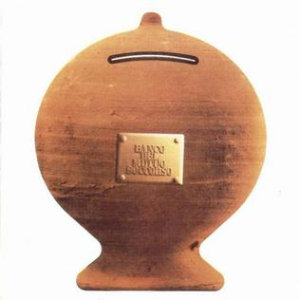
Founded in 1969, Italian band Banco del Mutuo Soccorso released their untitled debut album in May 1971 and followed it up with their second album, Darwin!, in December of the same year.
Banco del Mutuo Soccorso’s eponymous debut album is energetic and rough symphonic and very dramatic prog. The double keyboards of the Nocenzi brothers, who founded the band, dominate the sound, but electric guitarist Marcello Todaroki also gets some space. The passionate vocalist Francesco Di Giacomo mostly keeps himself in check on this album, unlike on some of Banco’s later albums, where the expression of the man hidden behind his giant beard often comes across as a little too grandiose.
The long 18-minute track ‘Il Giardino del Mago’ has some filler and the album has a slightly muddy sound, but otherwise it’s an excellent and energetic debut.
Best tracks: ”R.I.P. (Requiescant in pace)”
Author: JANNE YLIRUUSI
You can find other parts of the Year by Year series here.
 Pienemmät Purot
Jätä kommentti