John Zorn was born on 2 September 1953 in New York. Zorn became interested in music at a young age and chose the saxophone as his instrument as a teenager. He studied music at Webster College in Missouri and later composition at Columbia University in New York.
Zorn is an extremely prolific composer, and is particularly known for his ability to blend different musical styles and genres. Zorn’s repertoire includes chamber music, orchestral works, solo works and film music. He has also led many ensembles, most famously Naked City and Masada. What is typical of Zorn’s ensembles is that each of them takes a different direction, although avant-garde jazz is usually a particular point of interest for him.
Zorn has been a central figure in the so-called New York downtown scene, where he has collaborated with many avant-garde and experimental musicians. This scene has been a truly fertile hub of creativity and cross-pollination of artists. The downtown scene, which flourished particularly in the 80s, has been characterised by bold avant-garde experimentation, an unprejudiced mix of styles and a strong DIY culture. Alongside Zorn, the downtown scene has seen the emergence of Laurie Anderson, Glenn Branca, Bill Laswell, Sonic Youth, Swans, Bill Frisell and British defector Fred Frith.
The latter two are also featured in Zorn’s Naked City. Naked City is an album credited to saxophonist John Zorn, but it is in fact the debut album of the band of the same name. Alongside guitarist Frisell and Frith, who chose to play bass guitar as a secondary instrument, the band features drummer Joey Baron and keyboardist Wayne Horvitz. Vocalist Yamatsuka Eye also roars and screams wildly on a few songs on the debut album. To Frith’s credit, it’s quite an achievement to be able to hold his own on his second instrument in this group of jazz monsters!

Zorn founded Naked City as a workshop to stretch the boundaries of rock bands. And this workshop soon became a real band that really nailed it! Frith, who played bass in Naked City, had previously been part of a band called Henry Cow, who in the 1970s were pushing the boundaries of rock in their own unique way. Naked City did the same thing ten years later, but with very different results and methods.
Whereas Henry Cow’s approach was to bring art music modernism to rock music, Zorn’ s Naked City sought to take 1950s/60s rock and film music into the future by mixing not only avant-garde jazz but also the grindcore scene (a kind of fusion of metal and hardcore punk) that emerged in the mid-1980s. Naked City’s music often sounds as if Ornette Coleman’s band had joined forces with Napalm Death to play surf rock and old jazz.
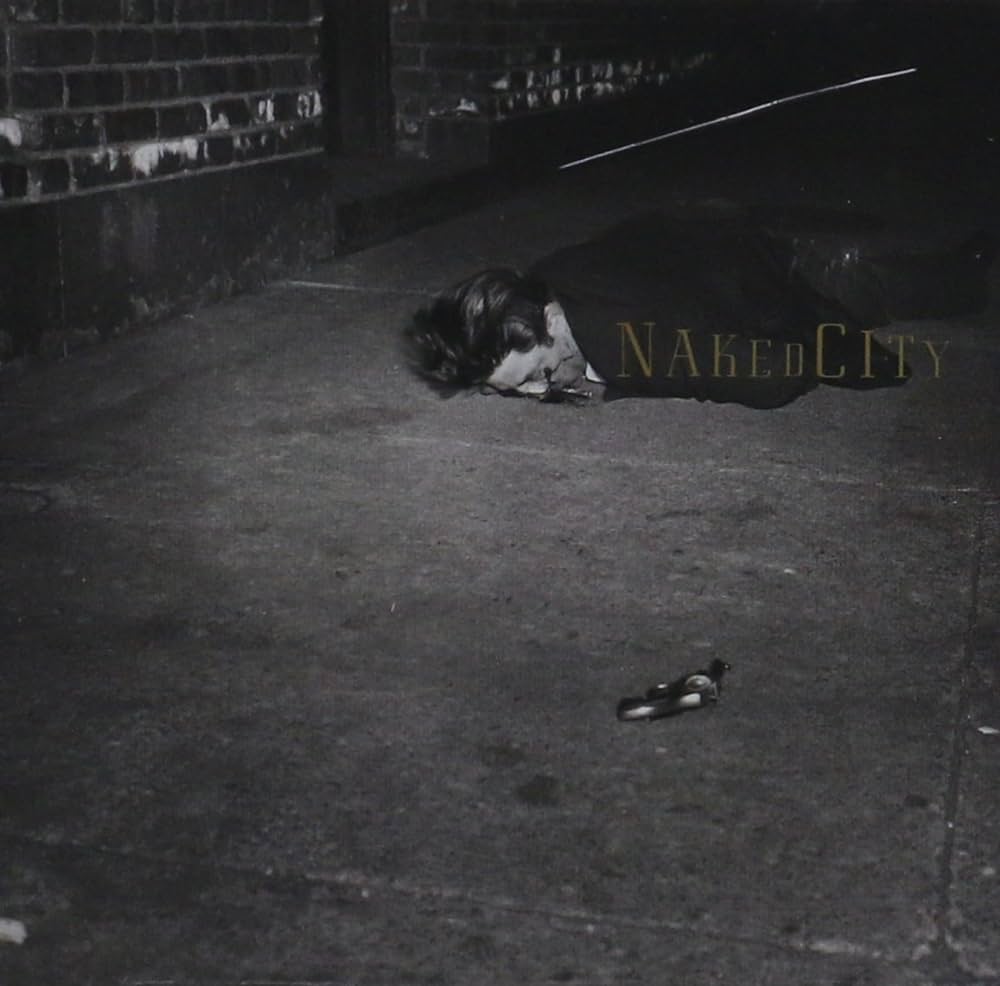
The band’s name was taken from a book of the same name published in 1945 by photojournalist/street photographer Weegee (real name Arthur Fellig 1899 – 1968), which compiled photos of his. The cover of Naked City is adorned with Weegee’s stark black and white photograph of a gangster shot in the face and lying on the ground bleeding. In a way, the cover is a good illustration of the violent atmosphere of the album’s music. On the other hand, I personally experience the music of Naked City as anything but black and white. The blood splatters of Zorn’s scathing music are even exaggeratedly bright red!
From the splash of blood we move swiftly to the film reference I have invented for the music of Naked City. I see it as a strong musical counterpart to Quentin Tarantino’s films. Tarantino twists his own unique vision through the conventions and clichés of cinematic history, in the same way that Zorn forces through the meat grinder a myriad of genres from jazz to grindcore and surf-rock to film music. While Zorn’s music is violent, it is not dark or oppressive, but has a similar detached feel to Tarantino’s films. Everything is experienced through a lightening filter of humour. Zorn and Tarantino are also linked by various small cross-artistic references to popular culture. And of course both auteurs have a great appreciation for the music of Ennio Morricone! Both gentlemen have used Morricone’s music as part of their own works (of course, Tarantino later commissioned Morricone to compose new music for him as well).
Where Zorn and Tarantino differ significantly is the pace of ”storytelling”. Whereas Tarantino’s films are sometimes very lingering (although I would still argue that some of the songs in Naked City would fit well in the background of the Kill Bill films), Zorn’s music almost constantly rushes forward at a tremendous pace. Zorn doesn’t bother to develop long themes, but Naked City’s songs surge forward like a jump-cut avant-garde short film. Although the transitions from one section to the next are often abrupt, they are nevertheless surprisingly smooth. Much of the credit for this must also go to Zorn’s virtuosic band, which effortlessly negotiates the fast-paced songs with their sudden changes and pauses. But there was hard work in the background. Naked City trained hard and had a strong work ethic. Frith has said that the band played at least one brand new song at every gig.
The main inspiration for the fast pacing and abrupt transitions was the fast-changing scores of old cartoons. Carl Stalling, who composed the music for many Warner Bros. cartoons, was one of Zorn’s greatest heroes.
Read also: John Zorn – Multiplicities II: A Repository Of Non-Existent Objects (2023)
Naked City’s debut consists of 26 short songs. A few of the longer songs exceed the four-minute mark, but the more typical length is a couple of minutes or less. The shortest song, ”Hammerhead”, lasts only 11 seconds! Most of the compositions are by Zorn, but there are seven covers, most of which are film compositions. The most famous are Jerry Goldsmith’s theme to Chinatown and John Barry’s James Bond theme.
I’m not going to go through every one of the 26 songs on the album, but I want to mention a few of my particular favourites.
For me, the highlights are ”Batman”, ”Sicilian Clan”, ”James Bond”, ”Latin Quarter”, ”Chinatown” and ”Punk China Doll”.
The album’s upbeat opener ”Batman” (which has nothing to do with real Batman tunes, by the way, but is actually more reminiscent of a Peter Gunn theme) is virtuosically played and turbo-charged surf rock with a screeching saxophone.
The gentler side of Naked City is successfully represented by ”Sicilian Clan”, which is surprisingly upbeat, but still a nice update of Morricone’s original. Zorn’s saxophone sounds beautifully wistful alongside Frisell’s cleanly strummed electric guitar. ”James Bond” is a successful cover as well. It smoothly combines John Barry’s familiar agent theme with Zorn’s blaring, ripping saxophone and a chaotic mid-tempo metal section.
”Latin Quarters”, a more relaxed take on the 50’s rock ’n’ roll style, which tastefully highlights keyboardist Horvitz’s piano, is also a very enjoyable listen. The four-minute song seems to have had a bit of improvisation in it.
”Chinatown” is, along with ”Sicilian Clan”, the album’s most tender offering. Zorn blows his horn in a warm melodic way and the rest of the band plays so nicely in the background that not even the blue-haired ladies on cruise ships with their succulent drinks in their hands would be frightened. The genius of ”Chinatown” is that the very aggressive grindcore grind ”Punk China Doll” that immediately follows sounds even more ferocious.
Read also
- Levyarvio: Steve Walsh – Glossolalia (2000)
- Year by Year : Best Albums of 1976 – 21-29
- Levyarvio: Jimmy Page – Outrider (1988)
- Review: Brian Eno + David Byrne – My Life in the Bush of Ghosts (1981)
- Levyarvio: Gong – Zero To Infinity (2000)
- Review: Michael Oldfield – Heaven’s Open (1991)
An uninitiated listener might mistake Naked City’s music for pure free jazz or just plain creepy mayhem, depending on their own preferences, but in fact most of the songs are very tightly composed. A good example of this is the half-crazy sounding ”You Will Be Shot” which is full of rapidly changing sections that can’t possibly be the result of improvisation. In fact, one online commentator has interpreted the song’s structure as ABABCBABABABCBCBABA. Quite insane considering that the song only lasts a minute and a half!
Naked City was active until 1993, releasing no less than six studio albums during its short amok run.
Best tracks: Batman”, ”Sicilian Clan”, ”James Bond”, ”Latin Quarter”, ”Chinatown” ja ”Punk China Doll”
Kirjoittaja: JANNE YLIRUUSI
Read also: John Zorn – New Masada Quartet, Vol. 3 (2024)
Tracks
- ”Batman” 1:58
- ”The Sicilian Clan” Ennio Morricone 3:27
- ”You Will Be Shot” 1:29
- ”Latin Quarter” 4:05
- ”A Shot in the Dark” Henry Mancini 3:09
- ”Reanimator” 1:34
- ”Snagglepuss” 2:20
- ”I Want to Live” Johnny Mandel 2:08
- ”Lonely Woman” Ornette Coleman 2:38
- ”Igneous Ejaculation” 0:20
- ”Blood Duster” 0:13
- ”Hammerhead” 0:08
- ”Demon Sanctuary” 0:38
- ”Obeah Man” 0:17
- ”Ujaku” 0:27
- ”Fuck the Facts” 0:11
- ”Speedball” 0:37
- ”Chinatown” Jerry Goldsmith 4:23
- ”Punk China Doll” 3:01
- ”N.Y. Flat Top Box” 0:43
- ”Saigon Pickup” 4:46
- ”The James Bond Theme” John Barry 3:02
- ”Den of Sins” 1:08
- ”Contempt” Georges Delerue 2:49
- ”Graveyard Shift” 3:25
- ”Inside Straight” 4:10
Musicians
John Zorn: alto saxophone Bill Frisell: guitar Fred Frith: bass guitar Joey Baron: drums Wayne Horvitz: keyboards Yamatsuka Eye: vocals
 Pienemmät Purot
Jätä kommentti