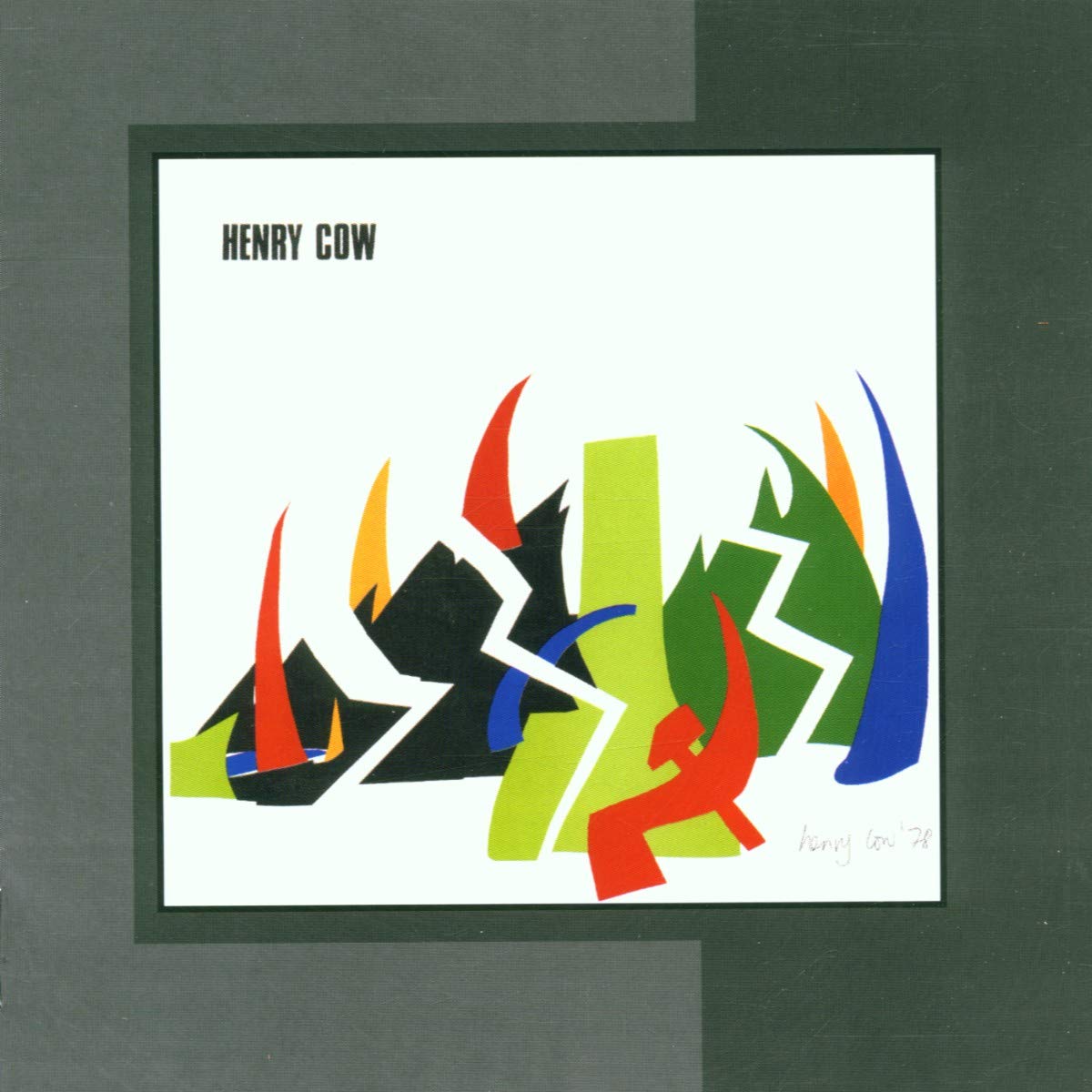
Western Culture is Henry Cow’s fifth studio album.
(Note: The first very small edition of Western Culture reached the shelves already in 1978, but as the album was not widely distributed until 1979 I decided to treat it as that year’s album.)
Founded in 1968 at Cambridge University, Henry Cow (a name taken from composer Henry Cowell) had made five serious and uncompromising avant- prog albums before Western Culture. This, the band’s latest album, may well be their most musically challenging work to date.
Western Culture is in a way a requiem not only for Western culture (Henry Cow, who was strongly left-leaning, did not see its future bright in the late 70s), but also for Henry Cow himself, as the band had decided to call it quits already in 1978 with the sessions of the Hopes And Fears album. Hopes And Fears was to have been Henry Cow’s fifth studio album, but artistic conflicts broke the band up and it was eventually released as an album by Fred Frith, Chris Cutler and Dagmar Krause’s new band Art Bears. At this point, it was also decided to end Henry Cow as long as the band fulfilled its obligations for the concerts already scheduled. The band also decided to make one last studio album.
Countercurrent rock music: Rock In Opposition
Before recording his studio farewells, Henry Cow organised the first Rock In Opposition festival under the direction of Cutler in March 1978. The London concert invited avant-garde inclined rock bands from all over Europe that Henry Cow’s members had met on tour. At the same time, a loose Rock In Opposition organisation was formed, whose first members, in addition to Henry Cow, were Stormy Six (Italy), Samla Mammas Manna (Sweden), Univers Zero (Belgium) Etron Fou Leloublan (France). In the next wave, Art Bears, Aksak Maboul (Belgium) and Art Zoyd (France) were added to the RIO. RIO was intended to be a kind of cooperation network for like-minded bands outside the music industry. The criteria for membership were as follows:
- The band had to be musically excellent/superior (as defined by the bands already admitted)
- The band had to be active outside the music industry
- The band had to be ”socially committed” to rock music
The official RIO organisation did not last more than a few years, but has survived as a kind of genre definition, although that was by no means the original intention. Today, RIO is practically synonymous with the term ”avant- prog”, which I prefer.
In 2007, a new Rock In Opposition festival was also established in France, but it has no direct link with the original RIO organisation, although many of the original RIO bands have performed at the festival over the years. Cutler set up his own experimental music label, Recommended Records (from 1989 RēR Megacorp), at the same time as the first RIO festival and Cutler sees the catalogue of that label as a kind of virtual extension of the RIO movement.
Western Culture
Western Culture was recorded and mixed in Switzerland over a two-week period in the summer of 1978. The same Sunrise Studios operated by Etienne Conodi was used where Hopes And Fears was recorded at the beginning of that year. One track from the Hopes And Fears sessions was saved for the album, ”½ the Sky”, composed by Lindsay Cooper and Tim Hodgkinson. The song was necessary because the band was in a hurry to write songs and this time they didn’t want to improvise the material as they had done so many times before.
Hopes And Fears was dominated by songs written by Frith and Cutler so it was decided to make Western Culture an instrumental album. In part, the instrumentality was also a practical necessity as the band had lost Dagmar Krause due to her health problems. To replace Krause, Henry Cow had courted Magma’s vocalist Klaus Blasquiz, but the invitations were not successful. With Blasquiz, Henry Cow would probably have finally recorded Tim Hodgkinson’s epic and extremely complex ”Erk Gah” which had been in the band’s repertoire for years. In the end, the album was built around a suites of two album sides. This time, the entire album was the work of Hodgkinson, who had been sidelined on Hopes And Fears, and Lindsay Cooper, a wind player making her compositional debut.
Henry Cow’s line-up also changed on Western Culture compared to Hopes And Fears. As already mentioned, Krause was no longer involved and bassist/singer Georgie Born was no longer invited due to personal conflicts. At Western Culture, Henry Cow’s line-up was reduced to a quartet for the first time. Hodkingson played keyboards and various wind instruments in the familiar style, Cutler continued as drummer/percussionist, Cooper as wind player and Frith took over the bass guitar this time as well as the guitars. Some bass patterns were also replaced by Cooper’s bassoon, which she called the ”air bass”. Western Culture also features a few guest players for the first time. In the past, Henry Cow had always been self-sufficient.
Henry Cow’s previous studio album In Praise Of Learning put lyrics at the heart of the album and was the band’s most explicitly political statement. For Western Culture, the politics take a back seat as the music is entirely instrumental. However, the only recognisable object on the semi-abstract and graphic cover by Cutler is a sickle and hammer. Combine this with the album title and especially the names of the songs on the A-side and it is clear where Henry Cow still stood.
But it is music, rather than politics, that is the main focus of Western Culture. Henry Cow’s music has always been far more complex than your average progressive rock (in the 70s the only real contenders were perhaps Frank Zappa and Gentle Giant), but this time the compositions feel even more challenging than before. On previous Henry Cow albums, the music had usually been a mix of composed and improvised, but now it was almost 100% through-composed, with the exception of some improvised solo parts. Apparently communicated almost entirely by notation to other musicians, the compositions are Henry Cow’s most academic music to date (with the possible exception of the currently unreleased ”Erk Gah”), sounding at least as much like modern art music as rock music. In fact, the only obvious connection to rock music is actually the band’s instrumentation. Western Culture is a fascinating album largely because it moves so smoothly in a unique no-man’s-land between progressive rock and art music.
As always, with Western Culture, Henry Cow strives for a natural sound. No gimmicks are used with effects, but the instruments are captured as authentically as possible. A bit like in jazz music. Western Culture sounds sharper and more defined than the band’s previous albums. On the other hand, the atmosphere is a little more sterile than before, probably because unlike Henry Cow’s previous albums, which were recorded mostly while the band played together ”live” in the studio, Western Culture was recorded instrument by instrument.
History And Prospects
The album opens with Hodkinson’s 18-minute, three-piece suite ”History And Prospects”, which is perhaps the band’s most austere and dense music to date.
”Industry”, which kicks off ”History And Prospects”, is reminiscent of Charles Chaplin’s film Modern Times (1936), in which his iconic tramp character is caught up in the cogs of the factory conveyor belt of the capitalist modern world. In its chaos, ”Industry” conjures up similar grotesque images of modern man as part of a relentlessly grinding machine with no room for humanity. The otherwise industrially clattering and banging ”Industry”, as its name suggests, is counterbalanced by the surprisingly warm and beautifully sounding woodwinds of Cooper. The heart of a man struggling against the machine is still beating. Cutler’s drumming in the song deserves a special mention. It is at once hyper-active and intense yet always supporting the ’story’ of the composition itself. Cutler is on fire throughout the album and his drum kit has never sounded so good in terms of recording technique. Changing its time signature dozens of times over its seven-minute duration, ”Industry” is a truly staggering start to the album.
Read also: Review: Henry Cow – Leg End (1973)
The ”second” part ”The Decay of Cities” begins with a complex intro played by Frith on a sharp-sounding steel-string acoustic guitar. The quieter and more minimalist track than the previous section brings the wistful wind instruments into the foreground one by one. Cutler’s drums rattle and clatter in the background as a reminder of the industrial atmosphere of the first movement. Amidst the peaceful moments, there are some really unnerving-sounding sudden jerky parts. The contrast is delicious. At the four-minute mark, the music becomes increasingly noisy and atonal, and it is easy to imagine the music describing the tragic collapse of a once-thriving metropolis, crushed by some catastrophe.
The third and final part ”On The Raft” starts with a fateful sound. Cutler’s deranged drum patterns (he doesn’t play a single clear repetition on the album) drive the mass of death played by the brass. The remnants of civilisation that survived the collapse of the previous track are floating on a small raft somewhere out there at the mercy of the elements. A large number of different wind instruments play chaotically in the piece, overlapping and interlacing to form an atonal mass of sound from which it is difficult to distinguish individual parts, but the whole is impressive. On ”History And Prospects” the role of the wind instruments is very big and Frith’s guitar in particular plays a very marginal role (e.g. the intro to ”The Decay Of Cities”) and Hodgkinson’s keyboards don’t really take the spotlight.
Although there is a clear break between each of the three parts of ”History And Prospects”, they form a coherent-sounding thematic whole. Admittedly, the actual narrative themes were tacked on after the fact, as Hodgkinson has admitted that the song titles were not invented until after the music was finished. Hodgkinson’s original compositions were ’pure music’ with no literal message. However, I think the music takes on an extra power from the names Cutler came up with, so seamlessly do they seem to fit together, even though there was no great plan behind the final synchronicity this time.
Day By Day
The B-side is filled with Lindsay Cooper’s 20-minute suite ”Day By Day”, divided into four parts. Cooper, who studied classical music at the Royal College Of Music, was the most formally qualified member of Henry Cow (according to Frith, Cooper has forgotten as much about music theory as all the other members of Henry Cow have ever learned), but ”Day By Day” was not only Cooper’s first composition for Henry Cow, but her first recorded composition in general. It is almost impossible to believe when listening to the music itself!
”Day By Day” is often referred to as the more melodic and lighter side of Western Culture, but I think that’s quite misleading considering how edgy Cooper’s music is as well. It does contain short (and very beautiful) melodic sections, but they often very quickly move to the other extreme in the midst of whirlwind chaos. A good example of this is the first part of ’Day By Day’, ’Falling Away’, which veers from charmingly melodic wind chords to hellish noise. The track also features some of Cutler’s most intense drumming on the whole album and some absolutely stunning bass playing from Frith. The end features a surprisingly old-fashioned jazzy clarinet solo, before the music effectively returns to the rather violent theme of the beginning.
The second movement of ”Gretel’s Tale” begins almost lyrically, but Cutler’s erratic drumming fights back and the peace is shattered forever when Swiss pianist Irène Schweizer is let loose. Schweizer’s chaotically sounding, highly avant-garde piano solo (Keith Tippett to the power of two?) is the most delicious solo on the whole album and I would have liked to listen to it for much longer. In fact, it’s possible that Schweizer’s piano solo is the only fully improvised moment on the album.
The third part ”Look Back” is an interlude of just over a minute, featuring Annemarie Roelofs on violin, the second guest on the album.
The fourth part ”½ the Sky” was co-written with Hodgkinson and recorded during the Hopes And Fears sessions, but was abandoned when the album became song-oriented. ”½ the Sky” takes its name from Chinese Communist Party leader Mao Zedong’s statement that ”women own half the sky”. ”½ the Sky” begins with a darkly majestic buzzing organ theme (and I wonder if Frith’s electric guitar is in the mix?) followed by a shimmering and shuddering electric guitar solo from Frith, after which a jerky skronking saxophone takes centre stage until Frith is let loose again. The song reaches something of an emotional climax at around the four-minute mark, after which the tempo picks up and the music turns into an avant-garde jazz-rock that recalls the music of Henry Cow from the band’s first album Leg End (1973). It’s almost as if the band, in their final minutes, are returning to their roots, as if closing a circle.
Cooper’s compositions seem more fragmentary than Hodgkinson’s music. They may not contain as natural a development, but their surprising twists and turns keep the listener constantly on his toes, and each new twist is a treat in itself, even if its significance to the whole may remain a mystery.
Western Culture is only 36 minutes long, but it offers such a wealth of musical ideas in a concise format that it certainly doesn’t feel too long. An hour of this kind of music would make you go nuts, but a generous half-hour serves as an inspiring injection of inspiration.
Read also: Review: Henry Cow – Unrest (1974)
After the culture
Hodgkinson himself has complained that Western Culture was too tame and that they didn’t ”go far enough”, which is rather amusing given the extreme uncompromising nature of the music on the album and the fact that rock music hasn’t really progressed much after 40 years compared to this Henry Cow swan song in terms of musical sophistication. On the other hand, when you listen to the avant-garde art music that Hodgkinson later composed, you kind of understand what he meant. Then again, a leap into such abstract music would have been too much and Western Culture succeeds precisely because it goes beyond the earlier Henry Cow music, but still sounds like Henry Cow music.
In all its sophistication, Western Culture feels like a kind of apex of 70s progressive rock. Or perhaps the pinnacle of progressive rock in general. Henry Cow seems to take his rock music as far as it can go and still be somehow recognisable as rock music. In the case of Western Culture, however, this is also somewhat questionable. However, it is noteworthy that Henry Cow did consider his own music to be rock music, as the third paragraph of the RIO criteria (see above) suggests. From the point of view of music theory, however, the link between Western Culture and rock remains largely at the level of instrumentation, which at least partly overlaps with the average rock band.
Henry Cow released only five studio albums during its existence and sold a pitifully small number of records (it is likely that all five albums sold less than 100 000 copies). However, Henry Cow’s extremely skilled and deeply thought-out music has inspired, beyond its sales figures, a large number of progressive musicians who have felt a longing to make music far beyond the boundaries of popular music. The so-called avant- prog genre is still doing well in 2024, even if, in terms of sales figures, it is still on the fringes of the fringe. Every year brings new and delicious openings in this field for new and old bands alike. Of course, Henry Cow was not the only band to give birth to avant-prog, but it is undoubtedly the single band that has most clearly influenced its form (or lack of form…). Perhaps the most obvious successors to Henry Cow’s work in the rich avant-proge scene have been The Muffins (USA), Thinking Plague (USA) and Yugen (IT), but an endless number of other notable bands have also drawn inspiration from the band’s output.
Although Henry Cow did not continue as a collective, its members have since worked together on several occasions and formed numerous new bands. Among the best known are the Feminist Improvising Group (Cooper), Skeleton Crew (Frith), Massacre (Frith), Cassiber (Cutler), News From Babel (Cutler, Cooper), The Science Group (Cutler) and Cosa Brava (Frith). In addition, almost every musician who has played at Henry Cow has also made a significant number of solo albums. The combined number of recordings by ex-Henry Cow members is in the hundreds and almost constitutes a sub-genre of experimental music in its own right. The band’s original bassist John Greaves has flirted with pop music on a few occasions, but otherwise the ex-Henry Cow members have worked mainly in an uncompromising way with experimental avant-garde music. Lindsay Cooper died of MS in 2013, Georgie Born went into academia in the early 80s and Dagmar Krause seems to have retired in recent years, but all the other former members of Henry Cow have continued to record and tour actively to this day.
Best tracks: ”Industry”, ”The Decay of Cities”, ”Falling Away”, ”½ the Sky”
Author: JANNE YLIRUUSI
Tracks
Side A
History And Prospects
- Industry (6:58)
- The Decay of Cities (6:56)
- On The Raft (4:01)
Side B
Day By Day
- Falling Away (7:39)
- Gretel’s Tale (3:58)
- Look Back (1:20)
- 1/2 the Sky (5:14)
Henry Cow
Tim Hodgkinson: organ, alto saxophone, clarinet, Hawaiian guitar (1,2), piano (3) Lindsay Cooper: bassoon, oboe, soprano saxophone, sopranino recorder Fred Frith: electric guitars, acoustic guitars, bass guitar, soprano saxophone (3) Chris Cutler: drums, electric drums, voices, piano (4), trumpet (3)
Vierailijat
Anne-Marie Roelofs: trombone, violin Irene Schweizer: piano (5)
 Pienemmät Purot
Jätä kommentti