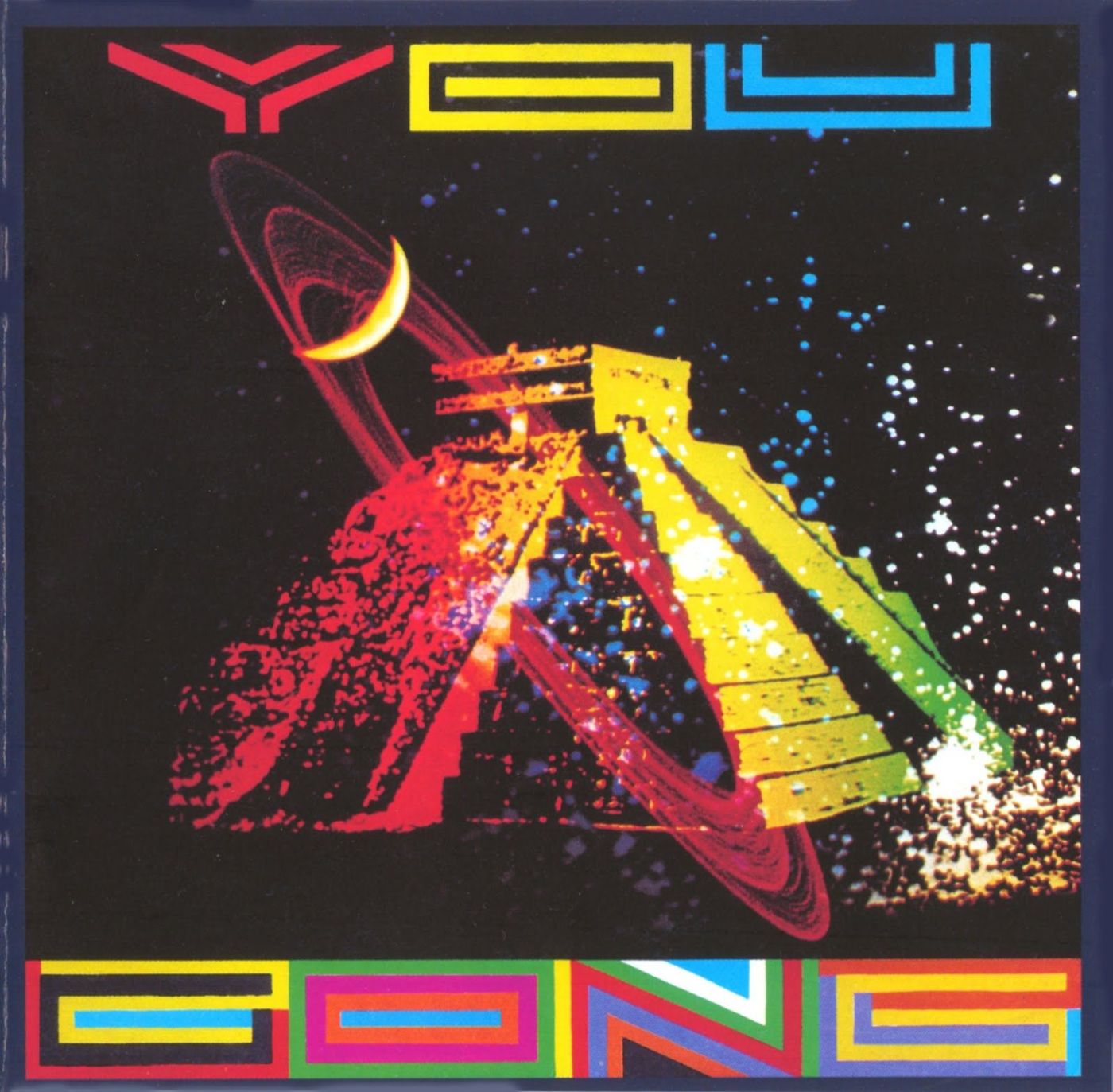
You is the fifth studio album by Gong, founded in 1968, and the final part of the Radio Gnome trilogy.
On You, Gong continues with the same line-up that played on the previous album Angel’s Egg (1973). This was very unusual for Gong, and this little bit of continuity clearly did the usually chaotic band good as You is the band’s first 100% success.

With You, the band achieves a fine balance between the humorous and psychedelic wackiness of founder vocalist/guitarist/visionary Daevid Allen (1938-2015) and the virtuosic jazz-rock direction of the rest of the band at this stage.
You’s songs are longer and more complex than before. Especially on the rhythmic side, the complexity has increased dramatically and the band plays with more skill and confidence than before. Especially the rhythm section of Mike Howlett (b.1950) and Pierre Moerlen (1952-2005) is on fire. Howlett anchors the music with his raucously rooted bass bouncing, which Moerlen is good at rocking on top of. Few bands have ever grooved so naturally in irregular time signatures as Gong did with their powerhouse rhythm buddies Howlett and Moerlen.
Moerlen’s style is a rather unique combination of the deep understanding of music that comes from classical training and the improvisational skills usually associated with jazz drummers. Moerlen hadn’t played rock music at all before joining Gong, but by the time he got to You, that side of things was also running smoothly. Moerlen’s peers that are on same skill level among 70s prog drummers are Christian Vander (Magma), Chris Cutler (Henry Cow) and Bill Bruford, who played in Yes and King Crimson. Bruford also played drums in Gong for a short time in 1974 after Moerlen left the band, again temporarily. And Moerlen himself made a short visit to Magma in the early 80s. Small circles! Good players tend to seek the company of other good players.
Moerlen, Howlett and Didier ”Bloomdido” Malherbe, who plays a wide range of wind instruments, were big Weather Report fans and wanted to take Gong in a more instrumental jazz-rock direction. On the other hand, virtuoso guitarist/super-hipster Steve Hillage and keyboardist Tim Blake still brought a strongly pulsating and slightly jammy spacerock spirit to the music. In fact, Hillage’s guitar playing played a much bigger role than before. This time, Hillage’s electric guitar playing, at turns relaxed and wild, plays a very prominent role in every song.
However, Blake’s role in the spacerock sound was perhaps even greater than Hillage’s, albeit more subtle. Tim Blake was not a typical Wakeman/Emerson school prog-virtuoso on keyboards, but was more inclined towards krautrock, creating various ”spacey” pulsations and buzzes from his synthesizers. Blake’s contributions on You are not necessarily the ones you would actively pay attention to, but they are ultimately a very essential part of the album’s sound. And it’s this sound that often sums up Gong’s style in people’s minds and was a very big influence on many bands to come, such as Ozric Tentacles and Hidria Spacefolk.
In addition to the musical direction, the band was also divided over drugs. Expanding consciousness chemically had always been an integral part of Gong’s activities and, with the exception of Pierre Moerlen (ironically, Moerlen sadly succumbed to hard drugs years later), the entire You line-up got high and dropped acid both for relaxation and artistic inspiration. However, Allen, who was a little more serious about the matter, came to the conclusion in the middle of the You recording sessions that drugs were an obstacle to the true spiritual enlightenment he was seeking. Allen decides to leave all drugs behind (though sometimes still relapsing) and encouraged the rest of the band to do the same. This surprising move by Allen divided the band. Hillage, Gilly Smyth and Howlett followed Allen, but Tim Blake in particular, whose drug use had escalated to speed, cocaine and heroin, became very annoyed and subsequently became very hostile to Allen.
The band would thus have been divided not only musically and philosophically (in Gong’s case, drugs can be included in this sector, as their use was not just escapism). Daevid Allen had to increasingly balance his own Pot Head Pixie mythology, which mixed psychedelia and Dadaism, between these two reinforced schools. There seemed to be no room for Allen’s lyrics at all as the rest of the band were so enthusiastic about their new tight instrumental sound which was undeniably effective.
Some members of the band would have even wanted Allen to shut up and leave the whole album instrumental. Tim Blake, in particular, was a strong proponent of this view and Moerlen was at least somewhat in line with it, though not as aggressively. Eventually, however, Allen managed to fight his way onto the album, supported in particular by Hillage, and Allen’s antics can be heard, especially in the few shorter tracks in the early part of the album.
Thematically, the final part of the Radio Gnome trilogy deals with the return of the story’s protagonist, Zero The Hero, from his journey (”trip”) to Planet Gong. Apparently Zero botched his trip by focusing too much on earthly pleasures, which also leads to the failure of his quest for enlightenment. Zero is tragically left to repeat the cycle of his endless reincarnations. Just like the rest of us (if you happen to believe roughly what Buddhists and Allen believe).
One of the key lyrical moments can be heard in the album-closing 11-minute psychedelic epic ”You Never Blow Your Trip Forever”:
But cha don’t have to give up hope
And ya don’t have to give up dope (until you do)
And ya don’t have to change your ways
You just
Have to
Be what you are my friends
Originally the second line was supposed to be ”And ya have to give up dope” reflecting Allen’s new perspective on drugs, but in the end I guess Allen was afraid of seeming hypocritical after years of fuming and decided that Zero, as a kind of anti-hero, was not supposed to be perfect and not succeed in his mission to achieve enlightenment.
In addition to a stronger jazz-rock element, the band’s sound is enriched by Malherbe’s increasing use of ethnic wind instruments and, on the other hand, by the lightly tinkling addition of tuned percussion. Both of these tendencies would only become stronger in Gong’s music in the future. Tuned percussion (vibraphone and marimba) is played on the album by Moerlen’s girlfriend Mireille Bauer and brother Benoit Moerlen as guests.
The album starts with three short vocal-centric tracks where Allen takes the listener back to the world of pot head pixies. The middle of these three tracks ”A P.H.P.’s Advice” contains mellow Balinese-influenced vibraphone runs that are also reminiscent of the early days of Gentle Giant. The third of these short tracks ”Magick Mother Invocation” is a ghostly track with Blake’s synths buzzing and Gilli Smyth ”space-whispering”, eventually the track seamlessly creeps into one of the highlights of the track, ”Master Builder”.
Allen and Smyth begin the song by chanting something vague, the music slowly builds in intensity until the song’s gorgeous and fierce riff kicks in. Malherbe honks wildly on saxophone and Moerlen drums with furious virtuosity, driving the song forward. Sometimes the song is interrupted by sudden stops and then the band keeps stomping effortlessly as if nothing had happened. Hillage plays three different guitar solos which, at times, are slightly overshadowed by Moerlen’s drumming in the mix.
The magical riff of ”Master Builder” is really addictive and became one of Gong’s trademarks. The song has since been covered by many bands such as Acid Mothers Temple and Steve Hillage also did his own instrumental interpretation of it called ”The Glorious Om Riff” for his solo album Green (1977). ’Master Builder’ originated during an acid ritual at sunset, but there is some mathematics involved in the song’s bohemian origins, as Allen explains that the rhythm of the song is chopped up according to the principles of Pythagorean numerology. So what does this mean? Perhaps just the normal arithmetic required to construct a more sophisticated rhythm?
Master Builder is one of Gong’s finest tracks, but the treat continues with the very next track, the excellent nine-minute ”A Sprinkling Of Clouds”. The track starts with a floating hypnotic swirl of synthesizers that continues for several minutes until the drums and bass finally come in at around four minutes, creating an absolutely amazing groove on the bottom with Tim Blake composing more various synthesizer patterns. Eventually the pace picks up as Steve Hillage plays psychedelically on top of, or actually as a natural part of, this great sound matrix, as the guitar solo is not particularly emphasised in the mix but is again an organic part of the whole. And so are Malherbe’s saxophones that get to buzz warmly in the very last minutes of the song. A really great song and perhaps the pinnacle of so-called progressive space rock!
”Clouds” is followed by the light and fun Allen/Smyth interlude ”Perfect Mystery” where the vibraphone (or maybe marimba?) makes a return.
The penultimate track on the album, ”The Isle Of Everywhere”, serves up a thick, warm groove that is brightened by Blake’s icy synth sounds and Smyth’s vocal flourishes. The groove doesn’t let up for a moment even though the song alternates between three different time signatures (6/8, 7/8, 4/4). Howlett’s bass sound is at its most delicious in this song and provides Malherbe with a great platform against which to solo with a variety of tasty wind instruments. The hypnotic ten minute track culminates in Hillage’s uninhibited guitar soloing.
There is still the closing track ”You Never Blow Yr Trip Forever” which is also the longest track on the album at over 11 minutes. This track also transitions seamlessly from the previous track and Gong deserves praise for these fine transitions as well, which are no easy feat to pull off. ”You Never Blow Yr Trip Forever” is perhaps the most seamless fusion of Allen’s trademark goofiness, space rock and the band’s new jazz-rock virtuosity. The song offers all three in fairly equal measure, but it’s still not up there with the best songs on the album, as the first half of the song is a bit sluggish at times. However, Howlett’s fierce bass riff kicks the song into gear after three minutes, and after that it’s pretty good until the end.
It’s a bit surprising how coherent and strong an album Gong managed to create together with producer Simon Heyworth after all the band’s conflicts. You is an amazing combination of psychedelic mischief, soaring space rock, jazz-rock flourishes and an incredible rhythm section that holds it all together and is one of the most accomplished in the 70s rock world.
In the end, however, Gong couldn’t handle all the drama and confrontation that came with the times and You could be seen as the album that tore apart the band’s most classic line-up ever, but at least the end result was worth all the pain.
The first to leave the band was Gilli Smyth. Smyth left the band to concentrate on her two young children (Allen and Smyth’s son Orlando was born just before the You sessions) and on her own music because, like Allen, she felt that what she had to offer would not be in demand in the band in the future.
The next to leave the band was Moerlen who was simply fed up with the chaotic way the band was operating. In a chain reaction, next up was Blake who started acting confused and violent and accusing Gill of witchcraft which drove Moerlen from the band. Blake’s drug use had at this point gotten completely out of hand and the man had become more erratic and even violent. Blake’s antics were tolerated for a surprisingly long time until he was finally sacked in February 1975 just before the tour.

Allen himself grew tired of the power struggles within the Gong a few months after Moerlen’s departure. There simply didn’t seem to be room for his views in the band anymore. On the other hand, without bitterness and with a touch of philosophy, Allen also felt that Hillage, whom he had regarded as a sort of apprentice, was now ready to continue his work as Gong’s leader.
The Gong story didn’t end with Allen’s departure, but on the contrary, soon the world was toured by several different Gongs featuring various ex-members of the band such as Mother Gong, Planet Gong, New York Gong and perhaps most famously Pierre Moerlen’s Gong who played pure jazz-rock instead of hazy psychedelia. Other Gong spin-offs such as Gongmaison and Acid Mother Gong were later to emerge. And, of course, in time Allen returned to the ”real” Gong brand.
Best tracks: ”Master Builder”, “A Sprinkling Of Clouds”, “The Isle Of Everywhere”
Author: JANNE YLIRUUSI
Read also: Review: The Soft Machine – Volume Two (1969)
Tracks:
Daevid Allen: vocals ja ”glissando” guitar Gilli Smyth: poems and space-whispering
Didier Malherbe: wind instruments and vocals Tim Blake: Moog ja EMS synthesizers and Mellotron Steve Hillage: guitar Mike Howlett: bass guitar Pierre Moerlen: drums, percussion
Other musicians:
Miquette Giraudy: vocals Mireille Bauer: percussion Benoit Moerlen: percussion
Producer: Simon Heyworth ja Gong
Label: Virgin
 Pienemmät Purot
a wonderful review that added depth to my knowledge of the background to one of my favourite albums of all time.
And yes amazing how natural and bouncy they were able to make those unusual time signatures sound.
My favourite Gong album and Side One is the absolute pinnacle.
thank you!
TykkääLiked by 1 henkilö
Thank you! I really appreciate your comment. 🙂
TykkääTykkää