
European Tour 1977 is composer Carla Bley’s (1936 – 2023) sixth album as leader of the band.
Carla Bley’s music is very difficult to categorise. It is a fascinating meeting of new and old. At times you feel like you are listening to some 1920s music and at the same time it is clear that of course it can’t be, both in terms of instrumentation and compositional techniques. Bley’s music can’t really be called ”just” jazz, but on the other hand it doesn’t quite fit under the heading of avant-garde either, because it so deliciously mixes strong melodicism with avant-garde techniques. On the other hand, Bley’s music also has moments of clear jazz-rock tones, if only because of the instrumentation, but on the other hand, the most obvious rock part of jazz-rock is usually missing. So Bley’s music is a real fusion where elements of art music (new and old), jazz and rock are thrown into the mixer and the result is something completely new.
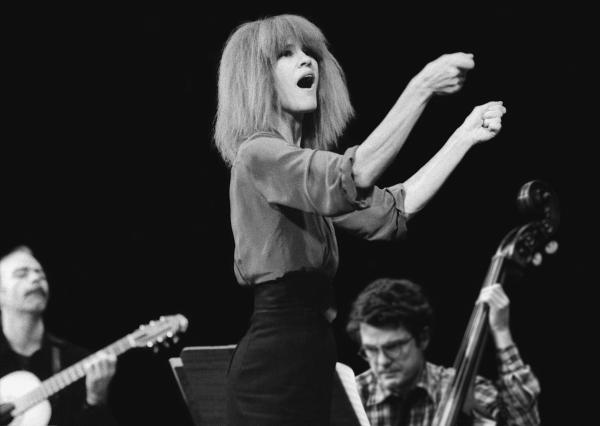
Despite its name, European Tour 1977 is not a live album, but was recorded in Munich at the Bavaria Musik Studios. Usually Bley recorded with her husband Michael Mantler (Bley and Mantler have since divorced) at his own Grog Kill studio in upstate New York, so perhaps this unusual recording trip to Europe inspired the album’s title.
And since it was recorded in Europe, the line-up of Bley’s band is also a bit unusual and lacks many of his regular players. For this album, Bley assembled a great new 10-piece band, half American and half European. Bley herself plays the organ (and some tenor saxophone) and is of course joined by her husband Michael Mantler, originally Austrian-born but now based in the US, composer/trumpeter. The American section is completed by trombonist Roswell Budd, tuba player Bob Stewart, pianist Terry Adams, avant-garde drummer Andrew Cyrille and French horn and electric guitarist John Clark (a different John Clark, I understand, from the one who replaced Allan Holdsworth in Bill Bruford’s band).
The European sector of the line-up is interestingly made up of avant-garde men with a Canterbury slant. There are two former Soft Machine members, Elton Dean, who plays alto saxophone with a vengeance, and Hugh Hopper, a bass guitarist known for his experiments with tape loops, who settles for a more traditional approach to bass on this album. The band is rounded off by the brash tenor saxophonist Gary Windo, who has played with many of England’s great progressive musicians such as Robert Wyatt and Keith Tippett.
So the band has no less than six full-time wind players and the album is a celebration of great wind instrument parts. Occasionally the band plays together in a big band style, but the British brass section in particular gets a number of great solo parts. Bley is adept at composing wind parts, but of course some of the solos are clearly improvised.
On an individual level, for me the instrumental forces that carry the album are Hopper’s laid-back but emphatic bass, Dean’s screaming alto sax and Windo’s screeching tenor sax, and Cyrille’s perky, rattling drumming. However, the whole band plays beautifully and even Bob Stewart’s tuba gets a few nice solo moments. Bley’s own organ playing may not be particularly virtuosic, but along with Hopper’s bass guitar and John Clark’s electric guitar, it too plays an important role as the only electric instrument in the line-up.
The compositional material of European Tour 1977 is somewhat uneven.
The A-side is really strong. The album starts with the 11 minute melodic ”Rose And Sad Song” which then grows into a very interesting collision of almost danceable music and avant-garde music.
”Wrong Key Donkey” is the best song on the album. It’s a powerfully pounding, intense tune that relies on Hopper’s hypnotic bass ostinato and at times recalls Soft Machine’s exploits from the band’s jazz period (i.e. the Fourth and Fifth albums). Dean and Windo’s riotously infectious saxophones are a delight to listen to.
The playful ”Drinking Music”, which ends the A-side, is also a fun track, with its croaking saxophone and old-fashioned bar piano. ”Drinking Music” is an old Bley composition and its predecessor was first heard on double bassist Charlie Haden’s Liberation Music Orchestra (1970).
The B-side is not as satisfying as the first half as it is filled with the more ambivalent ”Spangled Banner Minor and Other Patriotic Songs (Including Flags, And Now The Queen, King Korn And The New National Anthem)” which lasts over 19 minutes and doesn’t quite convince. True to its long title, ”Spangled Banner Minor and Other Patriotic Songs” rearranges a number of different patriotic anthems. Sometimes the themes of the different songs are intertwined with each other, which is a good example of how Bley uses avant-garde techniques in combination with very melodic material. The song contains many individual moments of great beauty, especially in the form of really wild solos by the wind players, but there is something very annoying about the clash of national anthem themes here and there throughout the song. Even though, of course, Bley, as a left-wing liberal, did not perform them in any idiotic patriotic sense.
Despite the somewhat frustrating epic ”Spangled Banner Minor and Other Patriotic Songs”, European Tour 1977 is one of my favourite albums by Carla Bley and a good example of her original way of combining different musical ingredients and genres.
Best songs: ”Rose And Sad Song”, ”Wrong Key Donkey”
Author: JANNE YLIRUUSI
Tracks
- ”Rose and Sad Song” – 11:11
- ”Wrong Key Donkey” – 7:52
- ”Drinking Music” – 4:26
- ”Spangled Banner Minor and Other Patriotic Songs” (Including Flags, And Now The Queen, King Korn And The New National Anthem) – 19:17
Musicians:
Carla Bley: organ, tenor saxophone Michael Mantler: trumpet Elton Dean: alto saxophone Gary Windo: tenor saxophone John Clark: French horn, guitar Roswell Rudd: trombone Bob Stewart: tuba Terry Adams: piano Hugh Hopper: bass guitar, bass drum Andrew Cyrille: drums
Producer: Carla Bley
Label: Watt / ECM

 Pienemmät Purot
Jätä kommentti