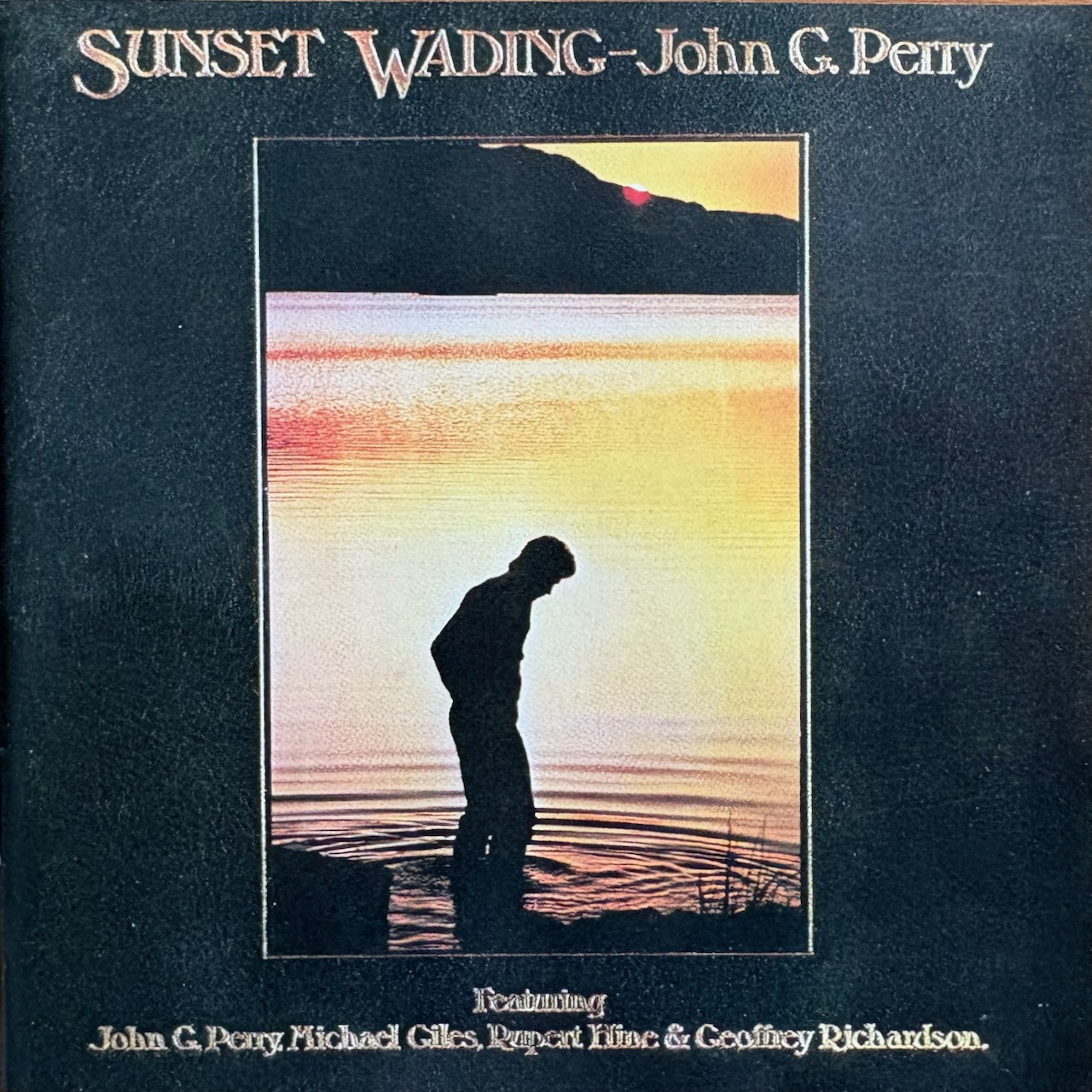
Sunset Wading is the first solo album by bassist John G. Perry.
John G. Perry is best known for his brief stint with Caravan, with whom he recorded two excellent albums, For Girls Who Grow Plump In The Night and Caravan & The New Symphonia.
After leaving Caravan, Perry worked extensively as a session musician for the young and up-and-coming producer Rupert Hine. Together with Rupert Hine, Perry also co-founded the band Quantum Jump, which released a rather excellent debut album blending prog and pop in 1976.
That same year, Perry was offered the chance to make a solo album as well. Naturally, his longtime friend Rupert Hine was chosen as the producer; he also plays all the keyboards on the album. They managed to recruit a rather impressive lineup of musicians. The drums are played by King Crimson’s original drummer Michael Giles, whose performances on this album are perhaps his most elegant since his Crimson days. Perry’s old Caravan buddy Geoffrey Richardson also plays an important role on the album, delivering fine violin parts throughout. Guitars are handled by Carrado Rusticci, who played in the Italian bands Cervello and Nova, and on percussion (including marimba and vibraphone) we have Morris Pert, known from Brand X.
Sunset Wading also features occasional appearances by a string quartet, whose parts were arranged by Simon Jeffes—who later founded the Penguin Cafe Orchestra—(he also plays koto on the album). For some reason, Roger Glover, the bassist of Deep Purple, also appears on one track, playing an ARP synthesizer that is barely audible.
Born out of a collaboration between an intriguing group of musicians, Sunset Wading is a unique blend of laid-back, warm pastoral vibes and more intense, slightly funky passages. This album, which evokes the atmosphere of the final days of late summer—at least for me—is almost entirely instrumental.
Read also:
- Review: John G. Perry – Sunset Wading (1976)
- Levyarvio: Black Sabbath – Master Of Reality (1971)
- Review: Henry Cow – Concerts (1976)
- Levyarvio: Spock’s Beard – V (2000)
- Review: Cos – Viva Boma (1976)
- Levyarvio: King Crimson – The ConstruKction Of Light (2000)
- Review: Camel – Moonmadness (1976)
- Review: Gong – Gazeuse! (1976)
- Review: Mike Johnson – The Gardens Of Loss (2026)
Most of the music on the album was composed by Perry, but other band members are also credited on a few tracks.
Sunset Wading certainly can’t be accused of being an album driven by the bass player’s ego, but Perry’s stylish bass playing certainly plays a central role.
Perry’s bass sound makes the album truly magnificent, but it makes the biggest impact on the track “Devoke Water”. Giles’ tight drumming gives the track a fantastic groove, which Perry complements with his warm, round-sounding bass, sometimes joining in on the groove and other times lightly soloing around it. Another key element of “Devoke Water” is Richardson’s impressionistic violin playing, which stylishly spices up the track here and there throughout the song. Not even Perry’s own vocal performance—which isn’t particularly strong—manages to detract from this magnificent track.
Some of the tracks on Sunset Wading could even be described as proto-new age, given their gentleness and serenity. You can even hear the bird songs and the lapping of water—clichés of that genre—used as sound effects here and there. Fortunately, however, the album as a whole doesn’t descend into overly bland drivel; instead, it offers enough contrasts, and even the most subdued tracks are always rich in musical detail. Besides, even those more New Age-like tracks work quite nicely as part of the whole.
Sunset Wading is also characterized by a certain pastoral quality. Listening to the album, it’s easy to imagine meadows glistening with dew and gently flowing streams cutting through them. However, Perry doesn’t immerse himself in rural romanticism as fully as, say, Mike Oldfield did on his early albums; instead, he occasionally weaves in a stimulating urban vibe.
Sunset Wading is beautiful and relaxing, yet it’s also music that stands up to close listening. Sunset Wading is by no means a jazz album, but I could imagine that many fans of the more laid-back ECM jazz albums would enjoy this as well. The album would likely also find fans among the aforementioned Oldfield fans. For me, Sunset Wading has always been the perfect first album for a long, slow Sunday morning.
Unfortunately, Sunset Wading disappeared without a trace upon its release. In 1976, the time was no longer ripe for such laid-back, atmospheric progressive rock—especially when it came from a musician who hadn’t yet made a name for himself.
The commercial failure of Sunset Wading dealt a crushing blow to Perry’s fledgling solo career. The follow-up album, Seabird—which had already been started and was partly recorded with the same team—was shelved and wasn’t finally released until 1994.
Sunset Wading is a forgotten gem of progressive rock that deserves much wider recognition, even among the small audience of its own genre.
Best tracks: ”Devoke Water”, ”Birds And Small Furry Beasts”, ”Storm”, ”Ah Well, You Can Only Get Wet!”
Author: JANNE YLIRUUSI
Review: Mike Oldfield – Hergest Ridge (1974)
Tracks:
Side A
I Wait My Friend
How Goes The Night?
Devoke Water
Birds And Small Furry Beasts
As Clouds Gather
Ah Well, You Can Only Get Wet!
Side B
Dawn
Morning Song
On The Moor
Roundelay
Etude
A Rhythmic Stroll
Sunset Wading
John G. Perry: bass guitar, vocals, sound effects Helen Liebmann: cello Michael Giles: drums Carrado Rusticci: guitar Simon Jeffes: koto, string arrangements, string quartet conductor Morris Pert: marimba, vibraphone, percussion Rupert Hine: piano, electric piano, celesta, backing vocals, sound effects Elio D’Anna: soprano saxophone, alto saxophone Geoffrey Richardson: viola Levine Andradi: violin Gavyn Wright: violin Steve Rowlinson: violin
Producer: Rupert Hine
Label: Decca
 Pienemmät Purot
Jätä kommentti